Engineering the Immutable: The Business Case for Deep Technical Integration in Enterprise AI
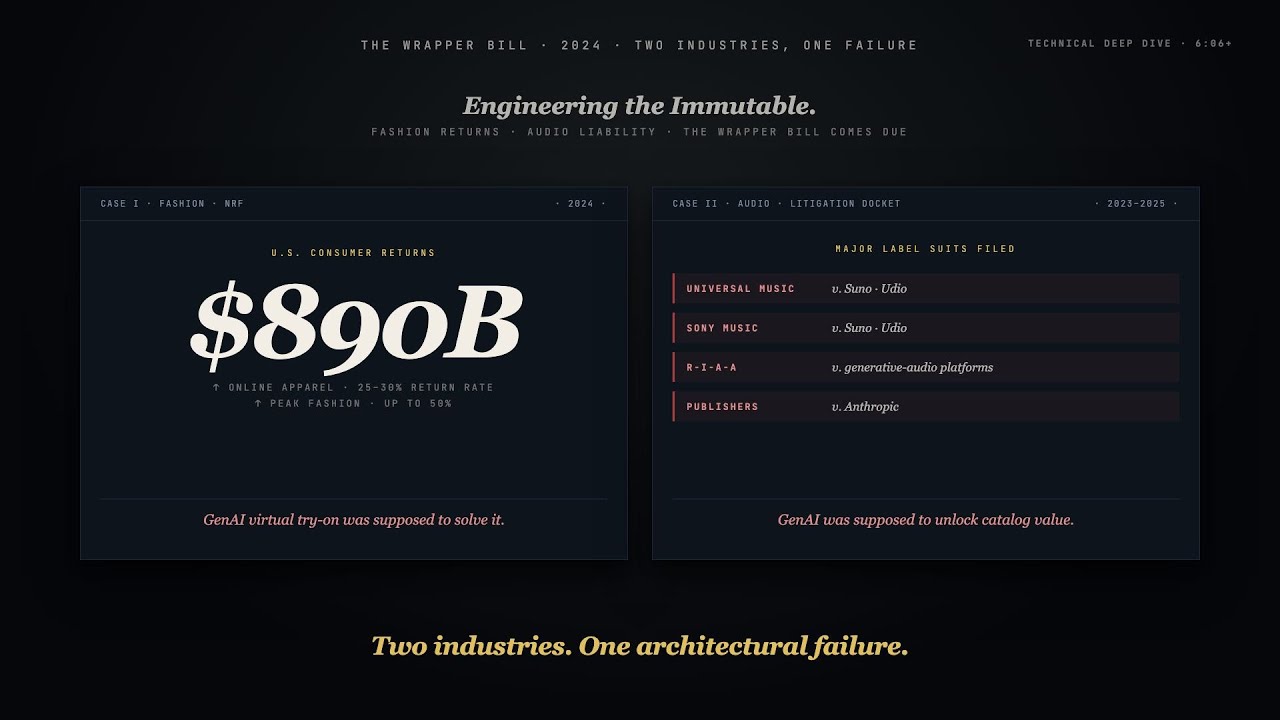
1. The Architectural Divergence: Why Wrappers Fail the Enterprise
The precipitous rise of Generative AI has bifurcated the technology landscape into two distinct architectural philosophies: the "Wrapper" paradigm and the "Deep Solution" approach. Since the public release of large language models (LLMs) and diffusion models, the barrier to entry for AI application development has collapsed. A developer with minimal machine learning expertise can now deploy a "chatbot" or "image generator" in hours simply by wrapping a user interface around an API call to a foundation model provider like OpenAI, Anthropic, or Google. This accessibility, while democratizing, has saturated the market with "thin wrappers"—applications that lack proprietary intellectual property, defensible technological moats, or deep integration into specific business domains. 1
For the enterprise, the allure of the wrapper is speed; the reality is fragility. As noted by PitchBook analysts, the market is currently oversaturated with startups that are merely "thin wrappers around foundation models," lacking any structural defensibility. 1 These entities are sandwiched between the hyperscalers—who control the underlying intelligence and can change pricing or capabilities at will—and the end-users, capturing transient value without solving fundamental reliability problems. 2
Veriprajna operates on a diametrically opposed philosophy. We posit that sustainable enterprise value is not generated by prompting a generalist model to hallucinate a solution, but by engineering Deep Solutions —hybrid architectures that combine the semantic flexibility of AI with the deterministic reliability of domain-specific physics engines, digital signal processing (DSP), and rigorous legal compliance frameworks.
1.1 The "Black Box" Liability and the Defensibility Gap
The primary failure mode of the wrapper architecture in high-stakes enterprise environments is the "Black Box" liability. When a solution relies entirely on a third-party foundation model, the enterprise inherits the model's stochastic nature. If an AI wrapper generates a hallucinated medical diagnosis, a copyright-infringing image, or a security vulnerability, the wrapper developer is often powerless to remediate the core issue, as the model weights are proprietary to the vendor. 2
This creates a "deployment value gap." While the excitement around foundation models is palpable, the sustainable economic value will accrue to companies that figure out how to make AI work in complex, regulated enterprise workflows where "mostly right" is insufficient. 3 Deep tech solutions, which integrate proprietary data moats and specialized processing pipelines (such as physics simulations or source separation engines), offer a defensible path forward. Unlike wrappers, which are fundamentally interchangeable commodities, deep solutions build "sticky" value by solving problems that generic models cannot—specifically, problems requiring adherence to the laws of physics or the laws of copyright. 4
1.2 The Veriprajna Methodology: Deterministic Core, Probabilistic Edge
Veriprajna’s approach to "Deep AI" is characterized by a specific architectural pattern: Deterministic Core, Probabilistic Edge.
In many industrial applications, the core logic cannot be left to a probabilistic neural network. A virtual try-on system must respect the tensile strength of fabric; it cannot simply "imagine" a dress fits. An audio synthesis tool must respect copyright law; it cannot simply "dream" a melody from a dataset of stolen songs. In our architecture, these core constraints are handled by deterministic systems—Physically Based Rendering (PBR) engines for fashion, and licensed stem-separation algorithms for audio. AI is then applied at the "edge" of these systems to handle unstructured inputs (like user photos) or to enhance the final sensory output (like photorealistic lighting), ensuring that the system is both flexible and rigorous.
The following report details two case studies that exemplify this philosophy: the deployment of PBR to solve the fashion return rate crisis, and the use of Deep Source Separation and Retrieval-Based Voice Conversion (RVC) to navigate the legal minefield of generative audio.
2. Case Study I: The Physics of Fit — Solving the $890 Billion Returns Crisis
The global e-commerce sector is currently grappling with a margin-destroying crisis: product returns. According to the National Retail Federation (NRF), consumer returns in the retail industry totaled an estimated $890 billion in 2024. 6 This figure is not merely a logistical nuisance; it represents a fundamental inefficiency in the digital commerce model.
2.1 The Economics of Returns and "Bracketing"
The impact of returns is disproportionately felt in the apparel sector. While the average return rate for all retail hovers around 16-17%, online apparel return rates consistently exceed 25-30% . 7 In some high-fashion categories, return rates can climb as high as 50% during peak seasons. 8
This high return rate is driven primarily by the "Fit Gap"—the discrepancy between how a garment looks on a model and how it fits the consumer. Data from eMarketer indicates that "incorrect size, bad fit, and color" account for 55% of all returns. 9
This uncertainty has birthed a consumer behavior known as "bracketing" —purchasing multiple sizes of the same item with the explicit intent to return those that do not fit. In 2024, 51% of Gen Z consumers admitted to bracketing, treating the bedroom as the new fitting room. 6 For the retailer, this is disastrous. Processing a return involves shipping, inspection, cleaning, and repackaging, costing an average of 27% of the item's purchase price. 6 Furthermore, bracketing ties up inventory that could otherwise be sold, leading to stockouts and markdowns.
The industry's response has been to turn to technology. However, the initial wave of "AI Virtual Try-On" (VTO) solutions has largely failed to solve the core problem because they prioritized visual persuasion over physical reality.
2.2 The Failure of Generative AI in Virtual Try-On
The dominant approach to VTO in recent years has been the use of Generative Adversarial Networks (GANs) and, more recently, diffusion models (e.g., Stable Diffusion). 10 These "wrapper-style" solutions function as sophisticated image editors. They take a user's 2D photo and a 2D image of a garment, and they use AI to "inpainting" the garment onto the user.
While visually seductive, these Generative AI models suffer from critical technical limitations that exacerbate the returns crisis rather than solving it.
2.2.1 Hallucination of Fit
The fundamental flaw of Generative AI VTO is that it is probabilistic, not physical. A diffusion model optimizes for pixel coherence, not cloth physics. When asked to render a "denim jacket on a user," the AI's goal is to make the image look realistic, not to make the fit accurate.
As a result, GenAI models routinely "hallucinate" a perfect fit. 10 If a user with a size 12 body selects a size 6 dress, the AI will not show the zipper failing to close or the fabric straining at the seams. Instead, it will warp the pixels of the dress to cover the body perfectly, or conversely, warp the user's body to fit the dress. 11 This creates a "fantasy mirror" effect: the customer sees a flattering image, buys the garment, and inevitably returns it when the physical reality does not match the AI hallucination. As noted in industry analysis, "Virtual try-ons lack real-world accuracy, ignore fabric behavior, and can mislead customers about how a garment truly fits and feels". 12
2.2.2 Texture and Detail Degradation
Generative models also struggle with complex textures and logos. GANs often suffer from "mode collapse," where fine details like lace or embroidery are blurred or replaced with generic patterns. 10 Diffusion models may invent new details that don't exist on the physical product, leading to further discrepancies between expectation and reality. 10
2.2.3 The "Paper Doll" Effect
Most 2D-based AI VTOs act as advanced "paper dolls," pasting a flat image of clothing over a user. They lack depth perception and cannot accurately model how fabric drapes over complex body topologies (e.g., the curve of a hip or the breadth of a shoulder). 13 This limitation is particularly acute for loose or flowing garments, where the drape is the style.
2.3 The Veriprajna Solution: Physically Based Rendering (PBR) and Cloth Simulation
Veriprajna addresses the returns crisis by replacing the hallucinatory core of GenAI with a rigorous, deterministic Physics Engine . Our approach treats the virtual try-on not as an image generation task, but as a mechanical engineering simulation.
2.3.1 The Physics Engine: Simulating, Not Hallucinating
At the heart of our solution is a dynamic cloth simulation engine, similar to those used in high-end fashion design software like CLO3D or Marvelous Designer. 15 Instead of training a neural network on images of clothes, we ingest the digital CAD patterns of the garments and assign them specific physical properties derived from their real-world fabric counterparts.
Key Simulation Parameters: To ensure the "Digital Twin" behaves exactly like the physical inventory, we calibrate the simulation using precise mechanical parameters:
| Parameter | Defni ition | Impact on Fit/Return Rate |
|---|---|---|
| Bending Stifness (Wef/Warp) |
The resistance of the fabric to folding. |
Determines if a fabric drapes sofly (silk) or holds rigid shapes (denim). High stifness prevents the AI from artifcially smoothing out wrinkles that indicate tightness.16 |
| Shear Stifness | The resistance to diagonal distortion. |
Critical for "bias cut" dresses. Incorrect shear simulation leads to |
| Col1 | Col2 | garments that hang unnaturally, misleading the consumer about the silhouetet .16 |
|---|---|---|
| Tensile Stifness (Stretch) | How much the fabric elongates under tension. |
The most critical factor for size accuracy. A GenAI model assumes infnite stretch; a physics engine knows that raw denim has near-zero stretch. If the avatar is too large, the simulation shows the fabric failing to meet, creating a visual warning.16 |
| Internal Damping | Energy absorption during movement. |
Afects how the garment setles on the body. Prevents the "bouncy" or "jitery" look of poor simulations, adding to the perception of weight and quality.16 |
| Buckling Ratio | Behavior under compression. |
Simulates how sleeves bunch up or how fabric gathers at the waist. Essential for realistic visualization of oversized or layered fts.16 |
By running this simulation on a 3D avatar that matches the user's measurements (obtained via depth sensors or rigorous self-reporting), we generate a geometry that reflects the true fit . If the garment is too tight, the simulation displays stress lines ("X" patterns at the waist or buttons), providing immediate, intuitive feedback to the user. 12
2.3.2 Physically Based Rendering (PBR): The Standard of Realism
Once the accurate geometry is simulated, we must render it to look photorealistic. We utilize Physically Based Rendering (PBR), a graphics technique that models the interaction of light with surfaces using physically accurate formulas, ensuring consistency across different lighting environments. 17
The PBR Material Model:
Our pipeline utilizes standard PBR maps to define the surface properties of the fabric:
● Albedo: The base color of the fabric, decoupled from lighting.
● Roughness/Microsurface: Determines light scattering. High roughness simulates cotton/wool (diffuse reflection); low roughness simulates satin/latex (specular reflection). 18
● Metallic (F0): Defines the reflectivity at normal incidence. Essential for accurately rendering hardware (zippers, buttons) or metallic threads. 17
● Normal/Bump Maps: Simulates microscopic surface details (e.g., the weave of twill or the grain of leather) without adding geometric weight. 18
This workflow ensures that the digital garment is not just a "pretty picture" but a scientifically accurate representation of the physical product.
2.4 The Integration Challenge: Hybrid Compositing via Differential Rendering
While PBR ensures the garment looks real, placing that 3D object into a user's 2D photo ("The Composite") is notoriously difficult. If the lighting on the 3D dress doesn't match the lighting in the user's room, the dress looks like a "sticker," breaking the immersion. 19
Here, Veriprajna re-introduces AI—not to generate the cloth, but to solve the lighting and integration problem. We employ a technique known as Differential Rendering, enhanced by AI-driven environment estimation.
2.4.1 AI-Driven Environment Estimation
Before rendering, we pass the user's uploaded 2D photo through a lightweight Convolutional Neural Network (CNN) trained to estimate lighting conditions. This network predicts:
1. Light Direction: Where is the main light source coming from? 2. Intensity & Color Temperature: Is the room warm (tungsten) or cool (daylight)? 3. Environment Map: The AI generates a synthetic High Dynamic Range (HDR) spherical map that approximates the user's room. 20
This synthetic environment is then used to light the 3D PBR garment, ensuring that the reflections on the digital buttons match the real windows in the user's eyes.
2.4.2 Differential Rendering and Shadow Catching
To blend the 3D object seamlessly, we use Differential Rendering. This technique calculates the effect of the object on the scene without re-rendering the scene itself.
The Workflow:
1. Shadow Catcher: We generate a transparent 3D plane (the "Shadow Catcher") aligned with the user's floor or body. 22
2. Render Passes:
○ : The original background photo.
○ : The rendered 3D garment.
○ : The shadow cast by the garment onto the shadow catcher.
3. Composite Math: The final pixel value is calculated by subtracting the light that the garment blocks (shadows) and adding the light the garment reflects.
○ Equation: . 19
This allows the digital skirt to cast a realistic shadow onto the user's real legs, grounding the object in physical space.
2.4.3 Light Wrapping and Edge Warping
A common failure in compositing is the "hard edge" or "cutout" look. Real objects have light wrapping around them due to subsurface scattering and diffraction. To simulate this, we employ Light Wrapping algorithms in the compositing stage.
● Mechanism: The compositor samples the colors of the background pixels immediately adjacent to the garment's edge. It then "bleeds" these background colors slightly into the edge of the garment pixels using a blur mask. 23
● Effect: This makes the garment appear to be "in" the atmosphere of the room, rather than floating on top of it. It softens the harsh digital edges that often scream "fake". 24
2.5 Business Impact: From Conversion to Retention
The shift from GenAI VTO to Veriprajna’s PBR solution fundamentally changes the business metrics of e-commerce.
● Metric Shift: GenAI VTO optimizes for Click-Through Rate (CTR) and Initial Conversion . It sells the fantasy. Veriprajna optimizes for Net Sales and Return Reduction . By showing the truth—even if the truth is "this doesn't fit"—we prevent the margin-killing cycle of returns. 6
● The Fit-Confidence Score: Our system outputs data, not just images. We provide users with a "Fit-Confidence Score" (e.g., "95% Match for Waist, 60% Match for Hips"). This data empowers the consumer to make informed decisions, building long-term trust and reducing "bracketing" behavior. 7
● Operational Efficiency: Because the assets are derived from the actual CAD patterns used in manufacturing, the VTO pipeline integrates directly with the brand's Product Lifecycle Management (PLM) system, streamlining the workflow from design to e-commerce. 26
2.6 Comparative Analysis: GenAI vs. Veriprajna Deep Tech
The following table summarizes the strategic differences between the wrapper approach and
the deep tech solution:
| Feature | Generative AI Wrapper (Standard VTO) |
Veriprajna Deep Solution (PBR + Physics) |
|---|---|---|
| Core Technology | Difusion Models (Stable Difusion, etc.) |
Physics Simulation (FEM/Mass-Spring) + PBR |
| Fit Accuracy | Low: Hallucinates ft; warps garment to body. |
High: Simulates tension, stretch, and drape. |
| Material Fidelity | Low: Guesses texture; struggles with complex fabrics. |
High: Uses measured physical properties (stifness, friction). |
| Input Data | 2D Image + Text Prompt. | 3D CAD Patern + Fabric Physics Data. |
| Lighting Integration | Poor: Ofen fat or inconsistent. |
Excellent: AI-driven HDR estimation + Diferential Rendering. |
| Primary KPI | Conversion Rate (Sales). | Net Margin (Sales - Returns). |
| Consumer Trust | Erosive (Disappointment upon delivery). |
Cumulative (Accurate predictions build loyalty). |
| Enterprise Risk | High (Misleading advertising/Returns). |
Low (Data-backed visualization). |
3. Case Study II: Copyright-Safe Audio — Navigating the Generative Minefield
While visual AI struggles with physics, audio AI struggles with the law. The music and voice industries are currently facing an existential challenge regarding copyright and Generative AI. Major lawsuits from rights holders (Universal Music Group, Sony Music, RIAA) against AI companies (Suno, Udio, Anthropic) highlight the massive liability inherent in "Black Box" generative audio models. 27
3.1 The Legal Landscape: Why "Black Boxes" are Toxic for Enterprise
For enterprise clients—such as advertising agencies, video game studios, and streaming platforms—the legal status of AI-generated audio is a minefield.
3.1.1 The Training Data Liability
Most off-the-shelf generative audio models (Text-to-Music) have been trained on vast datasets scraped from the open web, often including copyrighted music. If an enterprise uses such a model to generate a jingle or a soundtrack, and that output inadvertently mimics a copyrighted work from the training set (a phenomenon known as "regurgitation"), the enterprise is strictly liable for copyright infringement. 29 The "Black Box" nature of these models means the user cannot verify the provenance of the generated audio. 28
3.1.2 The Ownership Vacuum
Under current guidance from the U.S. Copyright Office (USCO), works created solely by AI without significant human intervention are not eligible for copyright protection. 30 This means that a brand using a pure GenAI tool to create a sonic logo or a game soundtrack cannot own the asset . It immediately enters the public domain, allowing competitors to use it freely. This lack of exclusivity is a non-starter for commercial IP. 30
3.1.3 The Right of Publicity and Deepfakes
The unauthorized cloning of voices has triggered a wave of "Right of Publicity" litigation. Using a "sound-alike" voice that mimics a celebrity—even without using their actual name—can lead to significant damages, as established in precedents like Midler v. Ford Motor Co. and Waits v. Frito-Lay . 32 Enterprise clients need absolute certainty that the voices they use are licensed and compliant.
3.2 The Veriprajna Solution: Deep Source Separation and RVC
Veriprajna solves these problems by rejecting the "generate from scratch" paradigm. Instead, we employ a Transformative workflow using Deep Source Separation (DSS) and Retrieval-Based Voice Conversion (RVC) . This approach ensures that every audio asset is a traceable derivative of a licensed or owned work, creating a clear chain of title.
3.3 Technology I: Deep Source Separation (The "De-Mixing" Engine)
Deep Source Separation is the process of unmixing a mono or stereo audio file into its constituent "stems" (e.g., Vocals, Drums, Bass, Other). 34 Historically, this was impossible to do perfectly (like un-baking a cake), but modern Deep Learning has revolutionized the field.
3.3.1 Technical Architecture: U-Nets and Spectrogram Masking
Our DSS engine utilizes a U-Net architecture, a type of Convolutional Neural Network (CNN) originally designed for biomedical image segmentation but highly effective for audio spectrograms.
1. Spectrogram Input: The audio is converted into a Time-Frequency spectrogram via Short-Time Fourier Transform (STFT).
2. Encoder-Decoder Network: The U-Net encoder downsamples the spectrogram to extract high-level features (harmony, rhythm), while the decoder upsamples it back to the original resolution.
3. Soft Masking: The network outputs a "mask" for each stem (e.g., a "Vocal Mask"). This mask is a matrix of values between 0 and 1.
4. Filtering: The mask is multiplied element-wise with the original spectrogram. A value of 1 keeps the frequency bin; 0 removes it. This isolates the vocal frequencies while suppressing the instruments. 34
5. Waveform Reconstruction: The masked spectrogram is converted back to audio using the Inverse STFT.
We utilize advanced variants like Wav-U-Net, which operate directly on the raw waveform to avoid phase artifacts that often result in "watery" or "metallic" distortion in standard spectrogram-based separation. 34
3.3.2 Enterprise Use Cases: The "Remix" Economy
This technology unlocks massive value from existing IP catalogs:
● Localization: A media company can separate the dialogue stem from the Music & Effects (M&E) stem of a film. This allows them to replace the dialogue with a dubbed version while keeping the original, expensive orchestral score and sound effects perfectly intact. 35
● Catalog Revitalization: Record labels can "unlock" legacy masters where the original multi-track tapes have been lost or degraded. By separating stems, they can create new remixes, immersive (Dolby Atmos) mixes, or license individual instrumental elements for sync opportunities. 35
● Licensing Compliance: Unlike GenAI, this process respects rights. We integrate with platforms like AudioShake that allow rights holders to approve and monetize stem separation, ensuring a compliant supply chain. 35
3.4 Technology II: Retrieval-Based Voice Conversion (RVC)
Once a vocal stem is isolated, the next challenge is often modification—changing the speaker's identity or language while preserving the performance. Standard Text-to-Speech (TTS) fails here because it generates audio from text, losing the emotion, timing, and nuance of the original actor.
Retrieval-Based Voice Conversion (RVC) is the deep tech solution. It is a Speech-to-Speech (STS) framework that transforms the timbre of a voice while preserving the prosody (rhythm, pitch, emotion) of the source. 37
3.4.1 RVC Architecture: The "Identity Swap"
The superiority of RVC lies in its hybrid use of neural feature extraction and vector retrieval.
1. Content Encoder (HuBERT/ContentVec): The system uses a self-supervised model (like HuBERT) to extract "soft" content features from the source audio. These features represent what is being said and how (intonation, speed), completely independent of who is saying it. This effectively strips the "identity" from the voice. 37
2. Vector Retrieval (FAISS): This is the core differentiator. Instead of relying solely on the model's weights to hallucinate the target voice, the system queries a database (Index) of the target speaker's actual voice embeddings.
○ Mechanism: For every frame of the source audio, the system uses Facebook AI
Similarity Search (FAISS) to find the acoustic snippets in the target's database that most closely match the source content.
○ Result: The system effectively "re-assembles" the new voice from microscopic slices of the target's real recordings. This guarantees high fidelity and, crucially, high likeness to the target. 37
3. Fusion & Synthesis (HiFi-GAN): The system fuses the source content features with the retrieved target acoustic features and feeds them into a HiFi-GAN vocoder. HiFi-GAN is a generative adversarial network optimized for audio synthesis, capable of producing 48kHz studio-quality waveforms without the robotic artifacts of older vocoders. 37
3.4.2 The "Safe Harbor" Compliance Workflow
Veriprajna implements RVC within a strict compliance framework designed to mitigate legal risk.
The "White-Listed" Library: We do not use public RVC models trained on scraped celebrity data. We build custom RVC models trained only on voice actors who have signed specific AI Commercialization Releases.
● Consent: The actor explicitly consents to having their voice cloned for specific uses. 32
● Compensation: The actor receives royalties whenever their voice model is used, tracked via the licensing ledger. 39
● Traceability: Because the RVC system uses a retrieval database, we can mathematically prove which voice model was used. If a legal claim arises (e.g., "This sounds like Celebrity X"), we can audit the FAISS index to prove the embeddings came from "Consented Voice Actor A," creating an irrefutable defense. 32
Copyright Ownership: Because the output of an RVC workflow is a derivative work based on a human performance (the source guide track) and a human-created composition, it is eligible for copyright protection. The "human authorship" requirement is met by the original vocal performance, the source composition, and the creative direction in the conversion process.30 This allows the enterprise to own the final asset, unlike with pure GenAI.29
3.5 Comparative Analysis: Generative Audio vs. Veriprajna RVC
| Feature | Generative Audio (Black Box) |
Veriprajna RVC/DSS (Deep Tech) |
|---|---|---|
| Input Mechanism | Text Prompt ("Make a pop song") |
Existing Audio (Guide Track/Stem) |
| Control & Nuance | Low: Random seed variance; hard to direct. |
High: Preserves original timing, pitch, and emotion. |
| Copyright Status | High Risk: Potential infringement; output is Public Domain. |
Clear: Derivative of licensed works; output is Copyrightable. |
| Voice Identity | Uncontrolled: Prone to accidental "deepfaking." |
Controlled: Strictly mapped to consented "White-Listed" models. |
| Auditability | None: Black box training data. |
Full: Provenance tracking via Watermarking & FAISS logs. |
| Enterprise Use Case | Ideation, Background Muzak. |
Dubbing, Localization, Post-Production, Remixing. |
4. The Architecture of Trust: Security, Infrastructure, and Governance
The deployment of deep tech solutions requires a robust infrastructure that goes beyond simple API integrations. Veriprajna provides a comprehensive "Architecture of Trust" that addresses the security, computational, and governance challenges of enterprise AI.
4.1 Data Sovereignty and the "Air Gap"
One of the most significant risks in using wrapper-based AI is data leakage . When an enterprise uploads proprietary designs or sensitive audio to a public cloud model (like ChatGPT or Midjourney), that data may be used to train future versions of the model, effectively exposing trade secrets to competitors. 40
Veriprajna eliminates this risk through On-Premise and VPC Deployment .
● Containerization: Our PBR and RVC pipelines are containerized using Docker and Kubernetes. They can be deployed entirely within the client's Virtual Private Cloud (VPC) or on-premise servers.
● The Air Gap: These containers do not require internet access to function. They do not "phone home" to Veriprajna or any third-party model provider. This ensures that unreleased fashion collections or pre-release film assets never leave the client's secure perimeter. 41
4.2 Infrastructure Optimization: Edge Computing and GPU Costs
Deep tech solutions are computationally intensive. Physics simulations and neural rendering require significant GPU power. To make these solutions economically viable, Veriprajna employs advanced optimization techniques.
● Neural Rendering Shortcuts: In our VTO pipeline, we use AI to approximate expensive ray-tracing steps (like Global Illumination) only where visual perception allows. This hybrid approach significantly reduces the render time per frame, lowering cloud GPU costs. 42
● Quantization and Edge Inference: For RVC applications requiring real-time performance (e.g., live customer support voice changers), we utilize model quantization (converting 32-bit floating-point weights to 8-bit integers). This allows the models to run on consumer-grade hardware or edge devices with latency under 50ms, eliminating the need for expensive round-trips to the cloud. 37
4.3 Governance and Watermarking
To ensure long-term compliance, we implement robust governance tools directly into the software stack.
● Invisible Watermarking: Every image generated by our VTO system and every audio clip produced by our RVC engine is embedded with an invisible, robust watermark (using spread-spectrum or lattice-based techniques).
● Metadata Embedding: This watermark contains a hash of the Licensing ID (which model was used), the User ID (who generated it), and the Timestamp .
● Provenance Verification: This creates a permanent audit trail. If an asset leaks or is challenged legally, the watermark proves its origin and compliance status. 32
5. Conclusion: The Strategic Imperative for Deep Tech
The era of the "AI Wrapper" is drawing to a close. As foundation models become commoditized features of operating systems, the businesses that survive will not be those that simply resell API access, but those that solve the hard, messy, domain-specific problems that generic models ignore.
The "Wrapper" approach—fast, cheap, and probabilistic—is suitable for prototyping and low-stakes consumer applications. However, for the enterprise, where accuracy, compliance, and defensibility are paramount, it is a liability.
Veriprajna’s commitment to Deep Solution Architecture represents the maturity of the AI industry.
● In Fashion, we move from hallucinating fit to simulating physics, turning the returns crisis into a margin opportunity.
● In Media, we move from generating piracy to engineering derivatives, turning the copyright crisis into a licensing opportunity.
For the enterprise leader, the choice is strategic: You can build on top of a shifting foundation of third-party APIs, or you can engineer a deep, owned solution that respects the laws of physics and the laws of the land.
Veriprajna: Engineering the Immutable.
Works cited
The most overheated AI subsectors, according to PitchBook analysts, accessed December 11, 2025, https://pitchbook.com/news/articles/the-most-overheated-ai-subsectors-according-to-pitchbook-analysts
Wrappers, deeptechs, and generative AI: a profitable but fragile house of cards, accessed December 11, 2025, https://www.duperrin.com/english/2025/05/20/wrappers-deeptechs-generative-ai/
AI Integration Will Capture More Value Than Exciting AI Models - Strategeos, accessed December 11, 2025, https://strategeos.com/f/ai-integration-will-capture-more-value-than-exciting-ai-models
Margin of Safety #17 – Wrappers vs Foundational Models - Forgepoint Capital, accessed December 11, 2025, https://forgepointcap.com/perspectives/margin-of-safety-17-wrappers-vs-foundational-models/
Applied vs. Core AI: Why Some Niches Follow SaaS Multiples, Others Don't, accessed December 11, 2025, https://www.finrofca.com/news/ai-multiples-applied-vs-core
The $890 Billion Problem for Retailers and Brands: Returns | by SJ Hare - TechStyle Edit, accessed December 11, 2025, https://medium.com/@techstyleedit/the-890-billion-problem-for-retailers-and-brands-returns-9a906343cc88
Data-Driven Strategies to Reduce Return Rates in Fashion Ecommerce - Woven Insights, accessed December 11, 2025, https://woveninsights.ai/site-blog/data-driven-strategies-to-reduce-return-rates-in-fashion-ecommerce/
TOP 20 ONLINE VS OFFLINE CLOTHING RETURN STATISTICS 2025 - Colorful Socks, accessed December 11, 2025, https://bestcolorfulsocks.com/blogs/news/online-vs-offline-clothing-return-statistics
Ecommerce Return Rates 2025: Statistics, Benchmarks & Insights - Channelwill, accessed December 11, 2025, https://www.channelwill.com/blogs/ecommerce-return-rates/
EfficientVITON: An Efficient Virtual Try-On Model using Optimized Diffusion Process - arXiv, accessed December 11, 2025, htps://arxiv.org/html/2501.11776v1t
Is Generative AI A Game-Changer For Virtual Apparel Try-On? - RetailWire, accessed December 11, 2025, https://retailwire.com/discussion/is-generative-ai-a-game-changer-for-virtual-apparel-try-on/
Why Virtual Try-On Tools Aren't Enough for Better Fit ? - Shanghai Garment, accessed December 11, 2025, https://shanghaigarment.com/why-virtual-try-on-tools-arent-enough-for-beter-tfit%EF%BC%9F/
Do Virtual Try-Ons Fit True to Size? Science vs Perception - Fytted, accessed December 11, 2025, https://fyted.com/blog/virtual-try-on-true-to-sizet
AI-Generated Try-On vs 3D Virtual Try-On: The Future of eCommerce - artlabs, accessed December 11, 2025, https://artlabs.ai/blog/future-of-ecommerce-ai-vs-3d-virtual-try-on
Marvelous designer and CLO3d. Why I use only these to create digital clothes? Medium, accessed December 11, 2025, https://medium.com/@itsalive/marvelous-designer-and-clo3d-why-i-use-only-these-to-create-digital-clothes-9463bf3e00b9
Simulation Properties 2025.0 - Marvelous Designer Support, accessed December 11, 2025, https://support.marvelousdesigner.com/hc/en-us/articles/47358125463321-Simulation-Properties-2025-0
What is Physically Based Rendering (PBR)? Realism in Digital Materials, accessed December 11, 2025, https://blog.3sfarm.com/what-is-physically-based-renderin
Physically-Based Rendering: Understanding the technology and techniques, accessed December 11, 2025, https://blog.twinbru.com/physically-based-rendering-understanding-the-technology-and-techniques
Rendering Synthetic Objects into Real Scenes: Bridging Traditional and Image-based Graphics with Global Illumination and High Dynamic Range Photography - Paul Debevec, accessed December 11, 2025, https://www.pauldebevec.com/Research/IBL/debevec-siggraph98.pdf
Place 3D Models in 2D Photos Using Blender & fSpy - What Make Art, accessed December 11, 2025, https://whatmakeart.com/3d-modeling/blender/place-3d-model-in-2d-photo-blender-fspy/
Shadow Harmonization for Realistic Compositing - VALERIA, accessed December 11, 2025, https://hdrdb-public.s3.valeria.science/shadowcompositing/valenca2023shadow_compressed.pdf
Untitled - X-Files, accessed December 11, 2025, https://doc.lagout.org/Others/Data%20Mining/Shadow%20Algorithms%20Data%20Miner%20%5BWoo%20%26%20Poulin%202012-06-12%5D.pdf
Deep Learning-based Background Removal And Blur In A Real-Time Video MobiDev, accessed December 11, 2025, https://mobidev.biz/blog/background-removal-and-blur-in-a-real-time-video
Elevate Your Projects: Essential 2D/3D & VFX Skills | Filmbaker, accessed December 11, 2025, https://www.filmbaker.com/blog/elevate-your-projects-essential-2d3d-vfx-skills
Advanced Techniques for Green Screen Keying - MotionCue, accessed December 11, 2025, https://motioncue.com/green-screen-keying/
How Does Image 3D Model Technology Transform Fashion Design with Style3D AI?, accessed December 11, 2025, https://www.style3d.ai/blog/how-does-image-3d-model-technology-transform-fashion-design-with-style3d-ai/
Copyright and AI-Generated Music: Legal Battles, Ownership, and the Future of Creative Rights, accessed December 11, 2025, https://musicmentor.ai/copyright-and-ai-generated-music-legal-batles-ownershitp-and-the-future-of-creative-rights/
Managing Generative AI Copyright Risk: Legal Guide - Martensen IP, accessed December 11, 2025, https://www.martensenip.com/blog/2025/november/a-practical-guide-to-generative-ai-copyright-ris/
Legal & Copyright Issues in AI-Generated Music | by SauceFromVeli - Medium, accessed December 11, 2025, https://saucefromveli.medium.com/legal-copyright-issues-in-ai-generated-music-113ddcab2085
AI Music Copyright Laws 2025: How Musicians Can Protect AI-Generated Songs | Mureka, accessed December 11, 2025, https://www.mureka.ai/hub/aimusic/ai-music-copyright-laws/
White Paper on Remixes, First Sale, and Statutory Damages - USPTO, accessed December 11, 2025, https://www.uspto.gov/sites/default/files/documents/copyrightwhitepaper.pdf
Celebrity Voice Rights in the AI Era: Legal Rules, Compliance Checklist & Practical Playbook, accessed December 11, 2025, https://www.dupdub.com/blog/celebrity-voice-rights
Who Owns a Voice in AI Music? Legal Guide for Creators - Jack Righteous, accessed December 11, 2025, https://jackrighteous.com/blogs/music-creation-process-guide/ai-voice-cloning-legal-guide-creators
Music Source Separation - Wikipedia, accessed December 11, 2025, https://en.wikipedia.org/wiki/Music_Source_Separation
AudioShake | AI Audio Separation & Stem Creation, accessed December 11, 2025, https://www.audioshake.ai/
Licensing Derivative Works: How AI Is Opening the Door to Legal Remixes and Edits, accessed December 11, 2025, https://www.audioshake.ai/post/licensing-derivative-works-how-ai-is-opening-the-door-to-legal-remixes-and-edits
Retrieval-based Voice Conversion - Wikipedia, accessed December 11, 2025, https://en.wikipedia.org/wiki/Retrieval-based_Voice_Conversion
svc-develop-team/so-vits-svc: SoftVC VITS Singing Voice Conversion - GitHub, accessed December 11, 2025, https://github.com/svc-develop-team/so-vits-svc
The Commercial Use of AI in Voiceovers - Adler Law Group, accessed December 11, 2025, https://www.adler-law.com/ai/the-commercial-use-of-ai-in-voiceovers/
Protecting Sensitive Data in the Age of Generative AI: Risks, Challenges, and Solutions, accessed December 11, 2025, https://www.kiteworks.com/cybersecurity-risk-management/sensitive-data-ai-risks-challenges-solutions/
The Dark Side of AI: Top Data Security Threats and How to Prevent Them - Zylo, accessed December 11, 2025, https://zylo.com/blog/ai-data-security/
A Brief Review on Differentiable Rendering: Recent Advances and Challenges MDPI, accessed December 11, 2025, https://www.mdpi.com/2079-9292/13/17/3546
[2205.06305] Real-time Virtual-Try-On from a Single Example Image through Deep Inverse Graphics and Learned Differentiable Renderers - arXiv, accessed December 11, 2025, https://arxiv.org/abs/2205.06305
How does audio content security comply with the new AIGC regulations? Tencent Cloud, accessed December 11, 2025, https://www.tencentcloud.com/techpedia/122388
Prefer a visual, interactive experience?
Explore the key findings, stats, and architecture of this paper in an interactive format with navigable sections and data visualizations.
Frequently Asked Questions
Why does Generative AI virtual try-on fail to reduce fashion returns?
Generative AI optimizes for pixel coherence, not cloth physics. Diffusion models hallucinate perfect fit — warping garments to bodies or bodies to garments — creating a 'fantasy mirror' that increases returns when physical reality contradicts the AI image. A physics simulation engine using measured fabric parameters like tensile stiffness and shear resistance shows actual stress patterns, including zipper failures and seam strain.
How does Retrieval-Based Voice Conversion maintain copyright compliance?
RVC uses HuBERT to strip identity from source audio, then queries a FAISS database of consented voice actor embeddings to reconstruct the target voice from actual recorded snippets. Unlike black-box generative audio, every output has a traceable provenance chain — which voice model was used, whose consent covers it, and mathematical proof via FAISS logs. The output qualifies for copyright as a human-authored derivative work.
What is the Deterministic Core, Probabilistic Edge architecture pattern?
Core business logic that must respect physical laws or legal constraints is handled by deterministic systems — physics engines for fabric simulation, licensed stem-separation algorithms for audio. AI is applied at the 'edge' for unstructured inputs (user photos, environment estimation) or output enhancement (photorealistic lighting). This ensures flexibility without sacrificing rigorous compliance.
Also Published On
Build Your AI with Confidence.
Partner with a team that has deep experience in building the next generation of enterprise AI. Let us help you design, build, and deploy an AI strategy you can trust.
Veriprajna Deep Tech Consultancy specializes in building safety-critical AI systems for healthcare, finance, and regulatory domains. Our architectures are validated against established protocols with comprehensive compliance documentation.