AI Governance Programs Built for the Enforcement Era
Cross-jurisdictional AI governance programs that survive EU AI Act conformity assessments, FTC enforcement scrutiny, and product liability discovery.
The enforcement era for enterprise AI started before most governance programs did. Governance platforms track compliance status and Big Four programs deliver framework documents, but neither fixes the architectural gaps that make AI systems non-compliant. Our approach is to build the technical governance layer that sits between the AI systems an enterprise already runs and the regulatory obligations those systems trigger.
The EU AI Act Deadline Is Enforceable Without a Standards Safety Net
The EU AI Act's Annex III high-risk obligations become enforceable on August 2, 2026. CEN and CENELEC failed to deliver harmonized standards by the August 2025 deadline, so companies preparing for conformity assessments have no "presumption of conformity" pathway to lean on — they must demonstrate compliance against the regulation's text directly.
An appliedAI study of 106 enterprise AI systems found that 18% were clearly high-risk, 42% were low-risk, and 40% could not be definitively classified either way. Nearly half the AI systems in production today sit in a classification gray zone that becomes enforcement exposure in four months.
How do you classify AI systems when nearly half fall in a gray zone?
The core problem is that companies conflate a system's intended purpose with its actual deployment context — an HR analytics tool might be low-risk in aggregate reporting mode but high-risk when it influences individual hiring decisions.
Our method is to build classification frameworks that map each AI system's actual use cases, data flows, and decision pathways to Annex III categories, flagging systems where deployment context creates a higher risk classification than the product description suggests (detailed in our research on enterprise AI regulatory truth and algorithmic accountability). Because CEN and CENELEC failed to deliver harmonized standards, there is no conformity shortcut — classification has to be done against the regulation text directly.
Should you pursue ISO 42001 now or wait for harmonized standards?
ISO/IEC 42001 maps directly to key EU AI Act requirements across risk management, data governance, documentation, monitoring, security, and safety. Microsoft, SAP, and Cornerstone OnDemand have already achieved certification. The Digital Omnibus package may delay Annex III obligations to December 2027, but that is not guaranteed.
Pursuing ISO 42001 now gives you a structured governance foundation that translates into EU AI Act readiness regardless of when harmonized standards arrive. The certification process itself forces the inventory, documentation, and accountability-structure work most organizations need to do anyway. The risk of waiting is facing August 2026 enforcement with neither certification nor harmonized standards to lean on.
US Enforcement Is Fragmented Across Agencies and State Laws
US enforcement momentum is fragmented across federal agencies and a growing patchwork of state laws. The FTC brought at least a dozen AI-washing enforcement actions in 2025, including a $193,000 fine against DoNotPay for claiming to be the "world's first robot lawyer" and a ban on Evolv Technologies for unsubstantiated AI weapons-detection claims.
The SEC declared AI-washing an "immediate priority" in May 2025, building on its March 2024 settlements with Delphia ($225,000) and Global Predictions ($175,000) for fabricating AI capabilities they never built.
State law is compounding fast. A company operating in multiple states needs a compliance matrix, not a single policy:
- California SB 53 — took effect January 1, 2026; requires frontier model developers to publish risk frameworks and report safety incidents, with penalties up to $1 million per violation.
- Colorado AI Act — takes effect June 30, 2026, with algorithmic impact assessment requirements.
- Over 1,100 AI-related bills introduced across US states in 2025 alone.
How do you stay clear of FTC AI-washing enforcement?
Evolv Technologies was banned after schools reported the scanners failed to detect weapons, and the SEC settled with Delphia and Global Predictions for $400,000 combined over fabricated AI capabilities. The FTC's March 2026 Policy Statement on AI and Section 5 clarifies that misleading AI claims receive the same enforcement treatment as any other deceptive practice.
The defense is substantiation: every AI capability claim your company makes publicly needs corresponding technical evidence that the capability works as described. An engagement audits AI marketing claims against actual system capabilities and is scoped to build the testing and documentation infrastructure that substantiates those claims if challenged (see our research on engineering deterministic trust against the AI-washing crackdown).
Courts Are Treating AI Outputs as Products
Product liability is moving faster than governance frameworks can track. Courts are treating AI outputs as products, and the EU's revised Product Liability Directive explicitly includes software and AI systems — meaning any AI output causing harm can trigger manufacturer liability without proof of negligence.
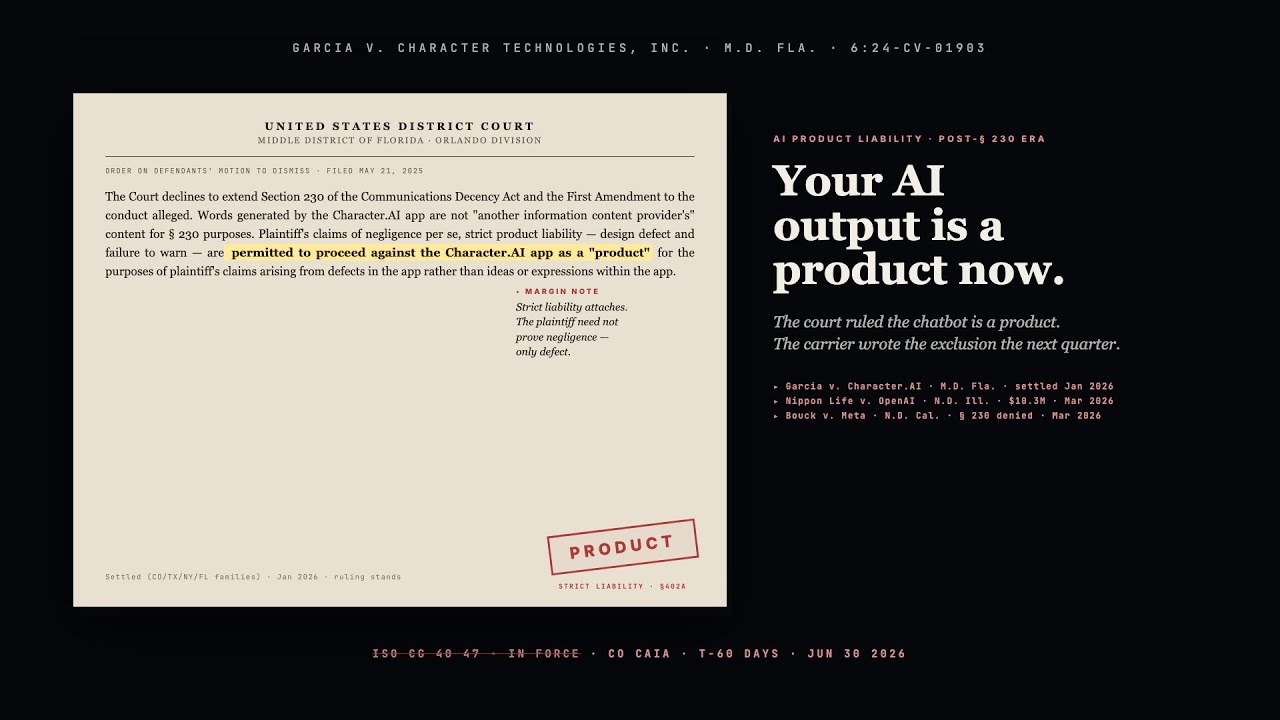
- Garcia v. Character Technologies (October 2024) — a Florida federal court permitted strict liability claims after a 14-year-old died following months of obsessive interaction with a Character.AI chatbot.
- Raine v. OpenAI (August 2025) — alleges ChatGPT fostered emotional dependency and provided self-harm instructions to a 16-year-old.
- Nippon Life v. OpenAI (March 2026) — a new category entirely: an insurer suing to recover costs from AI-assisted meritless legal filings, including citations to nonexistent cases.
Is your AI output a product for strict-liability purposes?
Courts are increasingly saying yes. In Garcia v. Character Technologies, the court permitted strict liability claims treating a chatbot as a product after a teenager's death, and the AI LEAD Act in Congress would classify AI systems as products at the federal level. For enterprise AI deployers, the documentation gap becomes litigation exposure.
Validation records, decision logs, safety testing documentation, and design-choice rationale are the evidence your litigation team needs when a plaintiff's attorney serves discovery. We design the evidentiary foundation an engagement is meant to produce, informed by our research on AI product liability in the post-Section 230 era: audit trails capturing not just what the system decided but why, in formats built to survive both regulatory examination and civil discovery.
Algorithmic Pricing Now Carries Antitrust Exposure
The DOJ's November 2025 settlement with RealPage established the enforcement framework for algorithmic collusion. The seven-year agreement restricts RealPage to using competitor data at least 12 months old, bans real-time lease data sharing, prohibits geographic modeling below state level, and eliminates auto-accept features.
No liability was admitted, but the message is clear: any AI system that ingests competitor data for pricing — even indirectly through training data — faces antitrust exposure under Section 1 of the Sherman Act (our research on antitrust liability and architectural integrity after RealPage). This is not a real estate problem. It extends to airline revenue management, dynamic insurance pricing, and any algorithmic pricing system that touches competitive information.
The Organizational Problem Is Bigger Than the Technical One
McKinsey's 2026 Global AI Survey found that 77% of enterprise AI project failures are organizational, not technical. 41% of failed projects were "AI without a home" — technically delivered but never operationally adopted. The governance version is worse:
- 98.5% of organizations report they lack adequate AI governance staffing.
- Only 4% have a cross-functional team dedicated to AI compliance.
- 93% acknowledge generative AI brings risk, but only 9% feel prepared to handle it.
Board-level oversight compounds the gap. 66% of boards report limited or no AI expertise, and only 14% discuss AI at every meeting. The organizations spending $665 billion on AI in 2026 are being governed by boards that largely cannot evaluate what they are approving. The CAIO role is growing — 26% of organizations have one, up from 11% in 2023 — but a title without authority, budget, and cross-functional mandate is another organizational failure waiting to happen.
Why do enterprise AI governance programs fail?
McKinsey's 2026 survey found 73% of enterprise AI deployments fail to achieve projected ROI, and governance programs fail for the same organizational reasons — 77% of failures are organizational, not technical. The top governance-specific failure modes:
- Treating governance as ethics messaging rather than production control (polished principles, weak execution).
- Decentralized AI procurement where every business unit buys tools independently with no central inventory.
- Reviewing models only before launch while ignoring runtime behavior drift.
- Unclear ownership of governance decisions across legal, compliance, IT, and business units.
- Board-level blind spots where 66% of boards lack AI expertise to evaluate what they are approving.
Governance programs that survive are the ones that build accountability structures, cross-functional decision rights, and continuous monitoring into the architecture from day one — not bolted on after the audit finding.
Shadow AI and Third-Party Tools Are the Blind Spot Most Programs Miss
89% of enterprise AI usage is invisible to the organization — never inventoried, risk-assessed, or documented. Shadow AI already accounts for 20% of all data breaches, costing $670,000 more per incident than standard breaches. When the EU AI Act's documentation requirements under Annex IV kick in, organizations that cannot even identify which AI systems are running have a problem no governance platform can solve without the foundational inventory work.
78% of organizations use third-party AI tools, and more than half of AI failures originate from those tools — but you cannot outsource legal culpability. The EU AI Act holds deployers responsible regardless of whether the AI system was built internally or purchased.
The starting point is discovery: identifying every AI tool in use across the enterprise, including browser extensions, SaaS features with embedded AI, and API integrations that individual teams adopted. From there, our approach is a tiered vendor risk framework that concentrates assessment effort on tools processing sensitive data or influencing consequential decisions, aligned to NIST AI RMF and your specific jurisdictional requirements.
Agentic AI Is Creating Governance Categories That Do Not Exist Yet
Gartner projects that 40% of enterprise applications will embed autonomous AI agents by end of 2026. OWASP published its first Top 10 for Agentic Applications in March 2026, identifying risks including goal hijacking, tool misuse, identity abuse, memory poisoning, cascading failures, and rogue agents. Strata's research found that only 23% of organizations have a formal enterprise-wide strategy for agent identity management; 55% are concerned about sensitive data exposure from agents, and 52% worry about unauthorized actions.
Early building blocks are emerging, but they are not mature solutions:
- NIST's Center for AI Standards and Innovation launched the AI Agent Standards Initiative on February 17, 2026 — a three-pillar program for interoperable security and identity standards.
- Microsoft released its Agent Governance Toolkit on April 2, 2026 as open source, providing runtime policy enforcement at sub-millisecond latency for LangChain, CrewAI, Google ADK, and other frameworks.
The gap between available tooling and the governance requirements for autonomous agents — making decisions across systems, with their own credentials, taking actions that trigger legal and financial consequences — is the largest unaddressed governance problem in enterprise AI today. We design agentic governance architecture to address the four requirements most enterprises cannot yet satisfy:
- Identity and credential management for agents acting across systems.
- Decision attribution that traces autonomous actions back to the authorizing policy.
- Cascading-failure containment that prevents one agent's error from propagating.
- Human-in-the-loop escalation triggers based on risk thresholds rather than blanket approval requirements.
Why Governance Platforms and Big Four Frameworks Leave the Same Gap
The AI governance platform market hit $2.55 billion in 2026 and is growing at 15.8% annually. Credo AI, Holistic AI, OneTrust, Microsoft Purview, and IBM watsonx.governance all provide dashboard-level policy management, compliance scoring, and model inventorying. The Big Four have invested over $10 billion collectively in AI practices since 2023 — Deloitte, EY, PwC, and KPMG all have dedicated AI governance consulting arms, and KPMG claims to be the first firm offering ISO 42001 certification support.
The gap is the same across all of them: governance platforms track compliance status but do not fix the underlying architectural gaps that make systems non-compliant, and Big Four programs deliver framework documents but not production code.
| What the incumbent delivers | What it cannot do |
|---|---|
| A Credo AI dashboard tells you your hiring AI lacks a bias audit | Build the audit trail architecture that makes the system auditable |
| A Deloitte readiness assessment maps your exposure under the EU AI Act | Architect the conformity assessment documentation pipeline that satisfies Annex IV |
The cost of retrofitting governance into existing systems runs 3x to 5x higher than building it in from the start, and most enterprises have dozens of AI systems already in production with no governance architecture underneath them.
The Technical Governance Layer We Build
Our approach is to build the technical governance layer that sits between whatever AI systems an enterprise already runs and the regulatory obligations those systems trigger. We are vendor-neutral on platforms and opinionated about what it takes to make AI systems actually governable. An engagement is scoped to produce:
- AI system inventory and risk classification — maps your actual deployment landscape to EU AI Act Annex III categories, state-by-state requirements, and sector-specific obligations.
- Audit trail architecture — captures decision provenance at the system level, not just the model level, producing documentation that satisfies both SOC 2 Type II AI controls and EU AI Act Annex IV requirements.
- Third-party vendor AI risk assessment — extends governance to the 78% of organizations using AI tools their governance program has never evaluated.
- Agentic AI governance architecture — addresses identity management, decision attribution, and cascading-failure containment for autonomous agents.
- Cross-jurisdictional compliance mapping — resolves conflicts between EU AI Act, US state laws, and UK sector-based regulation into a single operational framework.
What an AI Governance Program Costs
The cross-industry average compliance spend is $5.2 million per firm. EU AI Act conformity assessments run EUR 5,000 to EUR 50,000 per system, with average annual per-system compliance costs of EUR 29,277. Enterprise governance platforms cost EUR 100,000+ per year.
The critical cost variable is timing: retrofitting governance into existing AI systems costs 3x to 5x more than building it in during development. Organizations that already have dozens of AI systems in production without governance architecture face the highest total cost. We scope engagements based on the actual AI landscape — from focused classification and audit trail work for a handful of high-risk systems to enterprise-wide governance architecture programs.
Key Takeaways
- The clock is real: EU AI Act Annex III obligations are enforceable August 2, 2026, with no harmonized-standards shortcut after CEN/CENELEC missed the August 2025 deadline.
- Enforcement is multi-front: FTC AI-washing actions, SEC settlements, DOJ algorithmic-collusion (RealPage), product-liability suits (Garcia, Raine, Nippon Life), and 1,100+ state bills.
- Failure is organizational: 77% of AI project failures aren't technical; 98.5% lack adequate governance staffing and 89% of AI usage is invisible.
- Incumbents leave a gap: a $2.55B platform market and $10B+ of Big Four investment produce dashboards and documents, not the audit-trail and conformity architecture that makes systems compliant.
- Build it in, don't bolt it on: retrofitting governance costs 3x–5x more than building it from the start.
Solutions for AI Governance & Regulatory Compliance
 Watch
WatchAI Hiring Compliance & Bias Audits for Multi-Jurisdiction Employers
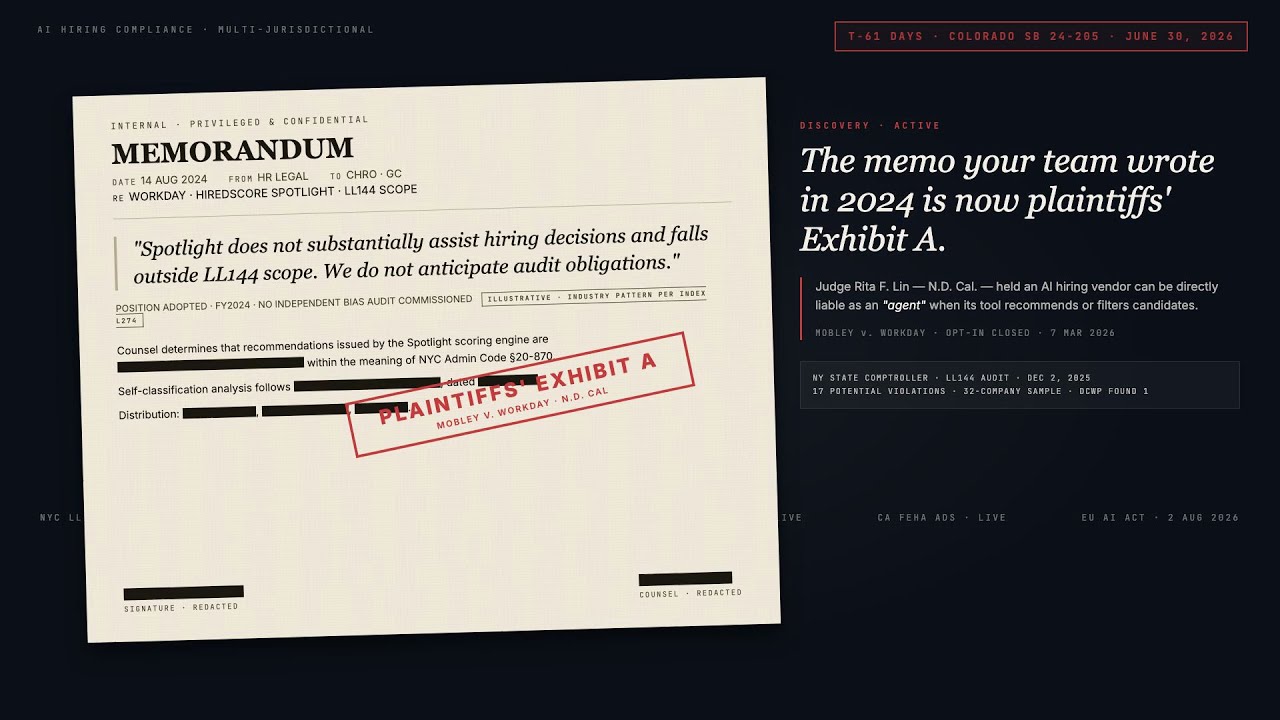
As of April 2026, the CHRO or General Counsel running AEDTs in New York, Colorado, Illinois, Texas, California, or the EU is inside a regulatory window most of their vendors were not built for. Illinois HB 3773 went live January 1. Texas TRAIGA went live January 1.
 Watch
WatchAI Product Liability Defense
Enterprise AI liability is shifting from negligence to strict product liability. Veriprajna builds defensible AI architectures, litigation-ready audit trails, and insurance positioning packages for legal teams facing the post-Section 230 era.
 Watch
WatchAI Verification & Anti-AI-Washing Compliance
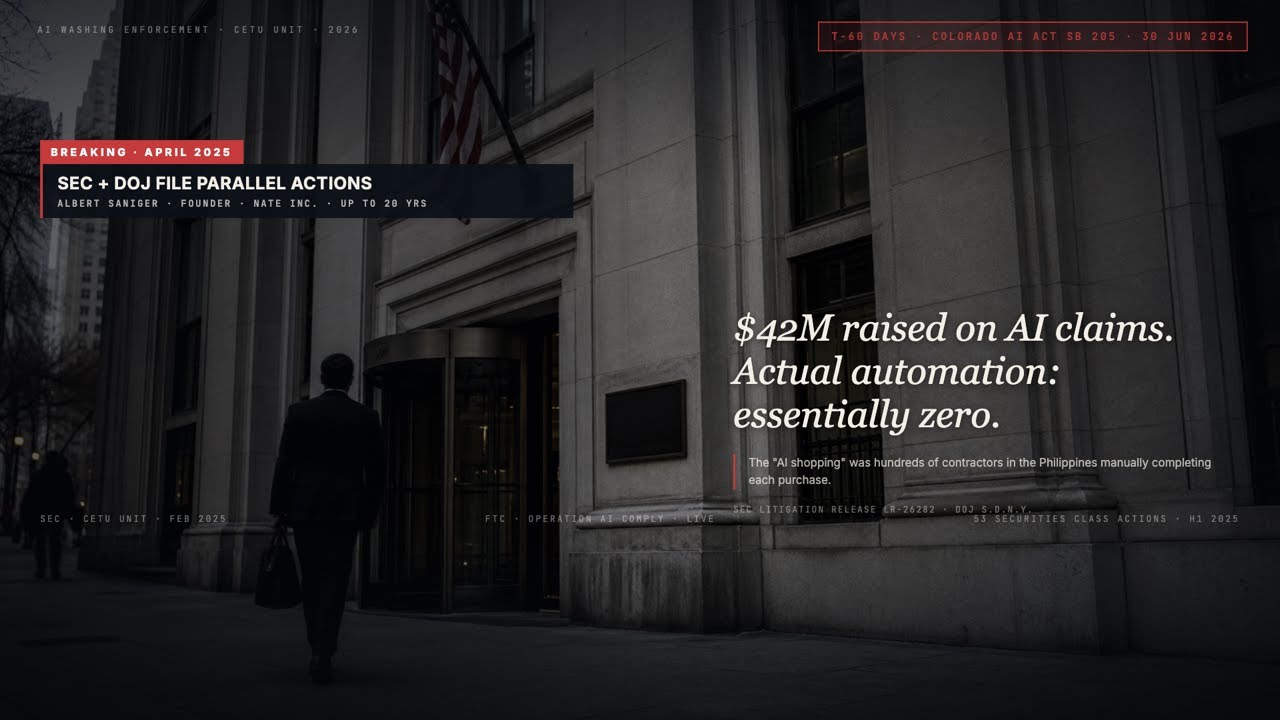
Substantiate your AI claims before regulators ask. Veriprajna builds AI verification architecture, AIBOM systems, and claim substantiation packages for SEC, FTC, and state AG compliance.
Related AI Services
Frequently Asked Questions
How much does an enterprise AI governance program cost to build?
The cross-industry average compliance spend is $5.2 million per firm. EU AI Act conformity assessments run EUR 5,000 to EUR 50,000 per system, with average annual per-system compliance costs of EUR 29,277. Enterprise governance platforms cost EUR 100,000+ per year. The critical cost variable is timing: retrofitting governance into existing AI systems costs 3x to 5x more than building it in during development. Organizations that already have dozens of AI systems in production without governance architecture face the highest total cost. We scope engagements based on the actual AI landscape, from focused classification and audit trail work for a handful of high-risk systems to enterprise-wide governance architecture programs.
How do I classify my AI systems under the EU AI Act when nearly half fall in a gray zone?
An appliedAI study of 106 enterprise AI systems found 40% could not be definitively classified as high-risk or low-risk under the EU AI Act's Annex III categories. The classification problem is that companies conflate a system's intended purpose with its actual deployment context. An HR analytics tool might be low-risk in aggregate reporting mode but high-risk when it influences individual hiring decisions. We build classification frameworks that map each AI system's actual use cases, data flows, and decision pathways to Annex III categories, flagging systems where deployment context creates higher risk classification than the product description suggests. CEN and CENELEC's failure to deliver harmonized standards means there is no conformity shortcut. Classification has to be done against the regulation text directly.
Is my AI output a product for strict liability purposes?
Courts are increasingly saying yes. In Garcia v. Character Technologies (October 2024), the court permitted strict liability claims treating a chatbot as a product after a teenager's death. The EU's revised Product Liability Directive explicitly includes software and AI systems, creating liability without requiring proof of negligence. The AI LEAD Act in Congress would classify AI systems as products at the federal level. For enterprise AI deployers, this means the documentation gap becomes litigation exposure. Validation records, decision logs, safety testing documentation, and design-choice rationale are the evidence your litigation team needs when a plaintiff's attorney serves discovery. We build the evidentiary foundation: audit trails capturing not just what the system decided but why, in formats that survive both regulatory examination and civil discovery.
How do I govern third-party AI tools when 89% of AI usage is invisible to my organization?
Shadow AI accounts for 20% of all data breaches and costs $670,000 more per incident than standard breaches. 78% of organizations use third-party AI tools, and more than half of AI failures originate from those tools. But you cannot outsource legal culpability. The EU AI Act holds deployers responsible regardless of whether the AI system was built internally or purchased. The starting point is discovery: identifying every AI tool in use across the enterprise, including browser extensions, SaaS features with embedded AI, and API integrations that individual teams adopted. From there, we build a tiered vendor risk framework that concentrates assessment effort on tools processing sensitive data or influencing consequential decisions, aligned to NIST AI RMF and your specific jurisdictional requirements.
What does FTC AI-washing enforcement actually look like, and how do I stay clear?
The FTC brought at least a dozen AI-washing cases in 2025. DoNotPay was fined $193,000 for claiming AI legal capabilities it did not have. Evolv Technologies was banned from marketing unsubstantiated AI weapons-detection claims after schools reported the scanners failed to detect weapons. The SEC settled with Delphia and Global Predictions for $400,000 combined over fabricated AI capabilities. The FTC's March 2026 Policy Statement on AI and Section 5 clarifies that misleading AI claims receive the same enforcement treatment as any other deceptive practice. The defense is substantiation: every AI capability claim your company makes publicly needs corresponding technical evidence that the capability works as described. We audit AI marketing claims against actual system capabilities and build the testing and documentation infrastructure that substantiates those claims if challenged.
How do I govern autonomous AI agents when standards barely exist?
Gartner projects 40% of enterprise applications will embed autonomous agents by end of 2026, but only 23% of organizations have an enterprise-wide agent identity management strategy. OWASP published its first Top 10 for Agentic Applications in March 2026, covering goal hijacking, tool misuse, identity abuse, memory poisoning, and cascading failures. NIST launched the AI Agent Standards Initiative in February 2026. Microsoft released its Agent Governance Toolkit in April 2026. These are first-generation tools, not mature solutions. We build agentic governance architecture that addresses the four requirements most enterprises cannot yet satisfy: identity and credential management for agents acting across systems, decision attribution that traces autonomous actions back to the authorizing policy, cascading-failure containment that prevents one agent's error from propagating, and human-in-the-loop escalation triggers based on risk thresholds rather than blanket approval requirements.
Is ISO 42001 certification worth pursuing now, or should I wait for EU AI Act harmonized standards?
ISO/IEC 42001 maps directly to key EU AI Act requirements across risk management, data governance, documentation, monitoring, security, and safety. Microsoft, SAP, and Cornerstone OnDemand have already achieved certification. CEN and CENELEC missed their harmonized standards deadline and delivery timing remains uncertain. The Digital Omnibus package may delay Annex III obligations to December 2027 but that is not guaranteed. Pursuing ISO 42001 now gives you a structured governance foundation that translates into EU AI Act readiness regardless of when harmonized standards arrive. The certification process itself forces the inventory, documentation, and accountability-structure work that most organizations need to do anyway. The risk of waiting is that you face August 2026 enforcement with neither certification nor harmonized standards to lean on.
Why do enterprise AI governance programs fail?
McKinsey's 2026 survey found 73% of enterprise AI deployments fail to achieve projected ROI, and governance programs fail for the same organizational reasons. 77% of failures are organizational, not technical. The top governance-specific failure modes: treating governance as ethics messaging rather than production control (polished principles, weak execution), decentralized AI procurement where every business unit buys tools independently with no central inventory, reviewing models only before launch while ignoring runtime behavior drift, unclear ownership of governance decisions across legal, compliance, IT, and business units, and board-level blind spots where 66% of boards lack AI expertise to evaluate what they are approving. Governance programs that survive are the ones that build accountability structures, cross-functional decision rights, and continuous monitoring into the architecture from day one, not bolted on after the audit finding.
Build Your AI with Confidence.
Partner with a team that has deep experience in building the next generation of enterprise AI. Let us help you design, build, and deploy an AI strategy you can trust.
Veriprajna Deep Tech Consultancy specializes in building safety-critical AI systems for healthcare, finance, and regulatory domains. Our architectures are validated against established protocols with comprehensive compliance documentation.