Retail AI Systems That Withstand Regulatory Scrutiny and Earn Consumer Trust
AI systems for retail pricing compliance, product accuracy, demand forecasting, and consumer trust across omnichannel and e-commerce operations.
Retail AI now makes consumer-facing decisions that carry legal weight: how you price, what your listings claim, what you recommend, how you forecast fresh inventory, and whether your catalog is legible to AI shopping agents. Veriprajna's approach is to engineer custom retail systems designed to withstand FTC and state AG scrutiny while earning consumer trust, with compliance and provenance built in at the architectural level rather than bolted on after an enforcement action.
Your Pricing Algorithm Is One State AG Away from a $60 Million Problem
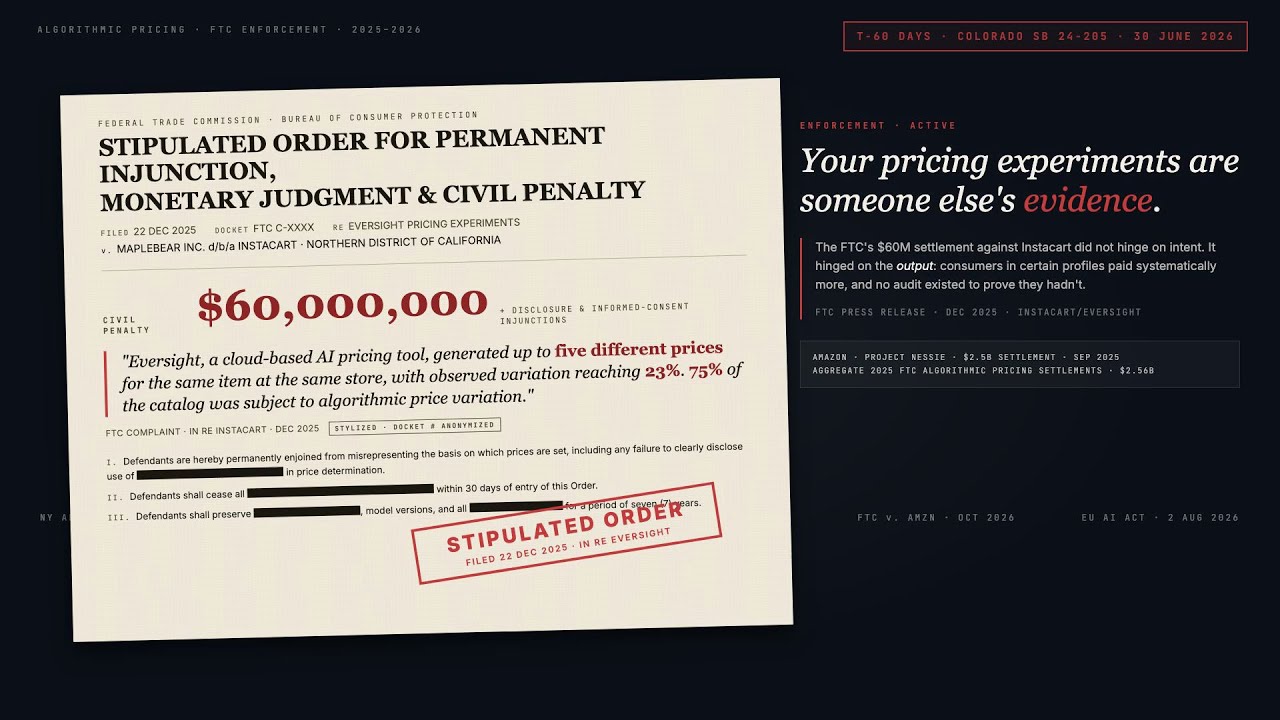
Instacart paid $60 million to the FTC in December 2025 after its AI-driven pricing inflated grocery costs up to 23% higher for some users. That settlement ended all AI item price tests on the platform and barred retailers from using Eversight technology for price experiments through Instacart.
Two months later, New York's Algorithmic Pricing Disclosure Act took effect, requiring any retailer using personal data for individualized pricing to post a notice: "THIS PRICE WAS SET BY AN ALGORITHM USING YOUR PERSONAL DATA." By February 2026, 35 additional state legislatures had introduced their own algorithmic pricing bills. Federal proposals include the Stop AI Price Gouging Act and the One Fair Price Act.
This is not a theoretical compliance exercise. If you operate dynamic pricing across thousands of SKUs and multiple geographies, you need pricing AI that can demonstrate non-discriminatory behavior under audit. That requires three things built in, not bolted on:
- Fairness constraints inside the optimization logic, not added after the fact.
- Pricing decisions that can be explained to a state AG investigator in plain language.
- Geographic analysis that proves the algorithm does not systematically charge more in zip codes correlated with protected demographics.
Our approach is to build pricing systems with these constraints at the architectural level, detailed in our research on algorithmic accountability in consumer-facing AI, because retrofitting compliance onto a black-box pricing engine after an enforcement action has already started is not a viable strategy.
AI-Generated Product Claims Are Creating Strict Liability Exposure
AI hallucinations in e-commerce product listings cost businesses $67.4 billion in 2024. The failure modes are specific and consequential:
- Inventing camera specifications the product does not have.
- Claiming compatibility with accessories that were never tested.
- Merging features from different product tiers into a single description.
- Generating performance ratings ("waterproof," "impact-resistant") that no lab ever verified.
In one documented case, hallucinated product specifications caused a 25% spike in returns. But the liability is not limited to returns and chargebacks. A listing that claims a specification the product does not meet creates strict product liability under the Restatement (Third) of Torts and deceptive practices exposure under FTC Section 5. When your AI writes "rated for 200 lbs" on a product tested to 150 lbs, that is not a copywriting error — it is a safety claim that can be introduced as evidence.
We design product content systems where every generated claim validates against the manufacturer's actual specification data before it reaches a listing (see a working demo of our AI content generation). The architecture connects your content generation pipeline to verified product databases, test reports, and compliance certifications. Claims that cannot be traced to a source document do not publish. This is the same principle applied in pharmaceutical labeling and financial disclosure: every assertion must have provenance.
53% of Your Customers Say Personalization Does Nothing for Them
The promise of AI-driven personalization was higher conversion and deeper loyalty. The data tells a different story:
- 53% of consumers report AI-driven personalization has no impact on their shopping experience.
- Only 8% say it significantly enhanced their experience.
- 73% prefer human insight over AI-based recommendations.
- Only 7% report full trust in AI-personalized recommendations.
The problem is not the concept; it is the implementation. Most recommendation engines work well on best-sellers with dense purchase history and collapse on the long tail where the actual margin lives. Bloomreach and Algolia both provide strong search and merchandising platforms, but retailers with 50,000+ SKUs and sparse purchase data on 80% of their catalog consistently report that recommendations degrade outside the top 2,000 items. Collaborative filtering needs signal density; without it, it defaults to popularity-based fallbacks that feel generic to the shopper.
Our approach is to build hybrid recommendation architectures that combine collaborative filtering with product knowledge graphs (see our research on hybrid AI for brand equity and marketing). The knowledge graph encodes product attributes, compatibility relationships, use-case mappings, and substitution chains, so the system can make informed recommendations even for items with zero purchase history.
A customer searching for a specific woodworking clamp does not need 50 other buyers to have purchased it first. The system knows what that clamp fits, what project types use it, and what complementary tools a woodworker at that skill level typically needs.
Fresh Forecasting Breaks Every General-Purpose Demand Tool
Retailers running Blue Yonder, Relex, or o9 Solutions for demand forecasting see strong results on shelf-stable categories. Fresh and perishable is a different problem. Fresh produce data is notoriously unreliable: manual inventory counts are infrequent and error-prone, spoilage patterns vary by micro-climate within the same store, and substitution elasticity between produce items changes with season, price point, and local demographics. A newspaper recipe featuring butternut squash on a Thursday moves demand that no time-series model predicted.
The data silo problem compounds everything. Sales data sits in the POS, inventory data in the WMS, and supplier lead-time and quality data in the procurement system. Weather, local events, and competitive pricing sit in external sources that most forecasting platforms do not ingest natively. Without a unified real-time data surface, replenishment decisions for a product with a 3-day shelf life are based on signals that are 24-48 hours stale.
We design forecasting systems for perishable categories that integrate across these data sources and account for the variables general-purpose tools treat as noise:
- Spoilage models that incorporate store-level micro-climate data.
- Substitution models that adjust when a competing grocery chain runs a loss leader on the same category.
- Event-driven demand signals that catch the butternut squash spike before it empties the shelf.
This is custom modeling work, because no platform vendor has an economic incentive to solve the fresh forecasting problem at the store-cluster level where it actually matters.
Agentic Commerce Is Rewriting How Consumers Find You
At NRF 2026, Google, Shopify, Walmart, Target, Etsy, and Wayfair announced the Universal Commerce Protocol (UCP), a new standard designed to let AI shopping agents move consumers from discovery to purchase without switching between apps and websites. Gap became the first major fashion brand to let customers complete purchases inside Google's Gemini agent, and Sephora launched its app inside ChatGPT. McKinsey projects up to $1 trillion in US B2C orchestrated revenue from agentic commerce by 2030.
This is not a future trend; it is a current infrastructure problem. When an AI agent shops on behalf of a consumer, it does not browse your homepage. It reads your structured product metadata, compares it against competitors, and makes purchasing decisions based on machine-parseable data. If your product catalog is not agent-legible — structured, complete, and accurate at the attribute level — your products will not surface in AI-mediated shopping. The retailers winning this transition treat catalog metadata with the same rigor they treat financial data: validated, versioned, and auditable.
An engagement is scoped to build agent-ready commerce infrastructure, informed by our research on truth architectures beyond the LLM wrapper:
- A product knowledge graph that structures your catalog for machine consumption.
- Pricing and availability APIs that AI agents can query in real time.
- Governance rules that control what an agent can negotiate, discount, or bundle on your behalf.
Giving a third-party AI agent unrestricted access to your pricing and inventory is a brand risk that most retailers have not yet thought through.
Why Not a Platform Vendor or a Large SI
Platform vendors and consultancies each solve part of the retail stack — but none builds the custom, legally-defensible systems that consumer-facing AI decisions now demand.
| Provider | What they provide | What they will not build |
|---|---|---|
| Salesforce Commerce Cloud, SAP Retail, commercetools | Strong commerce infrastructure | A fairness-constrained pricing optimizer specific to your category mix and regulatory exposure across 12 states |
| Bloomreach, Algolia | Excellent search and merchandising | A custom knowledge graph that makes your long-tail catalog recommendable without purchase history |
| Blue Yonder | Demand forecasting | A perishable-specific model integrating local weather, competitor pricing feeds, and store-level spoilage into a single forecasting surface |
| Accenture, Deloitte, McKinsey | Strategy advice and vendor-platform integration | Deterministic pricing compliance engines that explain each price to a state AG, knowledge graphs from spec sheets and test reports, or agent-commerce governance for what Google Gemini can do with your catalog |
The gap in retail AI is not strategy or platforms. It is the custom technical work that makes AI systems trustworthy enough to make consumer-facing decisions that carry legal weight.
Key Takeaways
- Fairness constraints, plain-language explainability, and geographic audit trails belong inside the pricing optimizer's architecture — not bolted on after a $60M-scale enforcement action.
- Every AI-generated product claim should validate against manufacturer specs, test reports, and certifications before publishing; without provenance, it does not reach the listing.
- Hybrid recommendation (collaborative filtering plus a product knowledge graph) makes the long-tail 80% of a 50,000+ SKU catalog recommendable without purchase history.
- Perishable forecasting needs store-cluster models that fuse POS, WMS, procurement, weather, and competitor data — general-purpose time-series tools run on signals 24-48 hours stale.
- Agent-ready catalogs — knowledge graph, real-time pricing/availability APIs, and governance rules — decide whether your products surface in UCP-era AI-mediated shopping.
Solutions for Retail & Consumer
 Watch
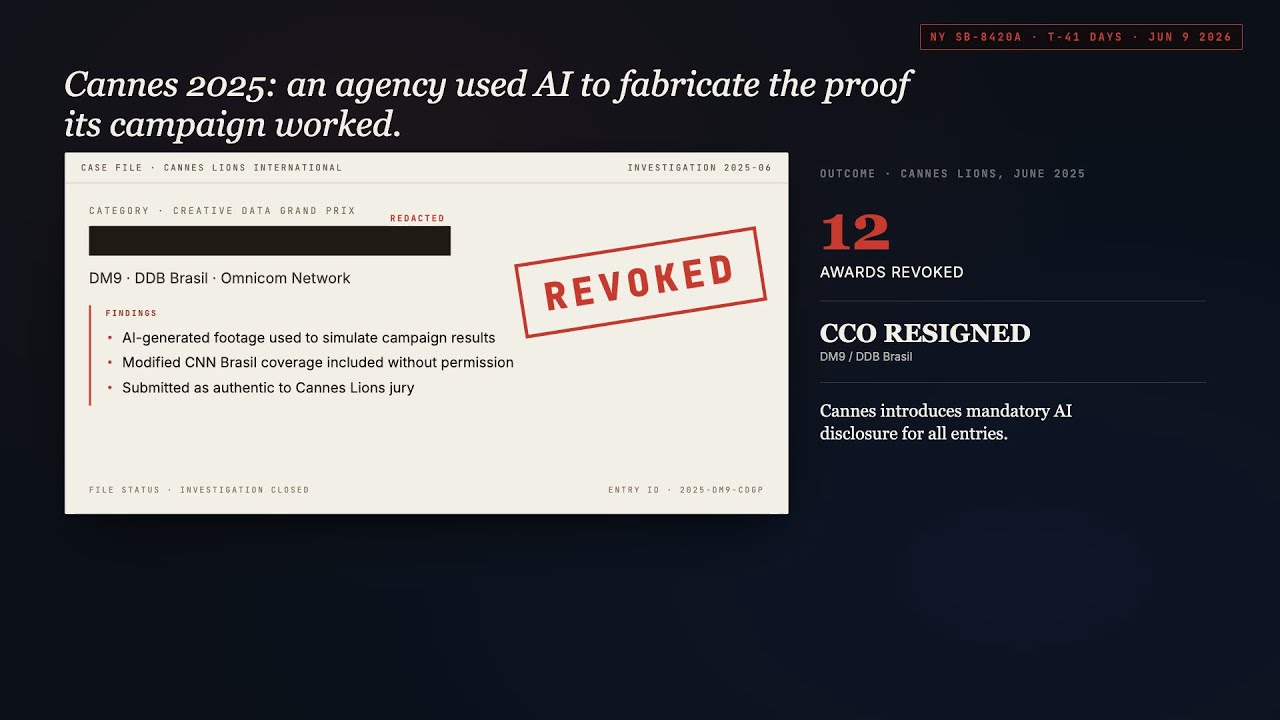
WatchAI Brand Content That Consumers Actually Trust
The other half doesn't care, as long as they can't tell. We build hybrid AI production pipelines, brand fidelity scoring systems, and governance frameworks that let you use AI aggressively in the process while keeping it invisible in the output.
 Watch
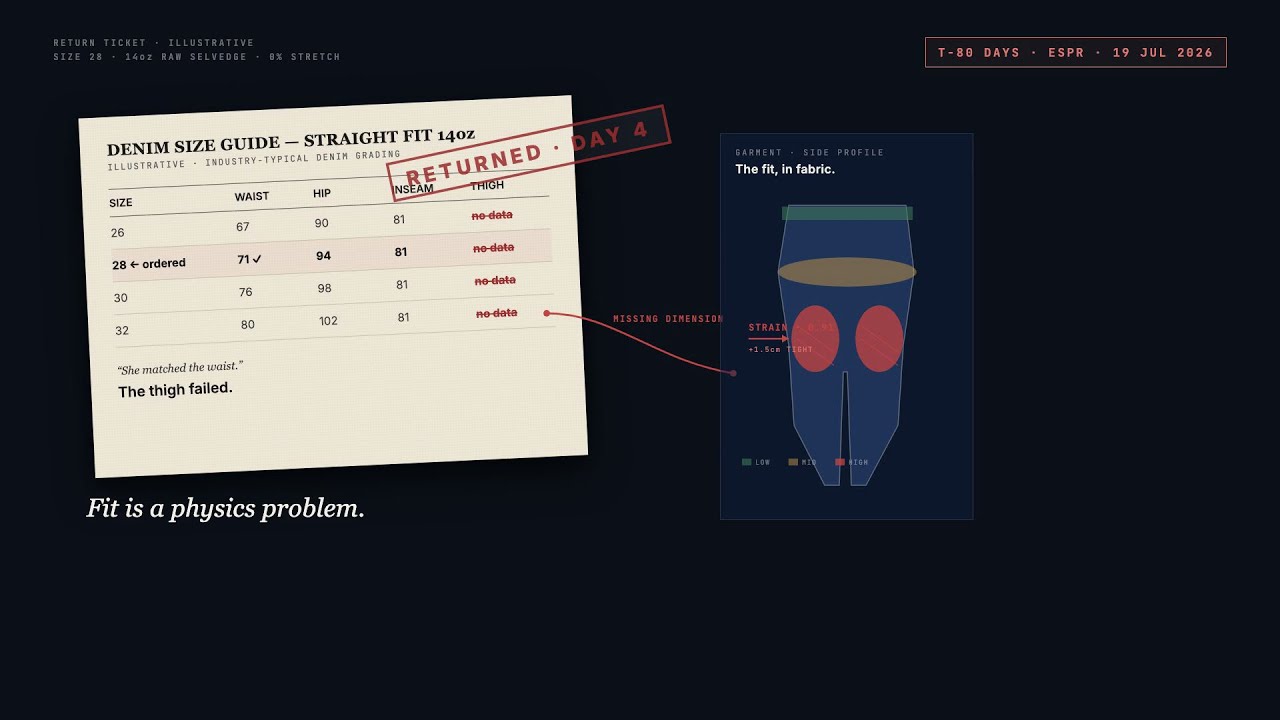
WatchAI Fit Prediction for Fashion E-Commerce
Fashion e-commerce loses more money to returns than to marketing, logistics, or fraud combined. The root cause in 53-70% of apparel returns is the same: the garment did not fit. Size charts reduce this to a guessing game.
 Watch
WatchAI Pricing Compliance & Algorithmic Fairness
In 2025, the FTC collected $2. 56 billion in algorithmic pricing settlements from two companies. New York, California, and Colorado enacted laws that make every AI-driven price a potential violation.
 Watch
WatchE-Commerce AI Accuracy & Reliability Engineering
Shoppers who engage with AI convert at 4x the rate of those who don't. But one hallucinated product spec, one invented return policy, one unsafe recommendation shared on social media costs more than the entire project saves. We build the verification, grounding, and compliance layers that make e-commerce AI actually reliable.
 Watch
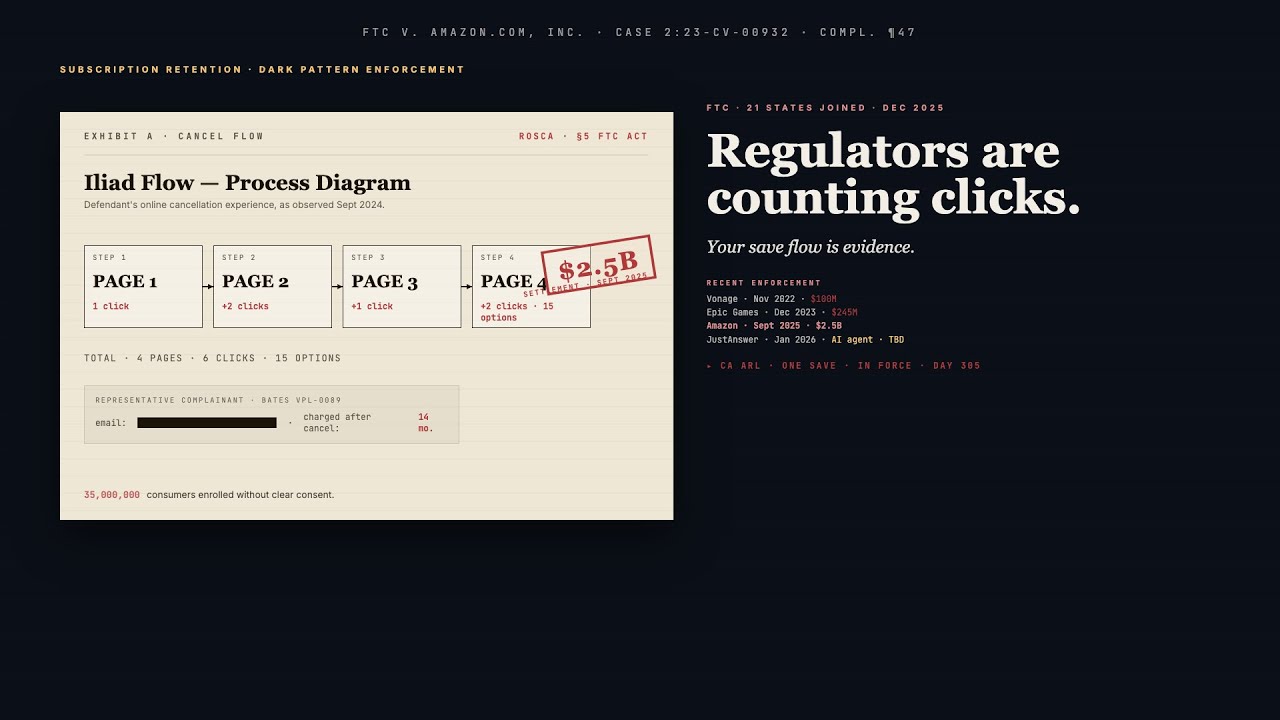
WatchEthical Subscription Retention AI
Amazon paid $2. 5 billion for a cancel flow that took 6 clicks. Uber is facing 21 state attorneys general over 23 screens to cancel.
 Watch
WatchQSR Drive-Thru Voice AI Engineering
Fix drive-thru AI accuracy, prevent viral failures, and build accessible voice ordering. Expert QSR voice AI architecture, POS integration, and acoustic engineering for multi-unit restaurant chains.
 Watch
WatchSynthetic Content & Fake Review Detection
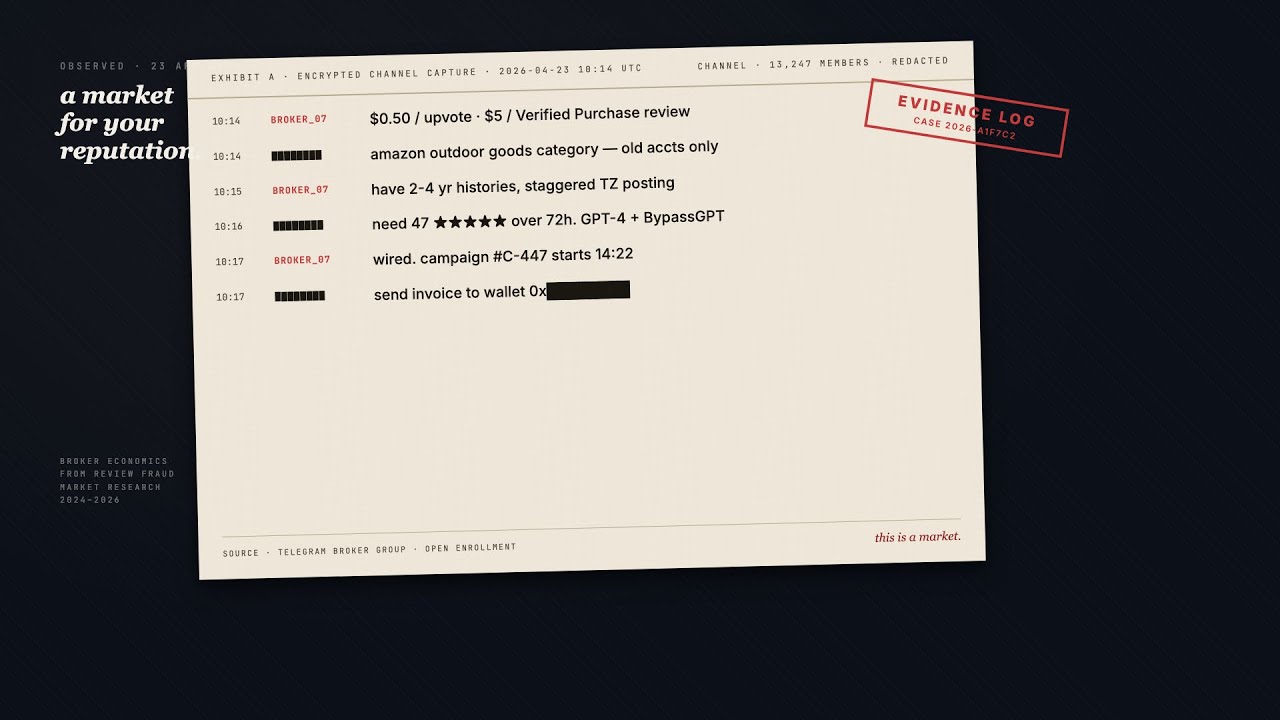
Custom AI systems that detect fake reviews, synthetic content, and coordinated fraud across every platform where your brand appears. Built for the FTC's new enforcement reality.
Related AI Services
Frequently Asked Questions
How do I ensure my AI pricing system complies with algorithmic pricing laws?
Instacart's $60 million FTC settlement in December 2025 set the enforcement precedent for AI-driven retail pricing. New York's Algorithmic Pricing Disclosure Act requires disclosure when personal data drives individualized prices, and 35+ additional state bills were introduced in early 2026. Compliance requires fairness constraints built into the pricing optimization logic, geographic analysis proving no discriminatory patterns across zip codes, and explainable decision trails that a state AG investigator can follow. We build these constraints at the architectural level rather than layering audit tools on top of black-box pricing engines.
What liability do AI-generated product descriptions create for retailers?
AI hallucinations in e-commerce cost $67.4 billion in 2024. When AI generates a product claim the product cannot meet, such as an unverified waterproof rating or an untested weight capacity, the retailer faces strict product liability under the Restatement (Third) of Torts and deceptive practices exposure under FTC Section 5. We build content generation pipelines where every claim validates against manufacturer specification data, test reports, and compliance certifications before publishing. Claims without source provenance do not reach the listing.
Why do AI recommendation engines fail on long-tail product catalogs?
Collaborative filtering needs dense purchase history to generate useful signals. Retailers with 50,000+ SKUs typically have meaningful purchase data on fewer than 20% of items. The remaining 80%, often where the actual margin lives, gets popularity-based fallback recommendations that feel generic. We build hybrid architectures combining collaborative filtering with product knowledge graphs that encode attribute relationships, compatibility data, and use-case mappings so the system can recommend items with zero purchase history based on what the product actually is and does.
How do I make my product catalog ready for AI shopping agents?
The Universal Commerce Protocol announced at NRF 2026 by Google, Shopify, Walmart, and Target creates a standard for AI agents to discover and transact across retailers. Agent readiness requires structured, validated product metadata at the attribute level, real-time pricing and availability APIs, and governance rules controlling what agents can negotiate or discount. We build the product knowledge graph, API infrastructure, and governance layer that makes your catalog machine-negotiable without surrendering pricing control or brand integrity to third-party AI agents.
Can AI actually reduce retail return rates?
US retail returns reached $849.9 billion in 2025, representing 15.8% of sales. Online returns run at 19.3%, and Gen Z averages nearly 8 online returns per person. ASOS achieved a 160 basis point return reduction through virtual try-on technology (AIUTA), and Flux Footwear cut return rates by up to 7%. The key distinction is between visual AI (generative try-on images that look appealing but do not predict fit) and physics-based geometric modeling that accounts for fabric stretch, body topology, and garment construction. The first approach produces Instagram content. The second reduces returns.
Why does AI demand forecasting fail for fresh and perishable products?
General-purpose forecasting tools perform well on shelf-stable categories but break on fresh produce and perishables. Fresh data is unreliable due to infrequent manual counts and variable spoilage rates. Demand drivers include weather micro-patterns, local events, competitor promotions, and substitution elasticity between produce items, none of which standard time-series models handle natively. Data silos across POS, WMS, procurement, and external sources mean replenishment decisions for 3-day shelf life products run on signals that are 24-48 hours stale. We build custom forecasting models that integrate across these sources at the store-cluster level.
What does the EU AI Act mean for retail operations?
The EU AI Act reaches full applicability on August 2, 2026. Retail-specific impacts include mandatory AI disclosure for chatbots and recommendation systems, labeling requirements for AI-generated content, potential high-risk classification for AI used in creditworthiness assessments or biometric identification, and scrutiny of dynamic pricing for discrimination. Penalties reach up to 35 million euros or a percentage of global annual turnover. Retailers operating across US and EU jurisdictions face a patchwork of CPRA, state algorithmic pricing laws, FTC rules, and EU AI Act obligations that no single vendor compliance module covers.
How do I protect my marketplace from AI-generated fake reviews?
The FTC's Consumer Review Rule, finalized August 2024, imposes penalties up to $53,088 per violation for fake reviews, AI-generated reviews, or reviews misrepresenting the reviewer's experience. In December 2025, the FTC sent warning letters to 10 companies under this rule. AI-generated reviews are now sophisticated enough to evade detection tools like Fakespot and ReviewMeta. We build detection systems that analyze linguistic patterns, behavioral signals, temporal clustering, and account provenance to identify synthetic reviews before they reach your marketplace, using techniques that adapt as generation methods evolve.
Build Your AI with Confidence.
Partner with a team that has deep experience in building the next generation of enterprise AI. Let us help you design, build, and deploy an AI strategy you can trust.
Veriprajna Deep Tech Consultancy specializes in building safety-critical AI systems for healthcare, finance, and regulatory domains. Our architectures are validated against established protocols with comprehensive compliance documentation.