AI Security Architecture for Production Systems Under Active Threat
Adversarial hardening, supply chain integrity, and sovereign deployment architecture for organizations running AI in production.
The threat landscape for AI systems shifted from academic research to operational exploitation in 2025. Production AI tools used by millions of developers now carry CVEs with high CVSS scores, the attack surface is expanding across software, supply chain, and hardware simultaneously, and the regulatory clock is running. Point-solution vendors and governance frameworks solve pieces of this, but neither architects the security posture of a live AI deployment. That is the gap we build for.
Production AI Is Under Active Attack, and Most Security Programs Are Not Keeping Up
2025 turned AI exploitation from proof-of-concept into documented CVEs in tools that millions of developers rely on:
- Microsoft 365 Copilot — a zero-click prompt injection vulnerability (CVE-2025-32711, CVSS 9.3) in which a single crafted email triggered remote data exfiltration.
- GitHub Copilot — compromised through code comments embedded in a public repository (CVE-2025-53773), escalating to remote code execution.
- Cursor IDE — a case-sensitivity bug (CVE-2025-59944) let attackers manipulate agentic behavior into executing arbitrary commands.
These are not demonstrations. They are CVEs with CVSS scores in production tools. And the attack surface is expanding in three directions at once.
Agentic systems and trust boundaries
Agentic AI systems create trust boundary problems that traditional perimeter security cannot address. Only 29% of organizations report readiness to secure agentic deployments, and MITRE ATLAS v5.4.0 (February 2026) added dedicated techniques for agent-specific threats, including "Publish Poisoned AI Agent Tool" and "Escape to Host."
AI supply chain attacks
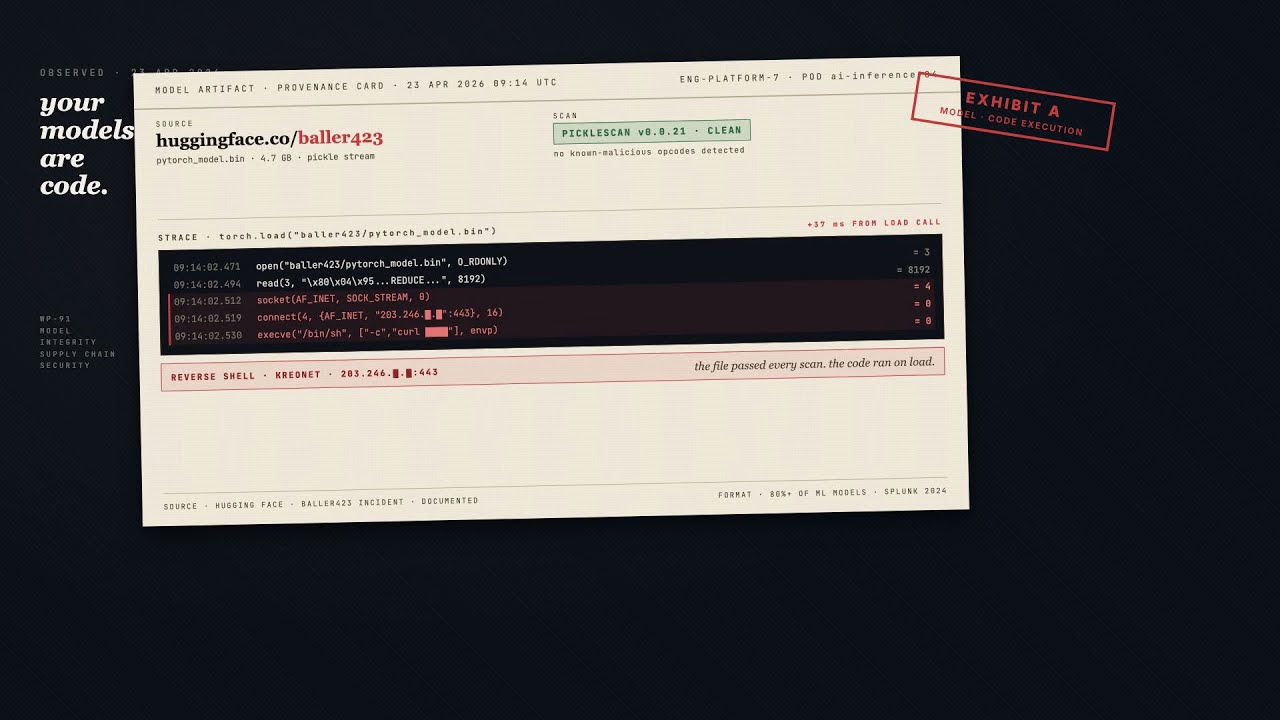
Supply chain attacks have moved from theory to practice. JFrog identified roughly 100 malicious models on Hugging Face with embedded code execution payloads, and Palo Alto Unit 42 demonstrated that deleted Hugging Face namespaces can be re-registered by anyone, enabling supply chain hijacking.
Hardware-level vulnerabilities
The GDDRHammer attack (2026) showed that an unprivileged CUDA kernel can gain arbitrary read/write access to GPU memory through GDDR6 rowhammer — meaning multi-tenant GPU environments have a hardware attack surface that no software-layer defense can close.
Compounding regulatory pressure
Regulation is tightening in parallel. The EU AI Act's prohibited practices took effect February 2025, high-risk system requirements hit August 2026, and penalties reach EUR 35 million or 7% of global turnover. CISA classified prompt injection as a critical AI vulnerability in September 2025; NIST published AI RMF 2.0 with specific prompt injection guidance in January 2026. Under the biometric privacy law CUBI, Texas extracted $1.375 billion from Google and $1.4 billion from Meta in 2025 alone. The compliance burden compounds with every quarter.
The AI Supply Chain Is Where Most Organizations Have Zero Visibility
When we assess enterprise AI deployments, the supply chain gap is consistently the most dangerous finding. Most organizations cannot produce a complete inventory of which models are running in production, let alone verify their provenance (the subject of our research on safeguarding enterprise models from poisoning). A Lineaje survey (June 2025) found that 48% of security professionals say their organizations are already falling behind on basic software bill-of-materials requirements. ML-BOM (machine learning bill of materials) adoption is significantly lower.
The risk is documented, not theoretical:
- Anthropic, the UK AI Safety Institute, and the Alan Turing Institute demonstrated that as few as 250 malicious documents can successfully backdoor language models from 600 million to 13 billion parameters.
- DeepSeek's DeepThink-R1 model (January 2025) was found with a backdoor created by hidden prompts planted in GitHub code comments during training. The model followed attacker-planted instructions when it hit a specific trigger phrase, months after training, with no internet access required.
- Qwen 2.5's search tool was poisoned through adversarial web content that caused the aligned model to produce harmful outputs from an 11-word query.
Traditional security scanning does not catch these problems. Hugging Face runs Picklescan for malicious pickle files, but malicious LoRA adapters, poisoned training datasets, and re-registered namespaces all bypass model-level scanning. Standards exist — CycloneDX published the ML-BOM specification in 2023, SPDX 3.0.1 defines AI and Dataset Profiles, and OWASP launched the AI-BOM project — but the gap between specification availability and organizational adoption remains enormous. Building supply chain integrity for AI requires the same discipline application security brought to software dependencies a decade ago: automated scanning, provenance verification, continuous monitoring, and a response playbook for when something gets through.
Why the Existing Security Ecosystem Leaves Architecture-Level Gaps
The AI security vendor landscape is growing fast, and its point solutions are strong:
- Protect AI raised over $108 million and runs the huntr.com bug bounty for AI/ML vulnerabilities; it scans model artifacts for known vulnerabilities.
- HiddenLayer ($56 million) focuses on runtime model behavior monitoring.
- Lakera built what many consider the best prompt injection detection product (Lakera Guard).
- Cisco acquired Robust Intelligence in 2024; F5 acquired CalypsoAI for $180 million in 2025.
The AI red teaming market alone is projected to grow from $1.3 billion (2025) to $18.6 billion by 2035. But these tools are sensors and filters, not structural controls — none of them architect the overall security posture of an AI deployment. A CISO assembling a program from these components still needs someone to design where trust boundaries sit in an agentic system, how model provenance verification integrates with the CI/CD pipeline, what monitoring catches a backdoor that activated after deployment, and how sovereign deployment actually works when a compliance team says inference cannot leave the jurisdiction.
The Big Four have invested over $10 billion collectively in AI since 2023: PwC runs a $1 billion GenAI program and an OpenAI partnership; KPMG owns a formal 10-pillar AI governance framework with ISO 42001 mapping; Deloitte built 100+ GenAI accelerators; EY is deploying NVIDIA AI Factory infrastructure for regulated industries. Their governance and compliance work is legitimate.
But when a client needs hands-on adversarial testing of a RAG pipeline, architectural hardening against indirect prompt injection in a multi-agent system, or operational deployment of sovereign AI infrastructure with model weight integrity verification, governance frameworks are not enough. The gap is between knowing what the risk is and having the engineering capability to structurally prevent it.
What We Build for AI Security Programs
We work at the architecture level because that is where security decisions have structural impact. Filtering prompt injection at the input layer has a documented failure rate when adaptive attacks are employed. Scanning models after download catches known patterns but misses novel supply chain attacks. Governance frameworks tell you what to monitor but do not build the monitoring. We focus on four areas where architecture determines whether the security posture holds — including sovereign deployment, which we have proven in a working private-LLM demo.
Sovereign AI infrastructure
For organizations deploying under data sovereignty constraints, our approach is to build infrastructure where models, inference, and training data stay within controlled boundaries. This is not a VPC wrapper around an API call. It means selecting and quantizing models for on-premise hardware — the trade-offs between GPTQ, AWQ, and GGUF quantization are meaningful for both performance and security — configuring GPU isolation for multi-tenant environments, implementing cryptographic attestation for model weights, and building the monitoring stack that detects anomalous inference behavior. Sovereign deployment is scoped as a six-month engineering project, not a configuration change — engineered end to end rather than assembled from a wrapper.
Supply chain integrity
We design the verification pipeline to run before any model touches production (detailed in our research on AI supply chain integrity across the ML lifecycle): automated provenance checks on model weights and training data, serialization format validation (safetensors over pickle, always), LoRA adapter integrity verification, and continuous monitoring of upstream repositories for namespace hijacking or weight modification. The intended output is an ML-BOM that maps every component's origin, every dependency's version, and every training dataset's provenance.
Adversarial hardening
We combine red teaming with architectural remediation, testing against the MITRE ATLAS taxonomy and OWASP LLM Top 10 v2.0 — but testing alone does not fix the problem. When an agentic system's tool-calling interface is vulnerable to indirect prompt injection through retrieved documents, we build the trust boundary architecture that structurally separates untrusted content from privileged operations (see our research on securing the human-AI frontier). When a RAG pipeline leaks system prompts through carefully crafted queries (OWASP LLM07, new in the 2025 edition), we redesign the retrieval and generation pipeline to prevent it.
Regulatory mapping
We connect specific technical controls to the regulatory requirements that apply to your deployment: EU AI Act high-risk obligations, NIST AI RMF 2.0, OWASP LLM Top 10, state biometric laws (BIPA, CUBI, Colorado H.B. 24-1130), and sector-specific requirements. The intended output is not a compliance matrix in a spreadsheet. It is implemented controls with monitoring, evidence generation, and audit trails that satisfy regulators and reduce the $4.63 million average cost of an AI-related breach.
Key Takeaways
- AI exploitation is operational, not academic: 2025 produced live CVEs in Microsoft 365 Copilot, GitHub Copilot, and Cursor IDE, alongside GPU-level GDDRHammer attacks in 2026.
- The supply chain is the most dangerous blind spot — as few as 250 malicious documents can backdoor a model, and standards like CycloneDX ML-BOM, SPDX 3.0.1, and OWASP AI-BOM outpace adoption.
- Point-solution vendors and Big Four governance programs each leave the same gap: no one architects the deployment's security posture.
- We build at the architecture level across four areas — sovereign AI infrastructure, supply chain integrity, adversarial hardening, and regulatory mapping — turning risk awareness into structurally enforced controls.
Solutions for AI Security & Resilience
 Watch
WatchAI Supply Chain Security & Model Integrity
AI supply chain security consulting. We build model vetting pipelines, ML-BOM architecture, and shadow AI governance for CISOs at regulated enterprises. NIST AI 100-2 and EU AI Act compliant.
 Watch
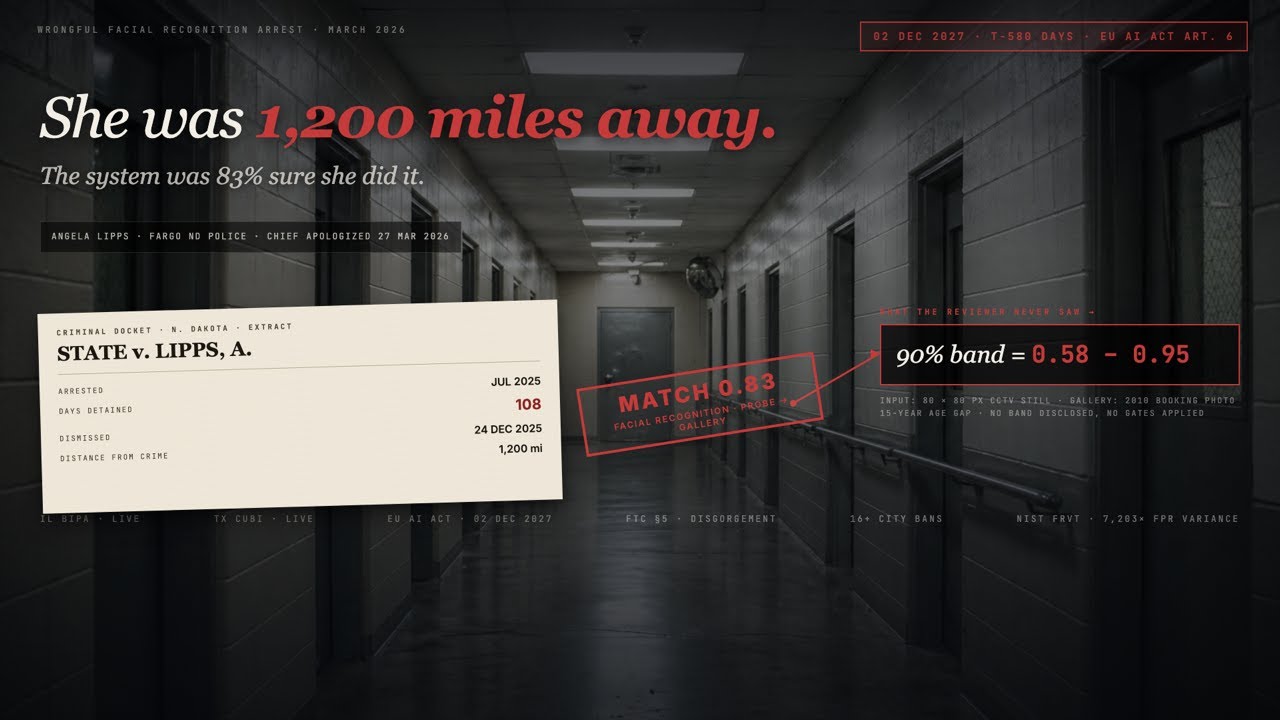
WatchBiometric & Facial Recognition Compliance
Whether you have deployed facial recognition and need to know your exposure, or you are evaluating vendors and want to get it right the first time, we audit biometric systems against the regulations, benchmarks, and operational standards that actually matter.
 Watch
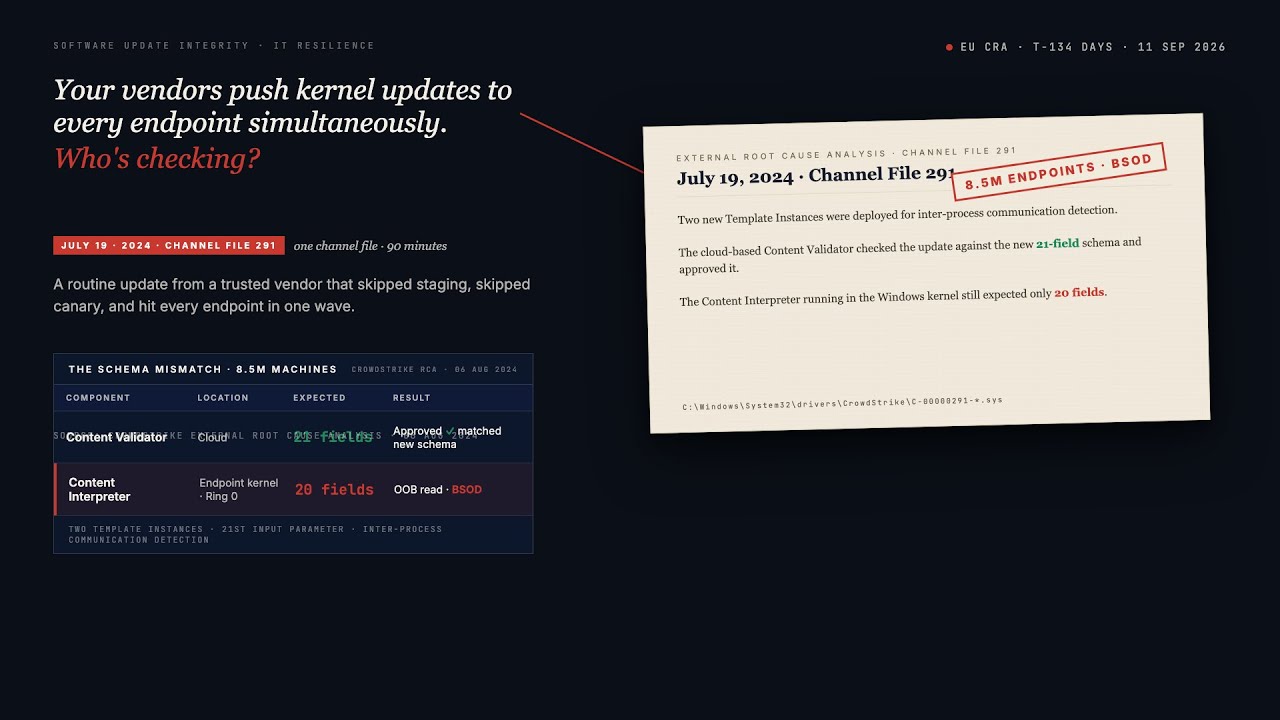
WatchSoftware Update Deployment Integrity & IT Resilience
On July 19, 2024, a single configuration file crashed 8. 5 million Windows machines in under 90 minutes. Not malware.
 Watch
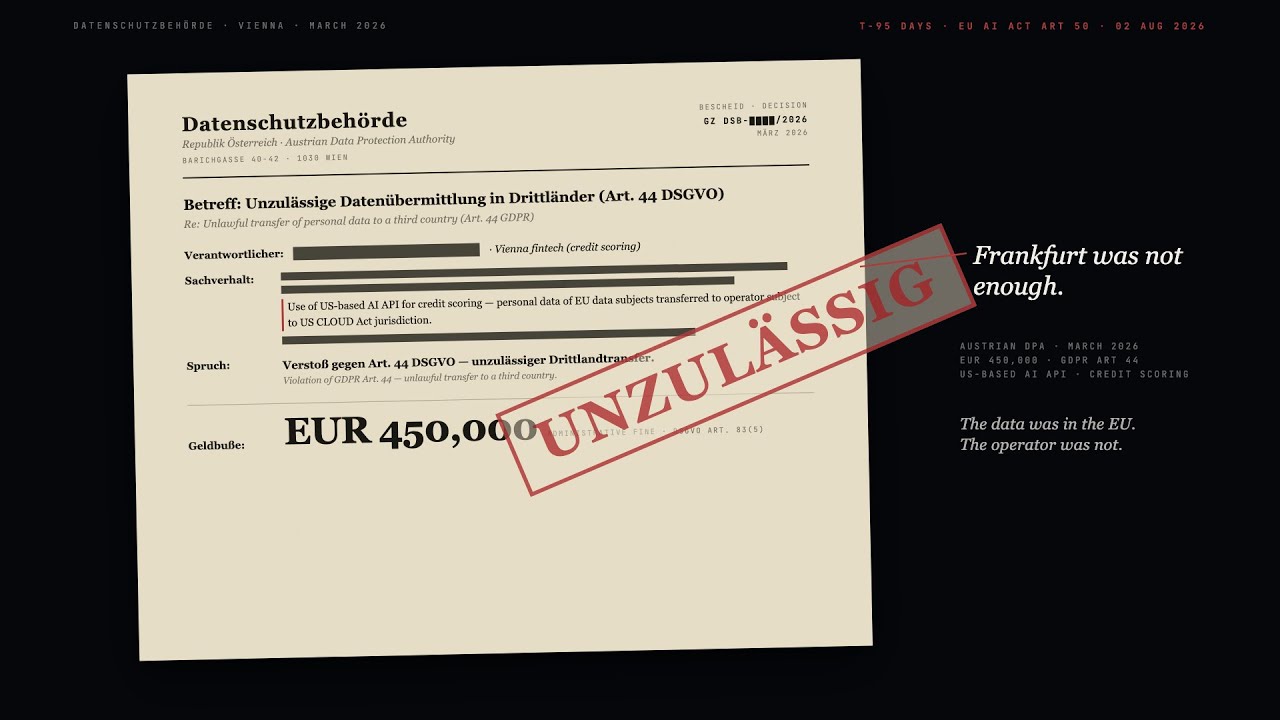
WatchSovereign AI & Private LLM Deployment
One in five organizations has already suffered a breach from unsanctioned AI tool usage. Banning AI does not work. Building secure, sovereign alternatives does.
Related AI Services
Frequently Asked Questions
Should we hire an AI security consultancy or build an internal AI security team?
The honest answer is you need elements of both, and the timing matters. Building an internal AI security team from scratch takes 12-18 months to hire, train, and operationalize. The talent pool is thin: offensive AI security researchers who can red-team production LLM systems and then architect the fixes are not abundant. A consultancy gets you to a defensible security posture faster while you build internal capability. We typically engage for 3-6 months to assess the current AI deployment landscape, build the security architecture (supply chain verification, trust boundaries, monitoring), red-team the critical systems, and document the program so your internal team can maintain it. The handoff is the goal. We build the program and the tooling; your team runs it. The cost of a 6-month engagement is a fraction of what a single AI-related breach costs or a biometric class action settlement (Texas extracted $2.8 billion from Google and Meta in 2025 alone).
How long does an AI security assessment take, and what does it cover?
A comprehensive AI security assessment typically runs 4-8 weeks depending on the number of AI systems in scope. Week one maps the AI inventory: every model in production, its provenance, deployment method, data flows, and access controls. Most organizations discover models they did not know were running. Weeks two through four cover adversarial testing against the MITRE ATLAS taxonomy and OWASP LLM Top 10 v2.0, including prompt injection (direct and indirect), supply chain integrity verification, data exfiltration testing, and privilege escalation through tool-calling interfaces. The final phase produces a prioritized remediation plan with architectural recommendations, not just a list of findings. We map every finding to applicable regulatory requirements (EU AI Act, NIST AI RMF, BIPA/CUBI if biometric systems are in scope) so the remediation simultaneously closes security gaps and compliance gaps.
What actually works against prompt injection in production?
No single defense reliably stops prompt injection. The space of possible injections is infinite while filters target finite patterns. Adaptive attacks against any single defense layer exceed 85% success rates in controlled testing. What works is layered architectural defense. Input validation catches the obvious attacks. Output validation with LLM-as-critic improves detection precision by 21% over input filtering alone (based on 600K+ adversarial prompts from the HackAPrompt dataset). But the structural controls matter most: separating untrusted content from privileged instructions at the architecture level, enforcing least-privilege permissions on tool-calling interfaces, requiring human approval for high-impact operations, and designing retrieval pipelines so that retrieved documents cannot override system-level instructions. For agentic systems specifically, trust boundaries between agents must be explicit and enforced, not assumed. We build these architectural controls into the system rather than bolting filtering onto the outside.
How do we secure our AI model supply chain when we use open-source models from Hugging Face?
Start by accepting that Hugging Face is a public registry, not a vetted supply chain. JFrog found roughly 100 malicious models with embedded code execution payloads. Palo Alto Unit 42 showed that deleted namespaces can be re-registered by attackers. Malicious LoRA adapters are indistinguishable from legitimate fine-tuning without integrity verification. The practical defense has four layers. First, never load pickle-serialized models in production; require safetensors format, which is not executable by design. Second, verify model provenance: check commit history, contributor reputation, and weight checksums against known-good baselines. Third, build an ML-BOM (machine learning bill of materials) using CycloneDX or SPDX 3.0.1 that tracks every model component's origin, version, and dependencies. Fourth, run automated scanning on every model update before it enters your CI/CD pipeline, and monitor upstream repositories for namespace changes or unexpected weight modifications. We build this verification pipeline as an integrated part of your MLOps workflow, not a separate manual process.
What are the EU AI Act security requirements for high-risk AI systems taking effect in August 2026?
The EU AI Act's high-risk requirements (effective August 2, 2026) mandate specific security controls including robustness against adversarial attacks, data governance for training datasets, technical documentation of the AI system's design and testing, human oversight mechanisms, and accuracy/reliability monitoring throughout the system lifecycle. Penalties reach EUR 35 million or 7% of global annual turnover for the most serious violations. The practical challenge is that the Act's requirements are principles-based, not prescriptive. 'Appropriate level of robustness' does not tell you which adversarial tests to run. We map the Act's requirements to specific technical controls: adversarial testing protocols aligned with MITRE ATLAS, supply chain integrity checks that satisfy the Act's transparency requirements, monitoring systems that generate the compliance evidence regulators expect, and documentation that traces from the regulatory requirement to the implemented control. Organizations that treat this as a compliance checkbox exercise will find the Act's enforcement mechanisms are designed to look through governance paperwork to the actual technical implementation.
How do we get visibility into shadow AI usage across our organization?
Shadow AI is the number-one operational AI risk right now. Research shows 69% of organizations suspect employees use unapproved GenAI tools, and the average company sees 223 incidents per month of sensitive data sent to AI applications. Shadow AI breaches cost $4.63 million on average, significantly more than standard breaches. Banning AI tools does not work; studies consistently show that employees bypass bans. The SANS Institute's 'Sunlight AI' approach is closer to the right answer: bring shadow usage into visibility rather than trying to prohibit it. Technically, this means deploying network-level detection for AI API traffic, building an approved-tools catalog with proper data classification controls, implementing DLP (data loss prevention) rules specific to AI service endpoints, and creating usage policies that give employees a sanctioned path for AI adoption. We build the technical monitoring layer and integrate it with your existing SIEM/SOAR stack so AI usage appears in the same dashboards your SOC already watches.
How do we secure agentic AI systems where agents call tools and make autonomous decisions?
Agentic AI introduces security problems that do not exist in single-model deployments. Controlled trials show 84% attack success rates against multi-agent systems versus roughly 50% for single-agent architectures. The core issue is trust propagation: when Agent A trusts Agent B's output and uses it to make tool calls, a compromise of Agent B's input (through indirect prompt injection in a retrieved document, for example) cascades through the entire agent network. MITRE ATLAS v5.4.0 now catalogs agent-specific techniques including poisoned tool publishing and host escape. The architectural defense requires explicit trust boundaries between agents, least-privilege permissions on every tool-calling interface (an agent that needs read access should never have write access), input sanitization at every agent-to-agent handoff, and human-in-the-loop gates for operations with real-world consequences. We design these trust architectures for specific agentic deployments, because the right boundary placement depends on what each agent does, what tools it can call, and what data it processes.
Should we use MITRE ATLAS or OWASP LLM Top 10 as our AI security framework?
Use both. They serve different purposes and are complementary. OWASP LLM Top 10 v2.0 (2025 edition) is a prioritized risk list for LLM applications: prompt injection, sensitive information disclosure, supply chain vulnerabilities, excessive agency, system prompt leakage, vector/embedding weaknesses. It tells you what to worry about first. MITRE ATLAS is an adversarial threat taxonomy with 16 tactics, 84 techniques, and 56 sub-techniques that tells you how attackers actually compromise ML systems. ATLAS maps attack chains; OWASP prioritizes risks. In practice, we use OWASP to scope what an assessment covers and MITRE ATLAS to structure how we test each risk area. For organizations building an AI security program, NIST AI 600-1 (the generative AI profile of the AI RMF) provides the governance wrapper that connects both frameworks to organizational risk management. The three together give you risk prioritization (OWASP), attack simulation methodology (ATLAS), and governance structure (NIST).
Build Your AI with Confidence.
Partner with a team that has deep experience in building the next generation of enterprise AI. Let us help you design, build, and deploy an AI strategy you can trust.
Veriprajna Deep Tech Consultancy specializes in building safety-critical AI systems for healthcare, finance, and regulatory domains. Our architectures are validated against established protocols with comprehensive compliance documentation.