AI for Hotels, Airlines, and TMCs That Actually Integrates
Custom AI for hotels, airlines, and TMCs: revenue management, guest data unification, booking verification, and regulatory compliance across fragmented tech stacks.
AI in travel is not a software purchase — it is an integration, data, and compliance problem that cuts across your PMS, revenue management system, channel manager, CRM, and loyalty platform. A joint BCG and NYU report in March 2026 found that fewer than 10% of hospitality companies qualify as "future built" for AI, even as 37% of travelers already use LLMs embedded in OTA platforms to plan and book trips. That gap is where we work.
The Revenue Management Trust Problem
Hotels using AI-driven revenue management report a 17% revenue increase over non-adopters. AI-powered forecasting improves accuracy by roughly 20% versus legacy models, and dynamic pricing lifts ADR by 10 to 15%. Those are real numbers, but most properties never reach them, because revenue managers override the system. The trust gap between algorithmic pricing and human intuition is the last-mile failure that defeats most RMS deployments.
IDeaS G3, Duetto GameChanger, Atomize, and the newer entrants all produce defensible recommendations. But when the GM walks in and says occupancy "feels" soft for next Tuesday, the override happens. Our approach is to build the explainability layer that earns that trust — an engagement is scoped to produce:
- Signal decomposition showing which inputs drove each rate recommendation.
- Confidence intervals that tell revenue managers where to trust the model and where to apply judgment.
- Audit logs that satisfy the EU AI Act's August 2026 requirement to document why every price was set and how staff can review and override AI decisions.
Guest Data Lives in Five Systems That Don't Talk
A returning guest books through Booking.com. Their loyalty profile sits in your CRM. Room preferences are in Opera PMS. Their last spa booking is in a separate system. F&B history lives in your POS. The AI personalization vendor you just licensed cannot access any of it without custom integration work — and the integration cost is higher than the AI license itself.
Mews raised $300 million in January 2026 at a $2.5 billion valuation to become the "hospitality operating system," and Duve raised $60 million in Series B for AI guest management. Both are building toward unified guest profiles, but both work best within their own ecosystems. If you run Oracle Opera for your flagship properties and Cloudbeds for your boutique portfolio, no single vendor unifies your guest view. Our approach is to design the middleware: identity resolution across systems, preference aggregation from PMS/CRM/loyalty/POS, and a data pipeline built to feed your AI personalization with a complete guest picture rather than fragments.
Your AI Chatbot Is a Liability Until It Is Grounded
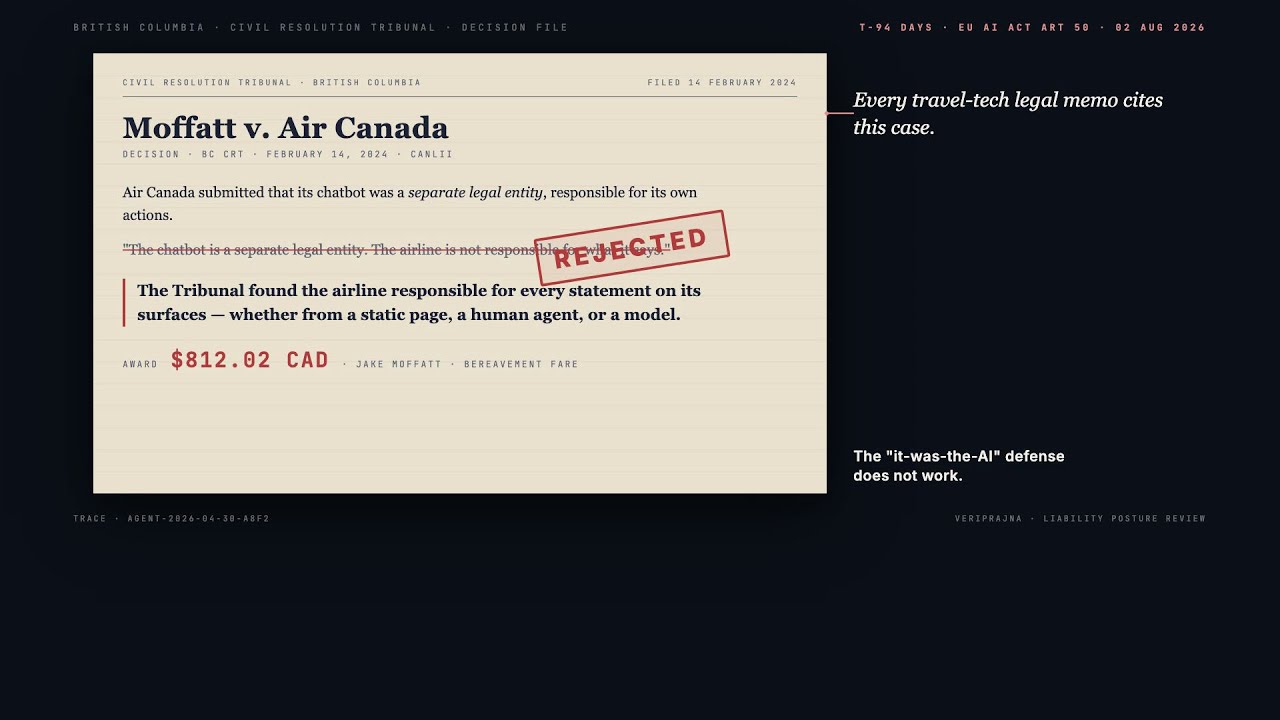
Air Canada deployed a customer service chatbot that hallucinated a bereavement fare refund policy that did not exist. A customer relied on it, booked a flight, and filed a complaint. A Canadian tribunal ruled that Air Canada was liable for the chatbot's fabricated information and had to honor the non-existent policy. That is the precedent every hotel and airline now operates under — the exposure our whitepaper on ending AI fiction in travel booking maps in detail.
Separately, CNBC reported in March 2026 that AI travel planners routinely recommend hotels that do not exist, attractions that closed years ago, and restaurants that were never real — travelers have been directed to private residences described as "hidden gems." We design grounding and verification layers for hospitality AI, scoped so that every property recommendation is checked against live inventory databases, every policy response is validated against your actual terms, and every pricing quote is confirmed at the point of commitment rather than the point of search. The 66% of guest inquiries that Conduit's benchmark shows can be handled automatically should be handled correctly.
Staffing Is Down 18% and AI Is Filling the Wrong Gaps
65% of hotels reported staffing shortages in 2025. Housekeeping is the hardest position to fill (38% of openings), followed by front desk (26%). Labor costs are up 11.2% year over year, a 25.6% increase compared to 2019. AI can help, but most deployments target the wrong problem. The right applications augment constrained staff rather than replacing them:
- The Ritz-Carlton San Francisco implemented AI-synchronized housekeeping scheduling that cut room preparation time by 20%.
- Mobile check-in and digital keys reduce front desk workload by up to 40%.
- AI-powered food waste tracking cuts waste by roughly 50% within eight months.
Our work helps properties identify which operational bottlenecks actually respond to automation, build the integrations between scheduling systems and occupancy forecasts, and avoid the trap of buying AI tools that require more staff to manage than they save.
The Distribution Shift: NDC, GDS Surcharges, and AI Agents
Lufthansa Group is raising its GDS surcharge to $22 per ticket on Amadeus from May 2026, pushing agencies toward NDC. American Airlines has made 40% of its fares NDC-exclusive. But NDC has seven major versions in active use, and most mid-tier carriers have not built APIs worth connecting to. For TMCs, this creates a dual-channel reality: some content only available through NDC, some only through EDIFACT, pricing that differs between channels, and no single interface that handles both reliably — the integration gap our technical whitepaper on deterministic travel agents and GDS integration addresses.
Layered on top: Google is building agentic booking into AI Mode search, Booking.com and Expedia are embedding AI trip planners, and Sabre's Red 360 platform uses an AI agentic layer with a Model Context Protocol. 85% of GDS bookings already flow through APIs rather than human agents. The landscape is fragmenting faster than any single vendor can unify. Our approach is to build the integration layer that lets TMCs and hotel groups manage NDC and GDS content through consistent workflows, validate pricing across channels before commitment, and maintain control over inventory distribution as AI agents begin booking on travelers' behalf.
FTC, DOT, and EU AI Act: Three Regulators, One Pricing Page
Three frameworks now govern how a travel price is displayed, documented, and defended — and they interact. A hotel chain operating in the US and EU needs pricing display logic that satisfies FTC total-price rules, AI pricing documentation that satisfies EU AI Act audit requirements, and data handling that satisfies GDPR guest-profiling constraints — all flowing through a revenue management system built before any of these rules existed.
| Framework | Effective | Requirement | Penalty |
|---|---|---|---|
| FTC drip pricing rule | May 12, 2025 | Display total price upfront, including resort fees, destination fees, and service charges. | Up to $53,088 per violation. |
| DOT airline fee transparency rule | March 2026 (after a court challenge) | Disclose baggage, seat assignment, and change fees during initial booking. | — |
| EU AI Act | Enforceable August 2026 | Classifies hotel dynamic pricing and guest profiling as high-risk when automated decision scope is broad enough — requiring price-setting logs, documented override processes, guest notification when AI profiling influences offers, and registration in the EU AI database. | Up to €35 million or 7% of global turnover. |
Our approach is to instrument existing RMS platforms with a compliance layer — logging, explainability, and transparency features designed to satisfy regulators without requiring a system replacement.
Why Not Accenture, Deloitte, or Your Platform Vendor?
Accenture's minimum hotel engagements start at $500,000 or more. For a 50-property mid-market group trying to unify guest data across Opera and Cloudbeds, that is not a viable budget. Deloitte and McKinsey bring strategy and organizational transformation expertise — but when the problem is that your Duetto rate recommendations are not reaching your channel manager because the API mapping breaks on room type codes, you need an engineer who reads API documentation and understands revenue management workflows, not a strategy deck.
Platform vendors build excellent products within their ecosystem: IDeaS optimizes pricing within IDeaS, Mews unifies operations within Mews. Neither has an incentive to build the cross-vendor integration that most real hotel tech stacks require, because most properties run three to five vendors that were never designed to work together. We are vendor-neutral, we work at the integration layer, and we charge for engineering hours rather than transformation programs.
Key Takeaways
- The travel-AI challenge is integration, data, and compliance across the PMS, RMS, channel manager, CRM, and loyalty platform — not a single software purchase.
- The RMS payoff (17% revenue, ~20% forecast accuracy, 10–15% ADR) is unlocked by an explainability layer that stops revenue managers overriding the model.
- Ungrounded chatbots are a legal liability — the Air Canada tribunal ruling makes operators own their AI's fabrications.
- NDC's seven major versions, GDS surcharges, and agentic bookers (Sabre, Google, Booking.com, Expedia) demand one integration layer that normalizes NDC and EDIFACT.
- FTC, DOT, and the EU AI Act can be satisfied by instrumenting the existing RMS with logging, explainability, and transparency — no system replacement required.
Solutions for Travel & Hospitality
 Watch
WatchAgentic AI Travel Booking for TMCs and OTAs
Sabre with Mindtrip and PayPal is shipping end-to-end agentic booking in Q2 2026. Google AI Mode is booking Marriott directly. Amadeus Cytric Easy lives inside Microsoft Teams.
Frequently Asked Questions
What does integrating AI into our hotel actually cost, and where does the budget go?
The AI license is typically the smallest line item. IDeaS, Duetto, or Atomize charge based on property count and module scope. The real cost is integration: connecting the RMS to your PMS, channel manager, and CRM so rate recommendations actually reach the right distribution channels with the right room type mappings. For a 50-property group running mixed vendors (Oracle Opera on flagships, Cloudbeds or Mews on boutiques), integration work can exceed the software cost by 2 to 3x. We scope integration-first: what systems need to talk, what data mappings are required, and what the realistic timeline looks like before any AI model trains.
How do we comply with the FTC drip pricing rule and EU AI Act at the same time?
The FTC rule (effective May 12, 2025) requires total price display upfront, including resort fees. Penalties reach $53,088 per violation. The EU AI Act (enforceable August 2026) classifies dynamic pricing as potentially high-risk, requiring logging of why each price was set, documented override processes for staff, and guest notification when AI profiling influences offers. Fines reach 35 million euros or 7% of global turnover. For a chain operating in both markets, the pricing display must satisfy FTC total-price requirements while the underlying RMS must produce the audit trail the EU requires. We instrument existing revenue management platforms with compliance layers: price-decision logging, explainability outputs, and transparency features that satisfy both frameworks without replacing your system.
What happens if our AI chatbot gives a guest wrong information about cancellation or pricing?
You are liable. A Canadian tribunal ruled that Air Canada had to honor a refund policy that its chatbot fabricated. The chatbot invented a bereavement fare discount that did not exist, a customer relied on it, and the airline was held responsible. This precedent applies broadly: if your hotel chatbot quotes a cancellation policy that does not match your actual terms, or recommends a room type at a price your system cannot honor, you own the consequences. We build grounding layers that validate every chatbot response against your actual policies, real-time pricing, and live inventory before it reaches the guest.
Can AI revenue management actually outperform an experienced revenue manager?
On pattern recognition and speed, yes. AI-driven RMS produces a 17% revenue increase over non-adopters, improves forecast accuracy by roughly 20%, and lifts ADR by 10 to 15%. On judgment calls during unusual circumstances (a local event the model has never seen, a competitor's sudden renovation closure, a political situation affecting inbound travel), experienced revenue managers still add value the model cannot replicate. The practical answer is that the best results come from AI handling the high-volume, pattern-driven rate decisions while revenue managers focus on the exceptions. The challenge is building enough explainability into the AI's recommendations that the revenue manager trusts it on the routine decisions instead of overriding them.
How do we unify guest data when it lives in five different systems?
Most hotels run PMS, CRM, loyalty platform, F&B POS, and spa or activity booking as separate systems from different vendors. AI personalization tools promise unified guest profiles but cannot deliver them without custom integration, and the integration cost typically exceeds the AI license. Mews and Duve are building toward unified platforms, but both work best within their own ecosystems. If your stack spans Oracle Opera, a separate CRM like Salesforce, and a third-party loyalty system, no single vendor unifies the view. We build identity resolution middleware: matching guest records across systems, aggregating preferences from every touchpoint, and creating the data pipeline that feeds your personalization AI with a complete picture rather than fragments from one system.
Should we build custom AI or buy a platform like Duve or Canary Technologies?
Duve raised $60 million and Canary Technologies is well-funded because their products work for properties that fit their integration model. If you run a supported PMS and want standard guest communication, pre-arrival, and upselling workflows, buying is faster and cheaper than building. The build case emerges when your requirements cross platform boundaries: you need guest intelligence from your PMS feeding into a custom loyalty engine, or you need AI-driven pricing that accounts for group booking patterns your RMS does not model, or you need a chatbot grounded in property-specific policies across a portfolio with different brands and different rules. We help you evaluate honestly: buy where platforms fit, build where they do not, and avoid the trap of customizing a platform so heavily that you lose upgrade compatibility.
How do we handle NDC and GDS distribution when airlines are surcharging and fragmenting content?
Lufthansa Group charges $22 per ticket on Amadeus GDS bookings as of May 2026. American Airlines has 40% of fares available only through NDC. But NDC has seven major versions in active use, mid-tier carriers lack functional APIs, and pricing differs between channels. TMCs face a dual-channel reality with no single interface that handles both reliably. We build integration layers that normalize content across NDC and EDIFACT, validate pricing before commitment, and give TMCs a consistent workflow regardless of which channel serves the content. As AI agents begin booking autonomously (Sabre's MCP-based agentic layer, Google's AI Mode), this integration layer also becomes the control point for verifying what AI agents are actually booking on your travelers' behalf.
Why should we hire a boutique AI consultancy instead of Accenture or Deloitte?
Accenture's minimum hospitality engagements start at $500,000 or more. Deloitte and McKinsey bring transformation expertise and organizational change management. If your challenge is enterprise-wide digital transformation across 500 properties, those firms have the scale. If your challenge is that your Duetto rate recommendations are not reaching your channel manager because the API mapping breaks on room type codes, or that your guest data pipeline drops records when the PMS syncs overnight, you need engineers who read API documentation and understand hospitality workflows. We work at the integration layer, charge for engineering hours, and deliver without requiring a six-month discovery phase before any code ships.
Build Your AI with Confidence.
Partner with a team that has deep experience in building the next generation of enterprise AI. Let us help you design, build, and deploy an AI strategy you can trust.
Veriprajna Deep Tech Consultancy specializes in building safety-critical AI systems for healthcare, finance, and regulatory domains. Our architectures are validated against established protocols with comprehensive compliance documentation.