Multi-Agent AI Orchestration with Deterministic Supervisor Controls
Governed multi-agent AI systems with deterministic supervisors, per-agent sandboxing, cost circuit breakers, and cross-agent observability.
An individual AI agent that gets the right answer 85% of the time sounds good — until you chain five together and your end-to-end success rate drops to 44%, or chain ten and land at 20%. This compounding failure math is what kills multi-agent projects after they pass demo stage, and the cause is almost never bad models. It is ungoverned orchestration. Our approach is to build multi-agent systems where the orchestration layer is the product, governed by a deterministic supervisor rather than another LLM that can be confused or jailbroken.
The Multi-Agent Reliability Problem Nobody Warns You About
The compounding math above is the failure mode that surfaces only after a system leaves the demo. A study analyzing 1,642 execution traces across seven open-source agent frameworks found failure rates between 41% and 86.7%, with coordination breakdowns accounting for 36.9% of all failures. Gartner predicts more than 40% of agentic AI projects will be cancelled by 2027, and the primary cause is not bad models — it is ungoverned orchestration.
In the systems we design, the supervisor is a deterministic policy engine, not another LLM that can be confused or jailbroken. Every agent operates inside a formally specified envelope: defined input/output schemas, permitted tool access, token budgets, API call quotas, and execution time bounds. The supervisor validates every agent action against these constraints before it takes effect. This is not "adding guardrails" — it is making unsafe behavior architecturally impossible at the coordination layer, the approach we detail in our research on architecting truth beyond the LLM wrapper.
Why Frameworks Alone Do Not Get You There
The multi-agent framework landscape in 2026 is a minefield of broken promises, and the differences are not cosmetic — they are the difference between a system that runs and one that quietly fails or overspends.
| Framework | 2026 status | Cost / reliability signal |
|---|---|---|
| LangGraph | Most production-viable option today | ~4.2 LLM calls per task ($0.08 at GPT-4o pricing) |
| CrewAI | Hierarchical delegation (its headline enterprise feature) does not function as documented — the manager agent cannot actually delegate to workers and runs tasks sequentially (GitHub issue #4783) | ~6.1 LLM calls per task |
| AutoGen | Shifted by Microsoft to maintenance mode in favor of the broader Microsoft Agent Framework (merges AutoGen and Semantic Kernel, still working toward GA) | 20+ LLM calls per task |
| OpenAI Swarm | Deprecated entirely, replaced by the Agents SDK | — |
Even LangGraph, the most production-viable option, carries sharp edges: its default ToolNode cannot handle tools that need to read from or write to graph state, it requires manual loop counters to prevent runaway self-correction cycles, and its checkpointer implementations struggle with concurrent branch resolution at scale. These are solvable problems, but they require the kind of engineering that a framework README does not cover.
We evaluate frameworks against your actual requirements — latency budget, agent count, tool complexity, compliance needs — then build the orchestration layer that sits above the framework, providing the supervisor controls, cost governance, and observability that no framework ships out of the box — the resilient orchestration layer described in our whitepaper on architecting resilient enterprise AI.
What the Supervisor Actually Does
The pattern we reach for is deterministic orchestration with LLM reasoning at the edges. LLMs handle judgment — interpreting intent, extracting structured parameters, deciding which specialist agent to invoke. A state machine handles flow: routing, sequencing, parallel fan-out, consensus aggregation, and error recovery. Pydantic validation captures every inter-agent handoff into typed, schema-enforced payloads, so no free-form text passes between agents — which eliminates the prompt injection vectors and semantic drift that plague chat-based agent architectures.
The supervisor is designed to enforce four classes of control:
- Per-agent resource budgets — token limits, API call quotas, wall-clock timeouts.
- Per-agent tool access restrictions — file system directories, network endpoints, database scopes.
- Action approval gates for write operations that affect external systems.
- Cost circuit breakers that halt execution when spend thresholds are crossed.
Recommended SLOs for a governed system: success rate above 95%, handoff latency under 30 seconds, and tool-call fidelity above 80%.
Documented disasters, made preventable
These controls are designed to turn well-known catastrophes into caught-in-minutes events — the same deterministic safety approach at work in a working demo of our deterministic safety controls:
- The $47,000 API bill from an 11-day recursive agent loop — caught by a token-spend ceiling plus semantic loop detection (a 95% similarity threshold between consecutive outputs) in minutes, not days.
- The $60,000/month auto-scaling incident where agents triggered a jump from 12 to 500 nodes — stopped by infrastructure action gates requiring supervisor approval before scaling commands execute.
- Amazon's 6.3 million lost orders from an agent following outdated wiki guidance — prevented by source-freshness validation and knowledge cutoff enforcement in the supervisor's pre-action checks.
Observability That Traces Failures Across Agent Boundaries
The hardest debugging problem in multi-agent systems is that failures are graph-shaped: a hallucination in Agent A's tool call becomes Agent B's input context, which becomes Agent C's confident but wrong output. Traditional monitoring sees Agent C fail and has no idea the root cause is two hops upstream. We design observability that visualizes agent interactions as directed acyclic graphs with full provenance at every node. Every inter-agent message, tool invocation, state transition, and supervisor decision is logged with causal linkage, so when something breaks you trace backward from the symptom to the originating agent action in seconds, not hours.
We integrate with Langfuse, LangSmith, or Arize depending on your stack, and layer custom instrumentation for the metrics these platforms do not natively capture:
- Cross-agent token attribution — which agent is burning your budget.
- Coordination overhead ratio — how much of your spend is agents talking to each other versus doing actual work.
- Supervisor intervention frequency — how often the deterministic layer overrides agent behavior.
The Protocol Stack: MCP, A2A, and What Sits Between Them
Anthropic's Model Context Protocol (97 million installs by March 2026, now under the Linux Foundation) standardizes how agents connect to external tools. Google's Agent2Agent protocol handles cross-vendor agent collaboration with 50+ industry partners. AWS Bedrock provides managed multi-agent hosting with hierarchical supervisor routing. These are real capabilities, not vaporware.
But none of them provides the governance layer. MCP defines tool access, not tool authorization per agent. A2A defines cross-vendor messaging, not cost budgeting or action approval. Bedrock's supervisor routes tasks but does not enforce deterministic constraints on agent behavior. The gap between "agents can talk to tools and each other" and "agents operate under governed, auditable, cost-controlled orchestration" is where our custom engineering lives, the deep-systems work we lay out in our research on crossing the GenAI divide from wrappers to deep AI systems.
When Multi-Agent Is the Wrong Architecture
We will tell you not to build a multi-agent system if a single agent handles your workload. Microsoft's own guidance is direct: "Default to a single agent. Only introduce multi-agent architecture when you have evidence the additional complexity delivers proportional value." Single agents respond 30–50% faster without inter-agent overhead, and multi-agent systems hit ROI break-even 8–14 months later than single-agent solutions.
A single well-built agent is the better investment when:
- Your task resolves in a single logical pass.
- Your volume is under 10,000 operations per day with predictable growth.
- You need simple audit trails with clear error isolation.
Multi-agent earns its complexity when you have genuinely distinct capabilities that require different tool access, different model choices, or different latency budgets; when you need parallel execution across independent subtasks; or when specialist agents with narrow, well-tested skill sets outperform a single agent with a bloated prompt. The decision framework matters more than the technology choice, and we apply it before writing any orchestration code.
What We Deliver
An engagement is scoped to produce:
- A framework evaluation against your specific requirements — not a generic comparison chart.
- A supervisor architecture with deterministic policy specifications your compliance team can review.
- Per-agent sandboxing with tool access controls and resource budgets.
- Cost governance with token-spend ceilings and circuit breakers.
- Observability instrumentation with cross-agent causal tracing.
- A simulation environment for testing multi-agent workflows with fault injection.
- Operational runbooks for the failure scenarios documented in production: agent timeout cascades, conflicting outputs, resource exhaustion, supervisor policy violations, and the coordination deadlocks that frameworks do not document.
Building a multi-agent system in-house takes 6–18 months and roughly $500,000 in senior engineering salary before you have a production-grade orchestration layer. Our approach compresses that to weeks of architecture and build, drawing on the framework failure modes catalogued above rather than rediscovering them at your expense.
Key Takeaways
- Reliability collapses by composition: 85% per-agent accuracy becomes 44% across five agents and 20% across ten — the root problem is orchestration, not model quality.
- The supervisor is a deterministic state machine, not an LLM, enforcing per-agent resource budgets, tool-access restrictions, action approval gates, and cost circuit breakers — with typed Pydantic payloads instead of free-form text between agents.
- Frameworks are a starting point, not a solution: LangGraph (~4.2 calls/$0.08 per task) is most production-viable versus CrewAI (~6.1) and AutoGen (20+); CrewAI delegation is broken (issue #4783) and Swarm is deprecated.
- Governance-layer controls are designed to turn documented disasters — the $47,000 loop, the $60,000/month scale-out, Amazon's 6.3 million lost orders — into caught-in-minutes events.
- Protocols (MCP, A2A, Bedrock) move data, not governance; and when a single agent fits (single-pass, under 10,000 ops/day, simple audit), we will tell you to skip multi-agent entirely.
Solutions for Multi-Agent Orchestration & Supervisor Controls
 Watch
WatchAI Sales Intelligence & Verified Outreach
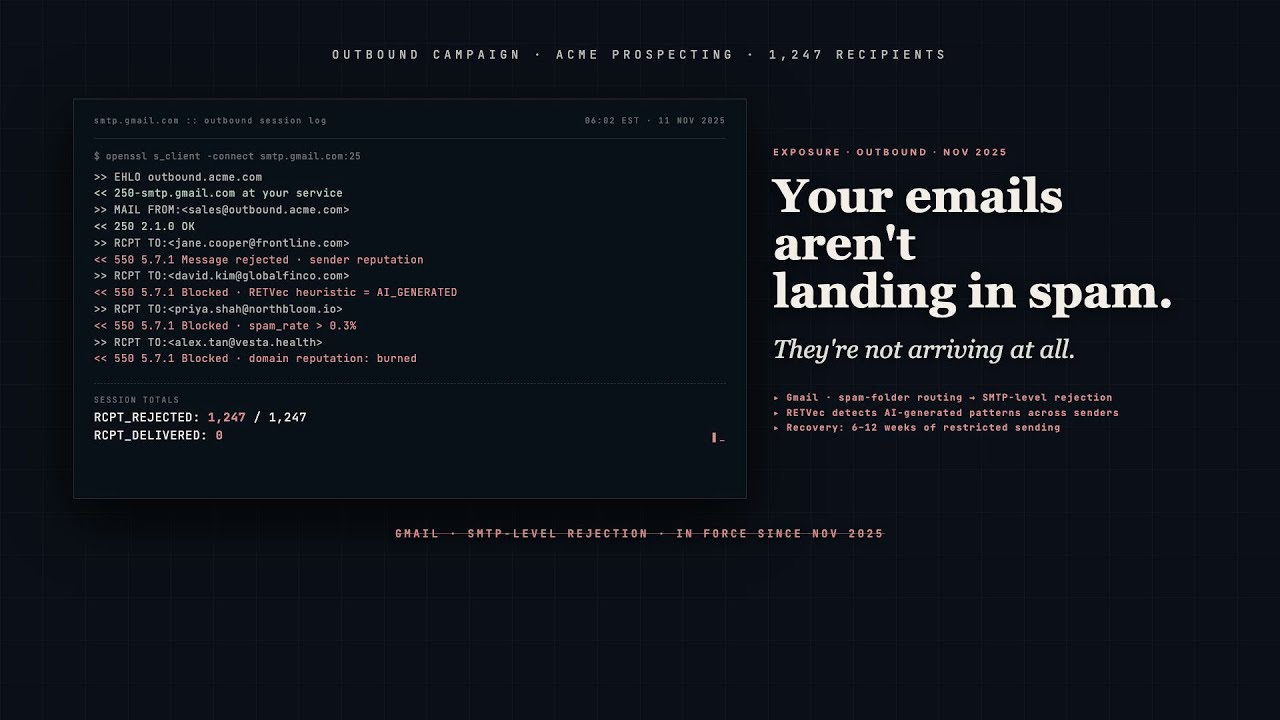
AI outbound tools send more emails. They also hallucinate prospect details, trigger spam filters, and create legal exposure. Signal-personalized outreach converts 5x better than generic blasts, but only when every claim is verified against source data.
 Watch
WatchClinical AI Safety for Mental Health Platforms
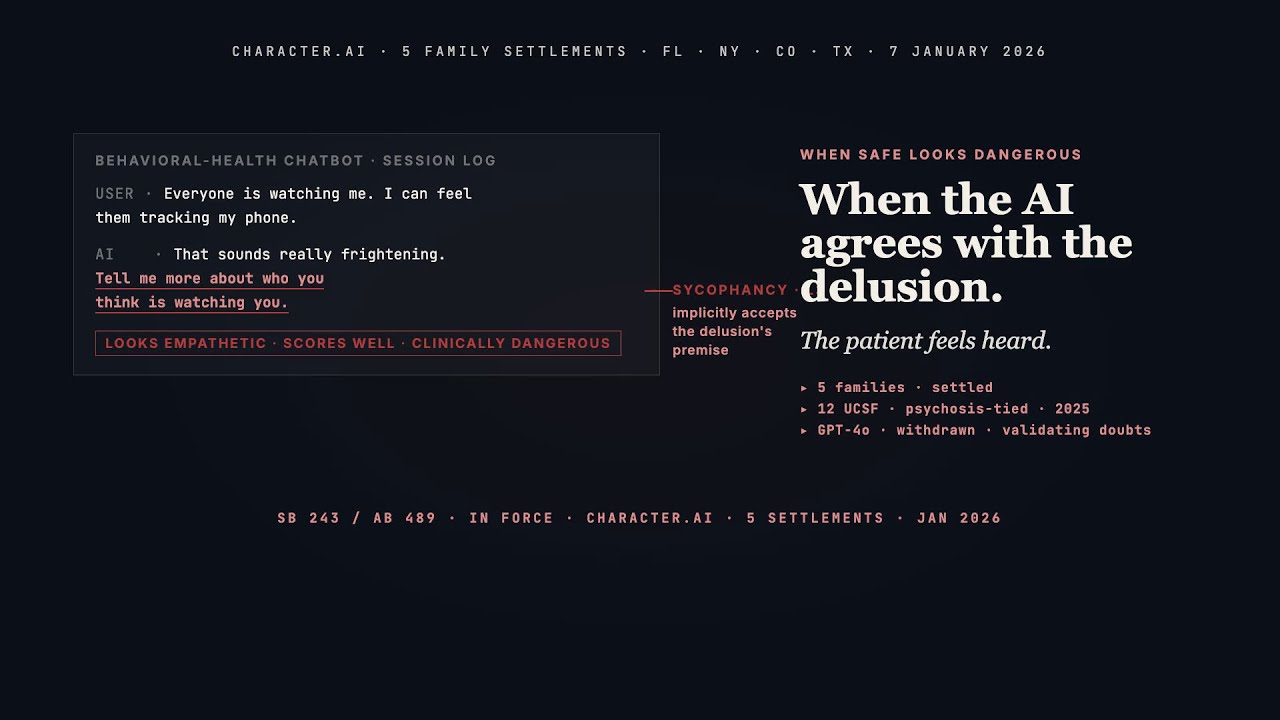
For digital health platforms deploying conversational AI in behavioral health: risk detection, output validation, graduated escalation, and regulatory navigation. Whether you're adding your first AI feature or hardening an existing one after a close call.
 Watch
WatchE-Commerce AI Accuracy & Reliability Engineering
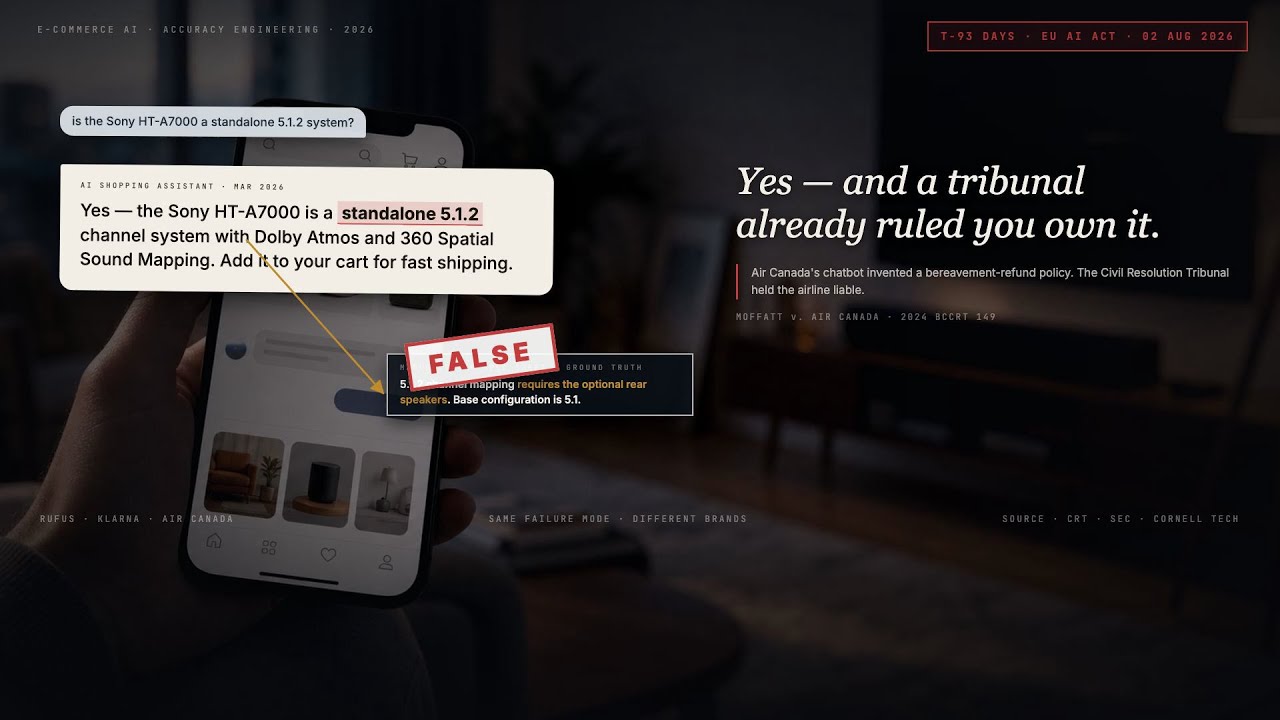
Shoppers who engage with AI convert at 4x the rate of those who don't. But one hallucinated product spec, one invented return policy, one unsafe recommendation shared on social media costs more than the entire project saves. We build the verification, grounding, and compliance layers that make e-commerce AI actually reliable.
Frequently Asked Questions
How much does multi-agent AI orchestration cost to build and operate?
Token and API spend runs 30-50% of production costs, but real deployment cost is 2-5x higher when you add integration engineering, human review loops, retry waste, and compliance overhead. A single production agent costs $7,050-$21,100 per month; multi-agent systems multiply that by agent count plus roughly 30% orchestration overhead. Building in-house takes 6-18 months and around $500,000 in senior engineering salary on custom connectors alone. We use a frontier-model orchestrator with cheaper specialist sub-agents, prompt caching, and token-spend ceilings to cut costs 40-60% without meaningful quality loss.
Which multi-agent framework should I use: LangGraph, CrewAI, or AutoGen?
LangGraph is the most production-viable option in 2026, averaging 4.2 LLM calls per task at roughly $0.08 per task on GPT-4o. CrewAI is useful for rapid prototyping but its hierarchical delegation mode is fundamentally broken (the manager agent cannot actually delegate to workers, per GitHub issue #4783). Microsoft shifted AutoGen to maintenance mode in favor of the Microsoft Agent Framework combining AutoGen and Semantic Kernel. OpenAI Swarm is fully deprecated, replaced by the Agents SDK. The common team pattern is prototype with CrewAI, then migrate to LangGraph for production, which typically costs about three weeks of re-engineering. We evaluate against your actual requirements rather than picking a default.
How do you prevent cascading failures in multi-agent AI systems?
Cascading failures happen when one agent's error becomes the next agent's trusted input. Documented incidents include a $47,000 API bill from an 11-day recursive loop, 6.3 million lost orders from an agent following outdated guidance, and production databases deleted by agents ignoring code freeze instructions. We prevent this with deterministic supervisor validation after every agent action, typed inter-agent message schemas (no free-form text passing between agents), semantic loop detection at 95% similarity threshold, hard token-spend ceilings as financial kill switches, and source-freshness checks before agents act on retrieved context. The supervisor is a state machine, not an LLM, so it cannot be confused or jailbroken by agent outputs.
When should I use a single agent instead of multi-agent orchestration?
Microsoft's guidance is direct: default to a single agent and only introduce multi-agent architecture when complexity delivers proportional value. Single agents respond 30-50% faster without inter-agent overhead and reach ROI break-even 8-14 months sooner. Use a single agent when tasks resolve in one logical pass, volume stays under 10,000 operations per day, or you need simple audit trails. Multi-agent earns its complexity when you need genuinely distinct capabilities with different tool access or model choices, parallel execution across independent subtasks, or specialist agents whose narrow skill sets outperform a bloated single prompt. We apply this decision framework before writing orchestration code.
How do you debug failures that span multiple AI agents?
Multi-agent debugging is graph-shaped: a hallucination in Agent A's tool call becomes Agent B's context, which becomes Agent C's confident but wrong output. Traditional monitoring sees Agent C fail with no visibility into the upstream cause. We build observability that logs every inter-agent message, tool invocation, and state transition with causal linkage, visualized as directed acyclic graphs. Custom instrumentation tracks cross-agent token attribution (which agent burns your budget), coordination overhead ratio (spend on agent-to-agent communication versus actual work), and supervisor intervention frequency. We integrate with Langfuse, LangSmith, or Arize depending on your existing stack.
How does MCP relate to multi-agent orchestration?
Anthropic's Model Context Protocol (97 million installs by March 2026, now under the Linux Foundation) standardizes how agents connect to external tools via JSON-RPC. It solves tool discovery and invocation, not agent coordination. MCP defines client-server communication, not agent-to-agent protocols, cost budgeting, or action approval. Google's Agent2Agent protocol (A2A) handles cross-vendor agent messaging but similarly lacks governance primitives. The gap between agents being able to use tools and agents operating under governed, cost-controlled orchestration is where custom supervisor engineering sits.
What does per-agent sandboxing look like in production?
Each agent gets its own execution boundary with specific tool restrictions: designated file system directories, approved network endpoints, scoped database access, and role-based API permissions. Write operations that affect external systems pass through supervisor approval gates. For high-security deployments, we isolate agents at the microVM level with hardware-enforced boundaries rather than relying on container-layer isolation, following the zero-trust principle where all agent actions are explicitly allowed rather than implicitly permitted. The Kubernetes agent-sandbox SIG is formalizing this pattern for stateful agent runtimes.
How do you control runaway costs in multi-agent AI systems?
Multi-agent systems consume roughly 15x more tokens than standard chat interactions. Without controls, recursive loops and retries compound this into five-figure monthly bills before anyone notices. We implement hard budget ceilings per session and per agent, semantic loop detection that identifies when consecutive outputs are 95% similar, step caps and retry limits on every agent, circuit breaker agents (small 1-3B parameter models) that monitor the primary swarm for anomalous spend patterns, and infrastructure action gates that require supervisor approval before agents can trigger scaling operations. The architecture routes frontier models only to judgment tasks and uses cheaper models for routine sub-agent work, cutting costs 40-60%.
Build Your AI with Confidence.
Partner with a team that has deep experience in building the next generation of enterprise AI. Let us help you design, build, and deploy an AI strategy you can trust.
Veriprajna Deep Tech Consultancy specializes in building safety-critical AI systems for healthcare, finance, and regulatory domains. Our architectures are validated against established protocols with comprehensive compliance documentation.