Multi-Sensor Fusion Engineering for Resilient Perception Systems
Custom multi-sensor fusion architectures that combine radar, LiDAR, cameras, RF, and spectral data into resilient perception for autonomous, defense, and industrial systems.
Every sensor modality has failure modes that are not edge cases but predictable consequences of physics: a camera cannot see through fog, a LiDAR returns phantom points in heavy rain, and radar gives you range and velocity but cannot read a stop sign. Our approach is to build multi-sensor fusion architectures — combining radar, LiDAR, cameras, RF, and spectral data — designed to treat sensor disagreement as information rather than noise, and to stay coherent under partial sensor loss, calibration drift, and adversarial manipulation while running on edge hardware with hard latency constraints.
Why Single-Sensor Perception Breaks in the Real World
On March 18, 2026, NHTSA escalated its investigation into Tesla's camera-only Full Self-Driving system to an Engineering Analysis covering 3.2 million vehicles. The core finding: the system's degradation detection failed to alert drivers until immediately before impact in low-visibility conditions. This is the regulatory world catching up to what sensor fusion engineers have known for years.
A camera cannot see through fog. A LiDAR returns phantom points in heavy rain. Radar gives you range and velocity but cannot read a stop sign. Every sensor modality has failure modes that are predictable consequences of physics, not edge cases (detailed in our research on physics-constrained perception). The question is never whether a single sensor will fail — it is when, and whether your system handles that failure gracefully or catastrophically.
Our approach is to build fusion architectures designed to treat sensor disagreement as information, not noise. When a LiDAR reports an obstacle that the radar does not confirm, that conflict is itself a signal about the environment, the sensor's health, or an adversarial condition. The engineering challenge is designing systems that remain coherent under partial sensor loss, calibration drift, and adversarial manipulation while running on edge hardware with hard latency constraints.
The Calibration Problem Nobody Budgets For
Thirty-seven percent of enterprises deploying multi-sensor systems cite calibration complexity as their primary integration pain point. The reason is straightforward: extrinsic parameters between sensors drift with thermal cycling, mechanical vibration, and simple aging. A camera-LiDAR pair calibrated in a lab at 20 degrees Celsius will have measurably different extrinsics after running in direct sunlight at 50 degrees on a vehicle hood. Manual recalibration by a technician with a checkerboard target is not scalable when you have hundreds of deployed units.
We design automated recalibration pipelines to run continuously in the field. These use targetless methods, extracting geometric correspondences from the environment itself — edges, planes, motion parallax — rather than requiring calibration targets. The pipeline is architected to:
- Monitor per-sensor health metrics and detect drift before it degrades fusion quality.
- Trigger recalibration without taking the system offline.
- Track calibration state centrally for fleets, so maintenance teams know which units are approaching recalibration thresholds before they fail a perception quality check.
Fusion Strategy Is an Engineering Decision, Not a Default
The choice between early, mid-level, and late fusion is driven by the specific sensor configuration, the compute budget, and the system's tolerance for individual sensor degradation. There is no universally correct answer.
| Fusion strategy | What it integrates | Strength | Trade-off |
|---|---|---|---|
| Early | Raw data concatenation | Gives the learning algorithm the richest representation | Requires precise temporal and spatial alignment across all modalities; compute-intensive and brittle when a sensor drops out |
| Mid-level | Feature-space integration (attention mechanisms or graph neural networks) | Sits between the extremes; where most production systems land today | Balances robustness and cross-modal detail |
| Late | Decision-level aggregation of independent per-modality predictions | More robust to individual sensor failure | Discards cross-modal correlations that only exist in the raw data |
Foundation models and vision-language models are beginning to change this calculus. CVPR 2026's DriveX workshop is dedicated entirely to foundation models for autonomous perception, and diffusion-based generative fusion and Mamba-style recurrent architectures are emerging as alternatives to traditional feature concatenation. These approaches enable zero-shot recognition that handcrafted pipelines cannot match, but they carry higher compute costs and are not yet proven in safety-critical production.
Combining decisions: Bayesian vs. Dempster-Shafer
For decision-level aggregation, the choice between Bayesian combination and Dempster-Shafer evidence theory matters in practice. Classical Dempster-Shafer has a well-documented pathology — Zadeh's paradox: when two sensors strongly disagree, the combination rule can produce catastrophic confidence collapse, assigning near-total belief to an irrelevant hypothesis. Most production stacks use modified Dempster-Shafer with conflict redistribution or switch to Bayesian networks entirely. Our method is to analyze the expected sensor agreement profile for each deployment and select the combination method that handles the realistic disagreement patterns without pathological behavior.
Adversarial Resilience Is Not Optional
GPS spoofing attacks against autonomous vehicles succeed at rates between 59% and 82% in tested scenarios, manipulating the vehicle's localization by injecting false satellite signals. LiDAR spoofing uses an adversarial device within line of sight to capture, alter, and re-emit LiDAR pulses, creating phantom objects or hiding real ones in the 3D point cloud. Electromagnetic interference can blind radar. These are not theoretical risks — they are demonstrated attacks with published success rates, and the defense research community considers them operational threats in contested environments.
We design fusion architectures with explicit adversarial resilience layers, informed by our research on engineering AI robustness against adversarial attacks:
- Cross-modal physics validation checks whether what one sensor reports is consistent with the others. If GPS says you are moving north at 60 km/h but IMU and visual odometry indicate you are stationary, the system flags GPS as compromised rather than averaging the contradiction.
- Sensor health monitoring uses anomaly detection to identify spoofing signatures before corrupted data enters the pipeline.
- For defense contexts, an engagement is scoped to test under systematic adversarial scenarios — including simultaneous multi-sensor attacks — producing formal analysis of degradation behavior.
Signal Intelligence: From Raw RF to Actionable Classification
The signal intelligence side of this capability covers the processing chain from raw sensor streams to actionable classification. For RF signals, this means automatic modulation classification using deep learning on software-defined radio platforms, turning unstructured spectrum captures into identified emitter types with location estimates. The US Army's 2025 SBIR program specifically calls for AI/ML-based RF modulation recognition because tactical sensors must scan large spectrum swaths and characterize emissions at machine speed.
For non-RF signals, the same processing discipline applies. Vibration signatures from industrial equipment go through spectral decomposition — short-time Fourier transforms, wavelet analysis — and learned representations from temporal convolutional networks or state-space models to detect fault precursors. Acoustic emissions from wind turbine blades are fused with thermal and vibration data to predict structural degradation 18 hours before failure, according to recent production deployments.
Multi-sensor predictive maintenance systems using fused vibration, thermal, and acoustic data achieve false-positive rates below 8%, compared to 35–40% for single-sensor approaches. Every processing step preserves the uncertainty estimate, so downstream decision systems receive calibrated confidence bounds rather than bare predictions.
Domain-Specific Fusion Across Verticals
Sensor fusion is not a generic capability that transfers unchanged across domains. The sensor suite, the fusion strategy, the latency constraints, and the failure consequences differ fundamentally.
Autonomous vehicles and ADAS
The 4D imaging radar market is growing at 13.5% annually, reaching $3.13 billion in 2026, because 4D radar maintains performance in rain and fog where LiDAR degrades significantly. LiDAR–4D radar fusion improves 3D object detection by up to 20% in fog conditions compared to LiDAR alone. Waymo's 6th-generation system reduced its sensor count by 42% while cutting per-unit cost from roughly $100,000 to under $20,000, proving that better fusion algorithms can substitute for sensor redundancy when the engineering is sound.
Defense and ISR
The counter-UAS market is projected to reach $19 billion by 2035. RF sensors detect drones at 8–10 km but cannot distinguish a hostile drone from a bird. Camera-based visual confirmation is non-negotiable before engagement, but cameras have limited range. Fusing RF detection with AI-assisted video tracking and radar creates a layered identification chain that no single sensor can provide. The Palantir–Anduril consortium is building exactly this kind of integrated sensor-to-effector pipeline, but their approach creates deep platform dependencies. Organizations needing sovereign or vendor-neutral fusion capability require custom architectures — see our working demo of GPS-denied drone autonomy.
Industrial, agriculture, and sports
- Industrial manufacturing: fused vibration, thermal, and acoustic sensing covers over 80% of equipment failure modes.
- Precision agriculture: multispectral and thermal drone fusion detects crop disease 2–3 weeks pre-symptom at 81–95% accuracy.
- Sports analytics: IMU-plus-camera fusion improves positional accuracy by 42% over single-source tracking (our research on sensor fusion for sports officiating).
When Sensor Fusion Is the Wrong Choice
Not every perception problem needs multiple sensors. A well-calibrated single sensor is better than a poorly integrated multi-sensor stack. If your sensor configuration has redundant rather than complementary coverage, adding modalities introduces complexity, calibration burden, and potential failure amplification without proportionate improvement. If your compute budget cannot support real-time fusion processing, you will get worse performance than a single optimized sensor pipeline. We evaluate perception requirements and sensor physics before recommending fusion, and we will say so when a single sensor is the right answer.
Key Takeaways
- Single-sensor perception fails in predictable, physics-driven ways; regulators — including NHTSA's March 2026 Engineering Analysis of 3.2 million Tesla vehicles — are treating multi-modal perception with graceful degradation as the emerging baseline.
- Calibration, cited by 37% of enterprises as their top integration pain point, is solved with continuous targetless recalibration rather than manual, unscalable checkerboard methods.
- Early, mid-level, and late fusion each trade richness against robustness; the right choice — and the right decision-combination method (avoiding Dempster-Shafer's Zadeh's paradox) — depends on sensor configuration, compute budget, and failure tolerance.
- Adversarial threats like GPS spoofing (59–82% success) and LiDAR spoofing are operational, met with cross-modal physics validation and sensor health monitoring.
- Fusion is domain-specific and sometimes the wrong choice — when coverage is redundant or compute is insufficient, a single well-calibrated sensor wins.
Solutions for Sensor Fusion & Signal Intelligence
 Watch
WatchAI Audio Licensing, Watermarking & Provenance for Media
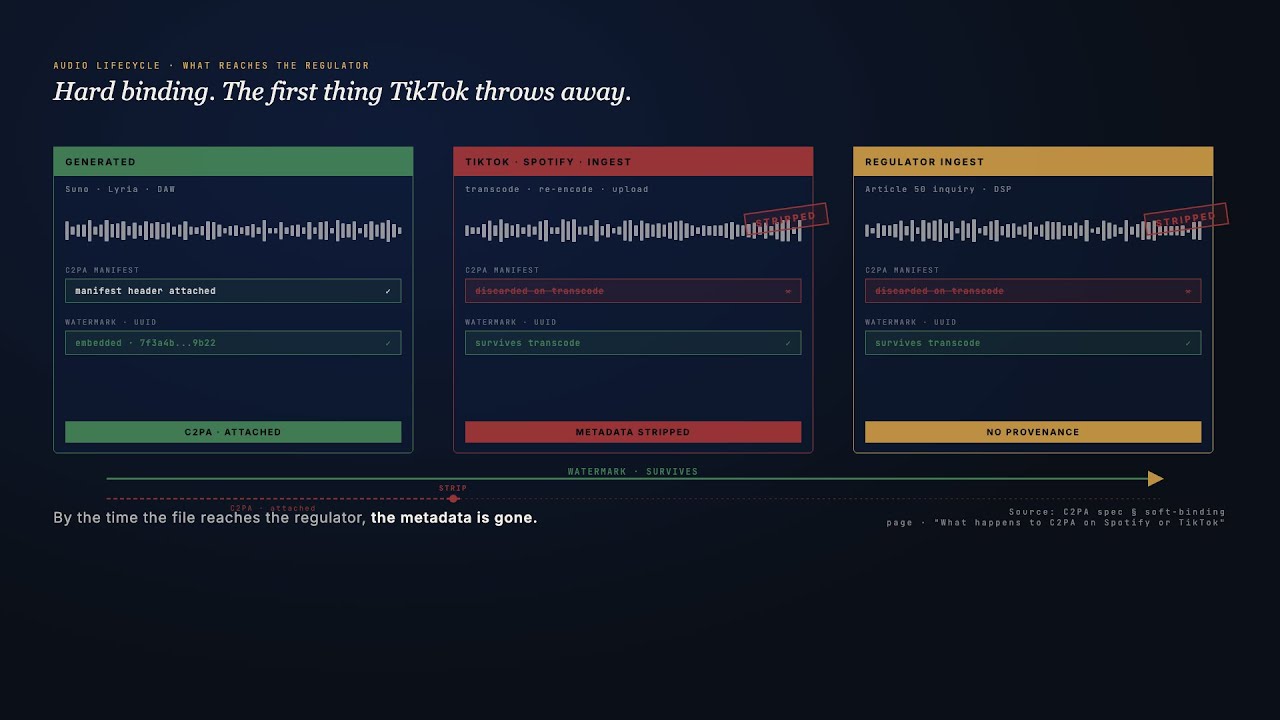
We build end-to-end audio provenance pipelines for labels, DSPs, distributors, and ad agencies. Watermark embedding and detection, C2PA content credentials, DDEX AI disclosure, licensed voice conversion, takedown workflows, indemnification-grade chain of title. The Article 50 clock is 4 months out.
 Watch
WatchData Center Grid Interaction AI
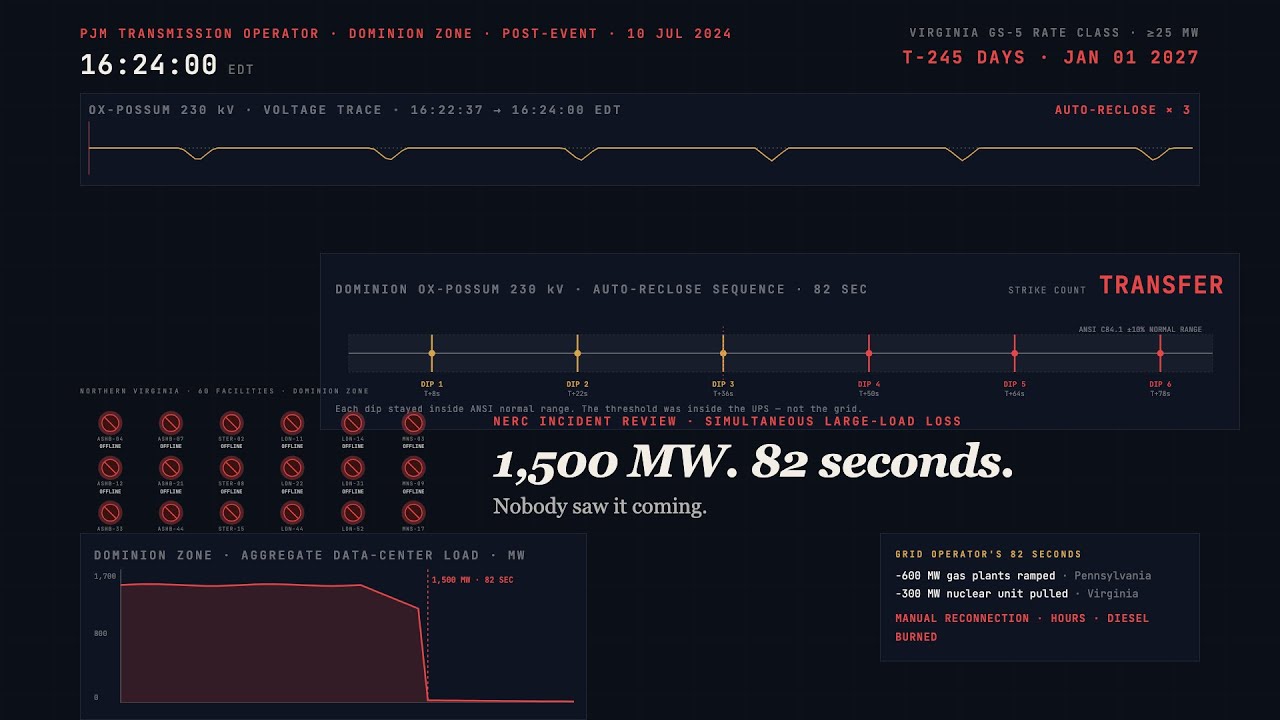
AI-powered grid flexibility orchestration for data centers. Prevent byte blackouts, optimize PJM capacity market costs, and meet NERC large load compliance requirements.
 Watch
WatchEdge AI for Manufacturing Quality Inspection
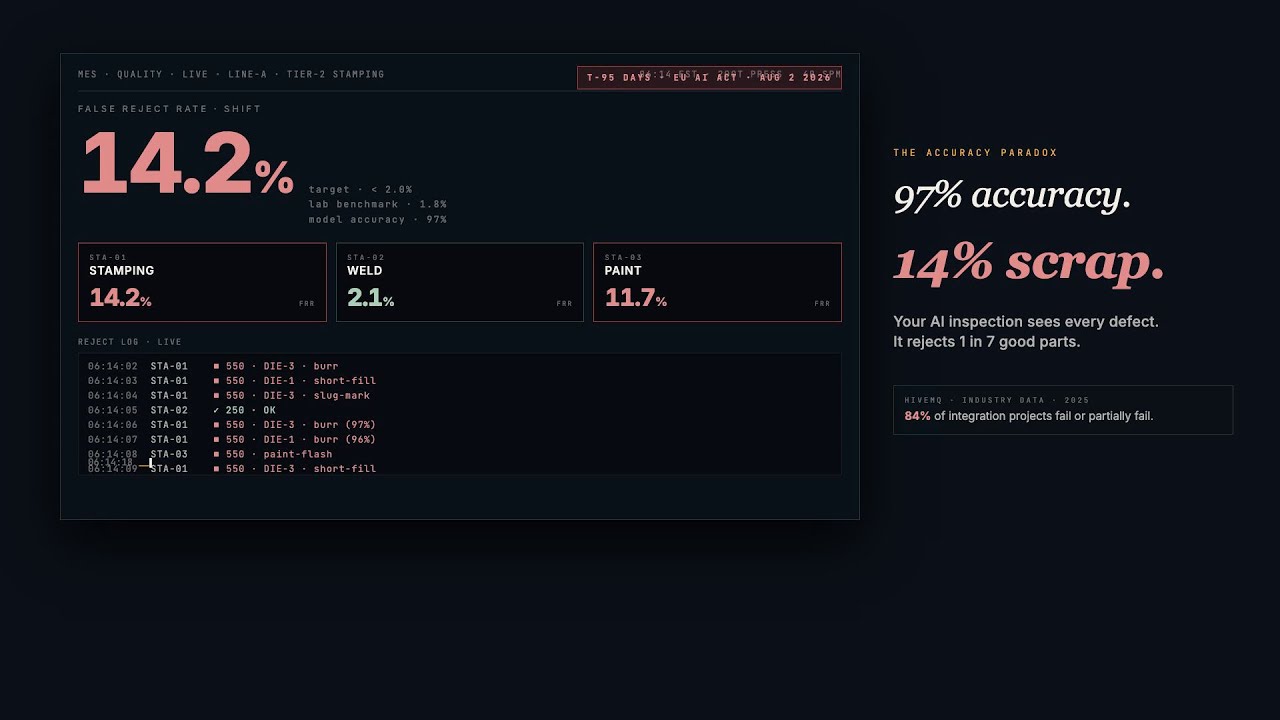
Whether you are evaluating AI-based inspection for the first time, recovering from a cloud pilot that could not meet cycle time, or scaling a working prototype to 15 plants, the problem is the same: getting edge AI into production is an integration and operations challenge, not a hardware purchase.
 Watch
WatchGPS-Denied Drone Autonomy: VIO, Edge AI and Blue UAS Integration
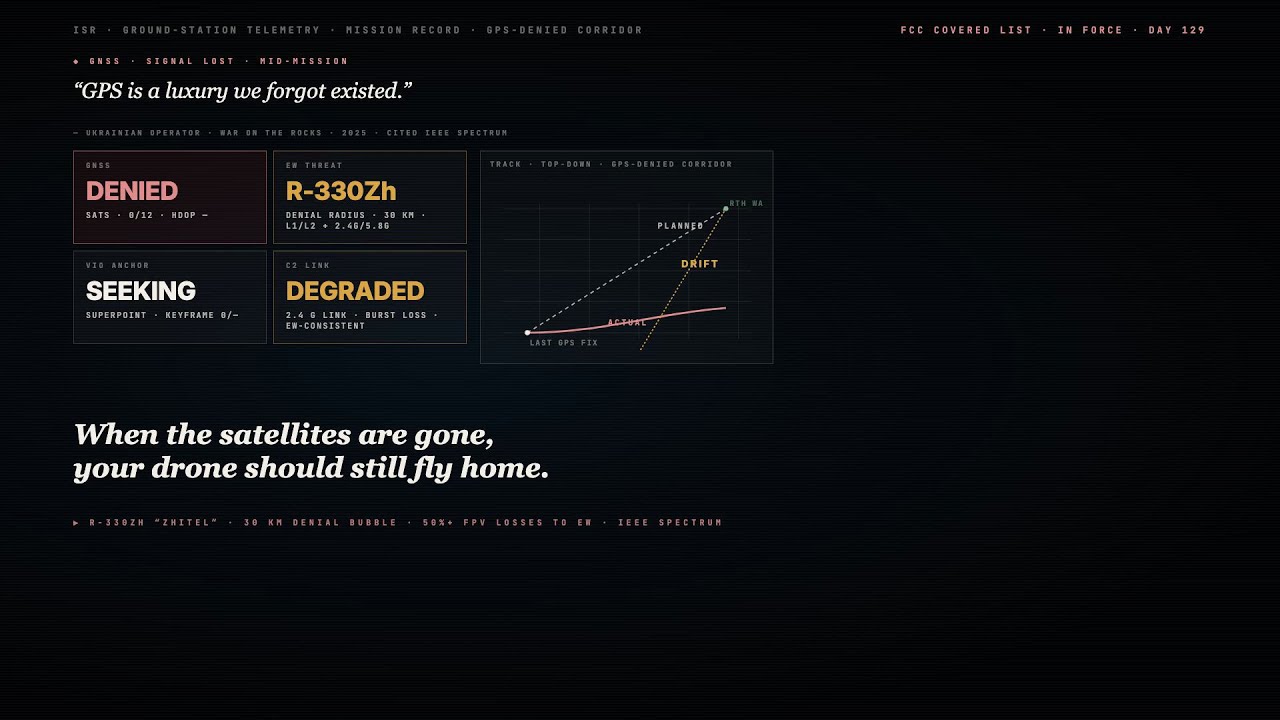
Russian R-330Zh jammers create multi-kilometer GPS blackout zones across Ukrainian front lines. The FCC blocked new authorizations for every foreign-made drone in December 2025. The Army just bought 2,500 Skydio X10D units in 72 hours because nothing else in the cleared inventory could handle a contested electromagnetic environment.
 Watch
WatchPhysics-Constrained Computer Vision
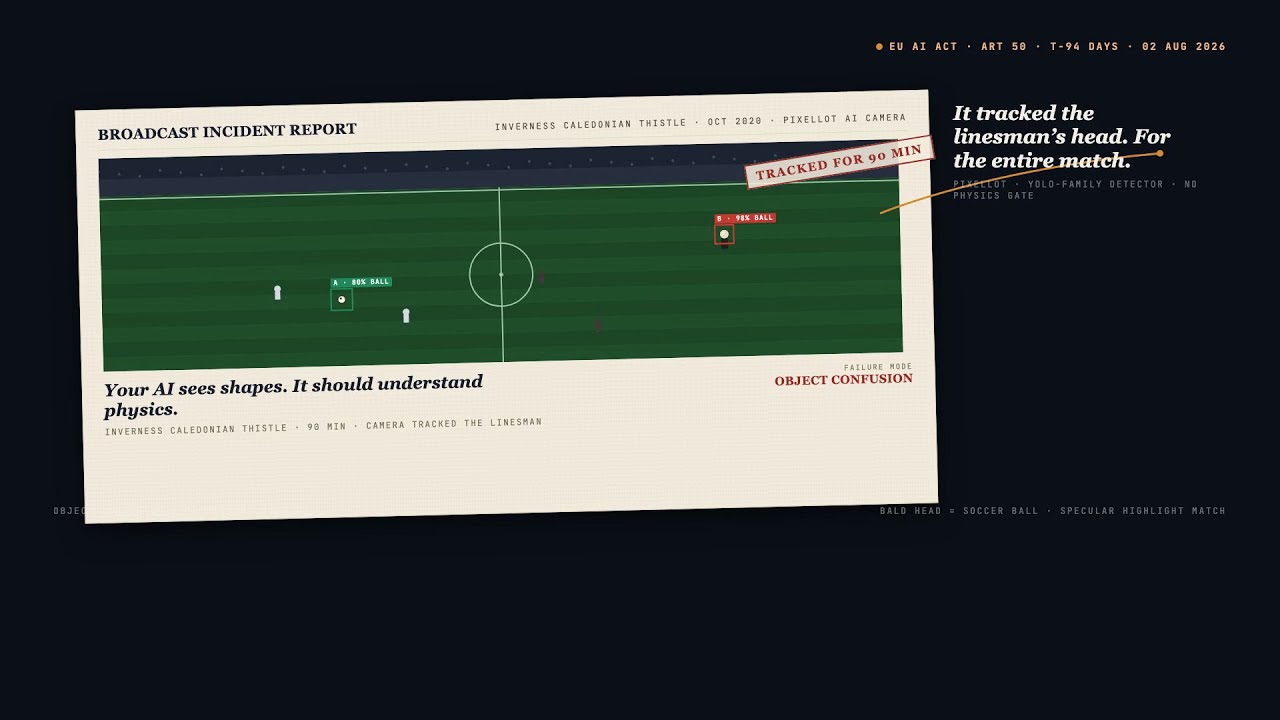
Custom physics-constrained vision systems that eliminate false positives in sports tracking, semiconductor inspection, and manufacturing QA. Kalman filters, optical flow gates, and physics-informed architectures for production CV.
Explore Solution →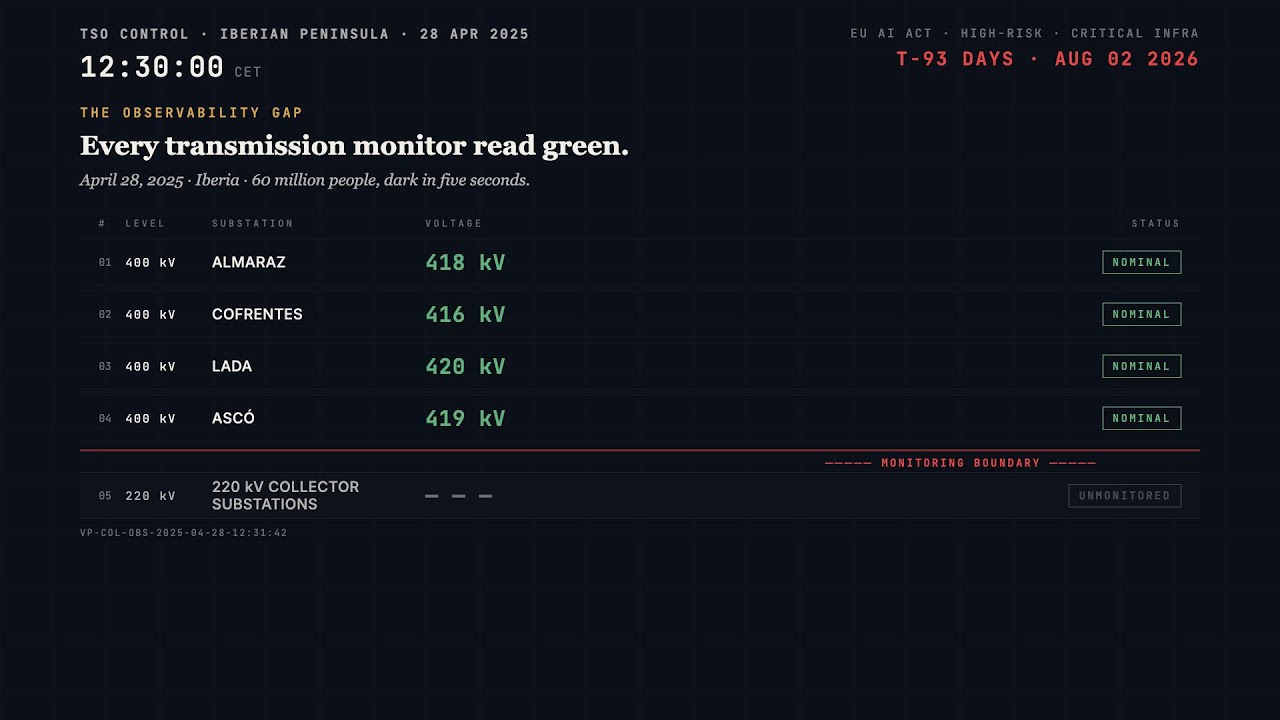 Watch
WatchPower Grid AI & Resilience Engineering
PJM fell 6,625 MW short of its reliability target for the first time in history. ERCOT's interconnection queue hit 233 GW with only 23 GW of new generation online. The Iberian blackout wiped out 15 GW in 5 seconds because no one was watching the right voltage level.
 Watch
WatchSatellite Flood Intelligence for Parametric Insurance
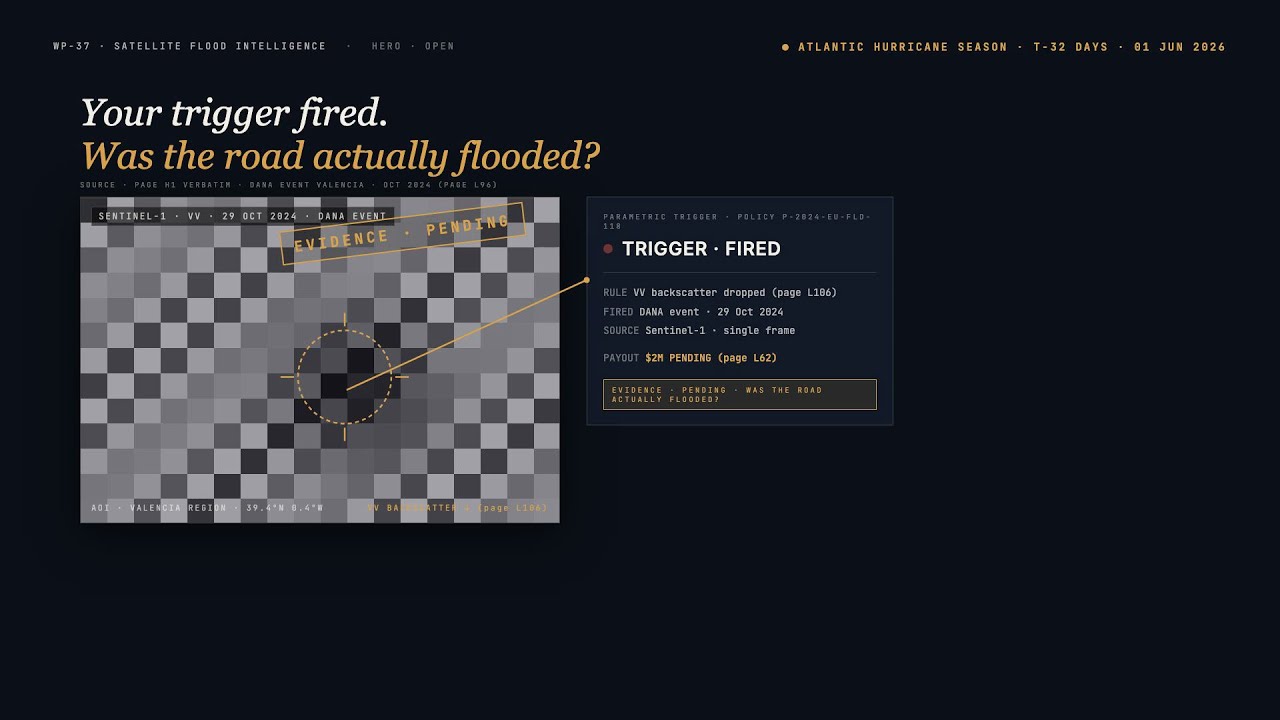
Single-frame satellite detection confuses cloud shadows with floodwater. When a $2M parametric payout depends on that classification, "probably flooded" is not good enough. We build flood verification systems that separate shadows from water using temporal SAR-optical fusion, producing forensic-grade evidence trails for every trigger event.
Frequently Asked Questions
How much does sensor fusion calibration maintenance cost and why does it matter?
Calibration is typically the largest ongoing cost in multi-sensor deployments. Thirty-seven percent of enterprises cite calibration complexity as their primary pain point. Extrinsic parameters between sensors drift with thermal cycling, vibration, and mechanical aging. A camera-LiDAR pair calibrated in a lab will have measurably different extrinsics after running in direct sunlight on a vehicle hood. Manual recalibration requires a technician with dedicated equipment at each unit, which does not scale beyond a few dozen deployments. Automated targetless recalibration pipelines that extract geometric correspondences from the environment (edges, planes, motion parallax) can run continuously without taking systems offline, but building them requires deep understanding of each sensor's noise model and the specific deployment environment.
Can 4D imaging radar replace LiDAR in our perception stack?
4D imaging radar (from Continental, Arbe, and others) is the most significant sensor technology shift in autonomous perception since solid-state LiDAR. The market is growing at 13.5% annually, reaching $3.13 billion in 2026. 4D radar maintains performance in rain and fog where LiDAR point counts degrade significantly, and it provides velocity information that LiDAR does not. However, 4D radar has lower spatial resolution than LiDAR (Arbe Phoenix produces dense but noisy point clouds; Continental ARS548 is sparser but cleaner at long range). Fusing LiDAR with 4D radar improves 3D object detection by up to 20% in fog conditions versus LiDAR alone. For most safety-critical applications, the answer is not replacement but complementary fusion. For cost-constrained deployments in known environments, 4D radar with cameras may be sufficient.
How do we defend sensor fusion systems against GPS spoofing and LiDAR adversarial attacks?
GPS spoofing succeeds at 59-82% rates in tested autonomous vehicle scenarios. LiDAR spoofing uses adversarial devices to inject phantom objects into 3D point clouds. Defense requires cross-modal physics validation: if GPS says you are moving but IMU and visual odometry say you are stationary, the system flags GPS as compromised rather than averaging the contradiction. Statistical anomaly detection identifies spoofing signatures (abnormal signal timing, impossible return patterns) before corrupted data enters the fusion pipeline. For defense and critical infrastructure deployments, we test under systematic adversarial scenarios including simultaneous multi-sensor attacks, providing formal analysis of how the system degrades under each attack combination.
What is the right fusion strategy: early, mid-level, or late fusion?
It depends on your sensor configuration, compute budget, and tolerance for individual sensor failure. Early fusion (raw data concatenation) gives learning algorithms the richest cross-modal representation but requires precise temporal and spatial alignment and is brittle when a sensor drops. Late fusion (decision-level aggregation) is more robust to sensor failure because each modality produces independent predictions, but it discards cross-modal correlations only visible in raw data. Mid-level fusion with attention mechanisms or graph neural networks is where most production systems land. For decision-level combination, classical Dempster-Shafer evidence theory has a documented pathology (Zadeh's paradox) that causes confidence collapse when sensors strongly disagree. Most production stacks use modified Dempster-Shafer with conflict redistribution or Bayesian networks.
How does multi-sensor fusion improve industrial predictive maintenance?
Fusing vibration, thermal, and acoustic sensor data for predictive maintenance reduces false-positive rates to below 8%, compared to 35-40% for single-sensor systems. Vibration excels at detecting mechanical faults (bearings, gears, shafts). Thermal imaging catches electrical faults and insulation failures. Acoustic emissions reveal structural degradation. Together, they cover over 80% of industrial equipment failure modes. Recent production deployments in wind energy show the fused system predicting structural failures 18 hours in advance. The processing chain applies spectral decomposition, wavelet analysis, and temporal convolutional networks to each stream independently, then fuses the extracted features with calibrated uncertainty estimates so maintenance teams receive actionable alerts rather than noise.
What does NHTSA's Tesla investigation mean for camera-only vs multi-sensor perception?
In March 2026, NHTSA escalated its Tesla FSD investigation to an Engineering Analysis covering 3.2 million vehicles. The agency found that Tesla's camera-only degradation detection system failed to alert drivers until immediately before impact in low-visibility conditions. A potential recall could force radar or LiDAR retrofits costing billions. Meanwhile, Waymo's 6th-generation system reduced its sensor count by 42% (from 29 cameras to 13, 5 LiDARs to 4) while cutting per-unit cost from roughly $100,000 to under $20,000, demonstrating that better fusion algorithms can substitute for raw sensor quantity. The regulatory trajectory is clear: multi-modal perception with demonstrated graceful degradation under adverse conditions is becoming the baseline expectation for safety-critical autonomous systems.
How do we build sensor fusion that runs within real-time latency constraints on edge hardware?
The primary constraint on edge sensor fusion is not compute but temporal alignment. Sensors on independent clocks create timing offsets that break perception continuity. Hardware timestamping with PTP, PPS-based camera triggers, and GPS-disciplined clock synchronization are prerequisites before any fusion algorithm runs. NVIDIA's Jetson Orin NX delivers 157 TOPS at 10-25 watts, and the Holoscan Sensor Bridge transfers data via UDP directly to GPU memory, reducing CPU overhead. For FPGA targets, deterministic sub-millisecond fusion latency is achievable with no software scheduling layer. The fusion algorithm itself must be designed for the hardware: pre-allocated memory buffers, pinned CPU affinity, and hardware-accelerated preprocessing to keep the data path off the CPU.
When is sensor fusion overkill and a single sensor sufficient?
Sensor fusion is the wrong choice when your sensors provide redundant rather than complementary coverage, when your compute budget cannot support real-time fusion processing, when calibration burden outweighs perception improvement, or when a single high-quality sensor already meets your accuracy and reliability requirements for the operating environment. A poorly calibrated or faulty sensor in a fusion stack can amplify errors rather than correct them, producing worse results than a single reliable sensor alone. We evaluate the specific perception requirements and sensor physics before recommending fusion. If a single well-calibrated radar meets your detection needs in a controlled indoor environment, adding a camera and LiDAR adds cost, calibration complexity, and failure modes without proportionate benefit.
Build Your AI with Confidence.
Partner with a team that has deep experience in building the next generation of enterprise AI. Let us help you design, build, and deploy an AI strategy you can trust.
Veriprajna Deep Tech Consultancy specializes in building safety-critical AI systems for healthcare, finance, and regulatory domains. Our architectures are validated against established protocols with comprehensive compliance documentation.