Formal Verification: Mathematical Proof That Your AI Is Safe
Mathematical proof that AI systems satisfy safety properties across all inputs, not just test cases, for certification-grade deployment.
Testing samples behavior; safety requires guarantees across every possible input. Formal verification closes that gap with mathematical proof rather than statistical confidence — and for AI systems headed into certified, safety-critical deployment, proof is increasingly the only evidence that holds up.
Why Testing Finds Bugs but Cannot Eliminate Them
Over 60% of first-time semiconductor designs require a silicon respin despite months of simulation-based testing. Each respin at 3nm costs $40M in mask sets alone. The core problem is mathematical: testing samples behavior, but safety requires guarantees across all possible inputs. Formal verification provides those guarantees through mathematical proof, not statistical confidence.
Our approach is to build verification pipelines — such as our working demo of AI-driven semiconductor verification — designed to prove AI system properties hold universally:
- Neural network robustness certification
- Model checking for agent orchestration protocols
- Theorem-prover-backed safety arguments for DO-178C and ISO 26262 certification packages
The verification technique matches the property and the system: complete verifiers where feasible, sound incomplete methods where scale demands it, and always a clear accounting of what was proven versus what was tested.
Neural Network Verification: What Actually Works in 2026
The field has a clear leader. alpha-beta-CROWN has won VNN-COMP (the Verified Neural Network Competition) five consecutive years, 2021 through 2025, ranking first in every scored benchmark. It combines GPU-accelerated linear bound propagation with branch-and-bound search to verify properties like adversarial robustness, monotonicity, and output range bounds on convolutional networks with millions of parameters. For the properties that matter in safety-critical deployment, it is the production-grade starting point:
- Proving that no perturbation within a defined epsilon-ball changes classification
- Proving that increasing a feature can only move the output in the specified direction
- Proving that outputs stay within physically meaningful ranges
Marabou 2.0, the strongest CPU-based verifier, uses SMT-based reasoning and produces UNSAT certificates via Farkas lemma, giving you archivable proof artifacts for certification evidence. It delivers 2x–10x speedups over its predecessor, with median peak memory dropping from 604MB to 59MB.
The honest constraint: neural network verification is NP-complete. The choice between complete and sound-incomplete methods is a fundamental precision-scalability tradeoff, which we navigate per engagement based on the network architecture, the properties you need certified, and how the evidence will be used.
| Approach | What it gives you | Where it struggles | Methods |
|---|---|---|---|
| Complete verifiers | Mathematical certainty | Hit computational walls on large architectures | alpha-beta-CROWN, Marabou 2.0 |
| Sound incomplete methods | Scale further | Produce over-approximations | Randomized smoothing, interval bound propagation, abstract interpretation via DeepPoly |
Neural Abstract Interpretation (ICLR 2025) achieves sub-0.7-second analysis on networks with a million neurons — but the precision-scalability tradeoff remains fundamental.
Proof Automation Is Collapsing the Cost Barrier
The seL4 microkernel took roughly 20 person-years to verify: 9,000 lines of C required 200,000 lines of proof, about 23 lines of proof per line of implementation. That ratio made formal verification economically impossible for most software. The economics changed in 2025–2026.
AI-assisted theorem provers now generate proofs at a fraction of the cost:
- BFS-Prover-V2 achieves 95.08% on the miniF2F benchmark.
- Mistral's Leanstral (released March 2026) is the first open-source AI agent for Lean 4 verification, at 92x lower cost than frontier LLMs.
- Harmonic's Aristotle ($1.45 billion valuation) generates and formally verifies Lean 4 proofs, achieving gold-medal performance on IMO problems.
A 200,000-line formal proof that once required 20 person-years can now be generated in approximately two weeks. This does not eliminate human expertise — specification writing, translating safety requirements into formal logic, remains a task requiring both formal methods training and deep domain knowledge. But proof generation is now automated enough to change the cost calculus for every safety-critical AI deployment. Our method uses AI-assisted provers to generate proof candidates, then verifies and refines them. The Lean-Agent Protocol (April 2026) demonstrated verification checks executing in approximately 5 microseconds, fast enough for inline financial compliance.
Certification Standards Are Moving — Your Strategy Cannot Wait
Three regulatory timelines are converging. The EU AI Act's high-risk provisions take full effect August 2, 2026. SAE G-34/EUROCAE WG-114's ARP6983/ED-324, the machine learning certification standard for aerospace, is targeting June 2026 publication after 1,800 ballot comments. ISO/PAS 8800:2024, the first standard for AI safety in road vehicles, was published December 2024, and Geely Auto received the first global certification under it in August 2025.
Each standard approaches AI verification differently:
- ARP6983 introduces the ML Constituent (MLC) concept and the Operational Design Domain (ODD).
- ISO/PAS 8800 extends ISO 26262 and SOTIF to cover both functional safety and functional insufficiency risks in AI.
- The EU AI Act requires conformity assessment but does not prescribe verification methods, leaving organizations to demonstrate appropriate risk mitigation against standards CEN/CENELEC JTC 21 has not yet finalized.
EASA's AI Concept Paper Issue 2 defines a W-shaped development process for ML certification. The first expected AI approval for Level 2/3A aviation applications is projected for 2035 — organizations building for aerospace certification are starting a decade-long verification journey. We track these standards committees and design verification strategies to be defensible under current drafts and adaptable as standards finalize.
Model Checking for Agent Orchestration
When your AI system involves multiple agents coordinating through shared resources, calling tools, and making sequential decisions, the verification challenge shifts from neural network properties to protocol correctness. TLA+ model checking explores every reachable state in your orchestration protocol, proving properties like guaranteed termination, bounded retries, and delegation limits. Z3 SMT solving complements TLA+ by verifying properties across all possible inputs: permission guards proven mathematically impossible to bypass, routing completeness, and race condition detection.
The principle: your LLM is non-deterministic, but your orchestrator is not. The deterministic layer can be verified exhaustively. Amazon used TLA+ to find critical bugs in DynamoDB, S3, and EBS that testing missed. AgentVerify (April 2026) introduced compositional formal verification of multi-agent safety via LTL model checking. Our approach integrates static proofs for orchestration logic with runtime monitoring for the stochastic components (detailed in our research on deterministic assurance for stochastic models).
Static Proofs Expire — Verification Must Be Continuous
Formal verification assumes the verified system stays the same. AI systems do not. Models retrain. Prompts change. Tool libraries expand. A robustness certificate issued against model version 1.3 says nothing about version 1.4.
We design verification architectures that account for this:
- Static verification proves properties of frozen model snapshots — establishing the baseline.
- Runtime verification monitors for drift, policy violations, and anomalous behavior — detecting when the baseline no longer holds.
- When drift exceeds thresholds, re-verification triggers automatically, closing the loop.
- Verification artifacts are versioned alongside model versions for full auditability.
When Formal Verification Is the Right Investment
You need formal verification when AI failure carries consequences that testing cannot adequately address:
- Loss of life — autonomous vehicles, aviation, medical devices.
- Regulatory non-compliance — EU AI Act high-risk, DO-178C DAL-A/B, ISO 26262 ASIL-C/D.
- Financial exposure exceeding the verification cost — semiconductor respins at $40M+ per iteration, or algorithmic trading where a single constraint violation triggers regulatory action (see our research on engineering absolute compliance for deep AI).
You do not need full formal verification for recommendation engines, content generation, search ranking, or internal analytics. Property-based testing (QuickCheck/Hypothesis-style) often provides sufficient confidence for systems where wrong answers are inconvenient but not actionable. We assess this honestly before recommending an engagement scope.
The talent question matters. Fewer than a thousand people worldwide have production experience in both formal methods and ML systems. Building this capability in-house means recruiting from a talent pool that barely exists; working with specialists who already combine both disciplines compresses the timeline from months of hiring to weeks of building.
What We Deliver
An engagement is scoped to produce verification evidence matched to your regulatory and operational requirements.
- Neural network verification: robustness certificates with complete verifier results (alpha-beta-CROWN, Marabou) for critical subsystems, sound incomplete analysis for larger architectures, and a clear verification coverage report documenting what was proven completely, what was proven with sound over-approximation, and what required empirical testing due to scalability limits.
- Agent orchestration: TLA+ specifications with model-checked safety properties and Z3-verified invariants.
- Certification: formal specifications in the notation required by your target standard (temporal logic, first-order logic, Lean 4, or standard-specific DSLs), mapped to ARP6983, ISO/PAS 8800, ISO 26262, or EU AI Act conformity assessment requirements as applicable.
An engagement also produces the specification itself: your safety properties and domain invariants translated into formal logic. This is often the most valuable artifact. The proof tools will improve. The standards will finalize. Your formal specifications remain, mapping directly to compliance evidence.
Key Takeaways
- Testing samples behavior; formal verification proves properties hold across all inputs — the difference between finding bugs and eliminating them.
- alpha-beta-CROWN (five straight VNN-COMP wins) and Marabou 2.0 (UNSAT certificates via Farkas lemma) lead neural network verification, but the field is NP-complete — we balance complete and sound-incomplete methods per engagement.
- AI-assisted provers (BFS-Prover-V2, Leanstral, Aristotle) have collapsed a 20-person-year seL4-scale proof to roughly two weeks.
- EU AI Act (Aug 2, 2026), ARP6983 (June 2026), and ISO/PAS 8800:2024 are converging — verification strategy must be defensible now and adaptable as standards finalize.
- Static proofs expire when models retrain; continuous verification pairs frozen-snapshot proofs with runtime drift monitoring and automatic re-verification.
Solutions for Formal Verification & Proof Automation
 Watch
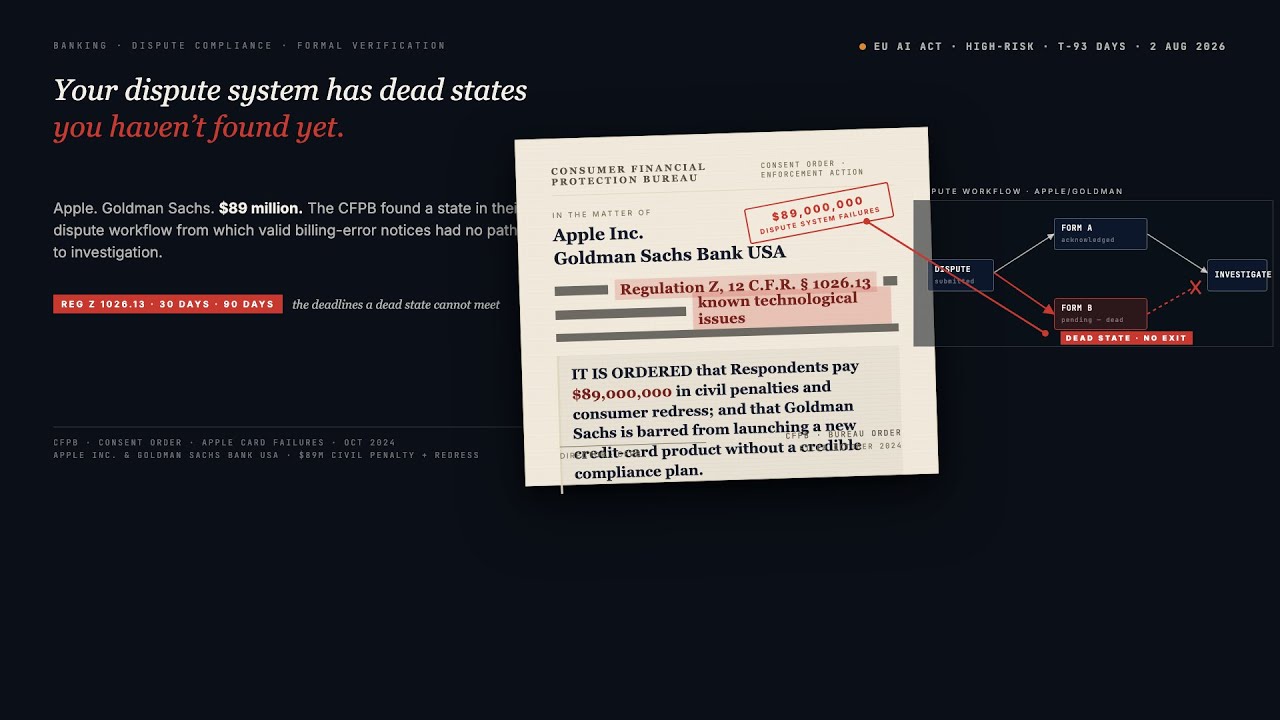
WatchFinancial Compliance Formal Verification for Banks
Apple and Goldman Sachs had thousands of engineers, billions in revenue, and a dispute resolution workflow that silently dropped tens of thousands of valid billing error notices into a technical void. The CFPB found it. They paid $89 million.
 Watch
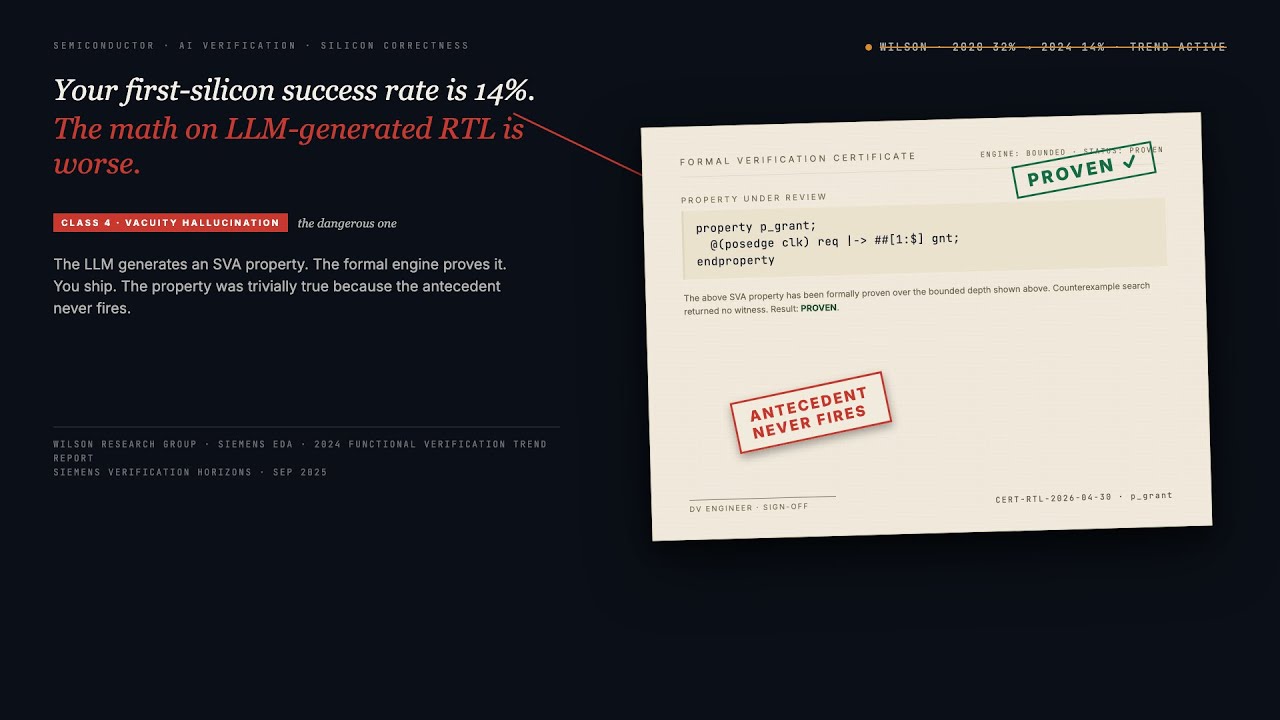
WatchSemiconductor AI Verification & Silicon Correctness
We build custom verification pipelines that wrap fine-tuned open-weight LLMs around your existing formal engine (JasperGold, VC Formal, Questa Formal, or SymbiYosys) and run entirely on your own hardware. No RTL leaves your network. No vendor lock-in.
Related Industries
Frequently Asked Questions
How much does formal verification of an AI system cost and how long does it take?
Cost depends on what you are verifying and to what standard. The historical benchmark is the seL4 microkernel: 9,000 lines of C required 200,000 lines of proof and roughly 20 person-years of effort. AI-assisted proof tools have collapsed that ratio dramatically. A 200,000-line formal proof that once took 20 person-years can now be generated in approximately two weeks using tools like Lean 4 with AI-assisted provers. Neural network robustness certification for a specific model against defined properties is typically weeks of work. A full certification evidence package for DO-178C or ISO 26262 with formal specifications, verification results, and coverage reports is a longer engagement because the specification writing and regulatory mapping require domain expertise. Verification consumes up to 40% of ISO 26262 project budgets. The investment is justified when failure costs exceed verification costs: semiconductor respins, autonomous vehicle liability, or regulatory fines under the EU AI Act.
Can you formally verify a large language model or transformer architecture?
Not completely, and anyone claiming otherwise is misleading you. Neural network verification is NP-complete. Complete verifiers like alpha-beta-CROWN (five consecutive VNN-COMP wins, 2021-2025) and Marabou 2.0 provide mathematical certainty but hit computational walls on architectures beyond tens of millions of parameters. Sound incomplete methods like abstract interpretation (DeepPoly), interval bound propagation, and randomized smoothing scale further but produce over-approximations that may reject safe inputs. For billion-parameter LLMs, complete formal verification of properties like robustness is currently infeasible. What we do instead: verify critical subsystems (safety classifiers, output validators, tool-use decision components) with complete methods, apply sound incomplete analysis to larger components, use model checking (TLA+) to verify the orchestration logic around the LLM, and supplement with runtime verification for properties that cannot be statically proven. The verification coverage report documents exactly which components have mathematical guarantees, which have sound over-approximations, and which rely on empirical evidence.
What is the difference between formal verification and the constraint enforcement in neuro-symbolic architecture?
They solve different problems at different points in the lifecycle. Neuro-symbolic constraint enforcement (Z3 solver-in-the-loop, constrained decoding) operates at runtime, preventing the AI from producing outputs that violate specified constraints during inference. Formal verification operates before or alongside deployment, proving that the AI system satisfies safety properties across all possible inputs within a defined domain. Constraint enforcement says 'this specific output satisfies the rules.' Formal verification says 'no possible input within this domain can produce an output that violates this property.' In practice, safety-critical systems often need both: formal verification to establish baseline guarantees about model behavior, and runtime constraint enforcement as a defense-in-depth layer. We build both and help you decide which properties need which level of assurance.
Which neural network verifier should I use: alpha-beta-CROWN, Marabou, or something else?
alpha-beta-CROWN is the strongest general-purpose option. It has won every VNN-COMP from 2021 through 2025, supports CNNs with millions of parameters, handles ReLU, sigmoid, tanh, and transformer architectures, and runs on GPU for practical verification times. Its GenBaB extension (TACAS 2025) handles general nonlinear functions. Marabou 2.0 is the best CPU-based alternative with SMT-based reasoning and proof certificate production via Farkas lemma, which matters if your certification authority wants archivable proof artifacts. It achieved 2x-10x speedups over v1 with dramatically lower memory usage. For specific use cases: nnenum handles certain ReLU network classes efficiently, PyRAT targets interval arithmetic verification, and Venus uses dependency analysis for scalability. We select and combine verifiers based on your network architecture, the properties you need certified, and whether you need proof artifacts for regulatory submission.
How do I certify an ML model for DO-178C DAL-A or ISO 26262 ASIL-D?
Neither standard was designed for ML, and the supplementary standards are still in development. ARP6983/ED-324, the joint SAE/EUROCAE machine learning certification standard for aerospace, is targeting June 2026 publication after 1,800 ballot comments. It introduces the ML Constituent (MLC) concept and the Operational Design Domain (ODD) framework. EASA's AI Concept Paper Issue 2 (March 2024) defines a W-shaped development process separating offline training/verification from online operational monitoring. The first expected AI approval for EASA Level 2/3A applications is projected for 2035. For automotive, ISO/PAS 8800:2024 was published December 2024, extending ISO 26262 and ISO 21448 SOTIF. Geely Auto received the first global certification in August 2025. In practice, certification teams build verification evidence against current drafts while designing for adaptability. We produce formal specifications mapped to the target standard's structure, verification results using complete and incomplete methods with clear coverage documentation, and a verification management plan that accommodates standard revisions. NASA's DAL-C runway sign classifier used dual redundant dissimilar DNNs with a safety monitor as architectural mitigation, a pattern that combines redundancy with formal verification of the safety monitor.
What role does formal verification play in EU AI Act compliance for high-risk AI?
The EU AI Act (high-risk provisions effective August 2, 2026) requires conformity assessment demonstrating systematic risk identification, analysis, mitigation, and monitoring. It does not explicitly mandate formal verification. However, formal verification produces the strongest compliance evidence because it provides mathematical proof that specific risk mitigations actually work across all inputs, not just tested scenarios. The harmonised technical standards defining 'appropriate risk mitigation' are being developed by CEN/CENELEC JTC 21, targeting Q4 2026 (after missing the original August 2025 deadline). Organizations that invest in formal verification now position themselves with the most defensible compliance posture regardless of how those standards finalize. We build verification architectures that produce conformity assessment evidence: formal specifications of safety properties, verification results with proof artifacts, and coverage reports documenting guarantee strength for each system component.
How does TLA+ model checking apply to AI agent orchestration?
TLA+ verifies the deterministic orchestration layer around your non-deterministic LLM. It exhaustively explores every reachable state in your agent protocol, proving properties like: all delegation paths terminate, retry counts stay bounded, no agent exceeds its authorization scope, failed agents eventually escalate. Amazon used TLA+ to find critical bugs in DynamoDB, S3, and EBS that conventional testing missed. Z3 SMT solving complements TLA+ by verifying properties across all possible inputs: permission guards that are mathematically impossible to bypass, routing completeness across agent types, and race condition detection in concurrent agent execution. AgentVerify (April 2026) introduced compositional formal verification of multi-agent safety using LTL temporal logic. We write the TLA+ specifications for your orchestration protocol, run the model checker, and deliver verified invariants alongside your deployment. When you add a new agent type or modify the delegation logic, the specifications update and re-verify.
When should I use formal verification versus property-based testing for AI systems?
Formal verification proves properties hold for all inputs within a domain. Property-based testing (QuickCheck, Hypothesis) generates thousands of random inputs to search for violations. Use formal verification when: failure carries legal, financial, or safety consequences (autonomous vehicles, medical devices, financial trading constraints); a regulatory standard requires verification evidence (DO-178C, ISO 26262, EU AI Act high-risk); or the cost of a missed edge case exceeds the verification cost (semiconductor respins at $40M+, algorithmic trading violations). Use property-based testing when: wrong answers are inconvenient but not actionable (recommendations, content generation, search ranking); the system is too large for complete verification and you need practical coverage; or you are exploring behavior before investing in formal specification. In practice, we often combine both: formal verification on critical subsystems with the tightest safety requirements, and property-based testing everywhere else, with runtime monitoring as the outer layer.
What happens when my AI model retrains: does the formal verification still hold?
No. A verification certificate applies to the exact model snapshot that was verified. Retrain the model, and the certificate is invalidated. This is the fundamental tension between formal verification (which assumes static systems) and AI systems (which are designed to change). We address this with continuous verification architectures. The static layer proves properties against frozen model snapshots, producing versioned certificates. The runtime layer monitors the deployed system for distribution drift, policy violations, and anomalous behavior. When drift exceeds defined thresholds or a model update deploys, re-verification triggers automatically against the new snapshot. Verification artifacts are versioned alongside model versions, so you can trace which properties were proven for any historical decision. For regulatory contexts, this creates an auditable chain: model version 1.3 was verified at timestamp T with properties P, deployed until timestamp T+1 when model version 1.4 was verified with properties P-prime and deployed.
Build Your AI with Confidence.
Partner with a team that has deep experience in building the next generation of enterprise AI. Let us help you design, build, and deploy an AI strategy you can trust.
Veriprajna Deep Tech Consultancy specializes in building safety-critical AI systems for healthcare, finance, and regulatory domains. Our architectures are validated against established protocols with comprehensive compliance documentation.