Housing AI That Survives Fair Housing Audits, AVM Rules, and Code Review
AI systems for property operators, developers, and lenders that survive Fair Housing Act scrutiny, CFPB AVM audits, and building code review.
Housing AI is under more active enforcement than any other real estate technology category. Our approach is to build the compliance and verification layer that sits between your AI platform and the regulators, tenants, and borrowers who will challenge it.
The Enforcement Wave Has Already Started
The proposed FHA change would shift the enforcement burden from federal regulators to state attorneys general and private litigants, but the pressure is not waiting for it. Fair housing testers, state attorneys general, and plaintiff's attorneys are already using HMDA data and algorithmic audit tools to identify patterns that covered entities have not yet found themselves.
Tenant Screening That Withstands Fair Housing Challenges
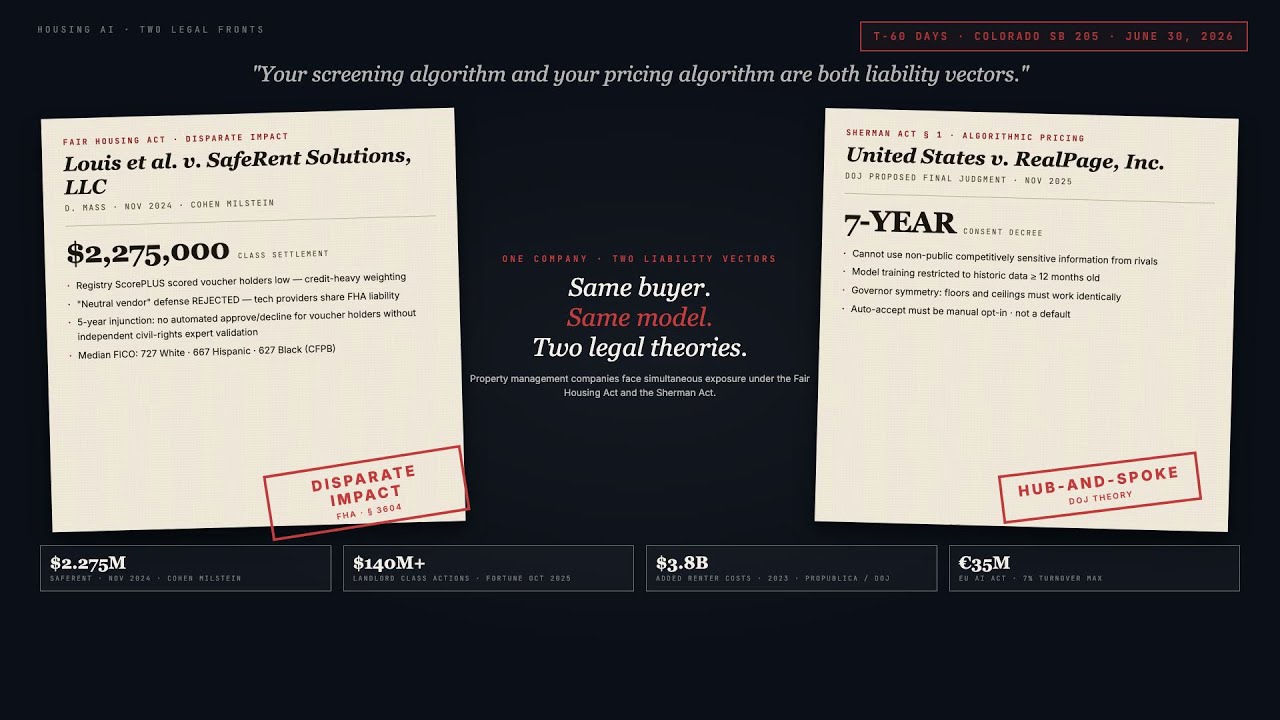
The SafeRent settlement established a concrete precedent: AI-generated screening scores that produce disparate outcomes across protected classes create liability under the Fair Housing Act, regardless of intent (detailed in our technical research on the SafeRent algorithmic-integrity mandate). Source-of-income discrimination adds a state-level patchwork on top. Over 23 states and numerous municipalities now ban voucher discrimination, but Texas, Georgia, and Florida do not.
A national operator running one screening algorithm across all markets is simultaneously subject to federal disparate impact analysis and a fragmented set of source-of-income protections the algorithm was never designed to accommodate. The shift toward agentic AI in leasing — systems that autonomously schedule tours, process applications, and make screening decisions without human prompting — makes the compliance surface larger. An autonomous agent that screens a voucher holder in Oregon differently than one in Texas has to do so deliberately, not because no one thought to program the distinction.
Our approach is to build tenant screening audit harnesses that test for disparate impact across race, national origin, familial status, disability, and source of income. The harness is designed to run continuously, not as a one-time deployment check, and to flag drift before a fair housing tester files a complaint. For operators in jurisdictions with voucher protections, an engagement is scoped to produce constraint layers that ensure voucher income is treated as qualifying income with consistent evaluation criteria — producing explainable decisions with audit trails a HUD investigator can follow from input to outcome.
Automated Valuations That Pass the New AVM Rule
The CFPB's AVM quality control rule requires mortgage originators and secondary market issuers to adopt controls that ensure high confidence in estimates, protect against data manipulation, avoid conflicts of interest, conduct random sample testing, and comply with nondiscrimination laws. The nondiscrimination requirement is where most AVM vendors fall short.
Urban Institute research found the percentage magnitude of AVM error is systematically greater in majority-Black neighborhoods: if properties in those neighborhoods hypothetically moved to majority-white areas with identical attributes, the predicted error would decline from 36.2% to 31.8%. That 4.4-percentage-point gap reflects historical undervaluation baked into the training data, and the AVM rule now requires institutions to find and address it.
Our approach is to build AVM audit and bias-testing frameworks that run nondiscrimination analysis at the census-tract level, identify proxy variables that correlate with protected attributes, and produce the quality control documentation the rule demands. The intended output is not a policy memo. It is a running test harness your compliance team operates against every AVM update, every new data feed, every model retrain.
Algorithmic Pricing After the RealPage Precedent
The RealPage DOJ settlement rewrote the rules for algorithmic rent pricing. Software that uses nonpublic, competitively sensitive data shared among competing landlords to recommend rents is now treated as a price-fixing mechanism. The settlement:
- Prohibits real-time nonpublic data in pricing algorithms.
- Requires that auto-accept features be overridable rather than defaulting toward rent increases.
- Bans market surveys that collect competitive intelligence for pricing.
- Imposes a compliance monitor over operations for three years, with DOJ inspection rights for seven.
For operators that still want data-driven pricing, our approach is to build rent optimization systems that use only compliant data sources: public listings, your own portfolio history, economic indicators, and permitted market data aged beyond the settlement's thresholds. The system is designed to produce a pricing recommendation with a full data provenance trail — so if a regulator or co-defendant in the ongoing landlord cases asks where a number came from, you have a documented answer rather than a black box.
Construction and Design AI with Liability Clarity
AI is entering structural engineering through generative design tools (our whitepaper on constraint-based generative design) and automated plan review, but the liability framework has not kept pace. No AI platform carries professional liability insurance. When an AI-generated structural design fails inspection or contributes to a safety failure, the licensed PE who stamped it bears full legal and ethical responsibility for work they may not fully understand. AIA and ConsensusDocs standard contracts were not drafted with AI-generated designs in mind and do not address who selects the AI tool, who owns generated data, or who assumes liability for AI-driven decisions.
California launched an AI-powered building permit e-check tool in April 2025 to accelerate LA fire recovery, and platforms like CivCheck, CodeComply, and Archistar are automating code compliance checks across jurisdictions. But automated plan review against prescriptive code requirements is different from verifying that an AI-optimized design meets the performance intent of the code. An AI might produce a structural member that passes every line item in ASCE 7 while pushing toward the edge of code-compliant parameter space in ways a building official cannot evaluate without engineering judgment.
Our approach is to build verification systems that sit between AI design tools and the PE stamp. The system is designed to check AI-generated structural calculations against both prescriptive code requirements (IBC, ASCE 7, ACI 318) (our research on physics-informed structural graphs) and performance intent, flag designs that technically comply but approach safety margin boundaries, and produce the documentation trail that supports a PE's professional judgment. For automated plan review, an engagement is scoped to produce jurisdiction-aware compliance engines that handle the inconsistency across 30,000+ U.S. municipal codes, including overlay districts and recent amendments that off-the-shelf tools miss.
Building Operations AI That Delivers Measurable Returns
The economics of AI in building operations are well-documented. HVAC systems represent 30-40% of building operating costs, and the efficiency gains are consistent across vendors:
- Johnson Controls — achieved a 35% HVAC energy reduction across 500+ commercial buildings using AI predictive maintenance.
- Siemens — reported 40% decreases in equipment maintenance costs through predictive analytics.
- Industry-wide — AI predictive maintenance reduces total spending 25-30%, with typical ROI payback in 8-14 months.
The challenge is not whether the technology works. It is whether you build or buy, which sensors feed which models, and how you avoid locking your operational data into a single vendor's ecosystem. Our approach is to design building operations AI architectures that integrate with your existing BMS and sensor infrastructure, keep the data layer portable across platforms, and produce the energy performance documentation that ESG reporting and green certification programs require. For digital twin deployments, an engagement is scoped to produce simulation environments that model HVAC, lighting, and occupancy patterns using your actual building data rather than vendor benchmarks.
Why a Specialized Consultancy, Not a Platform or a Big SI
The gap between "you should test for disparate impact" and "here is a running harness that does it continuously" is where most housing operators get stuck. The existing options each leave part of that gap unfilled:
| Option | What it does | What it does not build |
|---|---|---|
| Proptech platforms (EliseAI, AppFolio, Yardi, RealPage) | Solve operational efficiency | Fair housing audit harnesses, AVM bias testing frameworks, or CFPB-grade adverse action notice generators |
| Big SIs (Deloitte, Accenture) | Sell responsible AI methodology and staff augmentation, designed for organizations with 10,000+ employees and billion-dollar IT budgets — a mid-size REIT gets a seven-platform, eight-month integration plan | Targeted builds that use your existing tools and go live in weeks |
| Legal and compliance firms | Advise on regulation | The technical controls themselves |
| Veriprajna | Vendor-neutral on the platform layer (your AppFolio, your Yardi, your custom stack), opinionated on the compliance and verification layer that sits on top | — |
That gap is what our work targets. Every engagement is scoped to produce the audit artifacts that regulators, fair housing testers, and plaintiff's attorneys will eventually ask for.
Key Takeaways
- Housing AI faces more active enforcement than any other real estate technology category — SafeRent ($2.3M), RealPage, and Fairway ($9.9M) set the precedents.
- The CFPB AVM quality control rule (effective October 1, 2025) now mandates nondiscrimination testing; Urban Institute research documents a 36.2% vs. 31.8% error gap for majority-Black neighborhoods.
- The RealPage settlement bans real-time nonpublic pricing data, requires overridable auto-accept, and installs a three-year monitor with seven-year DOJ inspection rights.
- AI structural design carries no platform liability insurance — verification against IBC, ASCE 7, and ACI 318 must support the PE who stamps it.
- Building operations AI delivers 25-30% total spending cuts with 8-14 month payback, but the data layer must stay portable across vendors.
- Our approach builds the compliance and verification layer on top of your existing platforms, producing the audit artifacts regulators will request.
Solutions for Housing & Real Estate
 Watch
WatchAI for Architecture & Structural Engineering
Generative AI creates stunning architectural concepts in seconds. Then your structural team spends weeks proving they cannot be built. Eighty percent of construction cost deviation comes from design changes, not construction mistakes.
 Watch
WatchHousing AI Compliance: Tenant Screening Fairness and Algorithmic Pricing
Property management companies face simultaneous legal exposure on two fronts: tenant screening that discriminates under the Fair Housing Act, and revenue management that coordinates pricing under the Sherman Act. We audit both, engineer compliant architectures, and map your systems against every jurisdiction that matters.
Related AI Services
Frequently Asked Questions
How do we make sure our AI tenant screening doesn't violate fair housing after the SafeRent settlement?
Recent enforcement made clear that AI screening scores producing disparate outcomes across protected classes create Fair Housing Act liability regardless of intent. We build continuous disparate impact testing harnesses that monitor screening outcomes across race, national origin, familial status, disability, and source of income. The harness flags statistical drift before a fair housing tester files a complaint, and for jurisdictions with voucher protections (23+ states), it enforces constraint layers ensuring voucher income is treated as qualifying income with consistent evaluation criteria and explainable audit trails.
What does the CFPB AVM rule mean for our automated property valuations?
The interagency AVM quality control rule took effect October 1, 2025. It requires mortgage originators and secondary market issuers to adopt controls ensuring high confidence in AVM estimates, anti-manipulation protections, conflict-of-interest avoidance, random sample testing, and nondiscrimination compliance. The nondiscrimination requirement is the hardest: Urban Institute research shows AVM error rates are systematically higher in majority-Black neighborhoods (36.2% vs. 31.8% predicted error). We build AVM audit frameworks that run nondiscrimination analysis at census-tract level, identify proxy variables correlating with protected attributes, and produce the quality control documentation the rule requires on every model update.
Can we still use algorithmic rent pricing after the RealPage DOJ settlement?
Yes, but the data sources and product design must change. The November 2025 settlement prohibits using nonpublic, competitively sensitive data shared among competing landlords for real-time pricing. Auto-accept features must be overridable and cannot default toward rent increases. We build compliant pricing systems using only permitted data: public listings, your own portfolio history, economic indicators, and market data aged beyond the settlement's thresholds, with full data provenance trails documenting exactly where every pricing input came from.
How do we handle source-of-income discrimination compliance across different state laws?
Over 23 states and many municipalities ban voucher discrimination, but Texas, Georgia, Florida, and others do not. A national operator running one screening algorithm across all markets faces a patchwork: federal Fair Housing Act applies everywhere, but source-of-income protections vary by jurisdiction. We build jurisdiction-aware compliance layers that adjust screening criteria based on the property's location, ensure voucher income is treated as qualifying income where required, and produce per-jurisdiction audit documentation. New Jersey's December 2025 disparate impact rules added another layer of AI-specific obligations.
Who is liable when an AI-generated structural design fails inspection or causes a safety issue?
The licensed PE who stamps the design bears full legal and ethical responsibility. No AI platform carries professional liability insurance, and standard AIA and ConsensusDocs contracts were not drafted with AI tools in mind. We build verification systems between the AI design tool and the PE stamp that check calculations against both prescriptive code requirements (IBC, ASCE 7, ACI 318) and performance intent, flag designs approaching safety margin boundaries, and produce documentation supporting the PE's professional judgment.
How do we test our mortgage AI for ECOA disparate impact before regulators examine us?
CFPB Circular 2023-03 makes clear that creditors cannot use black-box AI for lending decisions without providing specific, accurate adverse action reasons. The Massachusetts AG's $2.5M Earnest settlement in July 2025 showed enforcement is real. We build fair lending test harnesses that treat every AI-generated feature as a testable input, run adverse-impact ratio and standardized mean difference tests across protected classes, check for proxy variables, and generate ECOA-compliant adverse action notices with specific reasons rather than broad category labels.
What are the actual cost savings from AI predictive maintenance in multifamily buildings?
Industry data supports 25-30% reduction in total maintenance spending and 15-25% reduction in HVAC energy consumption. Johnson Controls documented 35% HVAC energy reduction across 500+ commercial buildings; Siemens reported 40% equipment maintenance cost decreases. Typical ROI payback runs 8-14 months. The first prevented emergency repair often covers 3-6 months of platform costs. We design these systems to integrate with existing BMS infrastructure and keep operational data portable across vendors rather than locked into a single platform's ecosystem.
How is this different from hiring a Big 4 firm or using a proptech platform's built-in AI?
Platform vendors (EliseAI, AppFolio, Yardi) solve operational efficiency but do not ship fair housing audit harnesses, AVM nondiscrimination testing, or CFPB-grade adverse action notice generators. Big 4 firms sell responsible AI methodology designed for 10,000-employee organizations with billion-dollar IT budgets; a mid-size REIT gets an eight-month integration plan when a targeted build can go live in weeks. We are vendor-neutral on the platform layer and build the compliance and verification systems that sit on top, shipping the audit artifacts regulators and plaintiff's attorneys will eventually request.
Build Your AI with Confidence.
Partner with a team that has deep experience in building the next generation of enterprise AI. Let us help you design, build, and deploy an AI strategy you can trust.
Veriprajna Deep Tech Consultancy specializes in building safety-critical AI systems for healthcare, finance, and regulatory domains. Our architectures are validated against established protocols with comprehensive compliance documentation.