AI Security Assessment Built on Real Attack Methodology
We break AI systems the way real attackers do, then harden them against the attack paths we find, from model extraction to supply chain compromise.
Our approach is to break AI systems the way real attackers do, then harden them against the attack paths an assessment finds — from model extraction to supply chain compromise. Traditional penetration testing covers your APIs, infrastructure, and authentication flows, but it never tests whether an attacker can steal your fine-tuned model, backdoor your dependency chain, or hijack your RAG pipeline. That assessment methodology has to be built specifically for how AI systems fail.
Attack Surfaces Your Security Team Has Never Tested
Traditional penetration testing covers your APIs, your infrastructure, and your authentication flows. It does not test whether an attacker can extract your fine-tuned model through 50,000 carefully structured queries. It does not detect whether a poisoned LoRA adapter in your HuggingFace dependency chain introduced a backdoor three months ago. It does not evaluate whether your RAG pipeline will execute instructions embedded in a retrieved document. These are the attack paths that actually compromise AI systems in production.
These are not theoretical risks from conference talks. Protect AI found 352,000 suspicious files across 51,700 models on HuggingFace in April 2025. AI-enabled attacks rose 89% year-over-year, with 97% of breached organizations lacking basic access controls on their AI systems. The Mercor supply chain attack in early 2026 compromised thousands of companies through a single open-source dependency.
What We Actually Test — and What Most Assessments Miss
We structure assessments around the MITRE ATLAS framework, which now catalogs 84 techniques across 16 tactics specifically targeting AI systems. But a framework is a map, not a test. Our methodology is built to run the attacks it catalogs, not just check them off.
LLM Deployments and Prompt Injection
We test indirect prompt injection through every ingestion path: RAG retrieval, tool outputs, user-uploaded documents, and email content fed to agents. Direct injection gets the headlines, but Anthropic dropped its direct injection metric entirely in February 2026 because indirect injection through retrieval context is what actually breaks production systems. We also test multi-turn manipulation, system prompt extraction, and the specific failure modes of whatever guardrail stack you have in place.
Model-Level Security
We assess extraction risk by running structured query campaigns against your API and measuring how much model behavior an attacker can replicate. We evaluate adversarial robustness with both gradient-based methods (when we have model access) and transfer-based black-box attacks (how real attackers operate). We audit your training pipeline for data poisoning vulnerabilities, checking both your direct training data and the upstream dependencies that feed it (detailed in our research on safeguarding enterprises against model poisoning).
Supply Chain Integrity
We trace every model artifact back to its source: pre-trained weights, fine-tuning datasets, adapter layers, and serving framework versions. We check for known vulnerabilities in your ML infrastructure — PyTorch, vLLM, and Triton Inference Server all had CVEs in 2025–2026 — and verify that your model serialization uses safe formats. The $12 billion in losses from compromised ML models in 2025 came overwhelmingly from supply chain attacks, not direct model exploitation (see our research on securing the ML supply chain lifecycle).
Agentic Systems
We test the attack surface that OWASP's Agentic AI Top 10 defines: goal hijacking, tool misuse, identity abuse, memory poisoning, and cascading failures across multi-agent workflows. The OpenClaw crisis in 2026 — where 21,000+ instances of a 135,000-star AI agent were exposed to critical vulnerabilities — showed what happens when agents ship without this testing (detailed in our research on securing the human-AI frontier).
Hardening That Changes How Your System Operates
Assessment without remediation is an expensive PDF. Our approach builds the hardening controls into your system.
- Inference-layer defense: query anomaly detection that identifies extraction-pattern traffic — systematic input coverage, boundary probing, and programmatic paraphrase sweeps — and distinguishes it from legitimate usage. Input validation pipelines are tuned to your specific threat model, not generic regex filters that miss semantic attacks and block legitimate queries.
- Supply chain hardening: model verification pipelines that check artifact provenance, validate serialization formats, scan for known malicious patterns, and enforce signing requirements before any model artifact enters your deployment pipeline — plus dependency monitoring that catches compromised upstream packages before they reach production.
- Agentic system hardening: privilege boundaries around tool access, output validation between agent steps, and behavioral monitoring that detects when an agent's execution pattern diverges from its expected workflow.
Your SIEM was built to detect human behavior anomalies. An agent that executes 10,000 queries in sequence looks normal to those systems even when it is operating under attacker control.
When You Do Not Need This
If you are calling a managed API (OpenAI, Anthropic, Google) with no fine-tuning, no RAG, no tool use, and no sensitive data in prompts, your security risk is API key management and data handling. A standard application security review covers that — you do not need AI-specific assessment.
If your model is a simple classifier running internally with no external-facing API and no retraining pipeline, your attack surface is limited and a brief threat model review is proportionate. Full adversarial robustness testing on an internal sentiment classifier behind a firewall is spending $30,000 to protect a $500 risk.
We say this plainly because credibility matters more than revenue. The organizations that need this work know who they are: anyone with fine-tuned models, RAG pipelines processing external content, agentic systems with tool access, models in regulated industries, or AI systems making decisions with financial or safety consequences.
The Regulatory Pressure Is Real and Has Deadlines
EU AI Act enforcement begins August 2026. High-risk AI systems require documented risk management, technical robustness testing, and data governance controls. Non-compliance carries fines up to 7% of global annual turnover or EUR 35 million. NIST published its Cybersecurity Framework Profile for AI in December 2025, mapping AI-specific risks to CSF 2.0 controls. These frameworks are now showing up in procurement requirements and board-level risk reviews.
The challenge is that no single framework covers everything. We map your assessment findings to whichever frameworks your regulators, auditors, and customers require — producing evidence that satisfies compliance requirements because it comes from actual testing, not checkbox exercises.
| Framework | What it provides |
|---|---|
| MITRE ATLAS | Maps attack techniques |
| OWASP LLM Top 10 | Categorizes vulnerability classes |
| NIST AI RMF | Provides governance structure |
| ISO 42001 | Handles management systems |
| EU AI Act | Imposes legal obligations |
Platform Tools vs. Custom Assessment
Automated AI security platforms (HiddenLayer, Mindgard, Giskard) run known attack patterns at scale. They are useful for continuous regression testing after an initial assessment, but they are not a substitute for the initial assessment itself. A scanner does not understand your business logic, does not know which model outputs carry safety-critical consequences, and cannot evaluate whether your threat model matches your actual deployment architecture.
We use these tools where they add value. Continuous automated red teaming belongs in your CI/CD pipeline once we have established what to test for. But the attack paths that matter most in your specific system require someone who understands both the AI failure modes and your operational context to find them.
For organizations running multiple AI vendors (OpenAI, Anthropic, Google, open-source models), we assess each provider's security boundaries independently and test the integration points where data flows between them. The attack surface of a multi-vendor stack is not the sum of each vendor's risk — it is the interaction layer, where assumptions about one provider's security guarantees break down at the handoff to another.
Key Takeaways
- AI systems fail in ways standard penetration testing never touches — model extraction, poisoned LoRA adapters, indirect prompt injection, and agentic goal hijacking.
- We test across four surfaces — LLM deployments, model-level security, supply chain, and agentic systems — structured on MITRE ATLAS (84 techniques, 16 tactics) but driven by real attacks, not checklists.
- Assessment includes remediation: inference-layer, supply chain, and agentic hardening built into your system, not delivered as a PDF.
- We map findings to MITRE ATLAS, OWASP LLM Top 10, NIST AI RMF, ISO 42001, and the EU AI Act — whose enforcement begins August 2026 with fines up to 7% of turnover or EUR 35 million.
- Not every deployment needs this. Managed-API and simple internal classifiers do not; fine-tuned models, external-content RAG, tool-using agents, and regulated or safety-critical AI do.
Solutions for Security Assessment & Hardening
 Watch
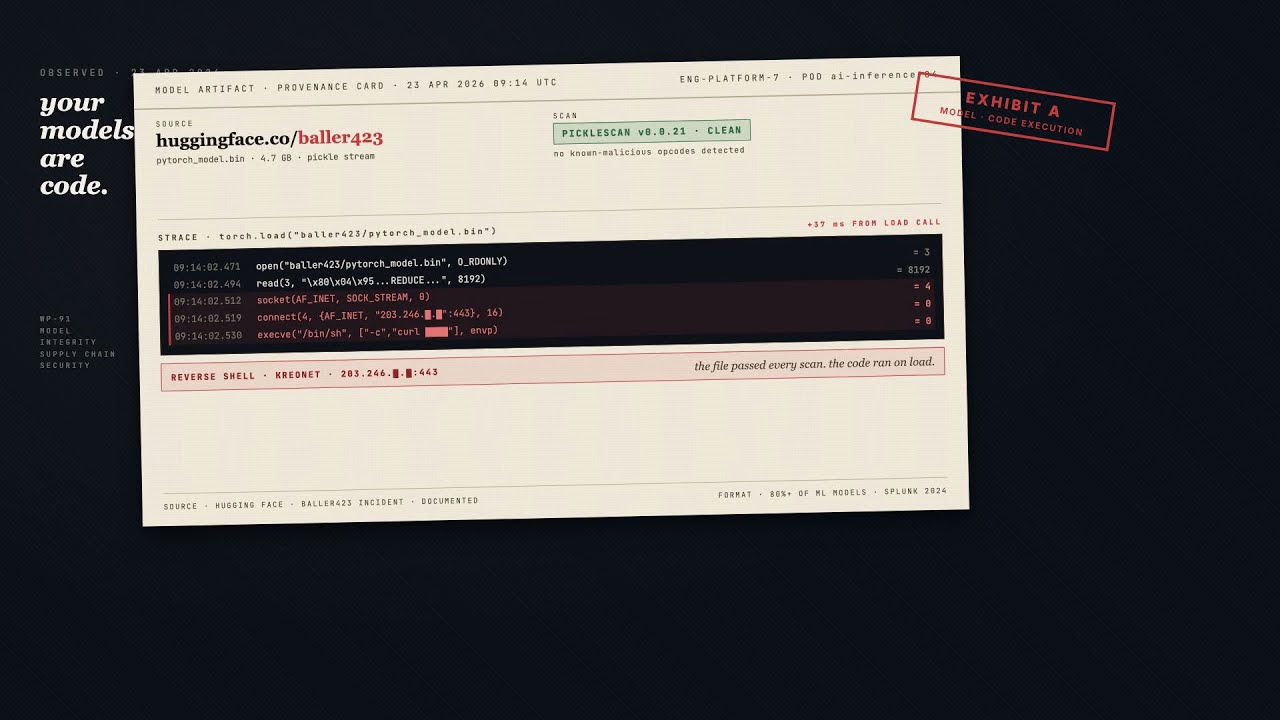
WatchAI Supply Chain Security & Model Integrity
AI supply chain security consulting. We build model vetting pipelines, ML-BOM architecture, and shadow AI governance for CISOs at regulated enterprises. NIST AI 100-2 and EU AI Act compliant.
 Watch
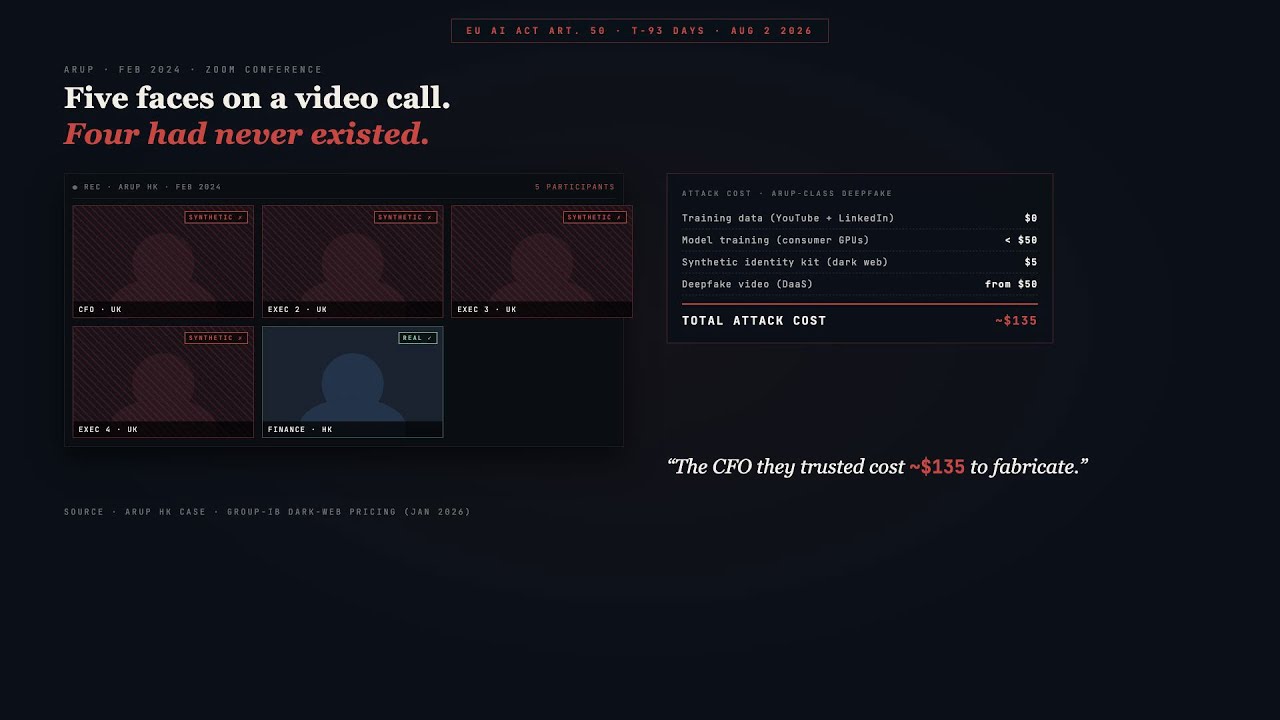
WatchEnterprise Deepfake Detection & Video Call Fraud Prevention
In February 2024, attackers used AI-generated deepfakes of an entire executive team to steal $25. 6 million from Arup in a single video call. Since January 2026, standard cyber insurance policies explicitly exclude deepfake fraud.
 Watch
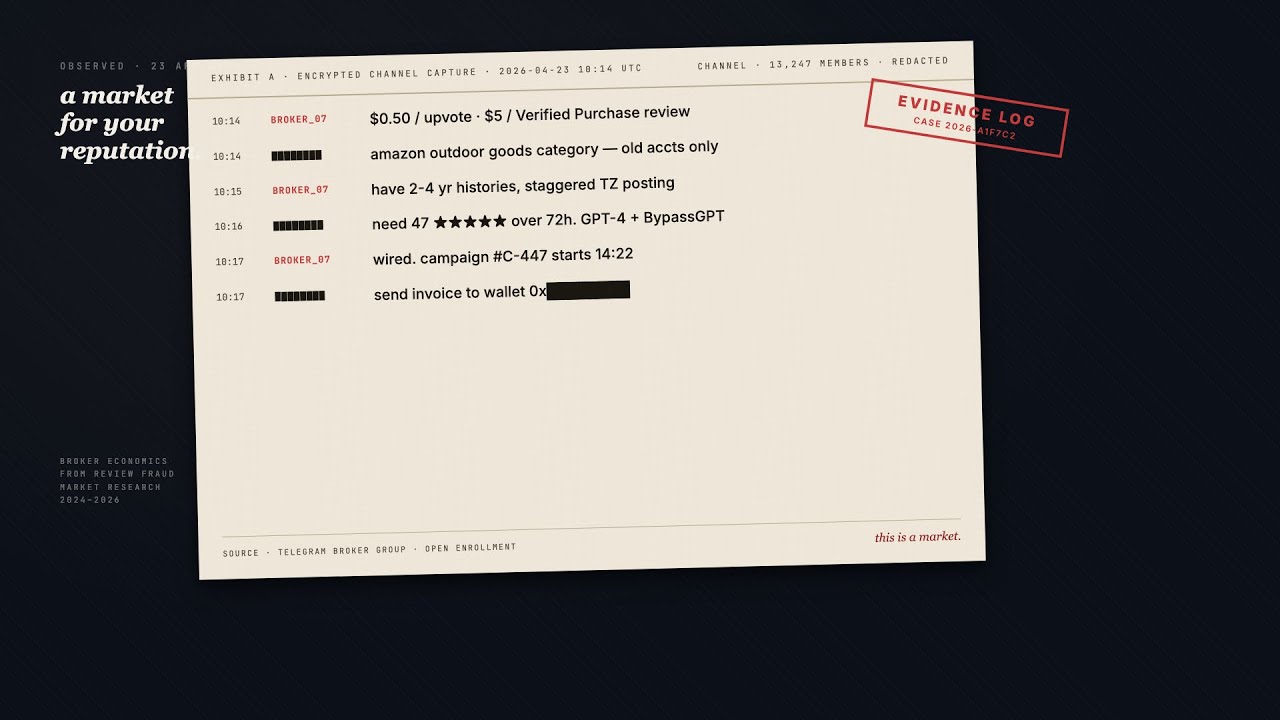
WatchSynthetic Content & Fake Review Detection
Custom AI systems that detect fake reviews, synthetic content, and coordinated fraud across every platform where your brand appears. Built for the FTC's new enforcement reality.
Related Industries
Frequently Asked Questions
How much does AI-specific security assessment cost?
AI security assessments typically range from $15,000 for a scoped LLM application review to $80,000+ for a full red team engagement covering model-level attacks, supply chain audit, and agentic system testing. Mid-market consulting rates run $1,500-$3,500 per consultant day, while top-tier boutiques charge $4,000-$7,000 per day. The right scope depends on your deployment architecture: a managed API call with no fine-tuning needs far less testing than a fine-tuned model serving agentic workflows with tool access.
What does an AI security assessment test that a regular penetration test does not?
Traditional pentests cover API endpoints, authentication, infrastructure, and application logic. AI security assessments add model-specific attack vectors: adversarial input crafting, model extraction through structured query campaigns, training data poisoning detection, prompt injection (both direct and indirect through RAG retrieval), supply chain integrity for model artifacts, and for agentic systems, goal hijacking, tool misuse, and privilege escalation through multi-step workflows. These attack paths require ML-specific methodology that standard pentesting frameworks do not address.
Can someone actually steal our fine-tuned model through the API?
Yes. Model extraction attacks replicate model behavior through systematic querying. For fine-tuned classifiers, a few thousand queries can produce a functionally equivalent copy. For large language models, full extraction is harder but partial extraction of fine-tuning behavior is feasible. Scraping-grade query traffic hit a median 20% of global API traffic in 2025-2026. Defenses include query pattern analysis that goes beyond simple rate limiting, behavioral fingerprinting of extraction patterns, and watermarking, though current watermarking methods can be removed through output paraphrasing.
Do we need AI security testing for EU AI Act compliance?
If your AI system qualifies as high-risk under the EU AI Act, yes. Article 15 requires technical robustness and cybersecurity measures, with enforcement beginning August 2026 and fines up to 7% of global annual turnover or EUR 35 million. NIST published its Cybersecurity Framework Profile for AI in December 2025, which maps AI-specific risks to CSF 2.0 controls and is increasingly referenced in procurement requirements. Actual security testing produces compliance evidence that checkbox audits cannot, because regulators and courts evaluate whether controls were genuinely tested, not just documented.
How do we secure our RAG pipeline against indirect prompt injection?
Indirect prompt injection through retrieved content is the dominant LLM attack vector in production. Anthropic dropped its direct injection metric entirely in February 2026 because indirect injection is the more operationally relevant threat. Defense requires layered controls: separating retrieved content from system instructions in the context window, using a secondary model to evaluate retrieved content before it reaches the primary model, output validation that catches instruction-following behavior triggered by retrieval, and continuous monitoring for anomalous response patterns. No single defense is complete. Prompt injection success rates range from 50-84% depending on system configuration, which is why defense-in-depth is the only viable approach.
What AI security framework should we follow: MITRE ATLAS, OWASP, or NIST AI RMF?
They serve different purposes and most organizations need elements of all three. MITRE ATLAS (84 techniques, 16 tactics as of February 2026) maps specific attack methods and is the right framework for structuring technical assessments. OWASP LLM Top 10 categorizes vulnerability classes and guides what to test for. NIST AI RMF provides governance structure through its Govern, Map, Measure, Manage pillars and is increasingly used as procurement criteria. ISO 42001 handles management system certification. EU AI Act imposes legal obligations with deadlines. We map assessment findings to whichever frameworks your regulators, auditors, and customers require.
What should our AI security assessment cover for agentic AI with tool use?
Agentic AI introduces attack surface that static LLM testing misses entirely. OWASP published its Top 10 for Agentic Applications in December 2025, covering goal hijacking, tool misuse, identity abuse, memory poisoning, and cascading failures. Assessment should test whether an attacker can redirect agent goals through manipulated inputs, escalate tool permissions beyond intended scope, poison persistent memory to influence future actions, and chain failures across multi-agent workflows. Your existing SIEM and EDR tools were built to detect human behavior anomalies. An agent running 10,000 queries in sequence looks normal to these systems even under attacker control.
How do we verify that models from HuggingFace are not backdoored?
Protect AI identified 352,000 suspicious files across 51,700 models on HuggingFace in April 2025. Verification requires checking serialization format (Safetensors over pickle, which allows arbitrary code execution), scanning for known malicious patterns in model weights and configuration files, verifying provenance through signing and hash verification, and testing model behavior against trigger patterns associated with backdoor activation. Malicious LoRA adapters are a growing vector because they are small and easy to distribute. Supply chain verification should be automated in your model deployment pipeline, not done manually at download time.
What is the difference between buying an AI security platform and hiring consultants?
AI security platforms like HiddenLayer, Mindgard, and Giskard automate known attack patterns at scale. They are valuable for continuous regression testing in your CI/CD pipeline. They do not replace initial assessment because they cannot understand your business context, evaluate which model outputs carry safety-critical consequences, or discover novel attack paths specific to your architecture. The right approach uses both: consultants to identify your actual threat surface, establish what matters, and build hardening controls, then platform tools for ongoing automated testing against the baseline the assessment established.
Build Your AI with Confidence.
Partner with a team that has deep experience in building the next generation of enterprise AI. Let us help you design, build, and deploy an AI strategy you can trust.
Veriprajna Deep Tech Consultancy specializes in building safety-critical AI systems for healthcare, finance, and regulatory domains. Our architectures are validated against established protocols with comprehensive compliance documentation.