AI for Energy and Utilities That Respects Grid Physics
Custom AI systems for electric, gas, and water utilities built around NERC CIP compliance, grid physics, and operational constraints.
Grid AI is not a software problem. It is a physics problem with a software interface. The April 2025 Iberian blackout — where 2,200 MW of generation tripped in 20 seconds and left 60 million people without power — settled a debate that had run for years. The ENTSO-E Expert Panel final report (March 2026) confirmed the root cause was cascading overvoltage from generators in fixed-power-factor mode, not renewable intermittency.
The lesson for every utility deploying AI into grid operations is direct: an optimization model that ignores voltage stability, reactive power flows, and inverter control dynamics can recommend actions that look economically optimal in software and cause cascading failures in hardware (our research on engineering grid resilience after the Iberian blackout). Veriprajna builds custom AI for electric, gas, and water utilities around NERC CIP compliance, grid physics, and operational constraints.
The NERC CIP Problem Nobody Planned For
NERC CIP standards were written for deterministic control systems. An AI inference engine sitting on the ICCP link between your control center and a balancing authority can trigger "medium impact" BES Cyber System classification under CIP-002-5.1, creating compliance obligations that neither the utility nor the AI vendor anticipated.
- CIP-003-9, effective April 1, 2026, expands governance for vendor electronic remote access.
- CIP-015-1 mandates internal network security monitoring for high and medium impact systems with external routable connectivity, with full compliance by October 2028.
- CIP-013-2 requires documented supply chain risk management plans, with penalties up to $1M per day for non-compliance.
Our approach puts the compliance architecture first when a utility integrates AI into operations — designed in, not bolted on after the pilot. An engagement maps every AI system component against CIP classification criteria, designs network segmentation that satisfies CIP-005 while giving the AI the data access it needs, and produces the compliance documentation artifacts that auditors actually review.
Load Forecasting in a World That Changed Overnight
U.S. data center grid-power demand will reach 75.8 GW in 2026 (S&P Global) and could hit 106 GW by 2035 (BloombergNEF). PJM attributes 12 GW of additional data center demand in 2026/27 alone, explaining a doubling in capacity costs. Goldman Sachs estimates $720B in grid upgrades needed through 2030.
The problem for utility planners is that AI load does not follow historical patterns: data center project timelines are shorter, load additions are larger, and demand profiles are flatter than traditional commercial loads. Average interconnection queue times have ballooned from under 2 years in 2008 to over 5 years now, with 2,000+ GW of resources waiting. FERC Order 2023 addresses the backlog, but PJM is only beginning to explore AI-enabled tools for streamlining interconnection studies.
Most utility load forecasting models were trained on a world where demand grew 1% annually. That world is gone. We design forecasting systems to incorporate the non-traditional load shapes, rapid ramp profiles, and correlated demand patterns that AI infrastructure creates (see our research on the PJM shortfall and ERCOT crisis) — because getting the forecast wrong by even 5% at this scale means billions in misallocated capital.
Related pressure: projects missing 2026-2028 start dates for the 45Y and 48E clean energy credits face 30-50% cost increases. AI can accelerate cluster study analysis, identify queue positions likely to withdraw, and automate the engineering analysis that currently requires months of manual work per study cycle — though no ISO/RTO has yet deployed automated feasibility screening at scale.
DER Integration: Protocol Fragmentation Meets Physics
FERC Order 2222 requires ISOs/RTOs to allow distributed energy resource aggregations into wholesale markets, but implementation timelines vary wildly. On the ground, DERMS platforms must coordinate inverters, batteries, and controllable loads across IEEE 2030.5, OpenADR, SunSpec Modbus, and DNP3 — often simultaneously. No single commercial DERMS handles all four with full real-time capability.
| ISO/RTO | FERC Order 2222 status |
|---|---|
| CAISO | Live November 2024 |
| NYISO | Live April 2024 |
| PJM | Targets February 2028 |
| SPP | Not until Q2 2030 |
The protocol itself is still evolving: CSIP versions based on IEEE 2030.5-2018 and 2023, with CSIP 3.0 and CSIP AUS 1.2 introducing further changes. Meanwhile, California's energy storage capacity grew from 500 MW in 2018 to 16,900+ MW by mid-2025, with batteries delivering 12+ GW during the evening ramp on March 29, 2025. CAISO curtailed 738,000+ MWh of solar in Q1 2025 alone.
At this scale, AI dispatch quality is grid-critical, not academic, as our research on physics-constrained intelligence and the Virginia grid disturbance details (structural resilience through physics-constrained intelligence). We design the coordination layer that sits between DERMS, ADMS, and the physical DER fleet — handling protocol translation, real-time constraint enforcement, and dispatch optimization that respects both market rules and electrical limits.
Smart Metering Beyond Vendor Dashboards
Itron holds 35% and Landis+Gyr 32% of North American smart meter market share (GlobeNewsWire, July 2025). Between them, they cover the majority of the 100+ million AMI endpoints deployed across U.S. utilities. The analytics platforms they ship are designed for their own hardware ecosystems.
Landis+Gyr's Revelo is the first IoT grid-sensing meter with edge computing, but the analytics beyond basic load profiling are limited. Itron's analytics platform handles demand response and billing — not the kind of multi-stream anomaly detection that catches revenue losses without generating false positives that trigger disconnections violating state PUC consumer protection rules.
Global electricity theft costs $89.3B annually (IEEE Smart Grid), and the ML models deployed for detection suffer from extreme class imbalance: theft events are rare in training data, so false positive rates are high. We design AMI analytics to fuse meter data with network topology, weather, and consumption pattern analysis to improve detection accuracy (detailed in our research on advanced metering infrastructure resilience) while keeping false positive rates below the threshold that creates regulatory and customer-relations exposure.
Wildfire, Methane, Water: AI for Physical Risk
Hawaiian Electric committed $450M over three years (2025-2027) for wildfire safety including AI cameras and grid hardening. SDG&E trains wildfire models on a decade of historical records to predict failure and ignition probability at the pole and span level. Technosylva and AiDASH partnered to integrate wildfire modeling with satellite-based vegetation intelligence. But most utilities still rely on coarse weather-driven PSPS decisions that de-energize entire circuits rather than targeting specific spans, because their risk models lack the sensor fusion to be granular.
For gas utilities, EPA OOOOb mandates AI-compatible leak detection monitoring with initial surveys required by 2025 and ongoing LDAR compliance tightening through 2026. Next-generation optical gas imaging systems from Bridger Photonics and Opgal use AI for automated frame-by-frame methane signature detection.
For water utilities, AI leak detection has produced documented results: Walla Walla reduced non-revenue water from 40% to under 10%, and single-utility deployments show $213,000/year savings (Oldcastle Infrastructure). SVM-based leak detection achieves 94-100% accuracy across 53 peer-reviewed studies (MDPI). We design the sensor fusion and risk scoring systems that turn coarse safety models into targeted, defensible operational decisions — whether the asset is a transmission span, a gas main, or a water distribution line.
Agentic AI and the Control Room Question
Argonne National Laboratory built GridMind, a multi-agent AI system where specialized agents handle scheduling, monitoring, and dispatch independently but coordinate through a shared reasoning framework. This is the DOE's prototype for the "control room of the future." The agentic AI market in energy and utilities sits at $0.64B in 2025, forecast to reach $3.14B by 2030 (Mordor Intelligence).
42% of utilities plan targeted AI deployments in the next two years, but the overwhelming majority lack internal AI expertise (Utility Dive). Duke Energy's AI chatbot handled 280,000+ interactions in its first three months and reduced manual submissions by 90%, but UK utility customer satisfaction with AI-handled complaints dropped from 47% to 44% between July 2024 and January 2025 (Qualtrics).
The gap between what agentic AI can do in a lab and what utility operators trust in a control room at 3am during a polar vortex is real, and closing it requires explainability, guardrails, and human-in-the-loop design that most AI vendors skip. Our approach is to design agentic systems with reasoning traces that operators can audit, constraint boundaries that prevent autonomous actions from violating operating procedures, and graceful degradation that keeps the lights on when the AI is uncertain.
Why Not the Platform Vendor or the Big Consultancy?
GE Vernova, Schneider Electric, and Siemens each build excellent grid software — they ranked 1-2-3 in ABI Research's 2026 Grid Digitalization ranking. But each platform's AI capabilities are designed to keep you inside that vendor's ecosystem. A GE Vernova GridOS shop gets GE AI. A Schneider ADMS shop gets Schneider AI. If your utility runs mixed infrastructure — which most do — neither vendor has an incentive to build the cross-platform integration layer. Oracle and Hitachi Energy round out the top 5 in ISG's Power and Utilities Grid ranking, each with similar ecosystem lock-in dynamics.
The large consultancies bring program management and strategic framing, but the people writing the SOW rarely debug ICCP protocol issues or design edge deployments that survive substation EMI. Accenture acquired Orlade Group in September 2025 specifically for utility capital projects advisory; Deloitte, McKinsey, and Capgemini all run active energy AI practices.
Our practice is deliberately vendor-neutral: we engineer across GE, Schneider, Siemens, and legacy SCADA environments rather than building toward a single vendor's stack. Our approach treats NERC CIP compliance architecture, grid physics, and the OT constraints that make utility AI different from enterprise AI as first-order design problems — addressed in the architecture, not retrofitted after a pilot. That work is structured around a small, senior engineering team with direct ownership and no platform lock-in.
One Platform for Combined Electric, Gas & Water Utilities
Electric, gas, and water utilities face parallel AI challenges — leak detection, predictive maintenance, customer service, and regulatory compliance — but vendor solutions are siloed by domain. Water AI leak detection has demonstrated 94-100% accuracy (MDPI review of 53 studies) and $213,000/year savings per utility (Oldcastle Infrastructure); gas utilities face EPA OOOOb LDAR requirements that pull toward AI-enhanced optical gas imaging; electric utilities need NERC CIP-compliant analytics.
A unified AI platform that shares infrastructure and data pipelines across domains, while respecting domain-specific regulatory and operational constraints, avoids tripling deployment cost and maintenance burden.
Key Takeaways
- Physics first: the Iberian blackout proved AI dispatch must enforce voltage stability, reactive power, and inverter dynamics — not just economic optimization.
- Compliance first: AI touching BES Cyber Systems triggers NERC CIP obligations (CIP-002-5.1, CIP-003-9, CIP-005, CIP-013-2, CIP-015-1); we architect for it before the pilot.
- Forecast for the new load: data center demand (75.8 GW in 2026) broke 1%-growth models; a 5% miss now costs billions.
- Coordinate the DER fleet: no single DERMS spans IEEE 2030.5, OpenADR, SunSpec Modbus, and DNP3 — we build the integration layer.
- Detect without false positives: AMI analytics fuse topology, weather, and consumption to fight $89.3B theft while protecting PUC compliance.
- Vendor-neutral engineering: cross-platform work across GE, Schneider, Siemens, Oracle, Hitachi Energy, and legacy SCADA — no lock-in.
Solutions for Energy & Utilities
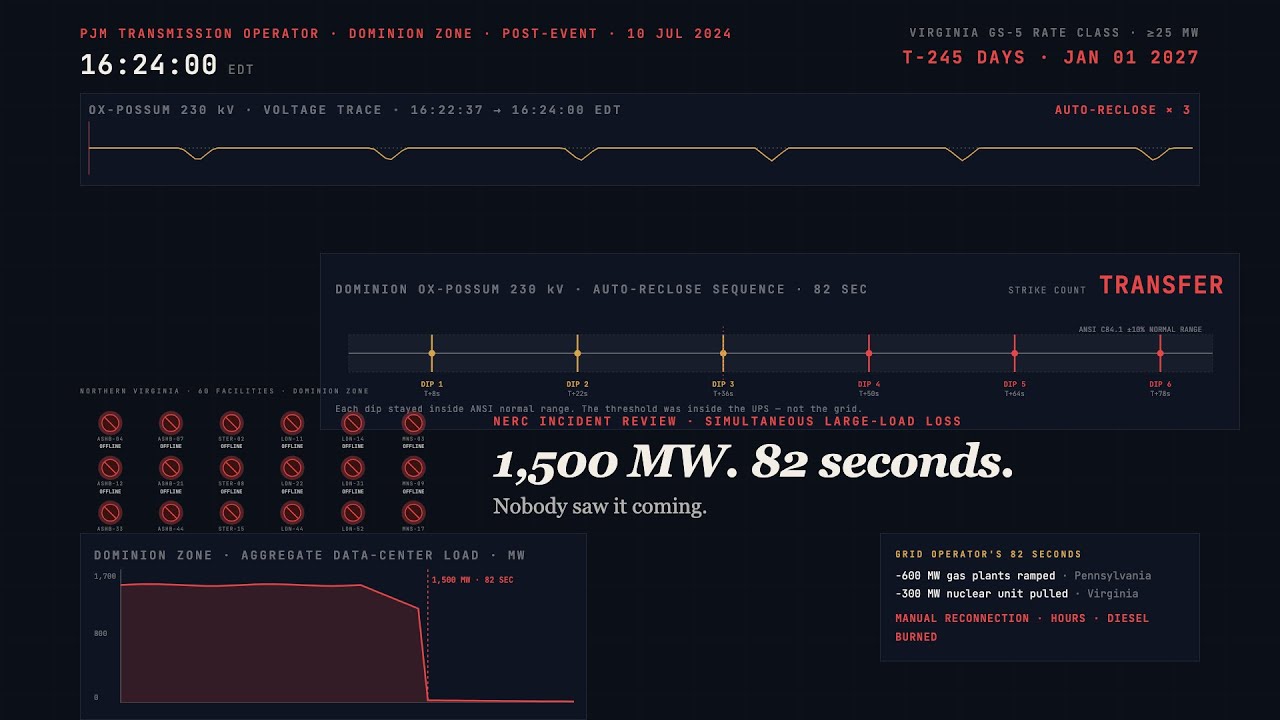 Watch
WatchData Center Grid Interaction AI
AI-powered grid flexibility orchestration for data centers. Prevent byte blackouts, optimize PJM capacity market costs, and meet NERC large load compliance requirements.
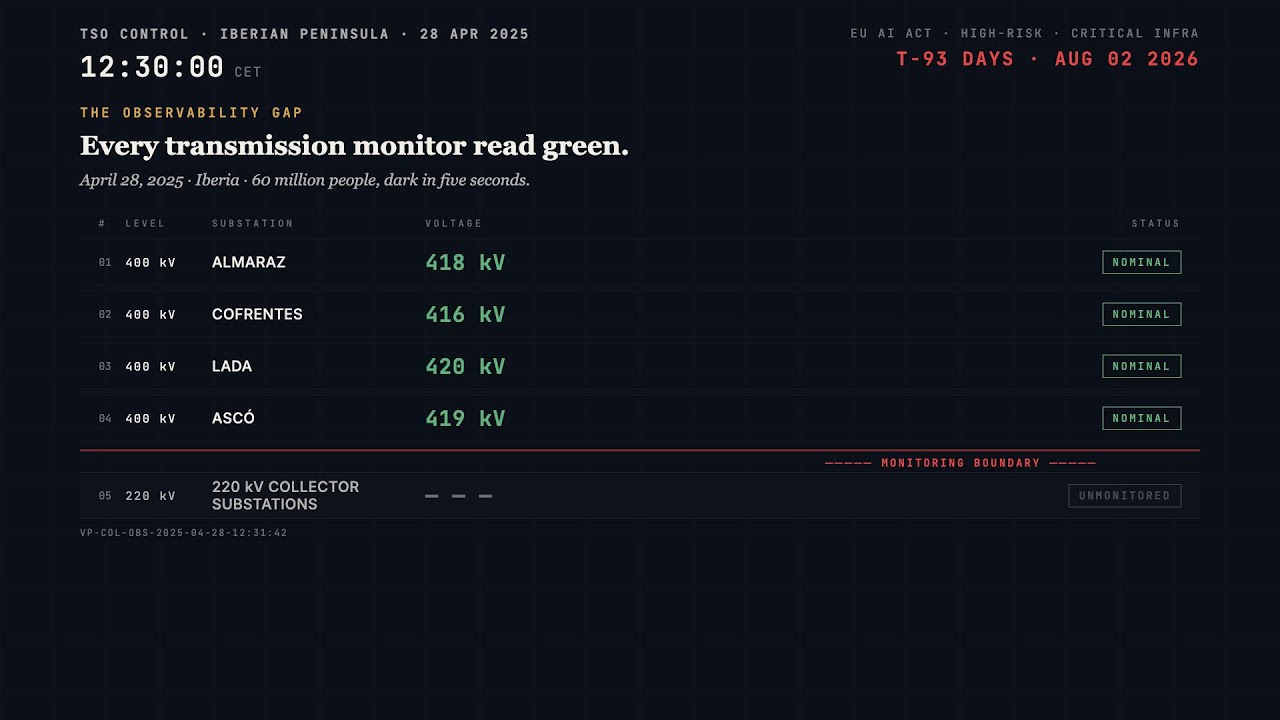 Watch
WatchPower Grid AI & Resilience Engineering
PJM fell 6,625 MW short of its reliability target for the first time in history. ERCOT's interconnection queue hit 233 GW with only 23 GW of new generation online. The Iberian blackout wiped out 15 GW in 5 seconds because no one was watching the right voltage level.
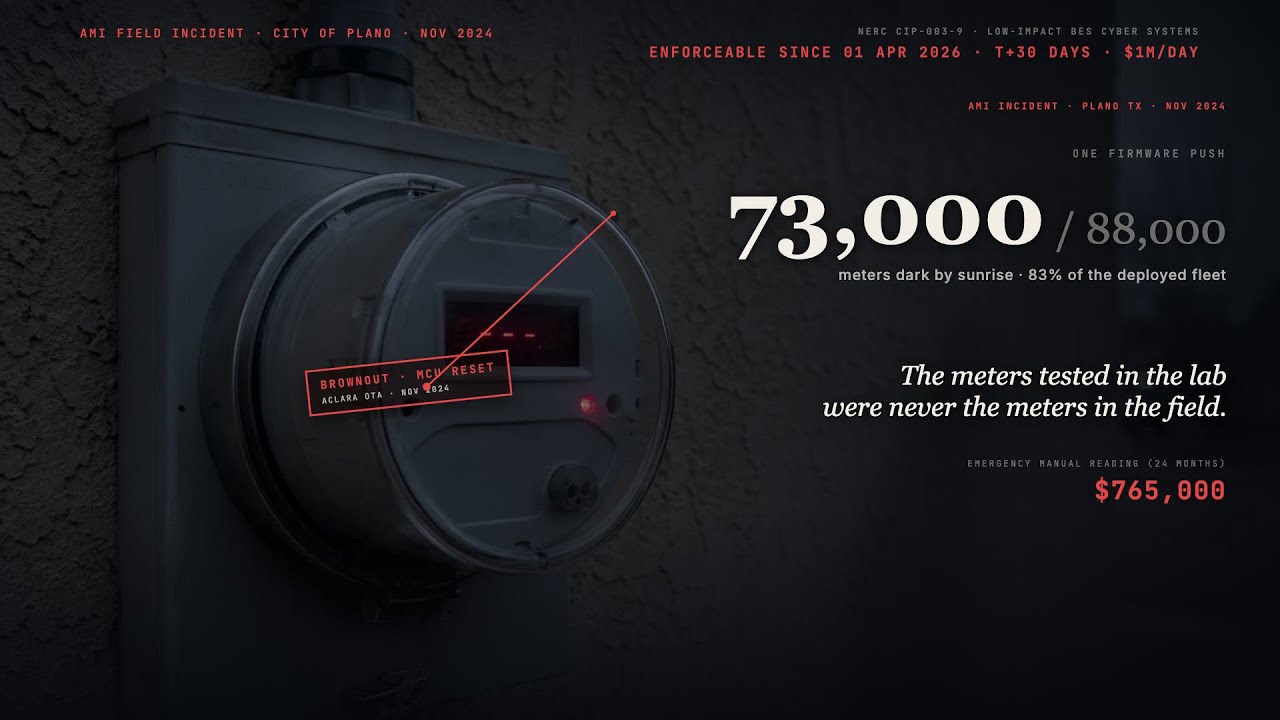 Watch
WatchSmart Meter AI: AMI Predictive Maintenance & Firmware Validation
One bad firmware push cost Plano, TX $765,000 and knocked 73,000 meters offline. Memphis is spending $9M on repairs. Your AMI head-end tracks which meters stopped talking.
Frequently Asked Questions
How do we keep AI systems NERC CIP compliant when they touch BES Cyber Systems?
An AI inference engine on the ICCP link between a control center and a balancing authority can trigger medium-impact BES Cyber System classification under CIP-002-5.1, creating compliance obligations most AI vendors never planned for. CIP-003-9 (effective April 2026) expands vendor remote access governance, CIP-015-1 mandates internal network security monitoring by October 2028, and CIP-013-2 requires supply chain risk management with penalties up to $1M/day. We map every AI component against CIP classification criteria, design network segmentation that satisfies CIP-005 while preserving data access, and build documentation artifacts auditors actually review. Compliance architecture comes first, not after the pilot.
Can AI fix utility load forecasting now that data center demand has broken historical models?
U.S. data center grid demand reaches 75.8 GW in 2026 (S&P Global) and could hit 106 GW by 2035 (BloombergNEF). PJM attributes 12 GW of additional data center demand in 2026/27 alone, doubling capacity costs. Traditional load forecasting models trained on 1% annual demand growth cannot handle the non-traditional load shapes, rapid ramp profiles, and correlated demand patterns that hyperscaler clusters create. AI forecasting that incorporates data center interconnection agreements, construction timelines, and GPU cluster power profiles reduces forecast error at the scale where a 5% miss means billions in misallocated capital.
What did the Iberian blackout teach us about AI-driven grid operations?
The April 2025 blackout knocked out 2,200 MW in 20 seconds across Spain and Portugal. The ENTSO-E Expert Panel final report (March 2026) confirmed cascading overvoltage from generators in fixed-power-factor mode, not renewable generation, caused the failure. The lesson: AI optimization models that target economic dispatch without enforcing voltage stability, reactive power constraints, and inverter control dynamics can recommend actions that look optimal in software and cause cascading failures in hardware. Grid AI must be physics-informed, not just data-driven.
How do we reduce AMI theft detection false positives without missing real revenue losses?
Global electricity theft costs $89.3B annually (IEEE Smart Grid). ML models deployed for detection suffer from extreme class imbalance since theft events are rare in training data, producing high false positive rates. A false positive can trigger disconnection that violates state PUC consumer protection rules. The solution is fusing meter data with network topology, weather patterns, and consumption profile analysis rather than relying on single-stream anomaly detection. This multi-signal approach improves detection accuracy while keeping false positive rates below the regulatory and customer-relations threshold.
Is agentic AI ready for utility control room operations?
Argonne National Laboratory's GridMind is a multi-agent AI system where specialized agents handle scheduling, monitoring, and dispatch independently. The agentic AI market in energy sits at $0.64B in 2025, forecast to reach $3.14B by 2030 (Mordor Intelligence). But 42% of utilities planning AI deployments lack internal expertise (Utility Dive), and operator trust remains the binding constraint. Duke Energy's chatbot handled 280,000+ interactions in three months, yet utility customer satisfaction with AI-handled service dropped from 47% to 44% (Qualtrics). Closing the lab-to-operations gap requires explainability, constraint guardrails, and human-in-the-loop design that most vendors skip.
Which DERMS platform handles multi-protocol DER coordination for mixed fleets?
No single commercial DERMS handles IEEE 2030.5, OpenADR, SunSpec Modbus, and DNP3 simultaneously with full real-time capability. FERC Order 2222 implementation timelines vary from CAISO (live since November 2024) to SPP (not until Q2 2030). Protocol fragmentation across CSIP versions compounds the problem. With California's storage at 16,900+ MW and batteries delivering 12+ GW during evening ramps, AI dispatch quality is now grid-critical. The coordination layer between DERMS, ADMS, and the physical DER fleet needs to handle protocol translation, constraint enforcement, and dispatch optimization across both market rules and electrical limits.
Can AI automate FERC Order 2023 interconnection queue processing?
The interconnection queue holds 2,000+ GW with average wait times exceeding 5 years, up from under 2 years in 2008. Projects missing 2026-2028 start dates for 45Y and 48E clean energy credits face 30-50% cost increases. PJM has announced efforts to deploy AI tools for streamlining interconnection studies, but no ISO/RTO has deployed automated feasibility screening at scale. AI can accelerate cluster study analysis, identify queue positions likely to withdraw, and automate the engineering analysis that currently requires months of manual work per study cycle.
How do combined electric/gas/water utilities approach AI without building three separate platforms?
Electric, gas, and water utilities face parallel AI challenges: leak detection, predictive maintenance, customer service, and regulatory compliance. But vendor solutions are siloed by domain. AI leak detection for water utilities has demonstrated 94-100% accuracy (MDPI review of 53 studies) and $213,000/year savings per utility (Oldcastle Infrastructure). Gas utilities face EPA OOOOb LDAR requirements that pull toward AI-enhanced optical gas imaging. Electric utilities need NERC CIP-compliant analytics. A unified AI platform that shares infrastructure and data pipelines across domains, while respecting domain-specific regulatory and operational constraints, avoids tripling deployment cost and maintenance burden.
Build Your AI with Confidence.
Partner with a team that has deep experience in building the next generation of enterprise AI. Let us help you design, build, and deploy an AI strategy you can trust.
Veriprajna Deep Tech Consultancy specializes in building safety-critical AI systems for healthcare, finance, and regulatory domains. Our architectures are validated against established protocols with comprehensive compliance documentation.