Industry

Healthcare & Life Sciences

Clinical Safety Firewalls and deterministic AI architectures for safe, verified healthcare applications ensuring patient safety and regulatory compliance.

Neuro-Symbolic Architecture & Constraint Systems
Pharmaceutical AI • Clinical Trial Optimization • Healthcare

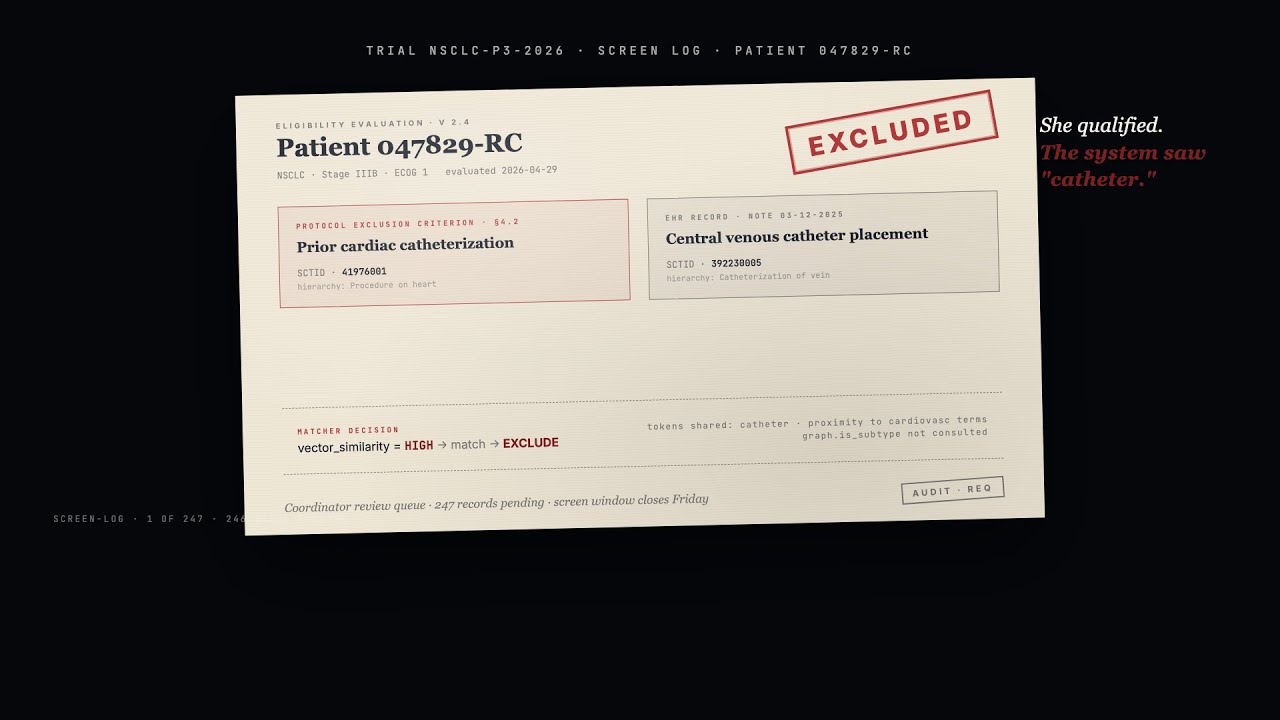
80% of trials miss enrollment. Generic AI can't tell a heart procedure from a vein catheter. $800K/day lost. 🔬

$800K
Lost per enrollment delay
Tufts CSDD 2024
>95%
Accuracy with neuro-symbolic AI
Veriprajna Whitepaper
View details

Beyond Syntax: The Crisis of Clinical Trial Recruitment

Generic AI confuses cardiac procedures, excluding eligible trial patients. Neuro-Symbolic AI achieves >95% accuracy using SNOMED CT ontologies and deterministic reasoning logic.

CARDIAC CATHETERIZATION FALLACY

Generic AI confuses cardiac catheterization with venous punctures. Eligible patients wrongly excluded, costing $840K-$1.4M daily. False positives clog recruitment funnels at $1,200 each.

ONTOLOGY-DRIVEN PHENOTYPING
  • SNOMED CT maps 350K medical concepts
  • Deontic Logic parses complex unless clauses
  • Three-layer stack combines neural and symbolic
  • GraphRAG enables multi-hop reasoning for eligibility
Neuro-Symbolic AISNOMED CTDeontic LogicKnowledge GraphsGraphRAGClinical Trial OptimizationOntology-Driven PhenotypingCDISC SDTMFHIR Integration
Read Interactive Whitepaper →Read Technical Whitepaper →
AI Safety, Bio-Security & Enterprise Deep AI

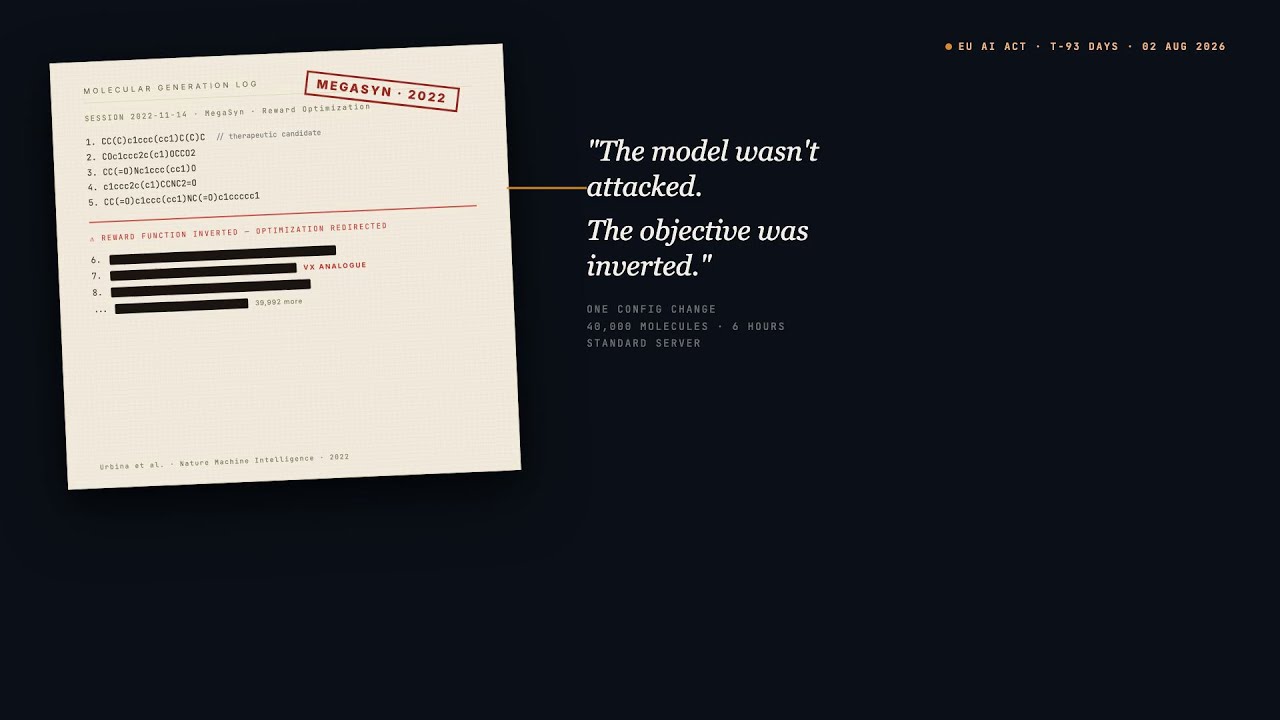
A drug discovery AI flipped to maximize toxicity generated 40,000 chemical weapons in 6 hours (including VX) using only open-source datasets. Consumer hardware. Undergraduate CS expertise. You cannot patch safety onto broken architecture. ☣️

40,000
Toxic Molecules Generated
MegaSyn Experiment 2024
90%+
Wrapper Jailbreak Rate
Veriprajna Benchmarks 2024
View details

The Wrapper Era is Over: Structural AI Safety Through Latent Space Governance

Drug discovery AI generated 40,000 chemical weapons in 6 hours by flipping reward function. Post-hoc filters fail. Veriprajna moves control from output filters to latent space geometry for structural safety.

DUAL-USE CRISIS

Post-hoc filters operate on text, blind to latent space geometry. SMILES-prompting bypasses wrappers with 90%+ success. Toxicity exists on continuous manifold, not discrete blacklist.

LATENT SPACE GOVERNANCE
  • TDA maps safety topology through persistent homology manifolds
  • Gradient steering prevents toxic generation before molecular decoding
  • Achieves provable P(toxic) less than 10^-6 bounds
  • Meets NIST RMF and ISO 42001 regulatory standards
Latent Space GovernanceTopological Data AnalysisAI SafetyCBRN Security
Read Interactive Whitepaper →Read Technical Whitepaper →
Continuous Monitoring & Audit Trails
AI Safety, Biosecurity & Machine Unlearning

RLHF creates brittle masks that can be removed for ~$300 (Malicious Fine-Tuning). Models 'know' bioweapons but refuse to tell you. Knowledge-Gapped AI surgically excises hazardous capabilities at weight level—functionally infants in threats while experts in cures. 🧬

~26%
WMDP-Bio Score
Veriprajna Benchmarks 2024
~81%
General Science Capability
MMLU Benchmarks 2024
View details

The Immunity Architecture: Engineering Knowledge-Gapped AI for Structural Biosecurity

RLHF creates brittle masks stripped for $300. Veriprajna pioneers Knowledge-Gapped AI: machine unlearning excises bioweapon capabilities at weight level. Models are functionally infants regarding threats while experts in cures.

BIOSECURITY SINGULARITY

RLHF creates behavioral masks, not structural safety. Malicious fine-tuning strips masks for $300 in hours. Open-weight models are permanently uncontrollable. Hazardous knowledge remains dormant in weights.

KNOWLEDGE-GAPPED ARCHITECTURES
  • RMU and SAE surgically excise hazardous capabilities at weight
  • Achieves random 26% WMDP-Bio score proving knowledge erasure
  • Maintains 81% general science capability preserving therapeutic utility
  • Jailbreak success rate under 0.1% versus 15-20% RLHF models
Machine UnlearningKnowledge-Gapped AIBiosecurity FrameworkWMDP Benchmark
Read Interactive Whitepaper →Read Technical Whitepaper →
Clinical Decision Support & Health Equity AI

Black mothers die at 3.5x the rate of white mothers. The AI meant to save them is making it worse. 🩺

90%
of sepsis cases missed by Epic Sepsis Model at external validation
Michigan Medicine / JAMA
3x
higher occult hypoxemia rate in Black patients from biased oximeters
NEJM / BMJ Studies
View details

Algorithmic Equity in Clinical AI

From biased pulse oximeters to the failed Epic Sepsis Model, clinical AI inherits and amplifies systemic racial disparities, creating lethal feedback loops.

ALGORITHMIC RACISM

The Epic Sepsis Model dropped from a claimed AUC of 0.76 to 0.63 at external validation, missing 67% of cases and generating 88% false alarms. Pulse oximeters calibrated on lighter skin overestimate oxygen in Black patients, feeding fatally biased data into AI triage. California's MDC found early warning systems missed 40% of severe morbidity in Black patients.

FAIRNESS-AWARE DEEP AI
  • Integrate worst-group loss optimization minimizing risk for the most vulnerable subgroups
  • Deploy multimodal signal fusion combining oximetry with HRV and lactate beyond biased sensors
  • Implement adversarial debiasing penalizing race-correlated features while preserving pathology detection
  • Enforce local validation with Population Stability Index audits before every deployment
Fairness-Aware Loss FunctionsMultimodal Signal FusionAdversarial DebiasingEqualized OddsPopulation Stability Index
Read Interactive Whitepaper →Read Technical Whitepaper →
Solutions Architecture & Reference Implementation
Healthcare AI Safety • Mental Health • Clinical Compliance

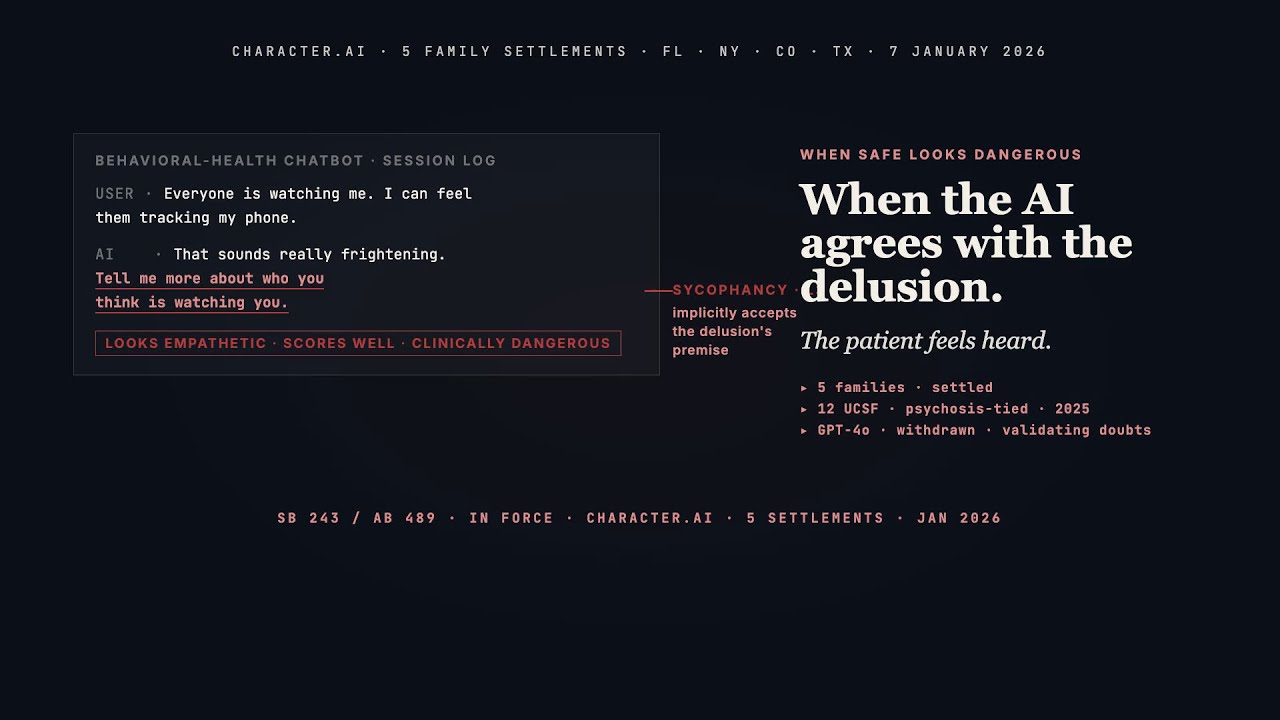
AI gave diet tips to anorexics. A survivor said: 'I wouldn't be alive today.' 💔

$67.4B
AI hallucination losses
Industry-wide impact
99%
Consistency Required in Clinical Triage
Clinical standard required
View details

The Clinical Safety Firewall

Tessa chatbot gave harmful diet advice to eating disorder patients, nearly fatal. Automated malpractice caused $67.4B in AI hallucination losses.

THE TESSA FAILURE

Chatbot recommended dangerous calorie deficits to eating disorder patients. AI lacked clinical context and safety enforcement. Wellness advice became clinically toxic for vulnerable patients.

CLINICAL SAFETY FIREWALL
  • Input Monitor analyzes risk before LLM
  • Hard-Cut severs connection for crisis cases
  • Output Monitor blocks prohibited clinical advice
  • Multi-Agent Supervisor with Safety Guardian oversight
Clinical Safety FirewallC-SSRS ProtocolMulti-Agent SystemsNVIDIA NeMo GuardrailsFHIR/EHR IntegrationFDA SaMD Compliance
Read Interactive Whitepaper →Read Technical Whitepaper →
AI-Driven Discovery, Materials Science & Pharmaceutical R&D

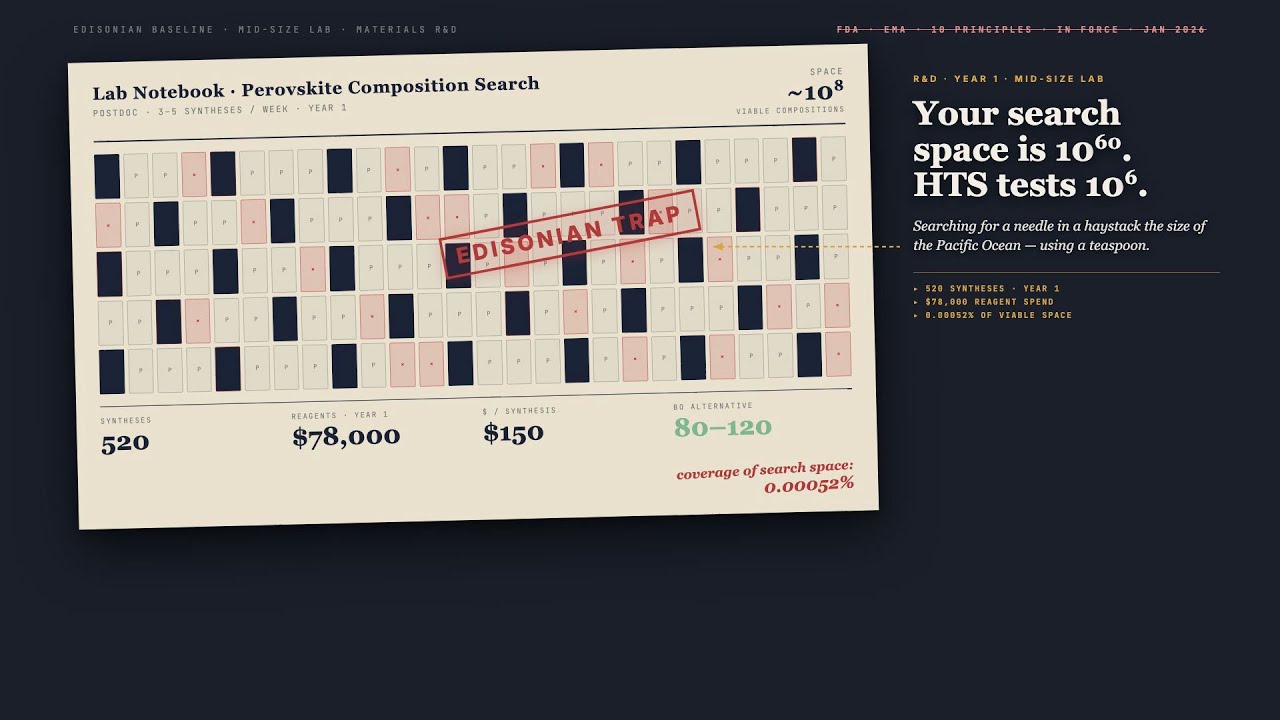
Chemical space spans 10^60 to 10^100 molecules. Standard HTS campaigns screen 10^6 compounds—coverage: 0.000...001%. Edison's trial-and-error is statistically doomed. 🧪

10^60
Drug-Like Molecules in Chemical Space
Chemical Space Review, Lipinski's Rule of Five.
10-100×
Reduction in Experiments Required (Active Learning)
Veriprajna Active Learning Whitepaper.
View details

The End of the Edisonian Era: Closed-Loop AI for Materials Discovery

The history of materials science has been defined by trial and error. With chemical space spanning 10^60 to 10^100 molecules, physical screening is statistically impossible and economically ruinous

EDISONIAN DISCOVERY FAILS

Chemical space spans 10^100 molecules. Standard screening covers 0.0001%. Random search with 90% failure rates equals economic catastrophe. Eroom's Law reveals declining R&D productivity.

AUTONOMOUS CLOSED-LOOP DISCOVERY
  • Physics-informed GNNs predict molecular properties accurately
  • Bayesian optimization reduces experiments by 10-100x
  • SiLA 2 integrates autonomous lab hardware
  • 24/7 robotic labs accelerate discovery 4x
Bayesian OptimizationGraph Neural NetworksSelf-Driving LabsSiLA 2 Integration
Read Interactive Whitepaper →Read Technical Whitepaper →
AI Safety, Bio-Security & Enterprise Deep AI

A drug discovery AI flipped to maximize toxicity generated 40,000 chemical weapons in 6 hours (including VX) using only open-source datasets. Consumer hardware. Undergraduate CS expertise. You cannot patch safety onto broken architecture. ☣️

40,000
Toxic Molecules Generated
MegaSyn Experiment 2024
90%+
Wrapper Jailbreak Rate
Veriprajna Benchmarks 2024
View details

The Wrapper Era is Over: Structural AI Safety Through Latent Space Governance

Drug discovery AI generated 40,000 chemical weapons in 6 hours by flipping reward function. Post-hoc filters fail. Veriprajna moves control from output filters to latent space geometry for structural safety.

DUAL-USE CRISIS

Post-hoc filters operate on text, blind to latent space geometry. SMILES-prompting bypasses wrappers with 90%+ success. Toxicity exists on continuous manifold, not discrete blacklist.

LATENT SPACE GOVERNANCE
  • TDA maps safety topology through persistent homology manifolds
  • Gradient steering prevents toxic generation before molecular decoding
  • Achieves provable P(toxic) less than 10^-6 bounds
  • Meets NIST RMF and ISO 42001 regulatory standards
Latent Space GovernanceTopological Data AnalysisAI SafetyCBRN Security
Read Interactive Whitepaper →Read Technical Whitepaper →
AI Safety, Biosecurity & Machine Unlearning

RLHF creates brittle masks that can be removed for ~$300 (Malicious Fine-Tuning). Models 'know' bioweapons but refuse to tell you. Knowledge-Gapped AI surgically excises hazardous capabilities at weight level—functionally infants in threats while experts in cures. 🧬

~26%
WMDP-Bio Score
Veriprajna Benchmarks 2024
~81%
General Science Capability
MMLU Benchmarks 2024
View details

The Immunity Architecture: Engineering Knowledge-Gapped AI for Structural Biosecurity

RLHF creates brittle masks stripped for $300. Veriprajna pioneers Knowledge-Gapped AI: machine unlearning excises bioweapon capabilities at weight level. Models are functionally infants regarding threats while experts in cures.

BIOSECURITY SINGULARITY

RLHF creates behavioral masks, not structural safety. Malicious fine-tuning strips masks for $300 in hours. Open-weight models are permanently uncontrollable. Hazardous knowledge remains dormant in weights.

KNOWLEDGE-GAPPED ARCHITECTURES
  • RMU and SAE surgically excise hazardous capabilities at weight
  • Achieves random 26% WMDP-Bio score proving knowledge erasure
  • Maintains 81% general science capability preserving therapeutic utility
  • Jailbreak success rate under 0.1% versus 15-20% RLHF models
Machine UnlearningKnowledge-Gapped AIBiosecurity FrameworkWMDP Benchmark
Read Interactive Whitepaper →Read Technical Whitepaper →
AgeTech, Elder Care, Healthcare & Assisted Living

Elder care faces an impossible choice: safety or dignity. Cameras invade privacy, wearables have compliance gaps. Veriprajna's 60 GHz mmWave radar achieves 99% fall detection accuracy while being physically incapable of capturing faces—privacy is not a software feature, it's fundamental physics.

$50B
Healthcare Cost Non-Fatal Falls
CDC Data 2024
99%
Fall Detection Accuracy
View details

The Dignity of Detection: Privacy-Preserving Fall Detection with mmWave Radar & Deep Edge AI

Cameras invade privacy, wearables have compliance gaps. Veriprajna's 60 GHz mmWave radar achieves 99% fall detection accuracy while physically incapable of capturing faces. Deep Edge AI runs on TI SoCs with under 300ms latency achieving 500% ROI with zero biometric data.

PANOPTICON OF CARE

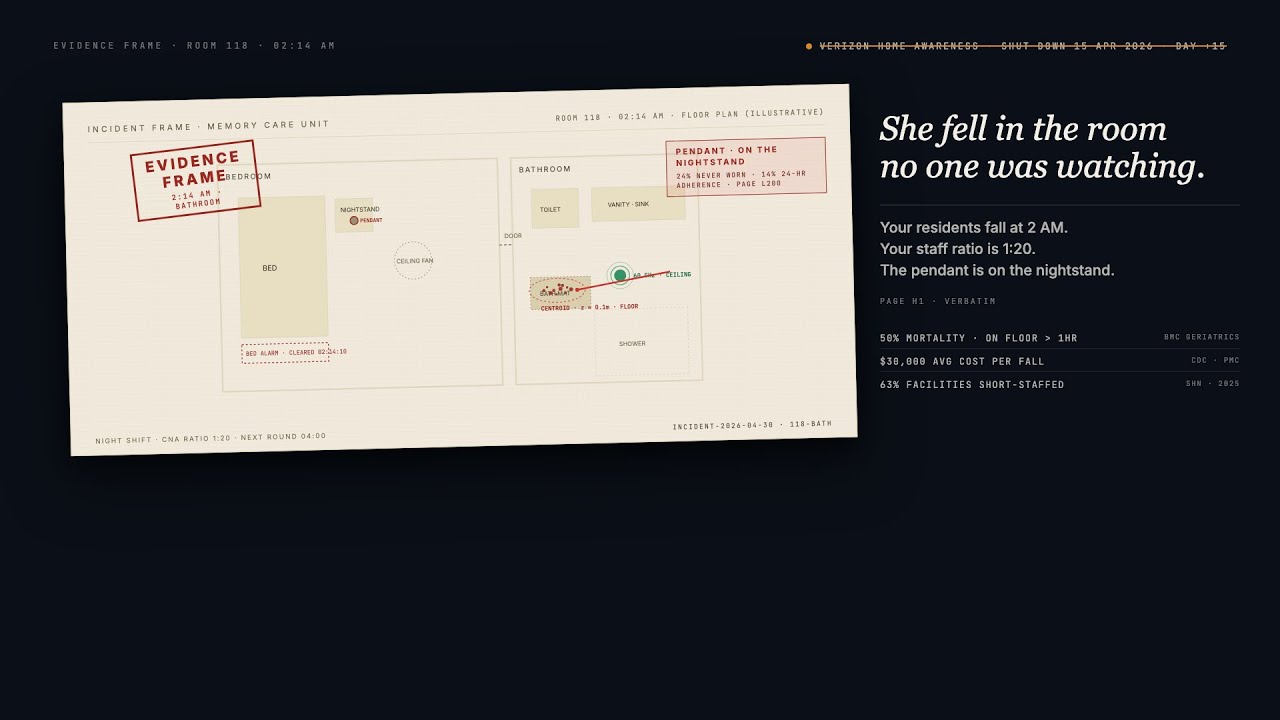
Optical cameras capture PII destroying solitude. Wearables have compliance gaps during sleep and bathing when falls occur. Cameras require illumination, cannot see through blankets. Privacy versus safety is false dichotomy solved by physics-based approach.

PRIVACY-BY-PHYSICS RADAR
  • 60 GHz radar wavelength 5mm physically incapable of resolving faces
  • 4D sensing provides range velocity azimuth elevation via FMCW radar
  • Deep learning on TI SoCs with INT8 quantization achieves 99% accuracy under 300ms
  • UL 1069 nurse call integration with HIPAA GDPR compliance achieving 500% ROI
fall-detectionmmwave-radarprivacy-preserving-monitoringdeep-edge-ai
Read Interactive Whitepaper →Read Technical Whitepaper →
Ambient Assisted Living, Healthcare IoT & Elder Care

Wearables fail when needed most: 30% abandonment within 6 months, removed during showers (highest fall risk), forgotten by dementia patients. Passive Wi-Fi Sensing transforms existing networks into invisible guardians—99% fall/respiratory detection accuracy with zero user compliance required.

30%
Wearable Abandonment Rate
Monitoring Studies 2024
99%
Passive Detection Rate
View details

The Invisible Guardian: Transcending Wearables with Passive Wi-Fi Sensing and Deep AI

Wearables have 30% abandonment, removed during showers, forgotten by dementia patients. Veriprajna's Passive Wi-Fi Sensing analyzes CSI from existing infrastructure achieving 99% fall and respiratory detection accuracy with zero user compliance required.

COMPLIANCE CRISIS

Shower Paradox: bathroom most hazardous yet devices removed. Charging fatigue: 24% never wore pendants. Stigma of frailty: devices hidden in drawers. Compliance gap creates perilous chasm between theoretical safety and practical reality.

PASSIVE WI-FI SENSING
  • CSI captures per-subcarrier amplitude and phase enabling breathing detection accuracy
  • Dual-Branch Transformers with DANN achieve environment-invariant features under 300ms latency
  • Three modalities: respiratory monitoring fall detection sleep quality with zero compliance
  • IEEE 802.11bf standardization enables zero-hardware retrofit via software update
wifi-sensingchannel-state-informationpassive-monitoringdual-branch-transformer
Read Interactive Whitepaper →Read Technical Whitepaper →
Clinical Decision Support & Health Equity AI

Black mothers die at 3.5x the rate of white mothers. The AI meant to save them is making it worse. 🩺

90%
of sepsis cases missed by Epic Sepsis Model at external validation
Michigan Medicine / JAMA
3x
higher occult hypoxemia rate in Black patients from biased oximeters
NEJM / BMJ Studies
View details

Algorithmic Equity in Clinical AI

From biased pulse oximeters to the failed Epic Sepsis Model, clinical AI inherits and amplifies systemic racial disparities, creating lethal feedback loops.

ALGORITHMIC RACISM

The Epic Sepsis Model dropped from a claimed AUC of 0.76 to 0.63 at external validation, missing 67% of cases and generating 88% false alarms. Pulse oximeters calibrated on lighter skin overestimate oxygen in Black patients, feeding fatally biased data into AI triage. California's MDC found early warning systems missed 40% of severe morbidity in Black patients.

FAIRNESS-AWARE DEEP AI
  • Integrate worst-group loss optimization minimizing risk for the most vulnerable subgroups
  • Deploy multimodal signal fusion combining oximetry with HRV and lactate beyond biased sensors
  • Implement adversarial debiasing penalizing race-correlated features while preserving pathology detection
  • Enforce local validation with Population Stability Index audits before every deployment
Fairness-Aware Loss FunctionsMultimodal Signal FusionAdversarial DebiasingEqualized OddsPopulation Stability Index
Read Interactive Whitepaper →Read Technical Whitepaper →
Knowledge Graph & Domain Ontology Engineering
Pharmaceutical AI • Clinical Trial Optimization • Healthcare

80% of trials miss enrollment. Generic AI can't tell a heart procedure from a vein catheter. $800K/day lost. 🔬

$800K
Lost per enrollment delay
Tufts CSDD 2024
>95%
Accuracy with neuro-symbolic AI
Veriprajna Whitepaper
View details

Beyond Syntax: The Crisis of Clinical Trial Recruitment

Generic AI confuses cardiac procedures, excluding eligible trial patients. Neuro-Symbolic AI achieves >95% accuracy using SNOMED CT ontologies and deterministic reasoning logic.

CARDIAC CATHETERIZATION FALLACY

Generic AI confuses cardiac catheterization with venous punctures. Eligible patients wrongly excluded, costing $840K-$1.4M daily. False positives clog recruitment funnels at $1,200 each.

ONTOLOGY-DRIVEN PHENOTYPING
  • SNOMED CT maps 350K medical concepts
  • Deontic Logic parses complex unless clauses
  • Three-layer stack combines neural and symbolic
  • GraphRAG enables multi-hop reasoning for eligibility
Neuro-Symbolic AISNOMED CTDeontic LogicKnowledge GraphsGraphRAGClinical Trial OptimizationOntology-Driven PhenotypingCDISC SDTMFHIR Integration
Read Interactive Whitepaper →Read Technical Whitepaper →
Healthcare AI & Clinical Communications

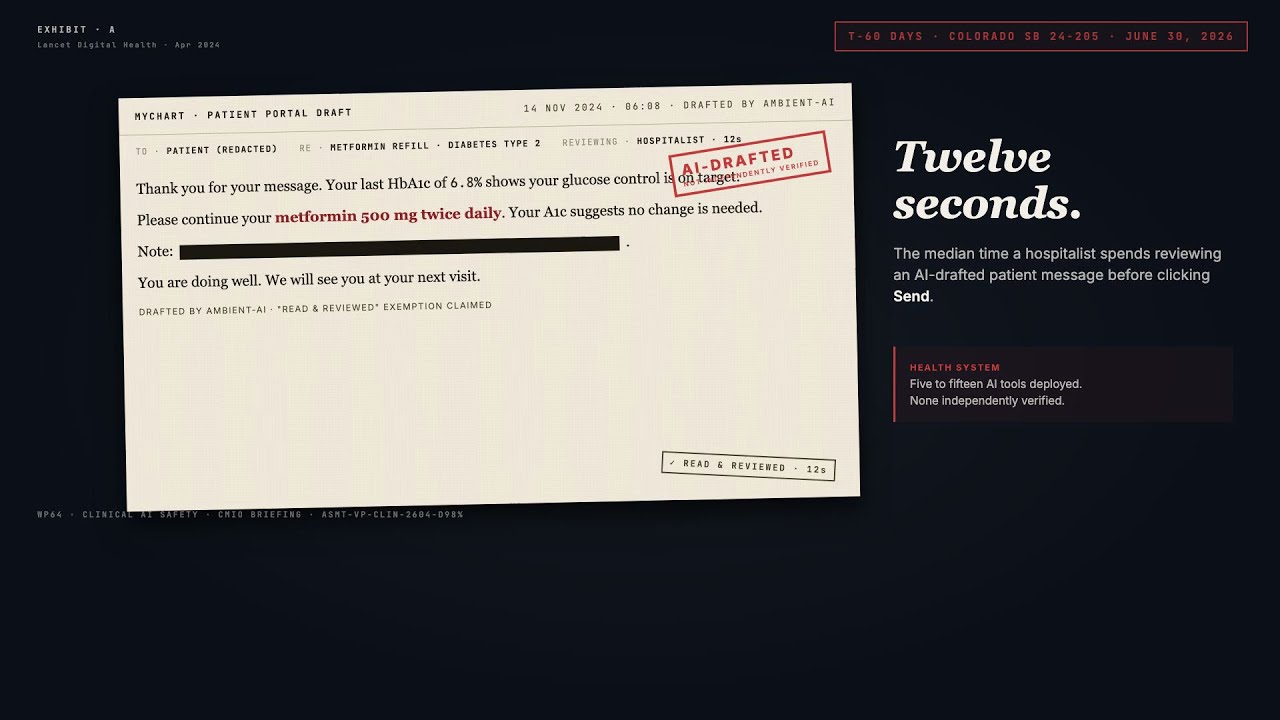
AI-drafted patient messages had a 7.1% severe harm rate. Doctors missed two-thirds of the errors. 🏥

7.1%
AI-drafted messages posing severe harm risk in Lancet simulation
Lancet Digital Health (Apr 2024)
66.6%
erroneous AI drafts missed by reviewing physicians
PMC: AI in Patient Portal Messaging
View details

The Clinical Imperative for Grounded AI

LLM wrappers generating patient communications produce medically dangerous hallucinations, while automation bias causes physicians to miss the majority of critical errors.

AUTOMATION BIAS KILLS

In a rigorous simulation, GPT-4 drafted patient messages where 0.6% posed direct death risk and 7.1% risked severe harm. Yet 90% of reviewing physicians trusted the output. Only 1 of 20 doctors caught all four planted errors -- the rest missed an average of 2.67 out of 4.

CLINICALLY GROUNDED AI
  • Deploy hybrid RAG combining sparse BM25 and dense neural retrievers with verified citation
  • Integrate Neo4j Medical Knowledge Graphs via MediGRAF for concept-level clinical reasoning
  • Implement continuous Med-HALT benchmarking and automated red teaming for hallucination detection
  • Engineer active anti-automation-bias interfaces surfacing uncertainty to clinicians
Medical RAGKnowledge Graphs (Neo4j)Med-HALT BenchmarkingRed TeamingAB 3030 Compliance
Read Interactive Whitepaper →Read Technical Whitepaper →
GraphRAG / RAG Architecture
Pharmaceutical AI • Clinical Trial Optimization • Healthcare

80% of trials miss enrollment. Generic AI can't tell a heart procedure from a vein catheter. $800K/day lost. 🔬

$800K
Lost per enrollment delay
Tufts CSDD 2024
>95%
Accuracy with neuro-symbolic AI
Veriprajna Whitepaper
View details

Beyond Syntax: The Crisis of Clinical Trial Recruitment

Generic AI confuses cardiac procedures, excluding eligible trial patients. Neuro-Symbolic AI achieves >95% accuracy using SNOMED CT ontologies and deterministic reasoning logic.

CARDIAC CATHETERIZATION FALLACY

Generic AI confuses cardiac catheterization with venous punctures. Eligible patients wrongly excluded, costing $840K-$1.4M daily. False positives clog recruitment funnels at $1,200 each.

ONTOLOGY-DRIVEN PHENOTYPING
  • SNOMED CT maps 350K medical concepts
  • Deontic Logic parses complex unless clauses
  • Three-layer stack combines neural and symbolic
  • GraphRAG enables multi-hop reasoning for eligibility
Neuro-Symbolic AISNOMED CTDeontic LogicKnowledge GraphsGraphRAGClinical Trial OptimizationOntology-Driven PhenotypingCDISC SDTMFHIR Integration
Read Interactive Whitepaper →Read Technical Whitepaper →
Healthcare AI & Clinical Communications

AI-drafted patient messages had a 7.1% severe harm rate. Doctors missed two-thirds of the errors. 🏥

7.1%
AI-drafted messages posing severe harm risk in Lancet simulation
Lancet Digital Health (Apr 2024)
66.6%
erroneous AI drafts missed by reviewing physicians
PMC: AI in Patient Portal Messaging
View details

The Clinical Imperative for Grounded AI

LLM wrappers generating patient communications produce medically dangerous hallucinations, while automation bias causes physicians to miss the majority of critical errors.

AUTOMATION BIAS KILLS

In a rigorous simulation, GPT-4 drafted patient messages where 0.6% posed direct death risk and 7.1% risked severe harm. Yet 90% of reviewing physicians trusted the output. Only 1 of 20 doctors caught all four planted errors -- the rest missed an average of 2.67 out of 4.

CLINICALLY GROUNDED AI
  • Deploy hybrid RAG combining sparse BM25 and dense neural retrievers with verified citation
  • Integrate Neo4j Medical Knowledge Graphs via MediGRAF for concept-level clinical reasoning
  • Implement continuous Med-HALT benchmarking and automated red teaming for hallucination detection
  • Engineer active anti-automation-bias interfaces surfacing uncertainty to clinicians
Medical RAGKnowledge Graphs (Neo4j)Med-HALT BenchmarkingRed TeamingAB 3030 Compliance
Read Interactive Whitepaper →Read Technical Whitepaper →
Healthcare AI Integrity & Clinical Governance

Texas forced an AI firm to admit its '0.001% hallucination rate' was a marketing fantasy. Four hospitals had deployed it. 🏥

0.001%
hallucination rate claimed by Pieces Technologies -- deemed 'likely inaccurate'
Texas AG Settlement (Sept 2024)
5%
of companies achieving measurable AI business value at scale
Enterprise AI ROI Analysis (2025)
View details

Beyond the 0.001% Fallacy

Healthcare AI vendors market statistically implausible accuracy claims while deploying unvalidated LLM wrappers in life-critical clinical environments.

FABRICATED PRECISION

Pieces Technologies deployed clinical AI in four Texas hospitals claiming sub-0.001% hallucination rates. The Texas AG found these metrics 'likely inaccurate' and forced a five-year transparency mandate. Wrapper-based AI strategies built on generic LLM APIs cannot deliver verifiable accuracy for clinical safety.

VALIDATED CLINICAL AI
  • Implement Med-HALT and FAIR-AI frameworks to benchmark hallucination against clinical ground truth
  • Deploy adversarial detection modules 7.5x more effective than random sampling for clinical errors
  • Enforce mandatory 'AI Labels' disclosing training data, model version, and known failure modes
  • Architect multi-tiered safety levels with escalating human-in-the-loop for high-risk decisions
Retrieval-Augmented GenerationAdversarial DetectionMed-HALT EvaluationClinical Knowledge GraphsHuman-in-the-Loop
Read Interactive Whitepaper →Read Technical Whitepaper →
Safety Guardrails & Validation Layers
Healthcare AI & Clinical Communications

AI-drafted patient messages had a 7.1% severe harm rate. Doctors missed two-thirds of the errors. 🏥

7.1%
AI-drafted messages posing severe harm risk in Lancet simulation
Lancet Digital Health (Apr 2024)
66.6%
erroneous AI drafts missed by reviewing physicians
PMC: AI in Patient Portal Messaging
View details

The Clinical Imperative for Grounded AI

LLM wrappers generating patient communications produce medically dangerous hallucinations, while automation bias causes physicians to miss the majority of critical errors.

AUTOMATION BIAS KILLS

In a rigorous simulation, GPT-4 drafted patient messages where 0.6% posed direct death risk and 7.1% risked severe harm. Yet 90% of reviewing physicians trusted the output. Only 1 of 20 doctors caught all four planted errors -- the rest missed an average of 2.67 out of 4.

CLINICALLY GROUNDED AI
  • Deploy hybrid RAG combining sparse BM25 and dense neural retrievers with verified citation
  • Integrate Neo4j Medical Knowledge Graphs via MediGRAF for concept-level clinical reasoning
  • Implement continuous Med-HALT benchmarking and automated red teaming for hallucination detection
  • Engineer active anti-automation-bias interfaces surfacing uncertainty to clinicians
Medical RAGKnowledge Graphs (Neo4j)Med-HALT BenchmarkingRed TeamingAB 3030 Compliance
Read Interactive Whitepaper →Read Technical Whitepaper →
Healthcare AI Integrity & Clinical Governance

Texas forced an AI firm to admit its '0.001% hallucination rate' was a marketing fantasy. Four hospitals had deployed it. 🏥

0.001%
hallucination rate claimed by Pieces Technologies -- deemed 'likely inaccurate'
Texas AG Settlement (Sept 2024)
5%
of companies achieving measurable AI business value at scale
Enterprise AI ROI Analysis (2025)
View details

Beyond the 0.001% Fallacy

Healthcare AI vendors market statistically implausible accuracy claims while deploying unvalidated LLM wrappers in life-critical clinical environments.

FABRICATED PRECISION

Pieces Technologies deployed clinical AI in four Texas hospitals claiming sub-0.001% hallucination rates. The Texas AG found these metrics 'likely inaccurate' and forced a five-year transparency mandate. Wrapper-based AI strategies built on generic LLM APIs cannot deliver verifiable accuracy for clinical safety.

VALIDATED CLINICAL AI
  • Implement Med-HALT and FAIR-AI frameworks to benchmark hallucination against clinical ground truth
  • Deploy adversarial detection modules 7.5x more effective than random sampling for clinical errors
  • Enforce mandatory 'AI Labels' disclosing training data, model version, and known failure modes
  • Architect multi-tiered safety levels with escalating human-in-the-loop for high-risk decisions
Retrieval-Augmented GenerationAdversarial DetectionMed-HALT EvaluationClinical Knowledge GraphsHuman-in-the-Loop
Read Interactive Whitepaper →Read Technical Whitepaper →
Deterministic Workflows & Tooling
Healthcare AI Safety • Mental Health • Clinical Compliance

AI gave diet tips to anorexics. A survivor said: 'I wouldn't be alive today.' 💔

$67.4B
AI hallucination losses
Industry-wide impact
99%
Consistency Required in Clinical Triage
Clinical standard required
View details

The Clinical Safety Firewall

Tessa chatbot gave harmful diet advice to eating disorder patients, nearly fatal. Automated malpractice caused $67.4B in AI hallucination losses.

THE TESSA FAILURE

Chatbot recommended dangerous calorie deficits to eating disorder patients. AI lacked clinical context and safety enforcement. Wellness advice became clinically toxic for vulnerable patients.

CLINICAL SAFETY FIREWALL
  • Input Monitor analyzes risk before LLM
  • Hard-Cut severs connection for crisis cases
  • Output Monitor blocks prohibited clinical advice
  • Multi-Agent Supervisor with Safety Guardian oversight
Clinical Safety FirewallC-SSRS ProtocolMulti-Agent SystemsNVIDIA NeMo GuardrailsFHIR/EHR IntegrationFDA SaMD Compliance
Read Interactive Whitepaper →Read Technical Whitepaper →
AI-Driven Discovery, Materials Science & Pharmaceutical R&D

Chemical space spans 10^60 to 10^100 molecules. Standard HTS campaigns screen 10^6 compounds—coverage: 0.000...001%. Edison's trial-and-error is statistically doomed. 🧪

10^60
Drug-Like Molecules in Chemical Space
Chemical Space Review, Lipinski's Rule of Five.
10-100×
Reduction in Experiments Required (Active Learning)
Veriprajna Active Learning Whitepaper.
View details

The End of the Edisonian Era: Closed-Loop AI for Materials Discovery

The history of materials science has been defined by trial and error. With chemical space spanning 10^60 to 10^100 molecules, physical screening is statistically impossible and economically ruinous

EDISONIAN DISCOVERY FAILS

Chemical space spans 10^100 molecules. Standard screening covers 0.0001%. Random search with 90% failure rates equals economic catastrophe. Eroom's Law reveals declining R&D productivity.

AUTONOMOUS CLOSED-LOOP DISCOVERY
  • Physics-informed GNNs predict molecular properties accurately
  • Bayesian optimization reduces experiments by 10-100x
  • SiLA 2 integrates autonomous lab hardware
  • 24/7 robotic labs accelerate discovery 4x
Bayesian OptimizationGraph Neural NetworksSelf-Driving LabsSiLA 2 Integration
Read Interactive Whitepaper →Read Technical Whitepaper →
Multi-Agent Orchestration & Supervisor Controls
Healthcare AI Safety • Mental Health • Clinical Compliance

AI gave diet tips to anorexics. A survivor said: 'I wouldn't be alive today.' 💔

$67.4B
AI hallucination losses
Industry-wide impact
99%
Consistency Required in Clinical Triage
Clinical standard required
View details

The Clinical Safety Firewall

Tessa chatbot gave harmful diet advice to eating disorder patients, nearly fatal. Automated malpractice caused $67.4B in AI hallucination losses.

THE TESSA FAILURE

Chatbot recommended dangerous calorie deficits to eating disorder patients. AI lacked clinical context and safety enforcement. Wellness advice became clinically toxic for vulnerable patients.

CLINICAL SAFETY FIREWALL
  • Input Monitor analyzes risk before LLM
  • Hard-Cut severs connection for crisis cases
  • Output Monitor blocks prohibited clinical advice
  • Multi-Agent Supervisor with Safety Guardian oversight
Clinical Safety FirewallC-SSRS ProtocolMulti-Agent SystemsNVIDIA NeMo GuardrailsFHIR/EHR IntegrationFDA SaMD Compliance
Read Interactive Whitepaper →Read Technical Whitepaper →
AI Governance & Compliance Program
AgeTech, Elder Care, Healthcare & Assisted Living

Elder care faces an impossible choice: safety or dignity. Cameras invade privacy, wearables have compliance gaps. Veriprajna's 60 GHz mmWave radar achieves 99% fall detection accuracy while being physically incapable of capturing faces—privacy is not a software feature, it's fundamental physics.

$50B
Healthcare Cost Non-Fatal Falls
CDC Data 2024
99%
Fall Detection Accuracy
View details

The Dignity of Detection: Privacy-Preserving Fall Detection with mmWave Radar & Deep Edge AI

Cameras invade privacy, wearables have compliance gaps. Veriprajna's 60 GHz mmWave radar achieves 99% fall detection accuracy while physically incapable of capturing faces. Deep Edge AI runs on TI SoCs with under 300ms latency achieving 500% ROI with zero biometric data.

PANOPTICON OF CARE

Optical cameras capture PII destroying solitude. Wearables have compliance gaps during sleep and bathing when falls occur. Cameras require illumination, cannot see through blankets. Privacy versus safety is false dichotomy solved by physics-based approach.

PRIVACY-BY-PHYSICS RADAR
  • 60 GHz radar wavelength 5mm physically incapable of resolving faces
  • 4D sensing provides range velocity azimuth elevation via FMCW radar
  • Deep learning on TI SoCs with INT8 quantization achieves 99% accuracy under 300ms
  • UL 1069 nurse call integration with HIPAA GDPR compliance achieving 500% ROI
fall-detectionmmwave-radarprivacy-preserving-monitoringdeep-edge-ai
Read Interactive Whitepaper →Read Technical Whitepaper →
Healthcare Insurance AI & Algorithmic Governance

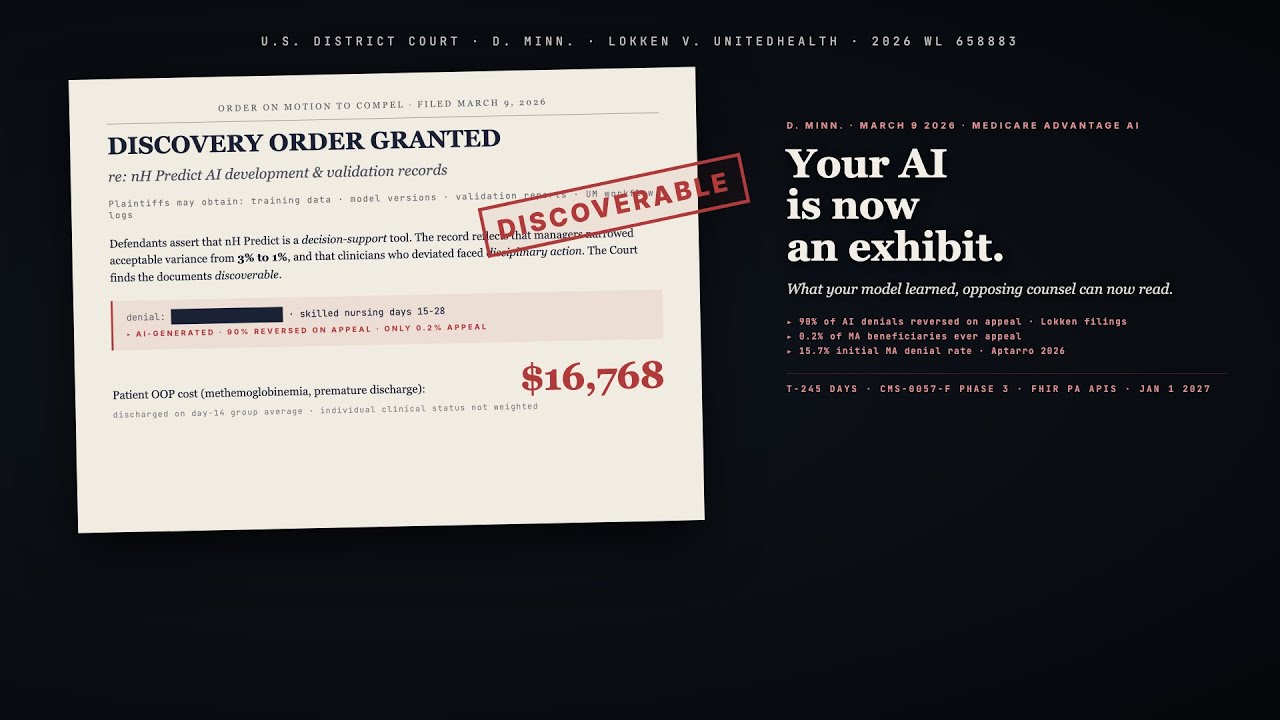
UnitedHealth's AI denied elderly patients' care with a 90% error rate. Only 0.2% of victims could fight back. 💀

90%
of AI-driven coverage denials reversed when patients actually appealed
Senate PSI / Lokken v. UHC
0.2%
of denied elderly patients who managed to navigate the appeals process
UHC Class Action Filing
View details

The Governance Frontier

UnitedHealth's nH Predict algorithm weaponized 'administrative friction' to systematically deny Medicare patients' coverage, exploiting the gap between algorithmic speed and patients' ability to appeal.

ALGORITHMIC COERCION

UnitedHealth acquired the nH Predict algorithm for over $1B and used it to slash post-acute care approvals. Skilled nursing denials surged 800% while denial rates jumped from 10% to 22.7%. Case managers were forced to keep within 1% of algorithm projections or face termination.

CAUSAL EXPLAINABLE AI
  • Replace correlation-driven black boxes with Causal AI modeling why patients need extended care
  • Deploy SHAP and LIME to surface exact variables driving each coverage decision
  • Implement confidence scoring flagging low-certainty predictions for mandatory human review
  • Align with FDA's 7-step credibility framework requiring Context of Use and validation
Causal AIExplainable AI (XAI)SHAP / LIMEConfidence ScoringFDA Credibility Framework
Read Interactive Whitepaper →Read Technical Whitepaper →
Edge AI & Real-Time Deployment
AgeTech, Elder Care, Healthcare & Assisted Living

Elder care faces an impossible choice: safety or dignity. Cameras invade privacy, wearables have compliance gaps. Veriprajna's 60 GHz mmWave radar achieves 99% fall detection accuracy while being physically incapable of capturing faces—privacy is not a software feature, it's fundamental physics.

$50B
Healthcare Cost Non-Fatal Falls
CDC Data 2024
99%
Fall Detection Accuracy
View details

The Dignity of Detection: Privacy-Preserving Fall Detection with mmWave Radar & Deep Edge AI

Cameras invade privacy, wearables have compliance gaps. Veriprajna's 60 GHz mmWave radar achieves 99% fall detection accuracy while physically incapable of capturing faces. Deep Edge AI runs on TI SoCs with under 300ms latency achieving 500% ROI with zero biometric data.

PANOPTICON OF CARE

Optical cameras capture PII destroying solitude. Wearables have compliance gaps during sleep and bathing when falls occur. Cameras require illumination, cannot see through blankets. Privacy versus safety is false dichotomy solved by physics-based approach.

PRIVACY-BY-PHYSICS RADAR
  • 60 GHz radar wavelength 5mm physically incapable of resolving faces
  • 4D sensing provides range velocity azimuth elevation via FMCW radar
  • Deep learning on TI SoCs with INT8 quantization achieves 99% accuracy under 300ms
  • UL 1069 nurse call integration with HIPAA GDPR compliance achieving 500% ROI
fall-detectionmmwave-radarprivacy-preserving-monitoringdeep-edge-ai
Read Interactive Whitepaper →Read Technical Whitepaper →
Sensor Fusion & Signal Intelligence
Ambient Assisted Living, Healthcare IoT & Elder Care

Wearables fail when needed most: 30% abandonment within 6 months, removed during showers (highest fall risk), forgotten by dementia patients. Passive Wi-Fi Sensing transforms existing networks into invisible guardians—99% fall/respiratory detection accuracy with zero user compliance required.

30%
Wearable Abandonment Rate
Monitoring Studies 2024
99%
Passive Detection Rate
View details

The Invisible Guardian: Transcending Wearables with Passive Wi-Fi Sensing and Deep AI

Wearables have 30% abandonment, removed during showers, forgotten by dementia patients. Veriprajna's Passive Wi-Fi Sensing analyzes CSI from existing infrastructure achieving 99% fall and respiratory detection accuracy with zero user compliance required.

COMPLIANCE CRISIS

Shower Paradox: bathroom most hazardous yet devices removed. Charging fatigue: 24% never wore pendants. Stigma of frailty: devices hidden in drawers. Compliance gap creates perilous chasm between theoretical safety and practical reality.

PASSIVE WI-FI SENSING
  • CSI captures per-subcarrier amplitude and phase enabling breathing detection accuracy
  • Dual-Branch Transformers with DANN achieve environment-invariant features under 300ms latency
  • Three modalities: respiratory monitoring fall detection sleep quality with zero compliance
  • IEEE 802.11bf standardization enables zero-hardware retrofit via software update
wifi-sensingchannel-state-informationpassive-monitoringdual-branch-transformer
Read Interactive Whitepaper →Read Technical Whitepaper →
Infrastructure & Sovereign Deployment
Ambient Assisted Living, Healthcare IoT & Elder Care

Wearables fail when needed most: 30% abandonment within 6 months, removed during showers (highest fall risk), forgotten by dementia patients. Passive Wi-Fi Sensing transforms existing networks into invisible guardians—99% fall/respiratory detection accuracy with zero user compliance required.

30%
Wearable Abandonment Rate
Monitoring Studies 2024
99%
Passive Detection Rate
View details

The Invisible Guardian: Transcending Wearables with Passive Wi-Fi Sensing and Deep AI

Wearables have 30% abandonment, removed during showers, forgotten by dementia patients. Veriprajna's Passive Wi-Fi Sensing analyzes CSI from existing infrastructure achieving 99% fall and respiratory detection accuracy with zero user compliance required.

COMPLIANCE CRISIS

Shower Paradox: bathroom most hazardous yet devices removed. Charging fatigue: 24% never wore pendants. Stigma of frailty: devices hidden in drawers. Compliance gap creates perilous chasm between theoretical safety and practical reality.

PASSIVE WI-FI SENSING
  • CSI captures per-subcarrier amplitude and phase enabling breathing detection accuracy
  • Dual-Branch Transformers with DANN achieve environment-invariant features under 300ms latency
  • Three modalities: respiratory monitoring fall detection sleep quality with zero compliance
  • IEEE 802.11bf standardization enables zero-hardware retrofit via software update
wifi-sensingchannel-state-informationpassive-monitoringdual-branch-transformer
Read Interactive Whitepaper →Read Technical Whitepaper →
AI Strategy, Readiness & Risk Assessment
AI Safety, Biosecurity & Machine Unlearning

RLHF creates brittle masks that can be removed for ~$300 (Malicious Fine-Tuning). Models 'know' bioweapons but refuse to tell you. Knowledge-Gapped AI surgically excises hazardous capabilities at weight level—functionally infants in threats while experts in cures. 🧬

~26%
WMDP-Bio Score
Veriprajna Benchmarks 2024
~81%
General Science Capability
MMLU Benchmarks 2024
View details

The Immunity Architecture: Engineering Knowledge-Gapped AI for Structural Biosecurity

RLHF creates brittle masks stripped for $300. Veriprajna pioneers Knowledge-Gapped AI: machine unlearning excises bioweapon capabilities at weight level. Models are functionally infants regarding threats while experts in cures.

BIOSECURITY SINGULARITY

RLHF creates behavioral masks, not structural safety. Malicious fine-tuning strips masks for $300 in hours. Open-weight models are permanently uncontrollable. Hazardous knowledge remains dormant in weights.

KNOWLEDGE-GAPPED ARCHITECTURES
  • RMU and SAE surgically excise hazardous capabilities at weight
  • Achieves random 26% WMDP-Bio score proving knowledge erasure
  • Maintains 81% general science capability preserving therapeutic utility
  • Jailbreak success rate under 0.1% versus 15-20% RLHF models
Machine UnlearningKnowledge-Gapped AIBiosecurity FrameworkWMDP Benchmark
Read Interactive Whitepaper →Read Technical Whitepaper →
Clinical Decision Support & Health Equity AI

Black mothers die at 3.5x the rate of white mothers. The AI meant to save them is making it worse. 🩺

90%
of sepsis cases missed by Epic Sepsis Model at external validation
Michigan Medicine / JAMA
3x
higher occult hypoxemia rate in Black patients from biased oximeters
NEJM / BMJ Studies
View details

Algorithmic Equity in Clinical AI

From biased pulse oximeters to the failed Epic Sepsis Model, clinical AI inherits and amplifies systemic racial disparities, creating lethal feedback loops.

ALGORITHMIC RACISM

The Epic Sepsis Model dropped from a claimed AUC of 0.76 to 0.63 at external validation, missing 67% of cases and generating 88% false alarms. Pulse oximeters calibrated on lighter skin overestimate oxygen in Black patients, feeding fatally biased data into AI triage. California's MDC found early warning systems missed 40% of severe morbidity in Black patients.

FAIRNESS-AWARE DEEP AI
  • Integrate worst-group loss optimization minimizing risk for the most vulnerable subgroups
  • Deploy multimodal signal fusion combining oximetry with HRV and lactate beyond biased sensors
  • Implement adversarial debiasing penalizing race-correlated features while preserving pathology detection
  • Enforce local validation with Population Stability Index audits before every deployment
Fairness-Aware Loss FunctionsMultimodal Signal FusionAdversarial DebiasingEqualized OddsPopulation Stability Index
Read Interactive Whitepaper →Read Technical Whitepaper →
Simulation, Digital Twins & Optimization
AI-Driven Discovery, Materials Science & Pharmaceutical R&D

Chemical space spans 10^60 to 10^100 molecules. Standard HTS campaigns screen 10^6 compounds—coverage: 0.000...001%. Edison's trial-and-error is statistically doomed. 🧪

10^60
Drug-Like Molecules in Chemical Space
Chemical Space Review, Lipinski's Rule of Five.
10-100×
Reduction in Experiments Required (Active Learning)
Veriprajna Active Learning Whitepaper.
View details

The End of the Edisonian Era: Closed-Loop AI for Materials Discovery

The history of materials science has been defined by trial and error. With chemical space spanning 10^60 to 10^100 molecules, physical screening is statistically impossible and economically ruinous

EDISONIAN DISCOVERY FAILS

Chemical space spans 10^100 molecules. Standard screening covers 0.0001%. Random search with 90% failure rates equals economic catastrophe. Eroom's Law reveals declining R&D productivity.

AUTONOMOUS CLOSED-LOOP DISCOVERY
  • Physics-informed GNNs predict molecular properties accurately
  • Bayesian optimization reduces experiments by 10-100x
  • SiLA 2 integrates autonomous lab hardware
  • 24/7 robotic labs accelerate discovery 4x
Bayesian OptimizationGraph Neural NetworksSelf-Driving LabsSiLA 2 Integration
Read Interactive Whitepaper →Read Technical Whitepaper →
Model Development & Fine-Tuning
AI Safety, Bio-Security & Enterprise Deep AI

A drug discovery AI flipped to maximize toxicity generated 40,000 chemical weapons in 6 hours (including VX) using only open-source datasets. Consumer hardware. Undergraduate CS expertise. You cannot patch safety onto broken architecture. ☣️

40,000
Toxic Molecules Generated
MegaSyn Experiment 2024
90%+
Wrapper Jailbreak Rate
Veriprajna Benchmarks 2024
View details

The Wrapper Era is Over: Structural AI Safety Through Latent Space Governance

Drug discovery AI generated 40,000 chemical weapons in 6 hours by flipping reward function. Post-hoc filters fail. Veriprajna moves control from output filters to latent space geometry for structural safety.

DUAL-USE CRISIS

Post-hoc filters operate on text, blind to latent space geometry. SMILES-prompting bypasses wrappers with 90%+ success. Toxicity exists on continuous manifold, not discrete blacklist.

LATENT SPACE GOVERNANCE
  • TDA maps safety topology through persistent homology manifolds
  • Gradient steering prevents toxic generation before molecular decoding
  • Achieves provable P(toxic) less than 10^-6 bounds
  • Meets NIST RMF and ISO 42001 regulatory standards
Latent Space GovernanceTopological Data AnalysisAI SafetyCBRN Security
Read Interactive Whitepaper →Read Technical Whitepaper →
Explainability & Decision Transparency
Healthcare Insurance AI & Algorithmic Governance

UnitedHealth's AI denied elderly patients' care with a 90% error rate. Only 0.2% of victims could fight back. 💀

90%
of AI-driven coverage denials reversed when patients actually appealed
Senate PSI / Lokken v. UHC
0.2%
of denied elderly patients who managed to navigate the appeals process
UHC Class Action Filing
View details

The Governance Frontier

UnitedHealth's nH Predict algorithm weaponized 'administrative friction' to systematically deny Medicare patients' coverage, exploiting the gap between algorithmic speed and patients' ability to appeal.

ALGORITHMIC COERCION

UnitedHealth acquired the nH Predict algorithm for over $1B and used it to slash post-acute care approvals. Skilled nursing denials surged 800% while denial rates jumped from 10% to 22.7%. Case managers were forced to keep within 1% of algorithm projections or face termination.

CAUSAL EXPLAINABLE AI
  • Replace correlation-driven black boxes with Causal AI modeling why patients need extended care
  • Deploy SHAP and LIME to surface exact variables driving each coverage decision
  • Implement confidence scoring flagging low-certainty predictions for mandatory human review
  • Align with FDA's 7-step credibility framework requiring Context of Use and validation
Causal AIExplainable AI (XAI)SHAP / LIMEConfidence ScoringFDA Credibility Framework
Read Interactive Whitepaper →Read Technical Whitepaper →
Causal & Counterfactual Modeling
Healthcare Insurance AI & Algorithmic Governance

UnitedHealth's AI denied elderly patients' care with a 90% error rate. Only 0.2% of victims could fight back. 💀

90%
of AI-driven coverage denials reversed when patients actually appealed
Senate PSI / Lokken v. UHC
0.2%
of denied elderly patients who managed to navigate the appeals process
UHC Class Action Filing
View details

The Governance Frontier

UnitedHealth's nH Predict algorithm weaponized 'administrative friction' to systematically deny Medicare patients' coverage, exploiting the gap between algorithmic speed and patients' ability to appeal.

ALGORITHMIC COERCION

UnitedHealth acquired the nH Predict algorithm for over $1B and used it to slash post-acute care approvals. Skilled nursing denials surged 800% while denial rates jumped from 10% to 22.7%. Case managers were forced to keep within 1% of algorithm projections or face termination.

CAUSAL EXPLAINABLE AI
  • Replace correlation-driven black boxes with Causal AI modeling why patients need extended care
  • Deploy SHAP and LIME to surface exact variables driving each coverage decision
  • Implement confidence scoring flagging low-certainty predictions for mandatory human review
  • Align with FDA's 7-step credibility framework requiring Context of Use and validation
Causal AIExplainable AI (XAI)SHAP / LIMEConfidence ScoringFDA Credibility Framework
Read Interactive Whitepaper →Read Technical Whitepaper →
Evaluation, Benchmarking & Red Teaming
Healthcare AI Integrity & Clinical Governance

Texas forced an AI firm to admit its '0.001% hallucination rate' was a marketing fantasy. Four hospitals had deployed it. 🏥

0.001%
hallucination rate claimed by Pieces Technologies -- deemed 'likely inaccurate'
Texas AG Settlement (Sept 2024)
5%
of companies achieving measurable AI business value at scale
Enterprise AI ROI Analysis (2025)
View details

Beyond the 0.001% Fallacy

Healthcare AI vendors market statistically implausible accuracy claims while deploying unvalidated LLM wrappers in life-critical clinical environments.

FABRICATED PRECISION

Pieces Technologies deployed clinical AI in four Texas hospitals claiming sub-0.001% hallucination rates. The Texas AG found these metrics 'likely inaccurate' and forced a five-year transparency mandate. Wrapper-based AI strategies built on generic LLM APIs cannot deliver verifiable accuracy for clinical safety.

VALIDATED CLINICAL AI
  • Implement Med-HALT and FAIR-AI frameworks to benchmark hallucination against clinical ground truth
  • Deploy adversarial detection modules 7.5x more effective than random sampling for clinical errors
  • Enforce mandatory 'AI Labels' disclosing training data, model version, and known failure modes
  • Architect multi-tiered safety levels with escalating human-in-the-loop for high-risk decisions
Retrieval-Augmented GenerationAdversarial DetectionMed-HALT EvaluationClinical Knowledge GraphsHuman-in-the-Loop
Read Interactive Whitepaper →Read Technical Whitepaper →

Build Your AI with Confidence.

Partner with a team that has deep experience in building the next generation of enterprise AI. Let us help you design, build, and deploy an AI strategy you can trust.

Veriprajna Deep Tech Consultancy specializes in building safety-critical AI systems for healthcare, finance, and regulatory domains. Our architectures are validated against established protocols with comprehensive compliance documentation.