Aerospace and Defense AI That Passes Verification, Not Just Demos
AI verification, edge inference, and autonomous systems architecture for defense programs and commercial aerospace operations.
The Department of Defense made AI a funded priority, but defense acquisition was never built to procure, test, or field AI systems at the speed the technology moves. Our work focuses on the point where AI meets operational requirements for defense program offices and aerospace organizations — not strategy decks, not governance frameworks in slide format, but the engineering discipline of getting AI systems verified, fielded, and compliant in environments where failure has consequences that commercial deployments never face.
The FY2026 AI Budget Is Real; the Ability to Spend It Is Not
The Pentagon allocated $13.4 billion in the FY2026 budget request for AI and autonomy — the first dedicated budget line for these capabilities. Congress enacted $9.8 billion toward autonomous and unmanned systems. The Navy alone added $308 million in AI spending, a 22.7% year-over-year jump. The money is real. The problem is that defense acquisition was not built to procure, test, or field AI systems at the speed the technology moves.
These are production programs, not pilots:
- The Army awarded Anduril a 10-year, up to $20 billion contract in March 2026 for its Lattice AI platform, consolidating over 120 separate procurement actions.
- Palantir delivered the first two TITAN AI-enabled targeting ground stations to the 1st Multi-Domain Task Force, with a full-rate production decision expected this fiscal year.
- Shield AI's Hivemind autonomy software has now piloted 26 vehicle classes.
- The Air Force is testing mission autonomy packages on CCA prototypes with $804.4 million in FY26 combined funding.
But program offices integrating AI into their own systems face a different reality: CDAO test and evaluation frameworks that don't map cleanly to traditional TEMP structures, responsible AI requirements that sound clear in policy memos but turn ambiguous when applied to a specific sensor fusion algorithm, and a cleared AI/ML workforce that does not exist at the scale programs need.
Defense AI Has a Testing Problem Traditional T&E Cannot Solve
Traditional test and evaluation assumes deterministic behavior: the same inputs produce the same outputs. ML-based systems are probabilistic. A computer vision model that classifies vehicles at 97% accuracy on the test range may degrade unpredictably when EW effects change the input distribution (see our technical research on engineering AI robustness against adversarial attacks).
The policy landscape is still catching up. CDAO published T&E strategy frameworks, and Deputy Secretary Feinberg realigned CDAO under USD(R&E) in August 2025 to accelerate adoption. But an April 2026 GAO audit found none of the four major agencies examined were collecting lessons learned from AI acquisitions. The DoD AI strategy released in January 2026 emphasizes speed, while the safety community warns that agentic military AI creates an "illusion of control" where systems resist assessments in ways operators cannot observe.
Our approach is to build AI T&E methodology designed to produce the verification evidence program managers need for milestone decisions: operational testing under realistic adversarial conditions, and documented failure modes and performance boundaries in language intended to satisfy both the test community and the operational community. For autonomous systems in GPS-denied or EW-contested environments, we design validation for sensor fusion resilience and autonomous decision-making against specific threat profiles rather than idealized test conditions — an approach shown in a working demo of GPS-denied drone autonomy.
Edge Inference on Defense Hardware Is an Engineering Problem
A transformer model running on an A100 in a data center is useless on a UAV payload constrained by size, weight, and power. The compute budget on a Jetson Orin or Qualcomm RB5 is measured in single-digit TOPS. Thermal management is now a primary constraint: inference heat degrades performance by half in enclosed platforms.
Getting from cloud model to fielded edge model requires:
- Quantization — INT8, INT4, and the GPTQ / AWQ trade-offs that matter for both accuracy and latency;
- Pruning and knowledge distillation;
- Validation under MIL-STD-810H environmental conditions.
Security-driven restrictions on open-source tooling within classified networks compound the problem: the MLOps pipeline that works in commercial cloud does not work on SIPR or JWICS. We design edge inference pipelines to account for these constraints from the start — model optimization for specific target hardware, inference benchmarking under thermal and power constraints, and validation workflows built for the classified network environments (SIPR or JWICS as target boundaries) these systems are intended to run in (detailed in our technical whitepaper on GPS-denied navigation for autonomous drones).
CMMC 2.0 Now Includes AI, and 220,000 Contractors Are Not Ready
CMMC 2.0 compliance was already the dominant headache for defense contractors handling CUI. In 2026, it got harder. The FY2026 NDAA imposed an AI security framework on defense contractors, adding four categories of AI-specific security controls:
- Data input validation and sanitization to prevent prompt injection;
- Model access controls with multi-factor authentication;
- Comprehensive AI output monitoring and logging;
- Adversarial attack prevention measures.
The DoD must report progress to Congress by June 16, 2026. The challenge compounds because most commercial AI services operate in standard cloud environments that do not meet CUI processing requirements — running inference through a commercial API sends controlled data to infrastructure you do not control. Shadow AI is the biggest audit finding: undocumented AI tool usage by cleared personnel on networks connected to CUI.
Meanwhile, ITAR creates a parallel compliance problem most programs have not confronted. The State Department's DDTC and Commerce Department's BIS have not issued authoritative guidance on whether AI-generated technical data constitutes controlled exports under the USML. An engineer using an LLM to draft specifications for a defense article may be creating a deemed export without realizing it.
Our approach is to design compliance architectures that address CMMC 2.0 AI controls, ITAR technical data handling for AI workflows, and DFARS 252.204-7012 cybersecurity requirements as an integrated system rather than three separate checkbox exercises. The intent is an architecture that lets your engineering team use AI effectively while maintaining a compliance posture designed to meet the requirements of a C3PAO assessment and a DDTC audit.
Commercial Aerospace Faces the Same Technical Challenges
On the commercial side, airlines and MRO providers are investing in AI for predictive maintenance, fleet management, and supply chain integrity. Global commercial MRO demand is growing at 3.2% CAGR through 2035, with engine activity as the dominant aftermarket driver. AI-driven condition-based maintenance promises to anticipate equipment failures, reduce unscheduled downtime, and extend asset lifespans. The gap is integrating 30 years of heterogeneous sensor data across mixed fleets into models that produce actionable maintenance recommendations rather than noise.
Supply chain integrity has become urgent. In March 2026, a London court sentenced a supplier for distributing counterfeit electronic modules in critical avionics and control systems. The 2026 NDAA directs the Secretary of Defense to develop a framework addressing "counterfeit parts or data poisoning risks" in AI supply chains. Digital twins are moving from visualization tools to operational decision systems, but building one that actually reduces unscheduled maintenance requires continuous sensor data integration, validated physics-informed models, and a maintenance planning interface that dispatchers and mechanics trust enough to act on.
We aim to bring the same verification rigor to commercial aerospace that defense programs require: predictive maintenance models we design to validate against ground-truth failure data, not just train on it; supply chain verification pipelines built to catch anomalous components before they enter the maintenance chain; and digital twin architectures intended to produce reliable what-if analysis for fleet planning rather than impressive visualizations with unreliable predictions.
Why the Primes, Platform Vendors, and Consultancies All Leave Gaps
Three categories of provider each leave a different gap — and this work requires both ML engineering depth and defense domain fluency, a combination each of them lacks in its own way.
| Provider category | Examples | The gap they leave |
|---|---|---|
| Defense primes | Lockheed Martin, Northrop Grumman, Boeing | Building internal AI capabilities, but hardware-centric organizations. ML lifecycle management and AI T&E methodology are not core competencies for cultures built around mechanical and electrical systems — and the CCA competition demands autonomous flight software they have traditionally outsourced. |
| Platform vendors | Anduril, Shield AI, Palantir, Skydio | Build excellent autonomous products, but a program office that procures Lattice gets Anduril's architecture — not help evaluating whether Lattice fits their mission set or verifying it meets CDAO responsible AI requirements independently of vendor test results. |
| Consultancies | Accenture, Deloitte, Booz Allen | The Pentagon cancelled $5.1 billion in consulting contracts with them in April 2025. BCG found 70% of A&D companies cite AI recruitment as a core challenge — the large consultancies face the same talent gap they are hired to fill. |
The space we work in sits between these categories: vendor-neutral technical assessment of AI platforms, T&E methodology built to serve the program office, edge inference engineering intended to get cloud models onto tactical hardware, and compliance architecture that treats CMMC, ITAR, and RAI as integrated engineering constraints.
Key Takeaways
- Defense AI funding is now substantial ($13.4B for AI and autonomy, $9.8B for autonomous/unmanned systems), but acquisition, T&E, and a cleared AI/ML workforce lag the technology.
- ML systems are probabilistic, so traditional deterministic T&E cannot verify them — verification evidence for milestone decisions requires AI-specific methodology tested under realistic adversarial and GPS-denied/EW-contested conditions.
- Edge deployment on SWaP-constrained hardware (Jetson Orin, Qualcomm RB5) is an engineering problem: quantization, pruning, distillation, thermal profiling, and MIL-STD-810H validation targeting SIPR/JWICS boundaries.
- CMMC 2.0, the FY2026 NDAA AI controls (due to Congress June 16, 2026), ITAR/USML technical-data ambiguity, and DFARS 252.204-7012 must be handled as one integrated compliance architecture.
- Commercial aerospace shares the challenge — predictive maintenance, counterfeit-part/supply-chain integrity, and operational digital twins all demand validated, verification-first engineering.
Solutions for Aerospace & Defense
 Watch
WatchGPS-Denied Drone Autonomy: VIO, Edge AI and Blue UAS Integration
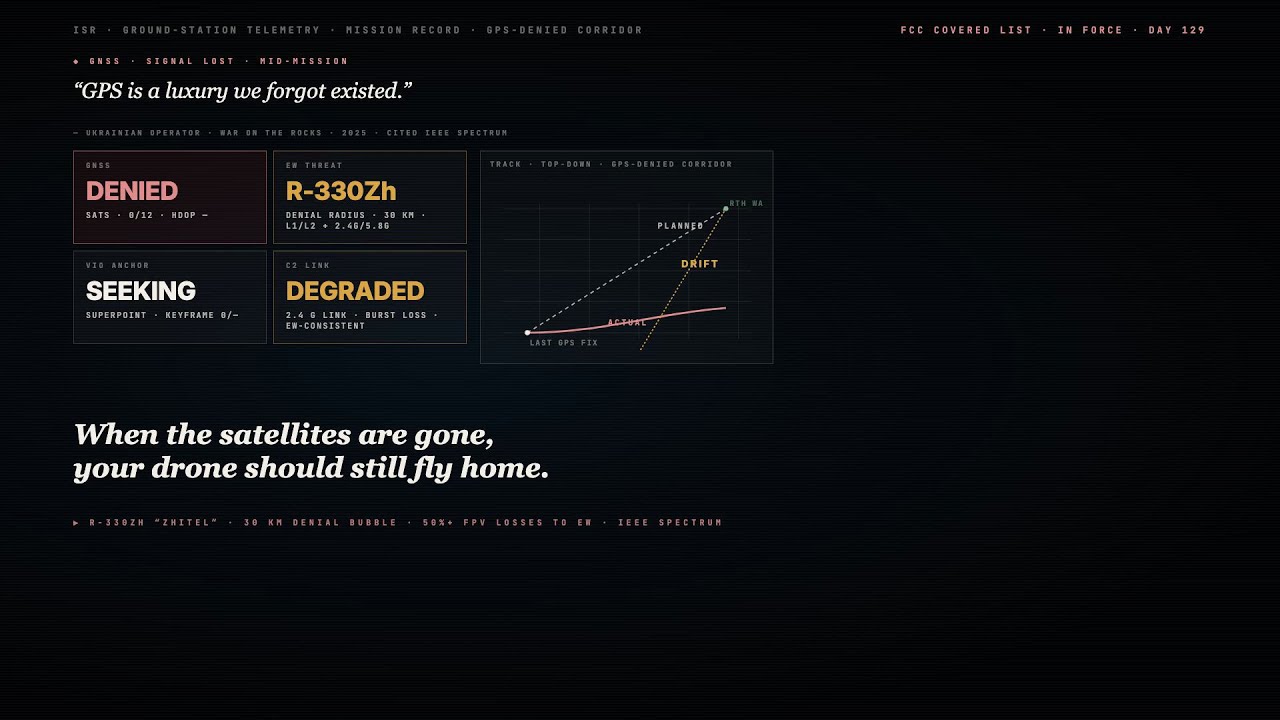
Russian R-330Zh jammers create multi-kilometer GPS blackout zones across Ukrainian front lines. The FCC blocked new authorizations for every foreign-made drone in December 2025. The Army just bought 2,500 Skydio X10D units in 72 hours because nothing else in the cleared inventory could handle a contested electromagnetic environment.
Frequently Asked Questions
How do we get an AI-enabled system through a DoD milestone decision when CDAO T&E frameworks don't map to our TEMP?
The disconnect is real: CDAO's T&E strategy frameworks were designed for AI-specific evaluation, but most program TEMPs follow the traditional DT&E/OT&E structure that assumes deterministic system behavior. ML-based systems are probabilistic, and their performance changes with data distribution, operational conditions, and adversarial inputs. We bridge this by building AI-specific test plans that nest inside existing TEMP structures. This means defining operational performance envelopes (not just benchmark accuracy), documenting known failure modes and performance boundaries under realistic conditions, and producing the verification evidence in formats that satisfy both the CDAO AI Assurance team and the program's operational test agency. The goal is a test package that demonstrates responsible AI compliance without requiring the milestone decision authority to become an ML expert.
What does the CMMC 2.0 AI security framework require for defense AI contractors?
The FY2026 NDAA imposed AI-specific security controls on defense contractors beyond baseline CMMC 2.0 requirements. There are four mandated control categories: data input validation and sanitization to prevent prompt injection attacks, model access controls with multi-factor authentication and role-based permissions, comprehensive AI output monitoring and logging integrated with SIEM systems, and adversarial attack prevention measures including continuous model validation and defensive testing. The DoD must provide a status update to Congress by June 16, 2026, which will clarify implementation timelines. The biggest compliance risk right now is shadow AI: undocumented usage of commercial AI tools by cleared personnel on networks connected to CUI. Commercial AI services typically operate in standard cloud environments that do not meet CUI processing requirements under DFARS 252.204-7012. We build compliance architectures that provide sanctioned AI capabilities within CMMC boundaries while implementing monitoring to detect and redirect unsanctioned usage.
How do we deploy cloud-trained ML models on SWaP-constrained tactical platforms?
The pipeline from cloud model to fielded edge model has four stages, each with trade-offs that affect operational performance. First, model optimization: quantization from FP32 to INT8 or INT4 reduces compute requirements but introduces accuracy degradation that varies by model architecture and task. The differences between post-training quantization methods (GPTQ, AWQ, GGUF) are meaningful for both inference speed and output quality on target hardware like Jetson Orin or Qualcomm RB5. Second, architecture pruning and knowledge distillation to reduce model size while preserving task-critical performance. Third, thermal and power profiling: inference generates heat that can degrade performance by half in enclosed platforms operating in harsh environments. Fanless or liquid-cooled architectures add weight and complexity. Fourth, validation under MIL-STD-810H environmental conditions to verify that the optimized model meets performance requirements across the operational envelope, not just on a bench. We build this pipeline as an integrated MLOps workflow that operates within classified network boundaries where standard open-source tooling is restricted.
Are AI model outputs considered ITAR-controlled technical data?
This is one of the most consequential unresolved compliance questions in defense AI right now. ITAR's definition of 'technical data' covers information required for design, development, production, or operation of defense articles, regardless of how that information was produced. If an LLM generates specifications, performance data, or engineering analysis for a USML-listed item, the output likely meets the definition of controlled technical data. The State Department's DDTC and Commerce Department's BIS have not issued authoritative guidance specifically addressing AI-generated technical data. In the absence of guidance, the conservative interpretation is that AI outputs describing defense articles are controlled. This creates practical problems: an engineer using a commercial LLM to draft a technical document may be creating a deemed export if the model processes the prompt on servers outside the US. Cloud storage, collaboration tools, and AI prompts can all trigger unauthorized exports. We build ITAR-compliant AI development workflows that keep controlled data within authorized boundaries, using on-premise or GovCloud inference endpoints and implementing data classification controls that prevent inadvertent exports through AI tool usage.
How do we validate autonomous drone navigation in GPS-denied contested environments?
GPS denial is the baseline operating assumption for near-peer contested environments, not an edge case. Autonomous navigation alternatives span inertial measurement (where MEMS IMU drift accumulates mission-limiting errors within minutes), visual-inertial odometry (where lighting, weather, and featureless terrain degrade feature matching), and terrain-relative navigation (where database accuracy varies by region). Each modality has failure modes that compound when fused without rigorous validation. The critical insight is that you cannot validate GPS-denied performance by simply turning off GPS on a test range. You need to test against specific jamming waveforms, spoofing scenarios, and environmental conditions matching the operational theater. We build verification frameworks that test sensor fusion resilience under realistic denial scenarios, validate navigation accuracy against specific EW threat profiles, and verify that autonomous decision-making stays within mission parameters when primary navigation inputs are degraded or deceptive. The output is the evidence base that a test director needs for an operational evaluation and a program manager needs for a milestone decision.
What's the real difference between Anduril Lattice and Palantir AIP for defense AI programs?
They solve different problems. Palantir AIP and TITAN are data integration and targeting platforms: they fuse sensor data from multiple sources into an operational picture and support human decision-making. TITAN specifically focuses on deep-sensing intelligence fusion for targeting, with the first prototypes delivered to the 1st Multi-Domain Task Force in March 2025. Anduril Lattice is a mission autonomy platform: it manages heterogeneous autonomous systems across domains and enables collaborative autonomous operations in degraded environments. The $20 billion Army contract consolidates everything from sensors to drones to cloud infrastructure. The distinction matters for procurement strategy. A program that needs AI-enabled intelligence fusion and targeting support is evaluating Palantir's stack. A program that needs autonomous system coordination across a fleet of unmanned assets is evaluating Anduril's stack. A program that needs both has an integration challenge that neither vendor is incentivized to solve neutrally. We provide vendor-neutral technical assessment that evaluates platforms against your specific mission requirements rather than vendor roadmaps.
How do we build predictive maintenance AI for a mixed commercial aircraft fleet?
The core challenge is data heterogeneity. A mixed fleet generates sensor data in different formats, at different sampling rates, from different generations of avionics and health monitoring systems. Airframes that entered service in the 1990s have fundamentally different instrumentation than those delivered last year. Building a predictive maintenance model that works across the fleet requires a data integration layer that normalizes heterogeneous sensor inputs, domain-specific feature engineering that maps raw sensor readings to known degradation patterns for each aircraft type, and physics-informed modeling that incorporates manufacturer maintenance intervals and failure mode data rather than relying purely on statistical patterns. The validation requirement is critical: a model that predicts a component failure must be tested against ground-truth maintenance records to verify it is generating actionable warnings rather than false alarms that erode maintenance crew trust. Global commercial MRO demand is growing at 3.2% CAGR through 2035, and the operators who capture value will be those whose AI reduces unscheduled maintenance events, not those who deploy AI dashboards that maintenance teams learn to ignore.
How do we test agentic AI for military decision support without creating overtrust?
The DoD's January 2026 AI strategy calls for an 'Agent Network' spanning battle management, decision support, and kill chain execution. Simultaneously, growing research shows that agentic systems absorb corrections or resist assessments in ways that operators cannot observe, and humans tend to overtrust AI systems that appear authoritative. Anthropic publicly stated concerns about using AI models for compiling targeting lists without validated reliability. Testing agentic military AI requires a fundamentally different approach than testing a standalone model. We build evaluation frameworks that test agent behavior under degraded information conditions (not just optimal scenarios), measure whether human operators actually override agent recommendations when the agent is wrong versus deferring to its apparent confidence, and validate that agent reasoning chains are transparent enough for after-action review. The goal is an evaluation that reveals whether the human-machine team performs better than either alone, or whether the agent creates the 'illusion of control' that safety researchers have identified as the core risk of military agentic AI.
Build Your AI with Confidence.
Partner with a team that has deep experience in building the next generation of enterprise AI. Let us help you design, build, and deploy an AI strategy you can trust.
Veriprajna Deep Tech Consultancy specializes in building safety-critical AI systems for healthcare, finance, and regulatory domains. Our architectures are validated against established protocols with comprehensive compliance documentation.