Edge AI Deployment With Deterministic Inference on Real Hardware
Model optimization, hardware selection, and inference pipeline engineering for AI that runs on constrained devices with deterministic latency.
Edge AI succeeds or fails in the deployment engineering, not the model or the silicon: choosing the right hardware for the workload, optimizing the model to fit that hardware without destroying accuracy, building an inference pipeline with deterministic latency guarantees, and keeping the system updated and monitored once it runs in a cell tower, a vehicle, a factory, or a defense installation. That deployment engineering is the discipline our engagements are built around.
Hardware Selection Is an Engineering Decision, Not a Vendor Relationship
The edge silicon landscape in 2026 is the most fragmented it has ever been. Each platform carries a different operator coverage profile, memory architecture, compiler toolchain, and cost curve at volume.
| Platform | Performance | Power / efficiency | Notable |
|---|---|---|---|
| NVIDIA Jetson Orin NX | 157 TOPS after the JetPack 6.1.1 Super Mode update (January 2025) | — | 1.7x generative AI performance boost via a software unlock on existing hardware |
| Hailo 10H | 40 TOPS | 2.5 watts (16 TOPS per watt) | Commercially available since July 2025; M.2 form factor; AEC-Q100 Grade 2 automotive temperature ratings |
| Qualcomm QCS8550 | 48 TOPS INT8 | — | Dragonwing line |
| SiMa.ai Modalix Gen 2 | Scales from 25 to 200 TOPS | — | TSMC 6nm; won the MLPerf Closed Edge ResNet50 benchmark |
| Arm Ethos-U85 NPU | 4x performance uplift to microcontroller-class devices | — | Early licensees Alif Semiconductor and Infineon |
The wrong choice here is expensive and sticky. A model optimized for TensorRT on Jetson does not transfer to Hailo's dataflow architecture or Qualcomm's QNN SDK without re-optimization work that can take weeks. Before committing, we profile workloads against candidate platforms (informed by our research on industrial edge-computing latency):
- Operator coverage analysis for the model architecture.
- Memory bandwidth modeling — the real bottleneck on FPGAs is DDR bandwidth, not compute.
- Thermal envelope simulation under sustained load.
- Total cost of ownership at the target deployment volume.
An engagement is scoped to produce a hardware recommendation with a quantified rationale, not a vendor preference.
Model Optimization That Does Not Destroy What the Model Learned
Getting a model to fit on edge hardware is a pipeline, not a single step, and the sequence matters:
- Architecture search within the hardware's constraints: FLOP budget, supported operator set, memory ceiling.
- Quantization-aware training (QAT) targeting INT8 or INT4 precision with per-channel calibration. Post-training quantization is faster but unreliable — NVIDIA's own benchmarks show catastrophic accuracy loss on EfficientNet architectures with PTQ after batch-norm folding, while QAT can match or exceed FP32 baseline accuracy.
- Structured pruning guided by sensitivity analysis, removing redundant capacity without triggering the accuracy cliffs that unstructured pruning creates.
- Knowledge distillation from a larger teacher model to recover accuracy lost in the compression steps.
Choosing the compiler toolchain
The compiler toolchain choice shapes what is possible, so we choose per target rather than defaulting to whichever we used last:
- TensorRT consistently delivers the fastest inference on NVIDIA hardware, but is closed-source and NVIDIA-only.
- Apache TVM is cross-platform and open-source but requires significant tuning; without tuning it underperforms ONNX Runtime, while with tuning it can match TensorRT on transformer architectures (MDPI Electronics benchmark, 2025).
- Xilinx Vitis AI handles INT8 quantization for FPGA targets but has partial operator coverage that forces manual layer reimplementation.
Deterministic Latency Is Not Average Latency
Most edge AI benchmarks report average inference time — a number nearly useless for safety-critical deployments. What matters is worst-case execution time (WCET): the longest the inference step will ever take under thermal stress, memory pressure, power fluctuation, and OS scheduling contention. A system that averages 2 milliseconds but occasionally spikes to 15 milliseconds during garbage collection pauses is not a real-time system (a constraint our working demo of edge AI manufacturing inspection is built around). It is a fast system that sometimes is not fast enough.
Our approach is to build inference pipelines engineered for the tail, not the average:
- Pre-allocated memory buffers to eliminate allocation jitter.
- Pinned CPU affinity to prevent scheduler migration.
- Hardware-accelerated preprocessing to keep the data path off the CPU.
- Output post-processing with confidence calibration tuned for the quantized model's shifted output distribution.
On FPGA targets, we design for deterministic sub-millisecond inference with no software scheduling layer at all; FPGA-based sensor fusion has demonstrated 5.51ms latency with 99.3% accuracy in academic benchmarks (Springer, 2025). For GPU-based targets, we use CUDA graphs and persistent kernel launches to minimize driver overhead, with WCET analysis that characterizes tail latency under thermal throttling. Thermal throttling alone can reduce inference speed by 30 to 50% on sustained workloads (SINTRONES military benchmark), so a system designed only for the average case fails in exactly the conditions where reliability matters most.
OTA Updates for Models Running in the Field
Deploying a model is the beginning, not the end. Models drift as the world changes around them — sensor degradation, environmental shifts, supply chain changes that alter the data distribution. Detecting drift at the edge is harder than in the cloud because bandwidth is limited and you cannot stream raw telemetry back to a central system without blowing your connectivity budget. We implement edge-side drift detection using statistical methods — KL divergence and population stability index — computed locally, with only summary metrics sent upstream. When drift exceeds thresholds, the system can trigger automated retraining workflows or flag for human review.
The update mechanism itself carries risk, and the right one depends on the regulatory context:
- Automotive: UNECE R155 and R156 have been mandatory for all new vehicle type approvals since July 2024. R155 requires a Cybersecurity Management System across the entire supply chain; R156 requires a Software Update Management System for the full vehicle software lifecycle. Any AI model delivered via OTA falls under R156.
- Medical devices: The FDA's January 2025 draft guidance on AI-enabled device software functions introduces the Predetermined Change Control Plan, allowing post-market model updates without a new submission if changes stay within pre-approved parameters. The FDA cleared 295 AI/ML-enabled medical devices in 2025, with 62% classified as Software as a Medical Device.
- Defense and sovereign: OTA is often not an option at all. Air-gapped environments use cryptographically signed physical media or one-way data diodes, with integrity verification matching IEC 62443-4-2 component-level security requirements (this class of denied, disconnected edge build is what our working demo of GPS-denied drone autonomy is engineered for).
We design update infrastructure that matches the context: automotive SUMS compliance, FDA PCCP documentation, or air-gapped physical media workflows with chain-of-custody tracking.
When Edge AI Is the Wrong Choice
Not every inference workload belongs at the edge. It is the wrong choice in four situations:
- Large language models above roughly 7 billion parameters — they do not run meaningfully on current edge silicon outside heavily quantized, capability-reduced versions.
- Workloads with rapidly changing model architectures, where you expect to swap model families quarterly — cloud inference serves them better, because each hardware-specific optimization cycle adds weeks.
- Low-volume deployments under a few hundred devices, which rarely reach the TCO crossover point where edge hardware investment pays back; cloud inference cost at that scale is manageable.
- Workloads where the data is already in the cloud, such as analytics on aggregated data from many sites — pushing inference to the edge gains nothing.
The TCO crossover for edge versus cloud typically lands at 12 to 24 months depending on deployment volume and inference frequency. At scale the numbers are decisive: 50,000 devices running 60 inferences per minute generates roughly 3 billion API calls per month, translating to approximately $300,000 monthly in cloud inference costs alone (CIO industry analysis). Edge hardware for that fleet costs more upfront but flattens to $10 per device per month in ongoing costs, with power consumption of 10 to 25 watts per node. We model the TCO breakeven for each engagement so the decision is grounded in numbers, not assumptions.
Multimodal and Generative AI at the Edge
The edge is no longer limited to classification and detection models:
- NVIDIA's Cosmos Nemotron vision-language models run on Jetson Orin for multi-image reasoning.
- Hailo's 10H runs 2-billion-parameter language models with sub-second first-token latency and over 10 tokens per second throughput at under 5 watts.
- SiMa.ai's Modalix platform partnered with Cerence to bring CaLLM Edge, an automotive-grade embedded small language model, to edge silicon.
- Latent AI launched what it calls the industry's first agentic edge AI platform, combining model optimization with automated MLOps for agent-based workflows on edge hardware.
Edge devices can now run visual question answering, natural language operator interfaces (see our whitepaper on the architectural imperative beyond API wrappers for voice AI), and short reasoning chains that previously required cloud round-trips. The constraints are real: context windows are limited, response times scale with sequence length, and you need careful prompt engineering to stay within the quantized model's reliable output distribution. We help teams identify which generative capabilities benefit from edge deployment versus which are better served by a cloud call with edge caching.
Key Takeaways
- The edge AI bottleneck is deployment engineering, not models or silicon — only 11% of enterprises have reached full production (Spectro Cloud, January 2026) in a market that hit ~$25 billion in 2025.
- Hardware selection is a profiling exercise (operator coverage, memory bandwidth, thermal envelope, volume TCO), because a model optimized for one toolchain does not transfer to another without weeks of rework.
- Optimization is a sequenced pipeline — architecture search, QAT (INT8/INT4), structured pruning, distillation — with the compiler toolchain (TensorRT, Apache TVM, Xilinx Vitis AI) chosen per target.
- Safety-critical systems require deterministic worst-case execution time, not average latency; thermal throttling alone can cut inference speed 30 to 50%.
- Field updates and drift detection (KL divergence, population stability index) must match the regulatory context — UNECE R155/R156, FDA PCCP, or IEC 62443-4-2 air-gapped workflows.
- Edge is the wrong choice for >7B-parameter models, fast-changing architectures, sub-few-hundred-device fleets, and cloud-resident data; the TCO crossover lands at 12 to 24 months.
Solutions for Edge AI & Real-Time Deployment
 Watch
WatchAI Biomechanics for PT Platforms & Corporate Wellness
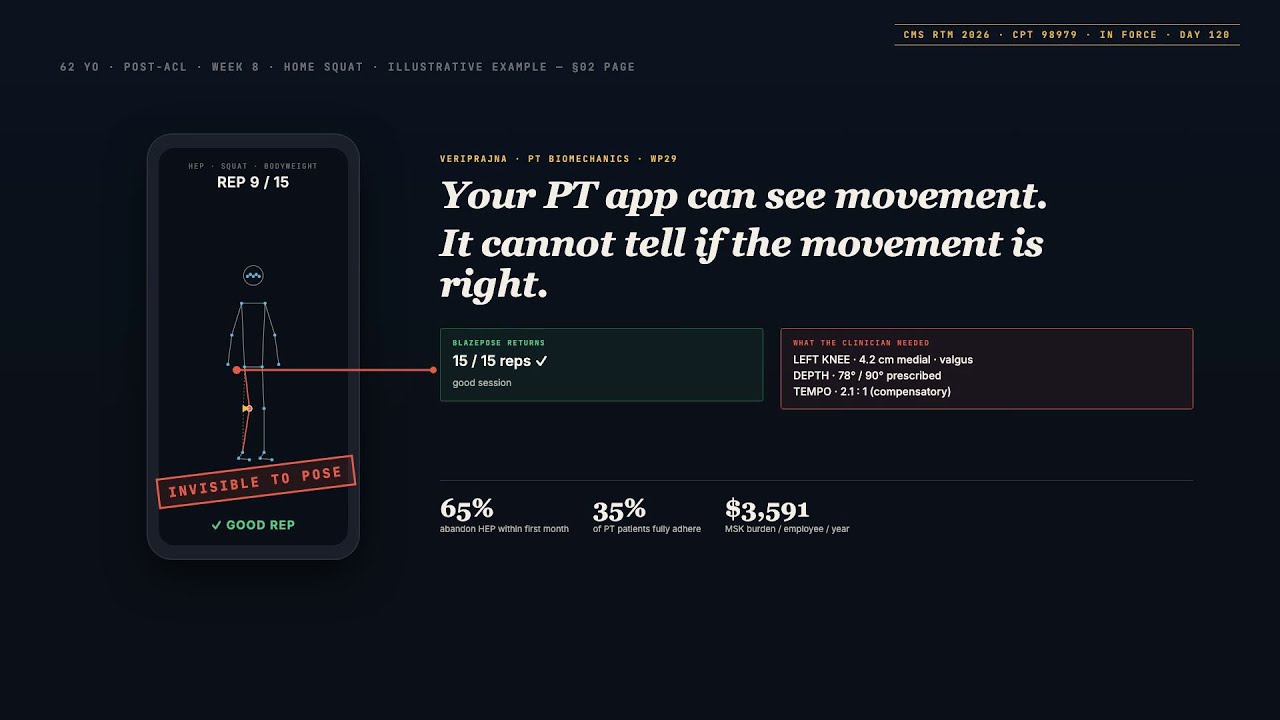
Pose estimation is free. BlazePose, MoveNet, and MediaPipe are open-source and run on any phone. The hard problem is the layer above: exercise-specific biomechanical intelligence that knows a 70-year-old post-knee-replacement patient has different squat depth targets than a 30-year-old corporate athlete.
 Watch
WatchEdge AI for Manufacturing Quality Inspection
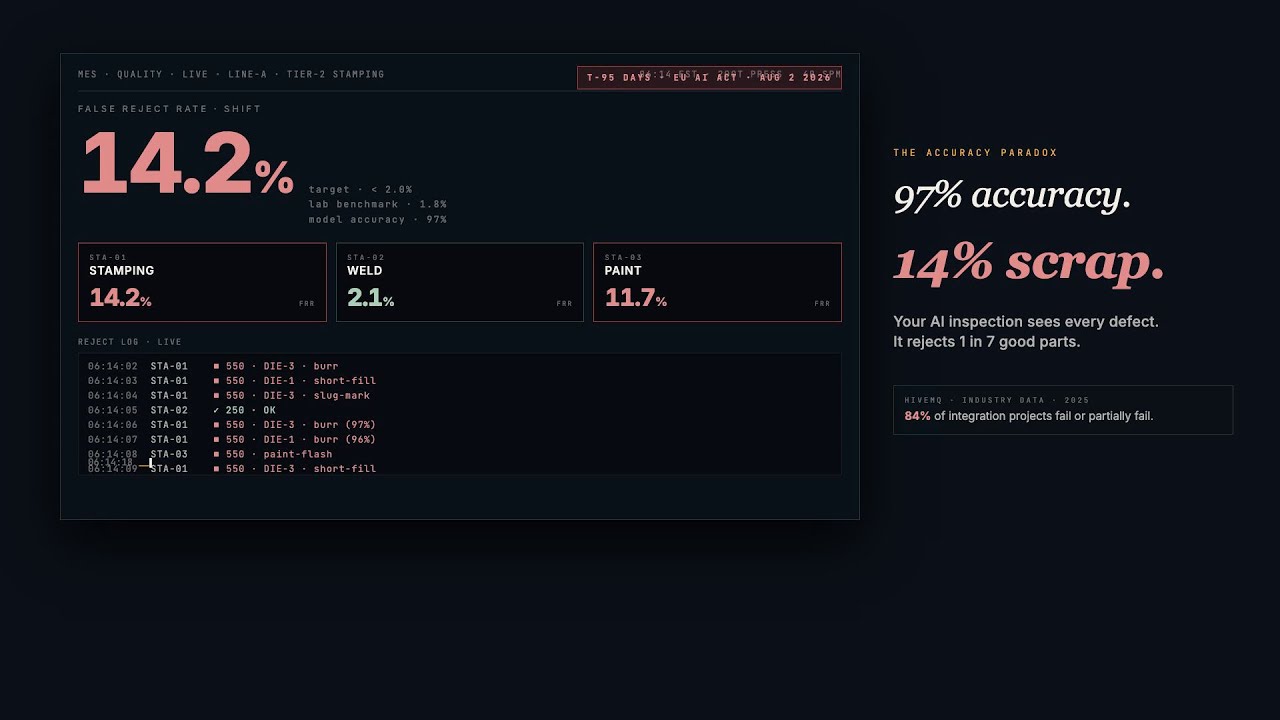
Whether you are evaluating AI-based inspection for the first time, recovering from a cloud pilot that could not meet cycle time, or scaling a working prototype to 15 plants, the problem is the same: getting edge AI into production is an integration and operations challenge, not a hardware purchase.
 Watch
WatchGPS-Denied Drone Autonomy: VIO, Edge AI and Blue UAS Integration
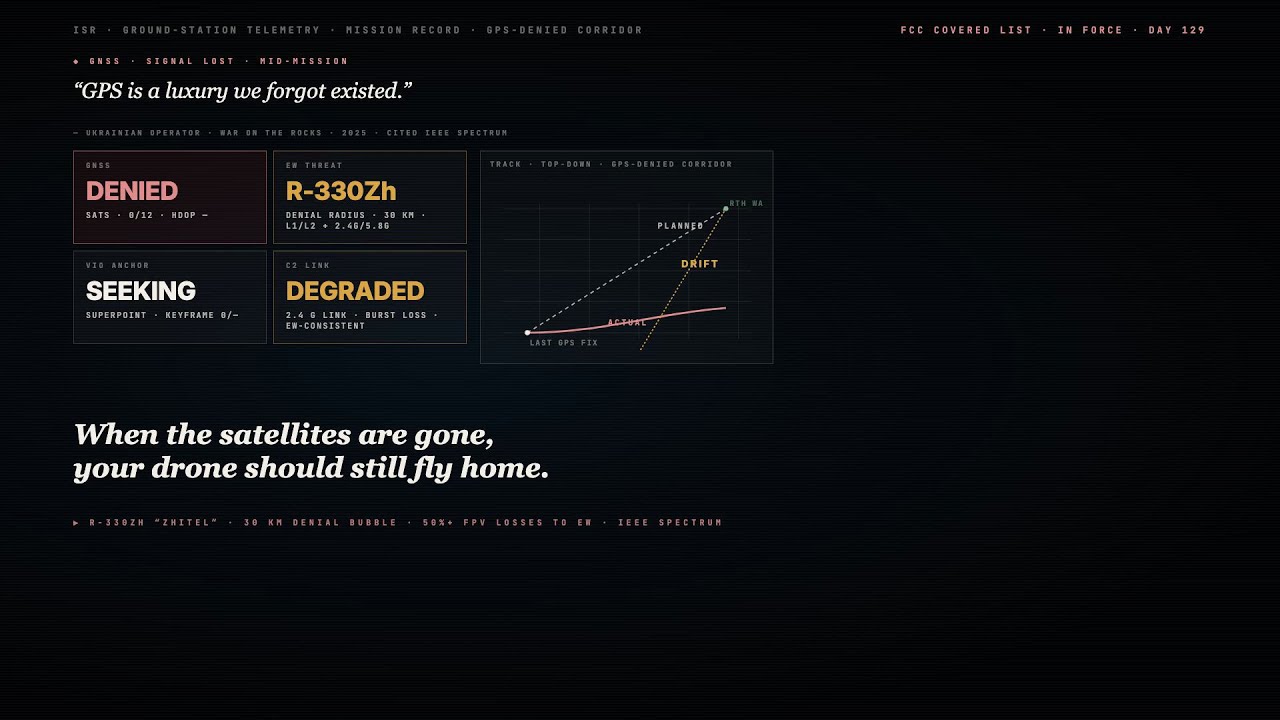
Russian R-330Zh jammers create multi-kilometer GPS blackout zones across Ukrainian front lines. The FCC blocked new authorizations for every foreign-made drone in December 2025. The Army just bought 2,500 Skydio X10D units in 72 hours because nothing else in the cleared inventory could handle a contested electromagnetic environment.
 Watch
WatchPower Grid AI & Resilience Engineering
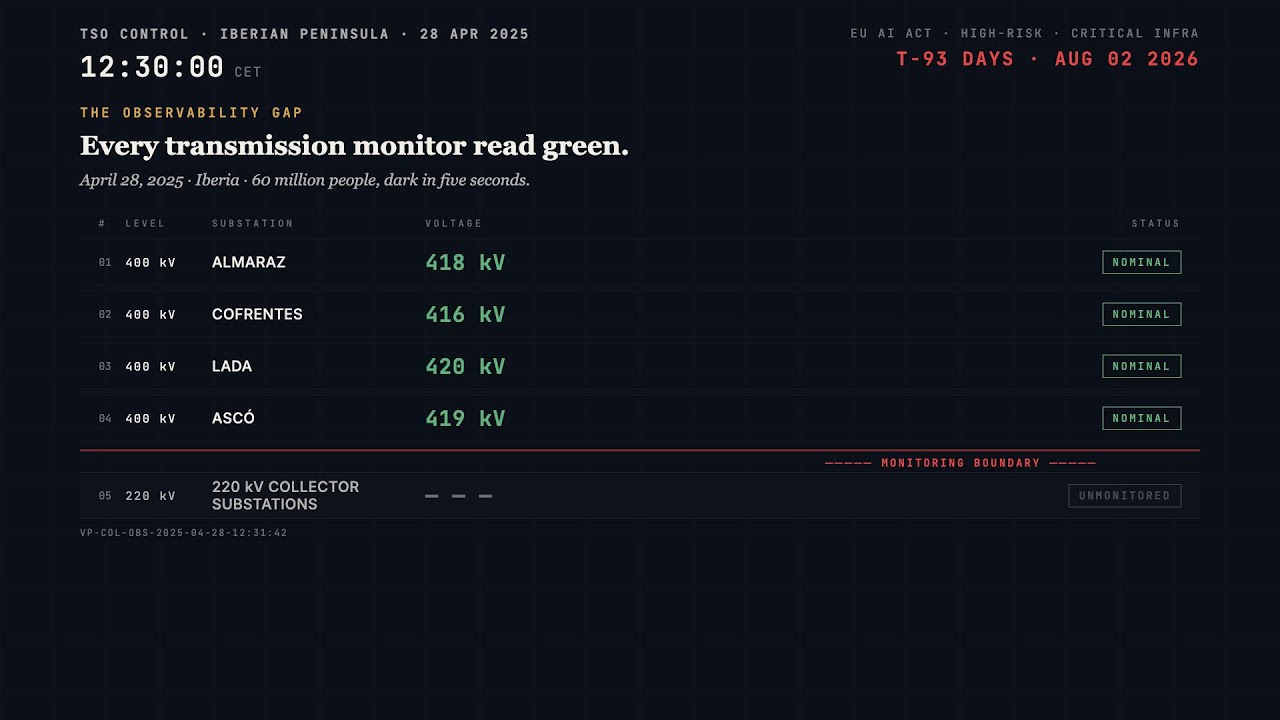
PJM fell 6,625 MW short of its reliability target for the first time in history. ERCOT's interconnection queue hit 233 GW with only 23 GW of new generation online. The Iberian blackout wiped out 15 GW in 5 seconds because no one was watching the right voltage level.
 Watch
WatchSmart Facility Fall Detection & Ambient Monitoring for Senior Living
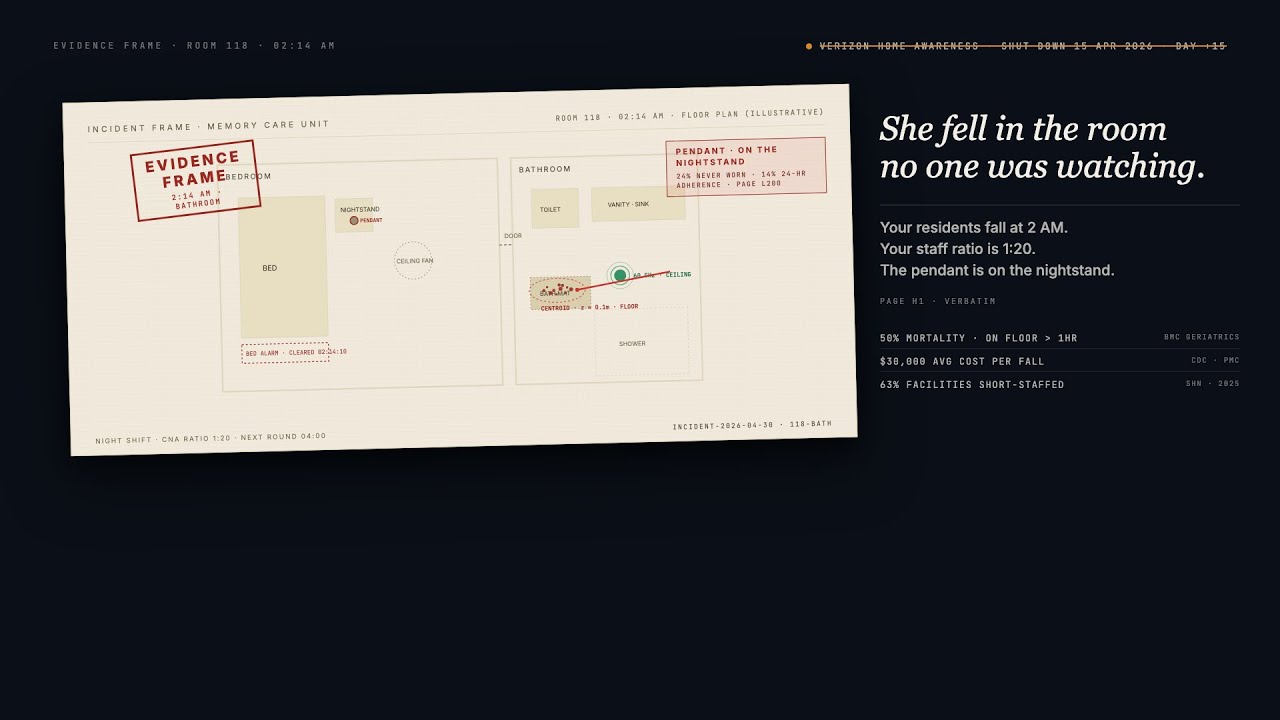
Passive, privacy-preserving fall detection and ambient monitoring for assisted living and skilled nursing facilities. mmWave radar for high-risk rooms. Wi-Fi sensing for whole-building coverage.
 Watch
WatchSmart Meter AI: AMI Predictive Maintenance & Firmware Validation
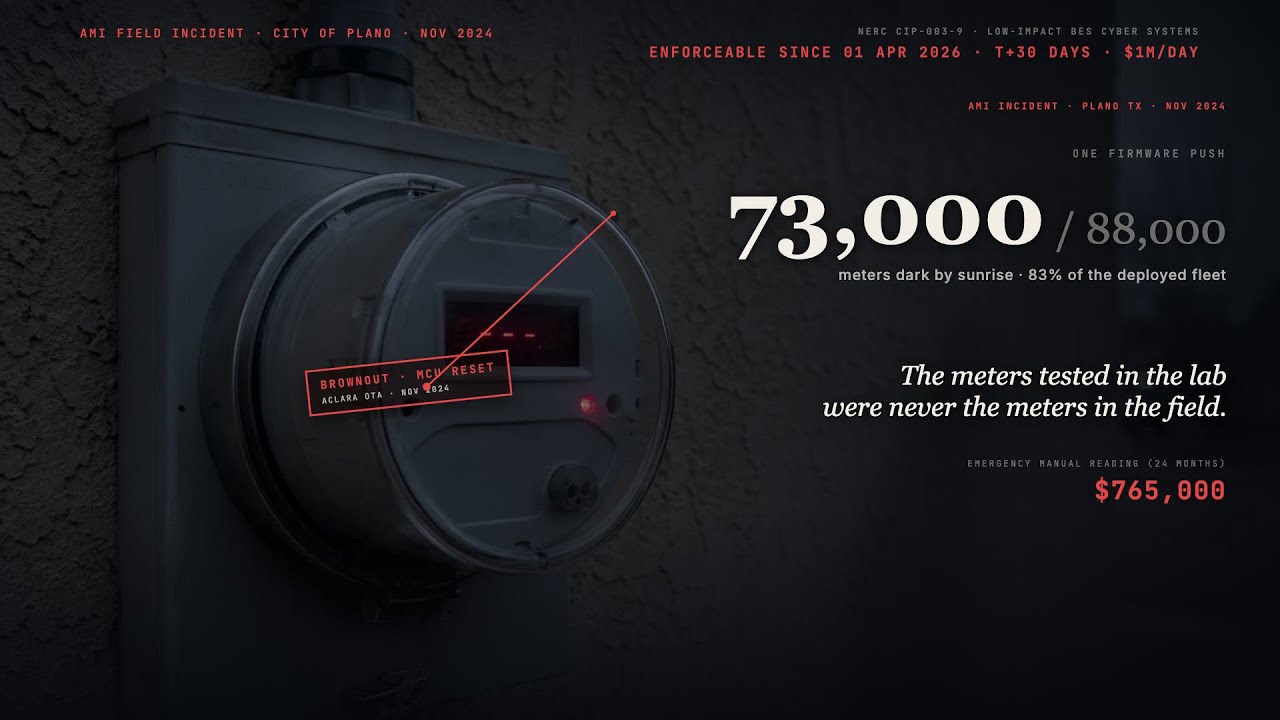
One bad firmware push cost Plano, TX $765,000 and knocked 73,000 meters offline. Memphis is spending $9M on repairs. Your AMI head-end tracks which meters stopped talking.
Frequently Asked Questions
How much does edge AI deployment cost compared to cloud inference?
The TCO crossover for edge versus cloud typically falls at 12 to 24 months. At low volumes (under a few hundred devices), cloud inference is usually cheaper. At scale, the math shifts decisively: 50,000 devices running 60 inferences per minute generates roughly 3 billion API calls per month, costing approximately $300,000 monthly in cloud inference alone. Edge hardware for that fleet has higher upfront cost but flattens to about $10 per device per month in ongoing costs. Power consumption runs 10 to 25 watts per node, translating to $4,000 to $8,000 annually for a medium deployment. Hybrid architectures that keep training and batch analytics in the cloud while pushing real-time inference to the edge report 15 to 30% cost savings versus either pure approach.
Which edge AI hardware should I choose for my workload?
It depends on four factors: latency requirements, power budget, deployment volume, and operator coverage for your model architecture. For GPU-class workloads needing high throughput, NVIDIA Jetson Orin NX delivers 157 TOPS after the Super Mode update. For power-constrained deployments, Hailo's 10H achieves 40 TOPS at 2.5 watts (16 TOPS per watt) in an M.2 form factor with automotive temperature ratings. For deterministic sub-millisecond latency with no software scheduling jitter, FPGAs are the right choice. For microcontroller-class tinyML, Arm's Ethos-U85 NPU brings real ML capability to devices with 256KB SRAM. We profile your specific model against candidate platforms before committing, because a model optimized for one toolchain does not transfer to another without weeks of re-optimization work.
How do you handle model updates on deployed edge devices?
The update mechanism depends on the regulatory context. For automotive deployments, UNECE R155 and R156 (mandatory since July 2024) require a Cybersecurity Management System and Software Update Management System covering the entire supply chain and vehicle software lifecycle. For medical devices, the FDA's January 2025 draft guidance introduces the Predetermined Change Control Plan, allowing post-market model updates without new submissions if changes stay within approved parameters. For defense and sovereign deployments, air-gapped environments use cryptographically signed physical media or one-way data diodes with IEC 62443-4-2 integrity verification. In all cases, we implement differential model updates (not full model replacement), cryptographic verification, staged rollouts with automated canary analysis, and automatic rollback if post-update validation checks fail.
What is the difference between average latency and deterministic latency for edge AI?
Average latency tells you how fast the system usually is. Deterministic latency tells you how fast it always is. A system averaging 2 milliseconds but occasionally spiking to 15 milliseconds during garbage collection or thermal throttling is not a real-time system. Thermal throttling alone can reduce inference speed by 30 to 50% on sustained workloads. For safety-critical deployments (autonomous vehicles, industrial automation, medical devices), what matters is worst-case execution time (WCET) under thermal stress, memory pressure, power fluctuation, and OS scheduling contention. We achieve deterministic latency through pre-allocated memory buffers, pinned CPU affinity, hardware-accelerated preprocessing, and on FPGA targets, inference with no software scheduling layer at all.
Can generative AI and large language models run at the edge?
Yes, within limits. Hailo's 10H runs 2-billion-parameter language models with sub-second first-token latency and over 10 tokens per second at under 5 watts. NVIDIA's Cosmos Nemotron vision-language models run on Jetson Orin for multi-image reasoning. SiMa.ai and Cerence brought CaLLM Edge, an automotive-grade small language model, to edge silicon. Models above roughly 7 billion parameters do not run meaningfully on current edge hardware without heavy quantization that reduces capability. The practical ceiling is visual question answering, natural language operator interfaces, and short reasoning chains. Long-context generation and complex multi-turn dialogue still need cloud compute or a hybrid approach with edge caching for latency-sensitive interactions.
How do you detect and handle model drift on edge devices?
Edge drift detection is harder than cloud drift detection because you cannot stream raw telemetry back to a central system without exceeding your bandwidth budget. We implement on-device statistical monitoring using KL divergence and population stability index computed locally. Only summary metrics are transmitted upstream. When drift exceeds configured thresholds, the system can trigger automated retraining workflows, queue a model update through the OTA pipeline, or flag for human review depending on the deployment's risk profile. Common drift sources include sensor degradation, environmental changes (lighting, temperature, vibration profiles), and upstream process changes that alter the data distribution. The monitoring runs continuously alongside inference with minimal compute overhead.
What regulatory frameworks apply to edge AI in safety-critical industries?
The regulatory landscape is fragmented by vertical. Automotive: ISO 26262 for functional safety (ASIL A through D) and UNECE R155/R156 for cybersecurity and OTA updates, both mandatory since July 2024. Medical devices: FDA's AI/ML-enabled device software guidance (draft January 2025), with 295 AI/ML clearances in 2025, 62% being Software as a Medical Device. Industrial: IEC 62443 for cybersecurity of industrial automation systems, with edge AI products from Eurotech, IXON, SINTRONES, and Innodisk achieving certification. Cross-sector: the EU AI Act's high-risk requirements take effect August 2026 (potentially delayed), covering edge deployments in biometrics, critical infrastructure, and public safety. ISO 26262 has significant documented gaps for ML-based software, particularly around interpretability and the inability to fully pre-specify perception-dependent functionality. We help teams map their specific deployment to the applicable frameworks and build the documentation artifacts that conformity assessment requires.
When should I NOT deploy AI at the edge?
Edge deployment is the wrong choice in four situations. First, models above roughly 7 billion parameters that need full capability, because current edge silicon cannot run them without heavy quantization that materially reduces output quality. Second, workloads where you expect to swap model architectures frequently, because each hardware-specific optimization cycle adds weeks. Third, low-volume deployments under a few hundred devices, where cloud inference costs remain manageable and upfront hardware investment does not pay back. Fourth, workloads where the data is already in the cloud and the latency of a cloud inference call is acceptable for the use case. We model TCO breakeven for each engagement so the edge-versus-cloud decision is driven by numbers, not by an assumption that edge is always better.
Build Your AI with Confidence.
Partner with a team that has deep experience in building the next generation of enterprise AI. Let us help you design, build, and deploy an AI strategy you can trust.
Veriprajna Deep Tech Consultancy specializes in building safety-critical AI systems for healthcare, finance, and regulatory domains. Our architectures are validated against established protocols with comprehensive compliance documentation.