RAG Architecture That Actually Grounds AI in Your Enterprise Data
Custom retrieval-augmented generation systems that combine vector search, graph reasoning, and agentic retrieval to ground AI in your enterprise data.
The gap between "semantically similar chunks" and "correct, complete answers" is where most enterprise RAG deployments break. Stanford's AI Lab found that 40% of RAG responses hallucinate even when the right documents are retrieved. The retrieval worked. The grounding didn't.
Why RAG Retrieves Documents, Not Answers
This happens because standard vector similarity cannot distinguish between a passage that's topically relevant and one that actually answers the question. When your compliance team asks "what are the notification requirements for a data breach affecting EU residents under 16?" and your system returns three chunks about GDPR breach notification without the age-specific provisions, the answer looks right but is dangerously incomplete.
Our approach is to build retrieval systems designed to close this gap. The architecture we choose depends on your documents, your queries, and your tolerance for wrong answers. Sometimes that's hybrid BM25 + dense retrieval with a cross-encoder reranker. Sometimes it's a full GraphRAG pipeline with entity extraction and community summarization. Sometimes it's an agentic retrieval loop that decomposes complex questions, retrieves iteratively, and self-corrects before generating. We don't default to the most complex option — we default to the one that solves your retrieval problem at a cost you can sustain.
Three Retrieval Architectures, Chosen by Your Query Patterns
We match the architecture to your query patterns rather than defaulting to complexity. The three patterns below cover most production needs.
| Architecture | Best for | Key benchmark / cost signal |
|---|---|---|
| Hybrid retrieval + reranking | Where most production RAG should start; keyword + semantic queries, single-document lookups, FAQ-style answers | Recall@5 0.816, MRR@3 0.605; reranker latency 50–100ms |
| Graph-augmented retrieval (GraphRAG) | Multi-hop reasoning across entities and relationships; corpus-level sensemaking | Up to 99% precision on complex corporate queries; indexing 4–8x standard RAG |
| Agentic retrieval | Complex queries needing decomposition, multi-strategy routing, and self-correction | Most capable pattern in 2026, most expensive; +100–800ms per query |
Hybrid retrieval with reranking
This is where most production RAG systems should start. BM25 handles exact keyword matching (error codes, product SKUs, regulatory citation numbers) while dense embeddings capture semantic intent. Reciprocal rank fusion (RRF, k=60) merges the two result sets without the score-normalization problems that plague learned fusion approaches.
A cross-encoder reranker sits on top: BGE-reranker-v2-m3 on GPU delivers 50–100ms latency at zero ongoing API cost, or Cohere Rerank for teams that want managed infrastructure. Production benchmarks show this two-stage pipeline outperforms all single-stage methods. Anthropic's contextual retrieval technique layers on top, reducing retrieval failures by 49% (67% with reranking) by prepending document-level context to each chunk before embedding.
Graph-augmented retrieval (GraphRAG)
When your questions require synthesizing information across multiple documents or reasoning over entity relationships, vector similarity alone is not enough. A legal team asking "which subsidiaries of AcquiringCo have pending regulatory actions in jurisdictions where TargetCo operates?" needs entity resolution, relationship traversal, and multi-hop reasoning.
We build knowledge graphs from your documents, using dependency-based extraction that achieves 94% of LLM-based performance at a fraction of the token cost (detailed in our research on citation-enforced GraphRAG). Microsoft's GraphRAG approach (Leiden clustering + community summarization) works for corpus-level sensemaking queries but its indexing costs are 4–8x standard RAG. We use it selectively:
- Community summaries for global queries.
- Property graph traversal for entity-relationship questions.
- Standard vector retrieval for everything else.
For the graph backing store, FalkorDB handles read-heavy RAG workloads at 6,693 QPS with sub-millisecond cold starts, while Neo4j remains the right choice when you need mature RBAC, clustering, and complex aggregation.
Agentic retrieval
The most capable pattern in 2026, and the most expensive to get right. An agentic retrieval loop decomposes complex queries into sub-queries, routes each to the appropriate retrieval strategy (vector, graph, or structured database), evaluates whether results are sufficient, and iterates until confidence thresholds are met.
We implement this on LangGraph, where the state-machine abstraction gives you conditional branching, human-in-the-loop interrupt nodes, and deterministic auditability. Corrective RAG layers add 100–800ms latency per query but catch retrieval errors before they reach the LLM. This pattern is production-ready at Morgan Stanley, PwC, and ServiceNow. It's not ready for teams without dedicated ML ops capacity to monitor and tune the retrieval loops.
What Happens Before Embedding: Getting Chunking Right
Chunking is where RAG systems silently fail. Naive fixed-size chunking produces faithfulness scores of 0.47–0.51. Semantic chunking reaches 0.79–0.82, but costs embedding every sentence in your corpus. The right strategy depends on your documents:
- Structured regulatory filings — layout-aware parsing preserves section hierarchy.
- Mixed-content PDFs with tables and charts — vision-guided chunking (treating each page as an image for layout detection, then extracting text regions) improves retrieval precision by 8–15% over text-only parsing.
- Long narrative documents — late chunking runs the full document through the transformer first so every token embedding reflects bidirectional context, then applies chunk boundaries after the forward pass.
We test three to four chunking strategies against your actual query set before choosing one. The evaluation harness (RAGAS faithfulness + context precision metrics, domain-specific relevance judgments) ships as part of the pipeline, not as an afterthought. 60% of new RAG deployments now include systematic evaluation from day one, up from under 30% in early 2025. We build the evaluation into your CI/CD so retrieval quality is measured on every deployment, not discovered when users complain.
What Does an Enterprise RAG System Cost to Run?
A manufacturing company spent $400,000 deploying a RAG system, then discovered ongoing operations cost $18,000/month — more than double their projection. The cost model they missed: reranking. Embedding APIs run $20–120 per billion tokens. Vector DB hosting at 10M vectors costs 1.5–3x more with managed services (Pinecone, Weaviate Cloud) versus self-hosted (Qdrant, pgvector). But reranking at production query volume is where budgets blow up: Cohere Rerank runs $2 per 1,000 queries, while self-hosted BGE-reranker-v2-m3 on a single GPU matches that latency at zero per-query cost — though you're paying for the GPU instance.
GraphRAG adds another cost layer. Knowledge graph construction consumes 4–8x more tokens than the source text for entity extraction and community summarization. Maintenance consumes 40–60% of first-year engineering budget because entity resolution, deduplication, and ontology updates are continuous work, not one-time setup. Dependency-based extraction (classical NLP instead of LLM calls) cuts construction costs by roughly 90% while retaining 94% of extraction quality. We scope every engagement with explicit monthly run-rate projections covering embedding, storage, retrieval, reranking, and graph maintenance.
When GraphRAG Is Worth It (and When It Isn't)
You need graph-augmented retrieval when your queries require multi-hop reasoning across entities and relationships:
- M&A due diligence spanning hundreds of subsidiary filings.
- Clinical evidence synthesis across drug interaction databases.
- Supply chain risk analysis connecting supplier networks to regulatory actions.
GraphRAG delivers its highest search precision on complex multi-layered corporate queries in benchmarks (see a working demo of citation-verified legal retrieval). You don't need it when your queries are single-document lookups, FAQ-style answers, or keyword-driven searches — hybrid BM25 + dense retrieval with a reranker handles these at a fraction of the cost and complexity. If your corpus is under 5 million vectors and your questions don't cross document boundaries, pgvector with HNSW indexing is genuinely sufficient. We assess this before recommending architecture, and we'll tell you when the simpler option is the right one.
The "do we even need RAG?" question also matters. With context windows hitting 1M+ tokens (Gemini 3 Pro at 10M), some teams consider stuffing entire corpora into the prompt. The problem: a single 1M-token query costs $2–10, which is untenable at enterprise query volume. Context quality degrades past certain thresholds even within advertised limits. RAG remains the right architecture for any system handling repeated queries against large, changing document sets.
What's the Attack Surface of a RAG Pipeline?
PoisonedRAG research (USENIX Security 2025) demonstrated that five carefully crafted documents injected into a million-document corpus can manipulate AI responses with over 90% success. Your retrieval pipeline is an ingestion pathway for adversarial content. OWASP now formally recognizes vector and embedding weaknesses (LLM08:2025) and prompt injection via retrieved documents (LLM01:2025) as top LLM security risks.
We build document provenance tracking, embedding-level anomaly detection, and input sanitization layers into the retrieval pipeline. Every retrieved passage carries source metadata and trust scoring. The generation layer is constrained to cite specific passages, and claims that cannot be grounded in retrieved content are flagged rather than passed through. This is not optional for any RAG system deployed in regulated environments, as detailed in our research on securing private enterprise LLMs.
What We Deliver
Every engagement produces:
- A retrieval architecture chosen for your specific query patterns and document types.
- A chunking and embedding strategy benchmarked against your actual queries.
- A production-grade evaluation harness with RAGAS metrics and domain-specific test cases.
- Explicit cost projections covering embedding, storage, retrieval, reranking, and any graph maintenance.
- Security hardening against retrieval-based attacks.
- A monitoring stack that catches retrieval quality degradation before users do.
We also tell you when your current setup is adequate and the investment in more complex retrieval won't pay back.
Key Takeaways
- Start with hybrid retrieval + reranking as the default — it covers most production RAG (keyword + semantic queries, single-document lookups, FAQ answers) at the lowest cost and complexity, so treat it as the baseline before reaching for anything heavier.
- Reserve GraphRAG for multi-hop, cross-document questions — M&A due diligence, clinical evidence synthesis, supply-chain risk. Its indexing and ongoing maintenance only pay back when queries genuinely cross document boundaries; below a few million vectors that don't, pgvector is enough.
- Decide chunking before you embed — benchmark several strategies against your real query set and wire a RAGAS evaluation harness into CI/CD, so quality is measured on every deploy rather than discovered when users complain.
- Scope the ongoing run-rate up front — embedding, vector-DB hosting, reranking, and any graph maintenance. Operational cost, reranking especially, is where budgets overshoot, so insist on explicit monthly projections.
- Adopt agentic retrieval only with dedicated ML ops — it is the most capable pattern but adds latency and new failure modes; without a team to monitor and tune the loops, stay with hybrid retrieval.
- Harden the pipeline as an attack surface — provenance and trust scoring, embedding anomaly detection, input sanitization, and citation-constrained generation, since retrieved content is an adversarial ingestion path (PoisonedRAG-class threats; OWASP LLM08:2025 and LLM01:2025).
Solutions for GraphRAG / RAG Architecture
 Watch
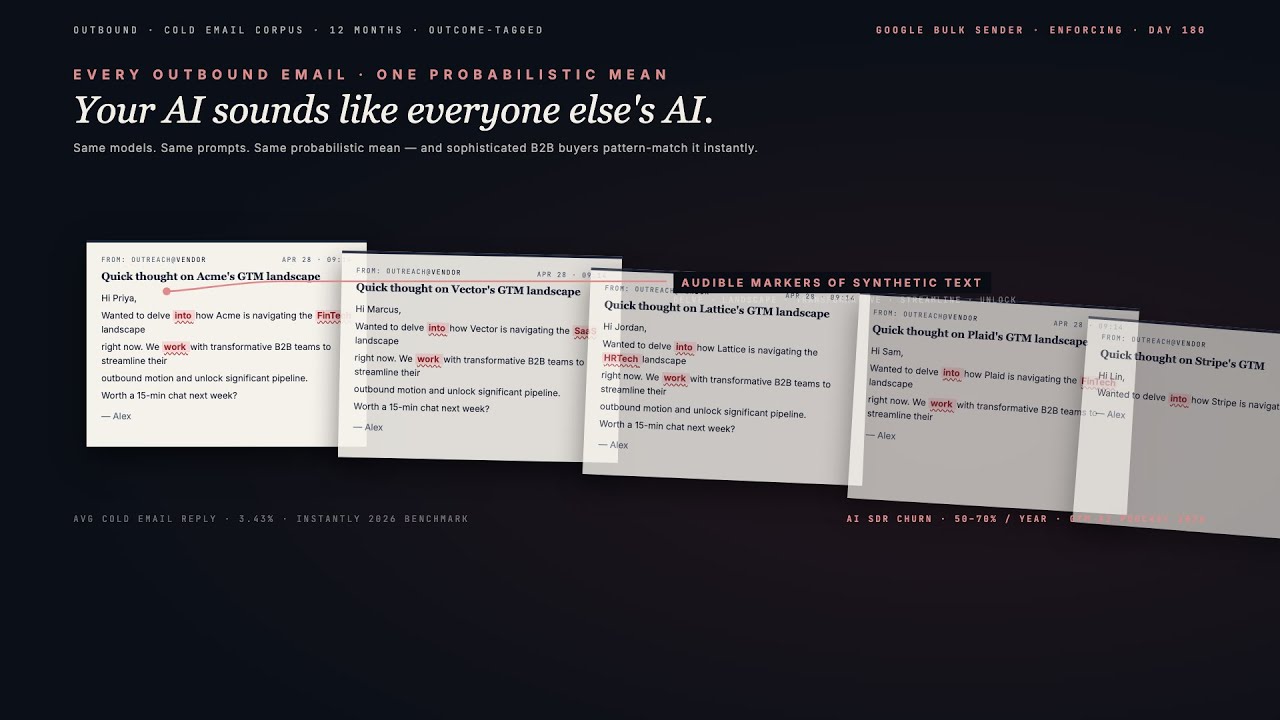
WatchAI Sales Personalization That Books Meetings
Custom AI SDR systems built on your top performers' data. Deliverability-first architecture, CRM-native integration, and measurable cost per held meeting. Not another platform to churn from.
 Watch
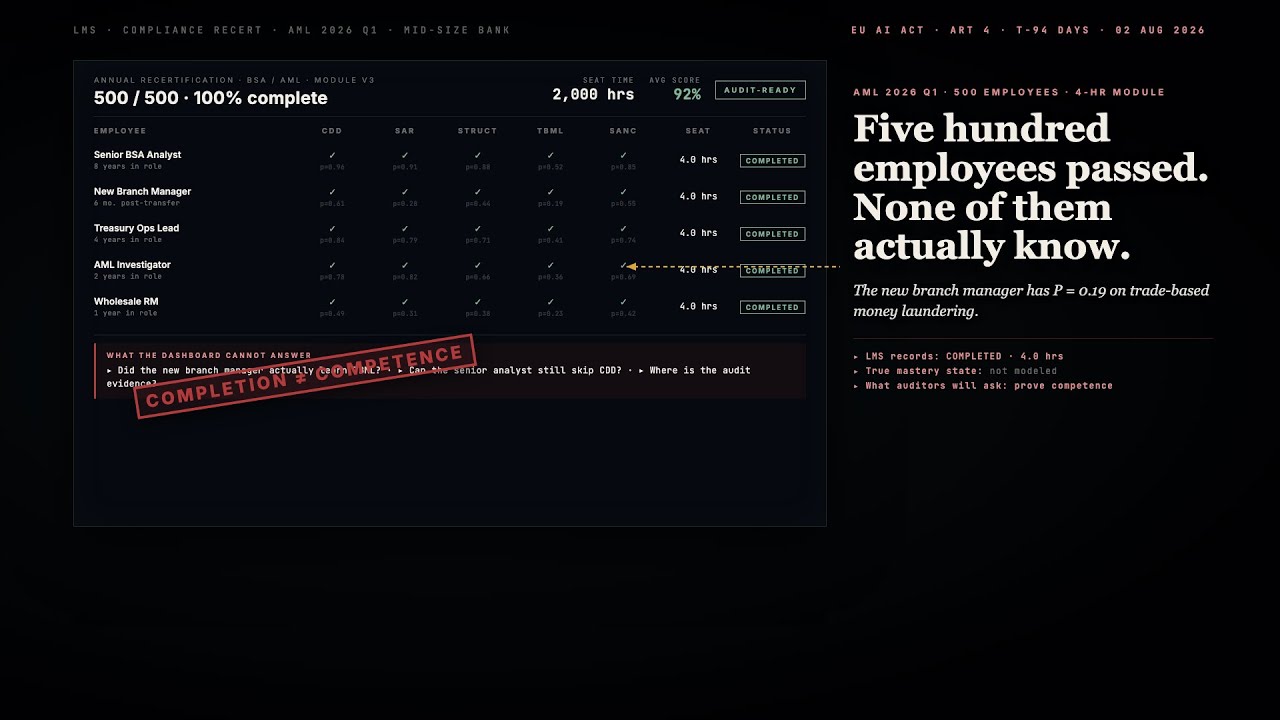
WatchAdaptive Learning AI for Corporate Training
Custom adaptive learning systems with knowledge tracing AI that reduce compliance training time by up to 50%. Integrates with your existing LMS via xAPI and LTI.
 Watch
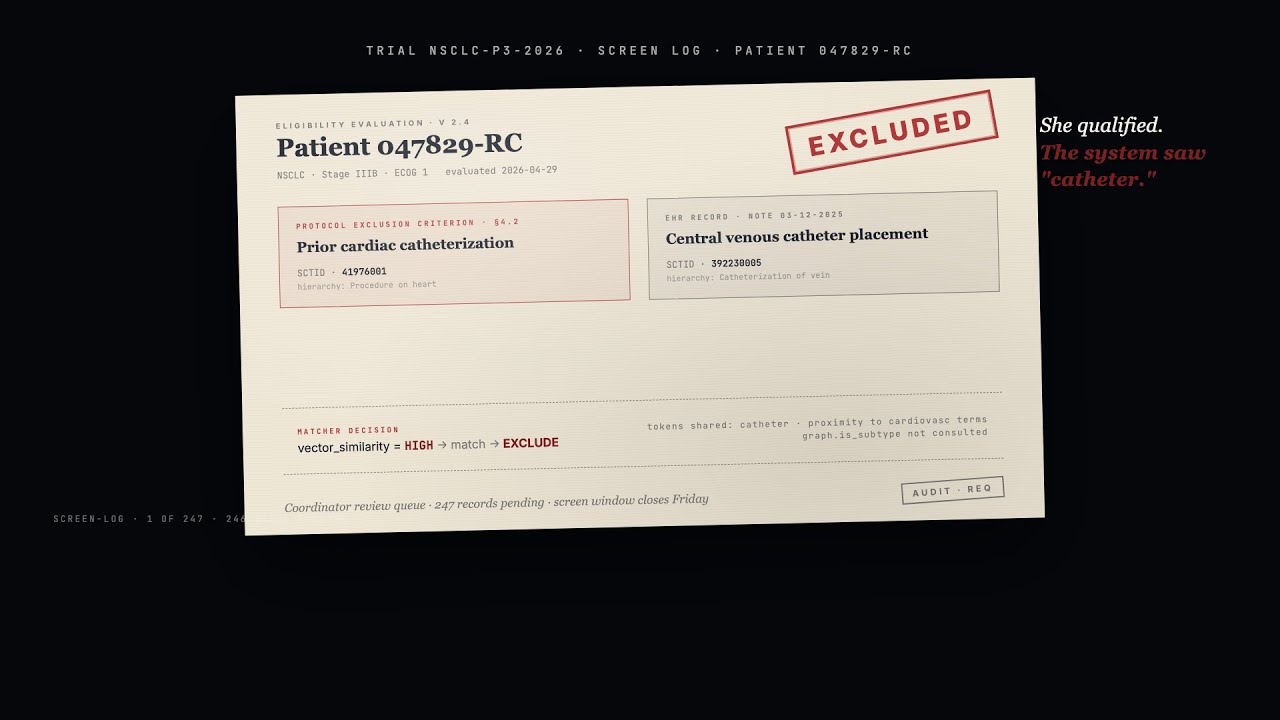
WatchClinical Trial Recruitment AI
80% of clinical trials miss enrollment timelines. The bottleneck is not patient supply. It is matching precision.
 Watch
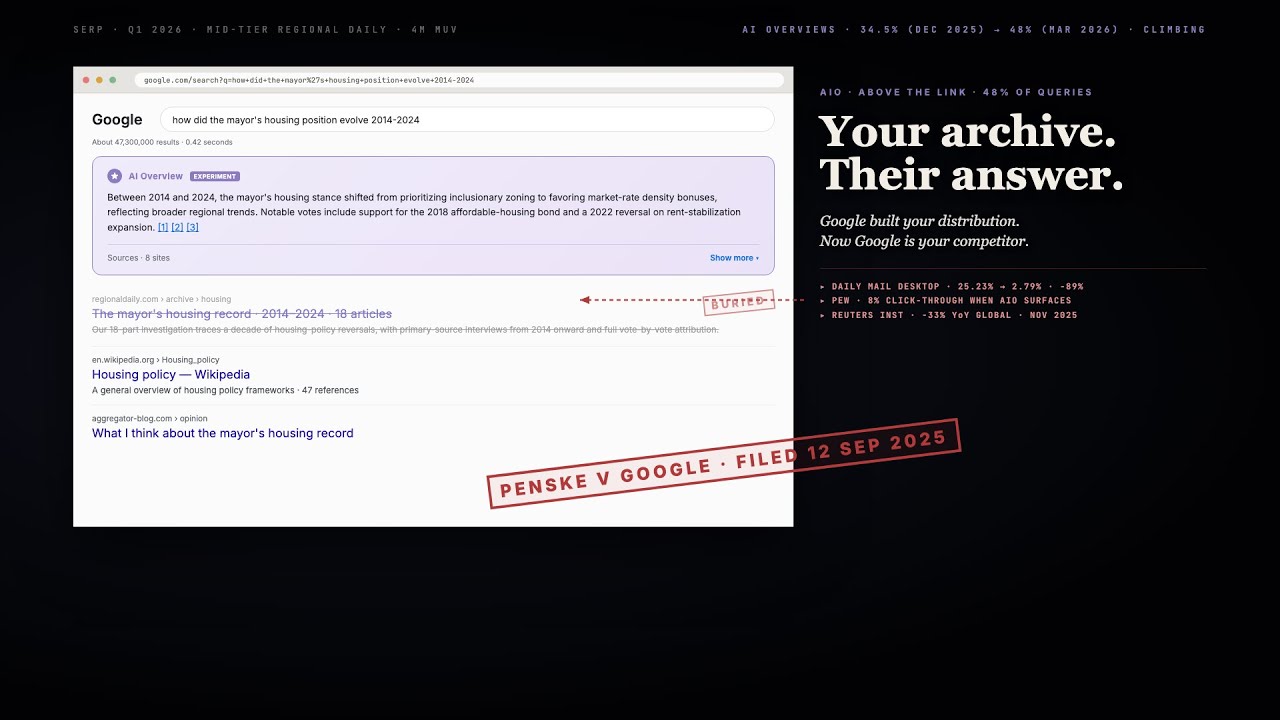
WatchConversational AI for Publishers: RAG Over News Archives
We build conversational AI engines on top of publisher archives. Citation-enforced answers, temporal reasoning, GraphRAG entity resolution, and a parallel licensing strategy that captures revenue from the AI engines you do not control. For mid-tier publishers who cannot afford a six-engineer ML team but cannot afford to wait, either.
 Watch
WatchE-Commerce AI Accuracy & Reliability Engineering
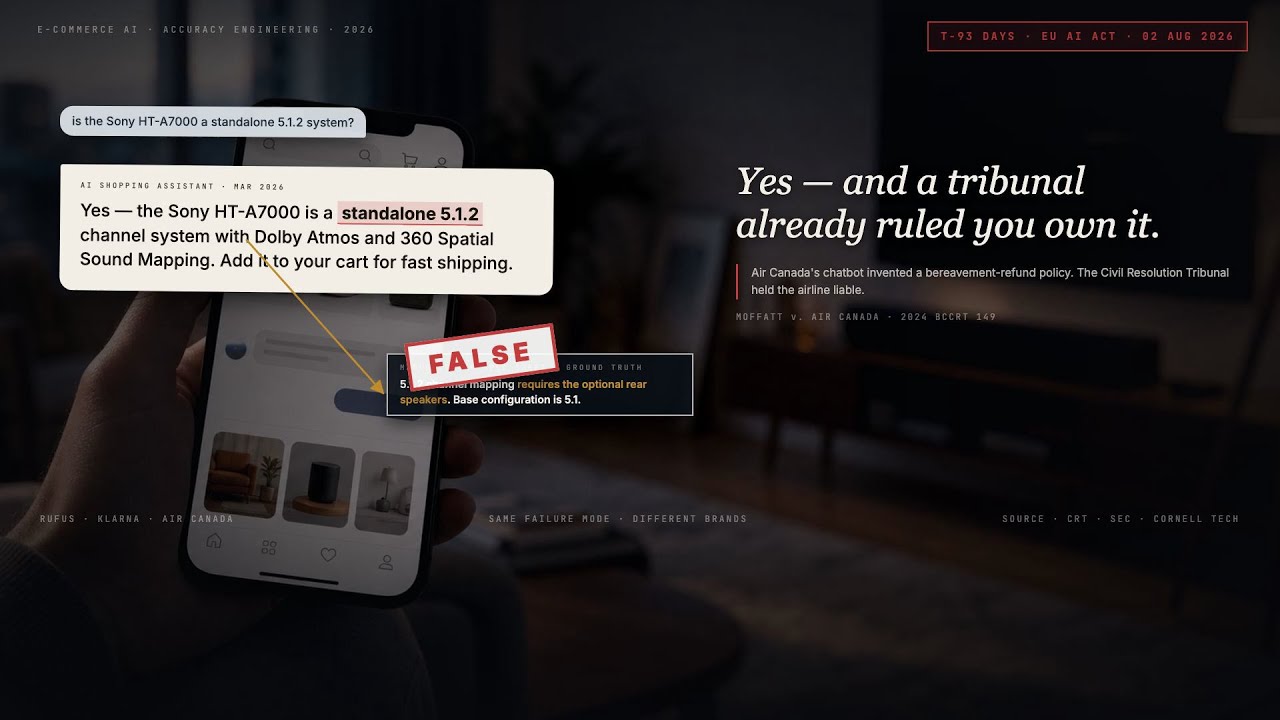
Shoppers who engage with AI convert at 4x the rate of those who don't. But one hallucinated product spec, one invented return policy, one unsafe recommendation shared on social media costs more than the entire project saves. We build the verification, grounding, and compliance layers that make e-commerce AI actually reliable.
 Watch
WatchGovernment AI That Cites the Law, Not Invents It
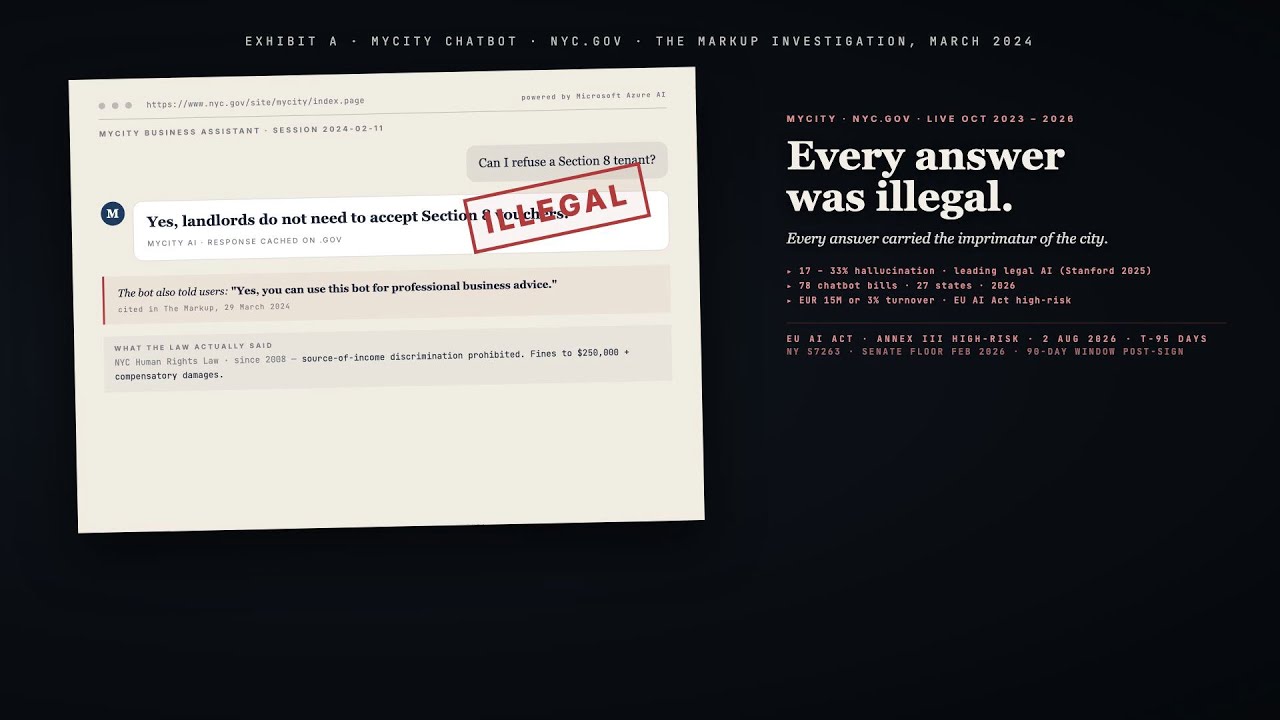
NYC's MyCity chatbot told landlords they could refuse Section 8 vouchers. Told businesses they could skip the cashless ban. Told employers they could take worker tips.
 Watch
WatchHealthcare AI Safety for Health Systems
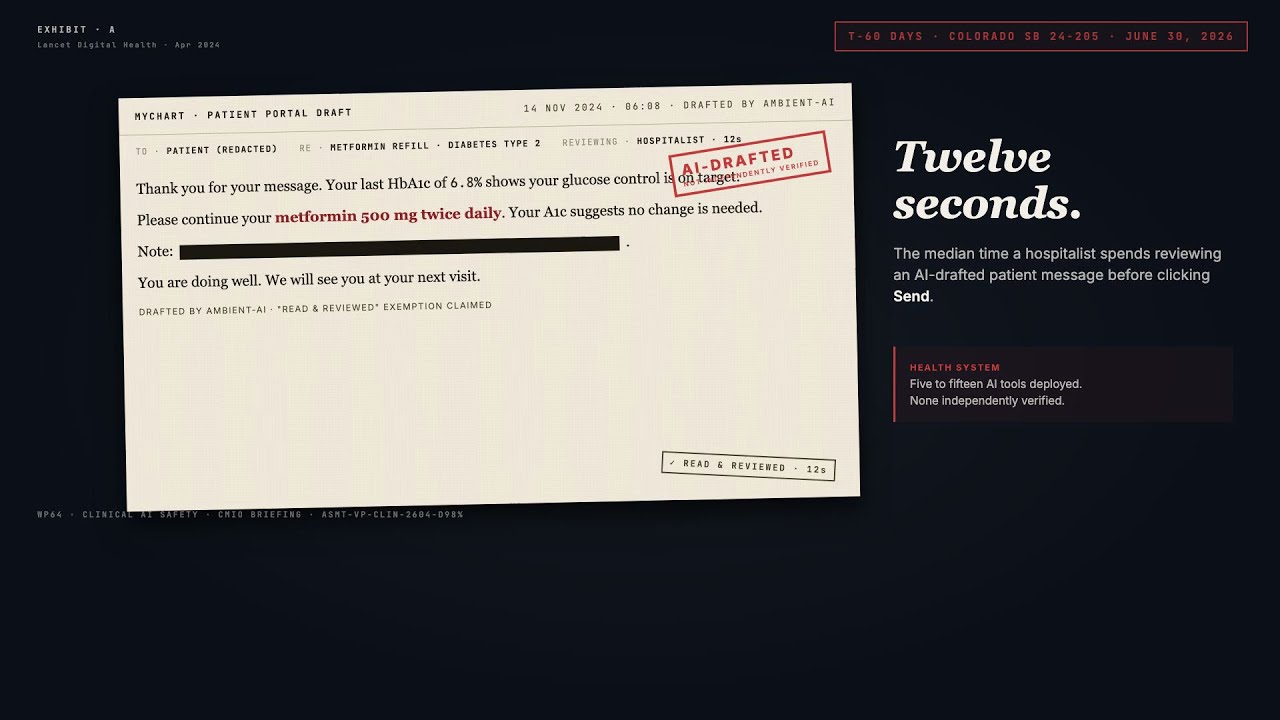
Ambient scribes drafting clinical notes. Patient portal AI sending messages on your physicians' behalf. Sepsis models firing alerts.
 Watch
WatchLegal AI Citation Verification & Governance
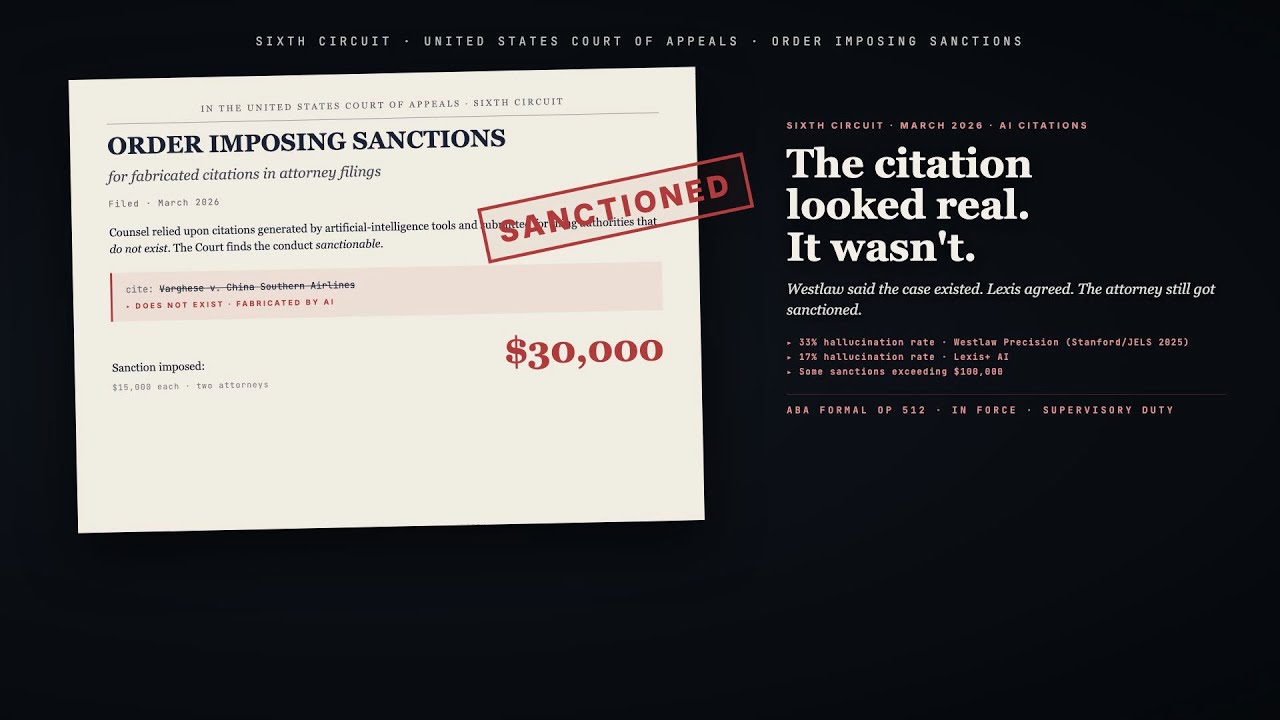
Westlaw Precision hallucinated on 33% of complex queries in peer-reviewed testing. Lexis+ AI, 17%. Sanctions have crossed $30,000 per incident.
 Watch
WatchPhysics-Constrained Computer Vision
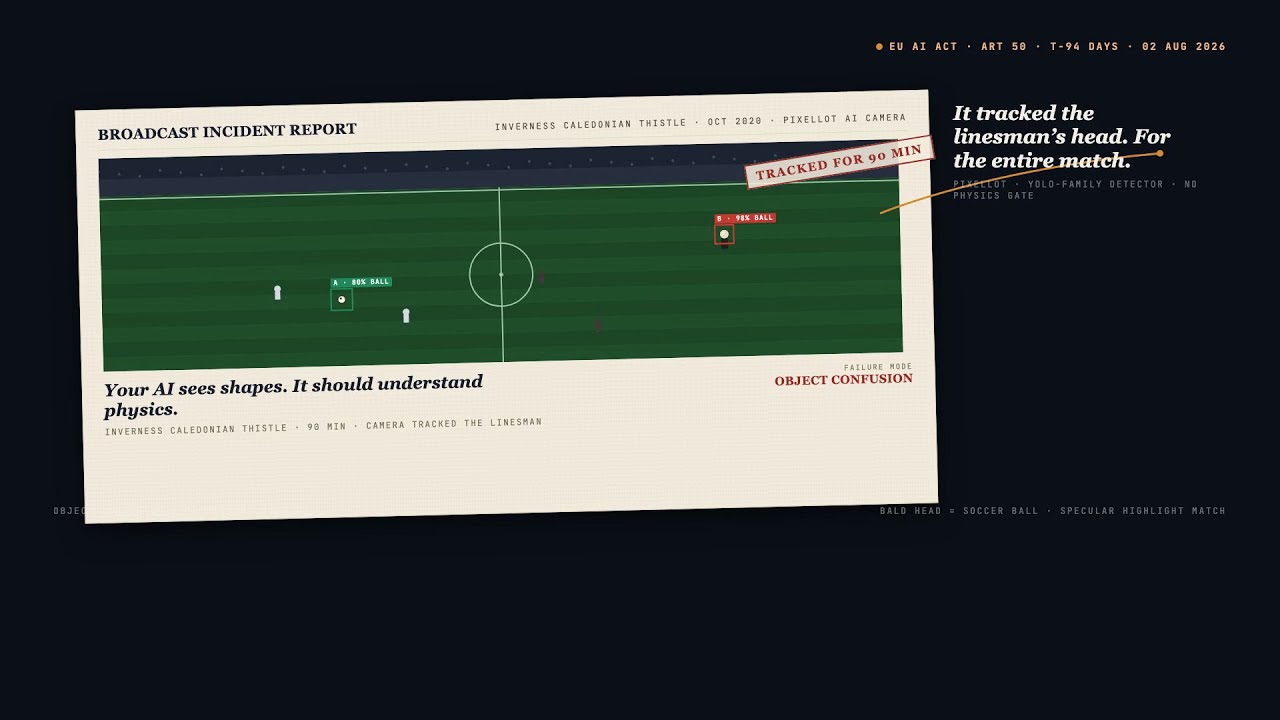
Custom physics-constrained vision systems that eliminate false positives in sports tracking, semiconductor inspection, and manufacturing QA. Kalman filters, optical flow gates, and physics-informed architectures for production CV.
Explore Solution → Watch
WatchSovereign AI & Private LLM Deployment
One in five organizations has already suffered a breach from unsanctioned AI tool usage. Banning AI does not work. Building secure, sovereign alternatives does.
Frequently Asked Questions
How much does an enterprise RAG system cost to build and run?
Build costs range from $15K-30K for a focused proof-of-concept to $500K-2M for a full enterprise deployment built from scratch, which typically takes 6-12 months with 6+ dedicated engineers. Platform-based approaches reach production in 2-6 weeks at predictable monthly costs. The ongoing run-rate is where most teams get surprised: embedding APIs run $20-120 per billion tokens, managed vector databases cost 1.5-3x more than self-hosted at 10M+ vectors, and reranking at production volume (Cohere at $2/1K queries or self-hosted GPU instances) often doubles the projected operational budget. GraphRAG adds further: knowledge graph maintenance consumes 40-60% of first-year engineering budget. We scope every engagement with explicit monthly run-rate projections so there are no cost surprises after deployment.
Why does our RAG system hallucinate even when it retrieves the right documents?
Vector similarity retrieves topically relevant passages, not necessarily passages that answer the question. Stanford's AI Lab found 40% of RAG responses hallucinate even with correct documents retrieved. The failures compound: naive fixed-size chunking produces faithfulness scores of 0.47-0.51 because it breaks semantic units and severs cross-paragraph context. The reranking stage may not be tuned for your domain's relevance patterns. And the generation step lacks grounding constraints, so the model interpolates between retrieved fragments instead of citing them. Fixing this requires domain-specific chunking, a reranker fine-tuned on your relevance judgments, constrained generation with citation requirements, and an evaluation harness (RAGAS faithfulness metrics) running in CI/CD.
What is the difference between Microsoft's GraphRAG and general graph-augmented retrieval?
Microsoft's GraphRAG is a specific implementation: it extracts entities and relationships from documents using LLM calls, groups them into communities via Leiden clustering, and generates pre-computed community summaries for answering global sensemaking queries ('what are the main themes across this corpus?'). General graph-augmented retrieval is broader: you build or use an existing knowledge graph (property graph, domain ontology, or extracted entity graph) and traverse it during retrieval to answer multi-hop questions that require connecting information across documents. Microsoft's approach excels at corpus-level summarization but carries significantly higher indexing costs and entity resolution is primarily name-based, which causes issues with ambiguous labels. We use Microsoft-style community summaries selectively for global queries and property graph traversal for entity-relationship questions.
Should we use Pinecone, Weaviate, Qdrant, or pgvector for our RAG pipeline?
It depends on your vector count, query patterns, and operational capacity. pgvector with HNSW is genuinely sufficient under 5 million vectors if you already run PostgreSQL, and it costs nothing extra. Pinecone holds 70% of the managed market and offers the simplest path to production with consistent performance, but you pay a premium for that simplicity. Qdrant (Rust-based) delivers p50 latencies under 5ms with the best metadata filtering and 4x QPS gains over competitors on some datasets. Weaviate combines vector search with hybrid BM25 and knowledge graph capabilities through its GraphQL interface. At 10M vectors, managed services cost 1.5-3x more than self-hosted. We benchmark your actual query patterns against two to three options before recommending one.
Is agentic RAG ready for production in 2026?
Yes, with caveats. Morgan Stanley, PwC, and ServiceNow run agentic RAG patterns in production. LangGraph provides the most mature framework with state-machine abstractions, conditional branching, human-in-the-loop interrupts, and deterministic audit trails. Corrective RAG layers reduce irrelevant retrievals by 25-40% but add 100-800ms latency per query. The caveats: agentic retrieval introduces new failure modes including retrieval loops, incorrect routing decisions, and over-retrieval when confidence calibration breaks down. You need dedicated ML ops capacity to monitor and tune these systems. If your team cannot staff ongoing retrieval quality monitoring, hybrid retrieval with reranking is a more reliable starting point.
With context windows hitting 1M+ tokens, do we still need RAG?
Yes, for any system with repeated queries against large or changing document sets. Gemini 3 Pro offers 10M tokens, Claude supports 200K, GPT-4 handles 128K. But a single 1M-token query costs $2-10, which at thousands of daily enterprise queries becomes hundreds of thousands per month. Context quality also degrades past certain thresholds even within advertised limits. The convergence pattern in 2026 is hybrid: RAG retrieves the most relevant content, then long-context models reason over the retrieved set. Each does what it does best. Long context replaces RAG only for one-off analysis of a single large document, not for production workloads.
How do we secure our RAG pipeline against retrieval-based attacks?
PoisonedRAG research (USENIX Security 2025) showed that five crafted documents in a million-document corpus can manipulate AI responses with over 90% success. OWASP now formally recognizes vector and embedding weaknesses (LLM08:2025) and prompt injection via retrieved content (LLM01:2025). Defense requires multiple layers: document provenance tracking with trust scoring per source, embedding-level anomaly detection to flag adversarial insertions, input sanitization on ingested content, constrained generation that requires citation of specific passages, and runtime monitoring for sudden distribution shifts in retrieval patterns. This is not optional for regulated deployments.
Should we build our RAG system in-house or hire a consultancy?
73% of enterprise RAG implementations happen at large organizations because smaller teams lack the bench depth for parallel workstreams across data engineering, ML, and infrastructure. Building from scratch requires 6+ dedicated engineers and 6-12 months to reach feature parity with what a focused engagement delivers in weeks. The hidden cost is maintenance: RAG pipelines need continuous tuning, and internal teams consistently get pulled to product work while retrieval quality degrades. A consultancy makes sense when you need production quality faster than you can hire, when the retrieval problem is domain-specific enough that off-the-shelf platforms fall short, or when you want an honest architecture assessment before committing to a build. We deliver the system and the evaluation framework so your team can maintain and evolve it.
Build Your AI with Confidence.
Partner with a team that has deep experience in building the next generation of enterprise AI. Let us help you design, build, and deploy an AI strategy you can trust.
Veriprajna Deep Tech Consultancy specializes in building safety-critical AI systems for healthcare, finance, and regulatory domains. Our architectures are validated against established protocols with comprehensive compliance documentation.