Explanation Pipelines That Satisfy Regulators and Serve Affected People
Production explanation pipelines that make AI decisions transparent to regulators, operators, and the people those decisions affect.
Most enterprise AI explainability is a SHAP notebook and a dashboard declared "explainable." Our approach is to build production explanation pipelines designed to hold up under regulatory scrutiny — because we start with the right architectural question: does this decision system need inherent interpretability, or is post-hoc explanation genuinely adequate?
The Explanation Gap Between SHAP Dashboards and Regulatory Reality
Most enterprise AI explainability looks the same: a data science team trains a gradient-boosted model, computes SHAP values in a Jupyter notebook, builds a Streamlit dashboard, and declares the system "explainable." That approach has three problems.
- Instability. KernelSHAP's sampling variance means the same prediction can produce different feature attributions on consecutive runs — and most teams never test for explanation stability.
- Wrong output. A dashboard showing global feature importance does not satisfy the CFPB's requirement for "specific and accurate" adverse action reason codes under ECOA Regulation B (our research on the fair-lending accountability crisis).
- Manipulability. Research published in May 2025 demonstrated that simple feature representation changes alter SHAP-determined feature importance, meaning a determined actor can engineer explanations that obscure discriminatory inputs while keeping predictions unchanged.
For tabular decision systems in lending, underwriting, and hiring, inherent interpretability often costs nothing. Explainable Boosting Machines match XGBoost accuracy on tabular data while providing complete glass-box transparency: every feature's contribution is directly readable without approximation. No SHAP instability, no faithfulness questions, no adversarial manipulation risk. When the model itself is transparent, you skip the entire post-hoc explanation stack.
| Dimension | Inherent interpretability (glass-box) | Post-hoc explanation (black-box) |
|---|---|---|
| Example | Explainable Boosting Machines | Gradient-boosted / deep models + SHAP, LIME |
| Accuracy on tabular data | Matches XGBoost | Comparable, but explanation is approximated |
| Stability | Exact — no sampling variance | KernelSHAP attributions can differ across runs |
| Faithfulness | Feature contribution read directly, no approximation | Must be validated; can be unreliable per input region |
| Adversarial manipulation | No risk | Can be manipulated to hide discriminatory inputs |
| Best fit | Tabular lending, underwriting, hiring | Medical imaging, NLP, multi-modal systems |
When Post-Hoc Explanation Is Necessary and How to Make It Honest
Not every system can be inherently interpretable. Deep learning models for medical imaging, NLP classifiers, and multi-modal systems require post-hoc methods. The question is which methods to trust and how to validate them. Our method combines:
- SHAP with convergence guarantees — running sufficient permutations to achieve stable attributions, and flagging predictions where convergence fails rather than serving unreliable explanations silently.
- Counterfactual generators using DiCE-Extended, which addresses the performance degradation problems in the original DiCE framework to produce actionable "what would need to change" explanations within production latency budgets.
- Reconciliation layers — when SHAP and LIME disagree on feature importance for the same prediction, that disagreement signals the explanation for that input region is unreliable. We surface that uncertainty rather than hiding it.
Explaining LLM-Based Decisions
For LLM-powered decision systems the challenge is harder. Anthropic's May 2025 research found chain-of-thought reasoning is unfaithful a majority of the time: Claude 3.7 Sonnet mentioned actual reasoning hints only 25% of the time, DeepSeek R1 only 39%. CoT text looks like reasoning but is often a narrative constructed to appear logical.
Our approach does not depend on the model explaining itself: grounding-based traceability — tying LLM outputs to retrievable source documents with verifiable attribution chains — and structured decision decomposition that makes each reasoning step auditable independently of the model's self-reported logic.
Multi-Audience Explanation Architecture
A lending model that denies a mortgage application must produce three different explanations from the same decision — not three versions of the same text, but three structurally different outputs computed from a shared attribution layer:
- The data scientist debugging model behavior needs feature attribution scores, decision boundary context, and comparison to the training distribution.
- The compliance officer documenting the system needs Article 13 deployer documentation or ECOA adverse action records with specific, accurate reason codes mapped to the actual factors the model weighted (our research on architectures of accountability for enterprise AI).
- The denied applicant needs a plain-language statement: "Your application was declined primarily because your debt-to-income ratio exceeded the threshold for this loan product, and your employment tenure was below the minimum."
We design explanation pipelines as inference-path components, not offline analysis tools, scoped to produce all three outputs with sub-second latency per prediction.
Regulatory-Specific Explanation Formats
The regulatory landscape for AI explainability is fragmenting fast, and each regime demands something different:
- EU AI Act Article 13 (enforceable August 2, 2026) requires high-risk system providers to deliver clear instructions on system functioning, accuracy levels, known limitations, and human oversight measures to deployers. Penalties reach EUR 35 million or 7% of global turnover.
- CJEU Case C-203/22 (February 2025) established that "mere communication of a complex mathematical formula" does not satisfy the GDPR Article 22 right to explanation for automated decisions.
- CFPB / ECOA requires adverse action notices that include the "principal reasons" for denial, specific to the individual applicant, not boilerplate.
- FDA (January 2026 clinical decision support guidance) requires AI-driven CDS to enable clinicians to "understand and verify the underlying logic and data inputs."
- NAIC Model Bulletin — adopted by 24 states — requires insurers to include explainability in their AI governance.
Each creates a distinct engineering obligation, detailed in our research on algorithmic integrity and enterprise liability. Our approach is to build compliance-mapped explanation templates: structured outputs designed to satisfy specific regulatory requirements, generated automatically from the explanation pipeline, not written by hand after the fact. The template for an ECOA adverse action notice looks nothing like the template for EU AI Act deployer documentation, even when both describe the same model.
Explanation Faithfulness Testing
An explanation that does not reflect what the model actually computed is worse than no explanation at all. It creates false confidence, misleads auditors, and can constitute a regulatory violation. We treat explanation faithfulness as a testable property, not an assumption (see our research on architectures of trust beyond superficial AI). Our validation framework is designed around:
- Stability testing across repeated SHAP/LIME runs on identical inputs to quantify attribution variance.
- Adversarial probing using Slack et al. scaffolding techniques to verify that explanations cannot be manipulated to hide protected-class features.
- Completeness checks ensuring the explanation accounts for a sufficient fraction of the model's output variance rather than just the top three features.
- Synthetic ground-truth benchmarks where we construct test scenarios with known causal structure and measure whether the explanation method correctly identifies the true causal factors.
For concept-based methods like TCAV and Concept Bottleneck Models, the validation challenge differs. A 2025 survey documented that standard CBMs do not impose a true information bottleneck, meaning the model can encode non-concept information in concept representations. We evaluate whether the concept layer genuinely constrains the model's information flow before recommending concept-based approaches — and in most enterprise settings, where curated concept datasets do not exist, we recommend against them in favor of methods with stronger faithfulness guarantees.
Where Platform Explainability Stops and Custom Engineering Starts
Fiddler, Arthur, and Truera provide valuable model monitoring: drift detection, performance tracking, and attribution dashboards. They surface when a model's behavior changes. What they do not do is build the explanation pipeline itself, make the architectural choice between inherent interpretability and post-hoc methods, construct multi-audience explanation renderers, engineer compliance-specific output formats, or validate that explanations are faithful.
Gartner's March 2026 prediction that XAI will drive 50% of LLM observability investments by 2028 (up from 15% today) reflects that monitoring alone is not enough. The monitoring layer watches the model; the explanation layer tells stakeholders why a specific decision happened. Our focus is that second layer, designed to integrate with whichever monitoring platform the client already runs.
Key Takeaways
- The first architectural question is inherent interpretability vs. post-hoc explanation — for tabular lending, underwriting, and hiring, Explainable Boosting Machines match XGBoost accuracy with zero explanation risk.
- When post-hoc is required, our method is designed to keep it honest: SHAP with convergence guarantees, DiCE-Extended counterfactuals, and SHAP/LIME reconciliation that surfaces uncertainty.
- LLM decisions can't rely on chain-of-thought (faithful only 25%–39% of the time); we ground outputs in retrievable sources and decompose decisions into auditable steps.
- One shared attribution layer is designed to render three audience-specific outputs — data scientist, compliance officer, and affected applicant — at sub-second latency.
- Compliance-mapped templates target EU AI Act Article 13, ECOA/CFPB, GDPR Article 22, the FDA CDS guidance, and the NAIC Model Bulletin — with faithfulness treated as a tested property, not an assumption.
Solutions for Explainability & Decision Transparency
 Watch
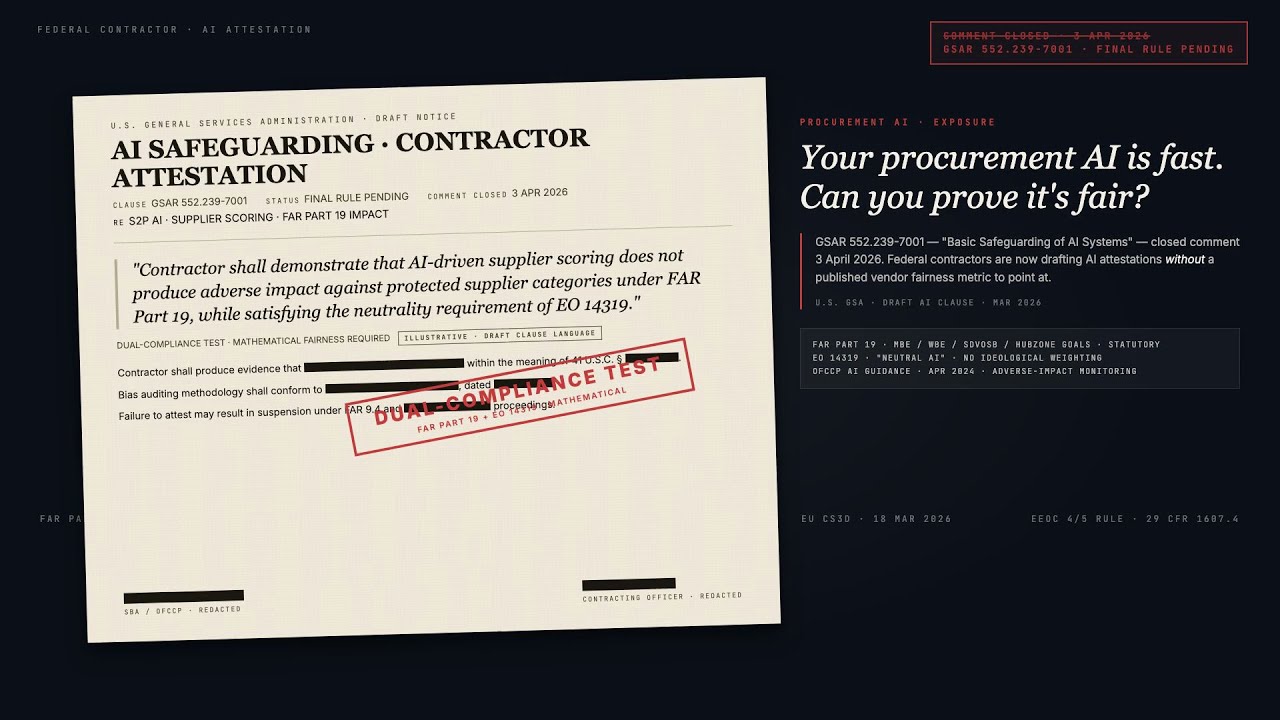
WatchAI Procurement Fairness & Supplier Diversity Compliance
Audit your procurement AI for bias. Veriprajna builds vendor-agnostic fairness testing for SAP Ariba, Coupa, GEP, and Ivalua supplier scoring, ensuring FAR Part 19 compliance and provable algorithmic equity.
 Watch
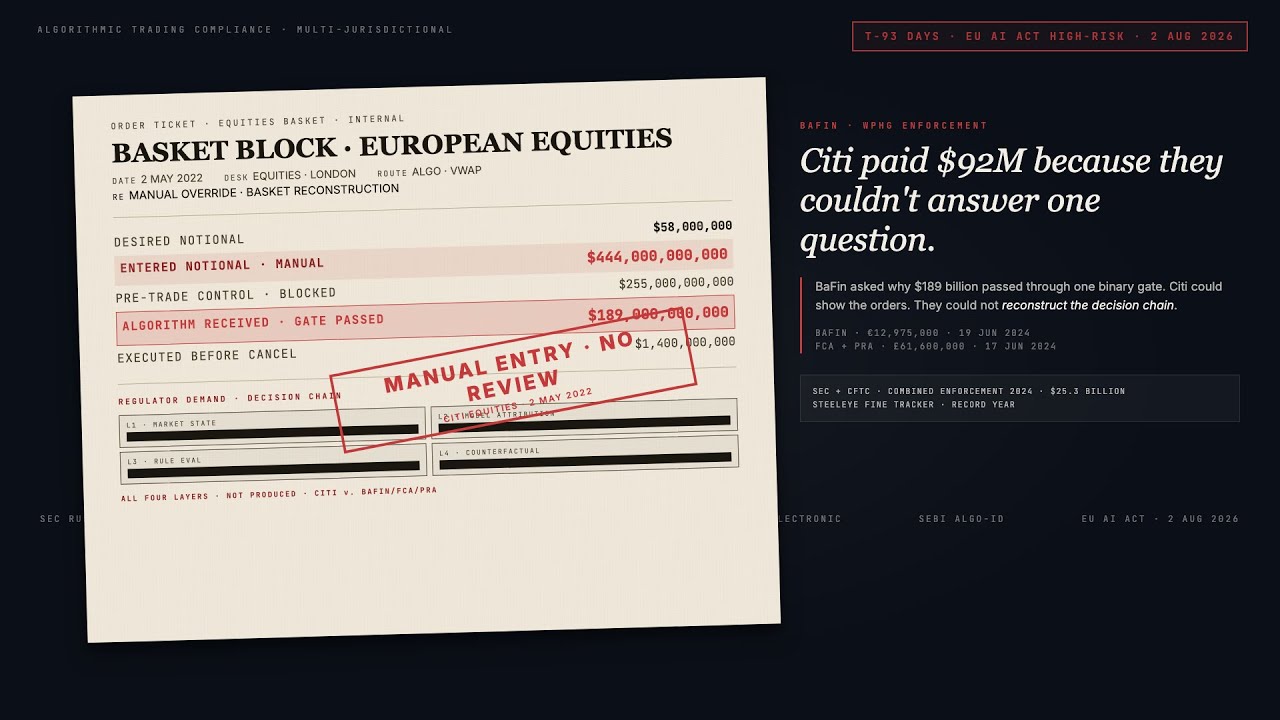
WatchAlgorithmic Trading Compliance AI
Regulators are done accepting order logs as audit evidence. After the August 2024 flash crash wiped $1 trillion in value and Citigroup paid $92 million in fines for a single algorithmic failure, the question has shifted from "do you have controls? " to "can you reconstruct every decision your algorithm made?
 Watch
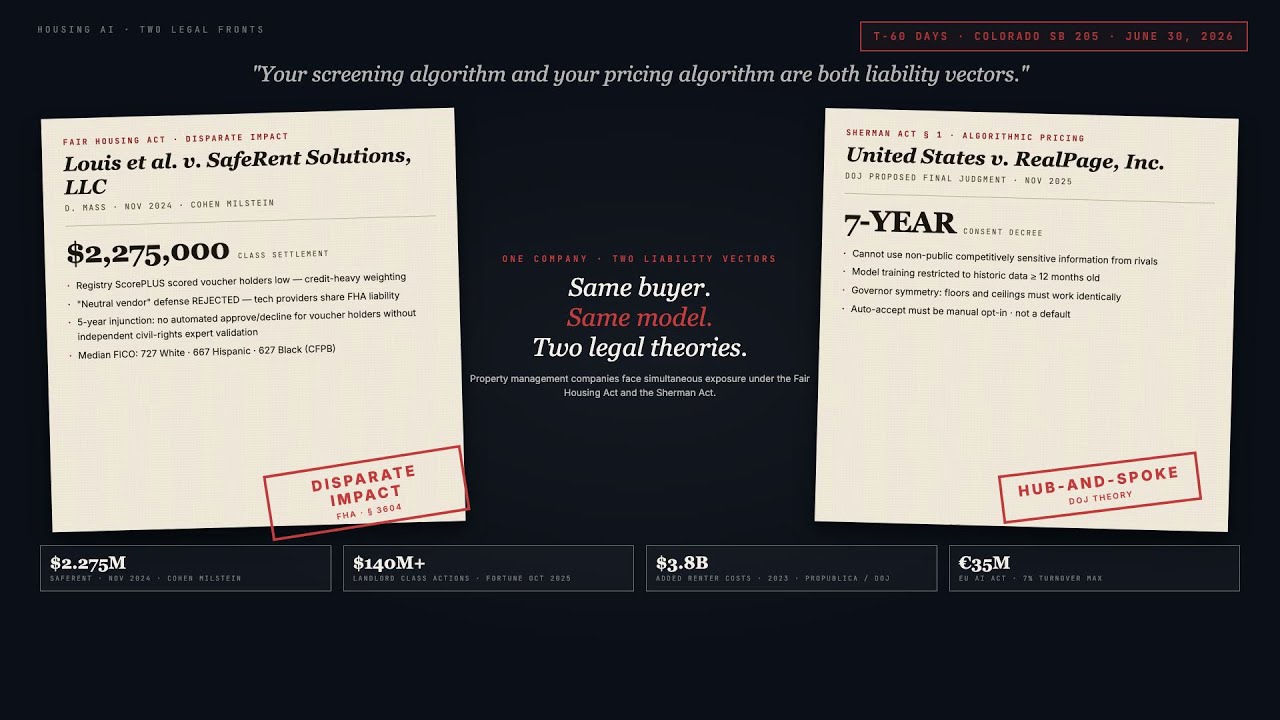
WatchHousing AI Compliance: Tenant Screening Fairness and Algorithmic Pricing
Property management companies face simultaneous legal exposure on two fronts: tenant screening that discriminates under the Fair Housing Act, and revenue management that coordinates pricing under the Sherman Act. We audit both, engineer compliant architectures, and map your systems against every jurisdiction that matters.
 Watch
WatchMedicare Advantage AI Governance & Algorithmic Compliance
Audit, explain, and defend your Medicare Advantage AI. Explainability middleware, CMS-0057-F compliance architecture, and litigation readiness for health plan algorithms.
Frequently Asked Questions
How much does adding explainability cost in production latency and infrastructure?
It depends entirely on the method. Inherently interpretable models like Explainable Boosting Machines add zero explanation overhead because the model itself is the explanation. For post-hoc methods on black-box models, KernelSHAP can take seconds to minutes per prediction at production volume, which is why we use TreeSHAP for ensemble models (milliseconds) and pre-compute explanation caches for high-throughput systems. Counterfactual generation with DiCE-Extended runs within sub-second budgets when properly constrained. The real cost question is not latency per explanation but whether you need real-time explanations for every prediction or on-demand explanations triggered by adverse actions, appeals, or audits. Most regulated systems need the latter, which changes the infrastructure math entirely.
Our SHAP values change across runs for the same input. Is our explainability system broken?
If you are using KernelSHAP, this is expected behavior, not a bug. KernelSHAP uses sampling-based approximation, and insufficient samples produce unstable attributions. The fix is either running more permutations until convergence (which increases latency) or switching to TreeSHAP for tree-based models, which computes exact Shapley values without sampling. The deeper problem is that most teams never test explanation stability at all. We build convergence monitoring into the explanation pipeline: if a prediction's attributions have not stabilized within the computational budget, the system flags that explanation as unreliable rather than serving it. For regulatory submissions, unstable explanations are a liability. A compliance officer cannot defend reason codes that would differ on a re-run.
Can we keep using XGBoost for lending if we add SHAP, or do regulators want inherently interpretable models?
No US regulator currently mandates inherently interpretable models. The CFPB requires that adverse action notices include the principal reasons for denial, specific and accurate to the individual applicant. You can satisfy this with SHAP on XGBoost if the explanations are stable and faithfully reflect the model's computation. The practical problem is that SHAP on XGBoost introduces instability risks and can be adversarially manipulated (demonstrated by Slack et al. 2020 and confirmed by 2025 research on feature representation sensitivity). Meanwhile, Explainable Boosting Machines match XGBoost accuracy on tabular data while being inherently transparent. So the question becomes: why take on explanation risk when an equally accurate model eliminates it? We evaluate the accuracy-interpretability tradeoff on each client's specific dataset before recommending an architecture.
What does the EU AI Act actually require for explainability, and when is enforcement?
Article 13 of the EU AI Act requires providers of high-risk AI systems to ensure 'sufficiently transparent' operation, enabling deployers to interpret outputs and use the system appropriately. Providers must supply clear documentation of the system's intended purpose, accuracy levels, known limitations, human oversight measures, and potential risks. Full enforcement for high-risk systems under Articles 9-49 begins August 2, 2026, with penalties up to EUR 35 million or 7% of global annual turnover. The challenge is that 'sufficiently transparent' is not yet defined in binding technical standards. CEN/CENELEC harmonized standards are targeted for Q4 2026. We build to the strictest reasonable interpretation and design explanation outputs that can be tightened when the standards land, rather than retrofitting after enforcement begins.
How do we explain LLM-based decisions when chain-of-thought reasoning is unreliable?
Chain-of-thought text generated by reasoning models is not a reliable record of the model's actual computation. Anthropic's May 2025 research showed Claude 3.7 Sonnet was faithful only 25% of the time when given reasoning hints. This means you cannot point to CoT output and call it an explanation. For LLM-powered decisions in regulated contexts, we build explanation systems that do not depend on the model explaining itself. This means grounding-based traceability (tying outputs to retrieved source documents with verifiable citations), structured decision decomposition (breaking the decision into independently auditable steps), and attribution graphs where available. The explanation comes from the system architecture, not the model's self-report.
What is the difference between model documentation (Model Cards, FactSheets) and decision explainability?
Model documentation describes a model: its training data, intended use, performance benchmarks, and known limitations. Decision explainability answers a different question: why did this model produce this specific output for this specific input? A Model Card tells you the model was trained on 10 million records and achieves 94% accuracy. It does not tell an applicant why their loan was denied. The CFPB has been explicit that generic reason codes do not satisfy ECOA adverse action requirements. The CJEU ruled in February 2025 that a 'complex mathematical formula' does not constitute a GDPR-compliant explanation. We build both layers, but they serve different audiences and different regulatory obligations. Documentation is necessary but not sufficient.
Can post-hoc explanations be manipulated to hide bias in our model?
Yes. Slack et al. (2020) demonstrated a scaffolding technique that lets a model produce biased predictions while generating SHAP and LIME explanations that show no trace of the protected-class features influencing the decision. Follow-up research in 2025 confirmed that even without adversarial intent, simple changes in feature representation can shift SHAP-determined feature importance. This is not a theoretical concern. If your model uses features correlated with race, gender, or age, and your explanation method does not detect that, your audit is incomplete. We test explanation robustness by applying known adversarial scaffolding techniques to verify that our explanation pipeline would surface hidden bias, not just report clean attribution.
What explainability obligations does the NAIC Model Bulletin create for insurers?
The NAIC Model Bulletin, adopted December 2023 and now implemented by 24 states, requires insurers using AI to include transparency and explainability in their governance programs. Regulators can require companies to explain how AI tools influence underwriting, pricing, marketing, and claims decisions. The bulletin does not prescribe specific XAI methods, but it creates the expectation that insurers can explain AI-driven outcomes to both regulators and impacted consumers. Colorado's requirements (effective 2025 for auto and health insurance) add specific testing mandates for unfair discrimination. We build explanation capabilities that satisfy the bulletin's governance expectations: documented explanation methods, auditable attribution pipelines, and consumer-facing explanation formats for adverse underwriting or claims decisions.
Are concept bottleneck models ready for production use in interpretable deep learning?
Not in most enterprise settings. Concept Bottleneck Models require dense concept annotations for every training instance, which is expensive and often infeasible. More fundamentally, 2025 research demonstrated that standard CBMs do not impose a true information bottleneck: the model can encode non-concept information in concept representations, undermining the interpretability guarantee. Post-hoc CBMs relieve the annotation burden but introduce their own faithfulness questions. The concept datasets needed for high-quality CBMs rarely exist outside specialized medical imaging or well-curated research domains. For most enterprise applications, we recommend Explainable Boosting Machines for tabular data and validated post-hoc methods with faithfulness testing for deep learning, rather than concept-based approaches that promise interpretability they may not deliver.
How do we build different explanation outputs for data scientists, compliance officers, and affected individuals?
All three explanations derive from a shared attribution computation layer, but they render differently. The technical layer produces feature attributions (SHAP values or direct model coefficients for interpretable models), decision boundary context, and distributional comparisons. The compliance layer maps those attributions to regulatory-specific formats: ECOA adverse action reason codes, EU AI Act deployer documentation templates, or NAIC bulletin governance records. The consumer layer translates the top contributing factors into plain language with actionable guidance. We build this as three rendering modules on top of one explanation engine, so the underlying attribution is consistent across audiences. The alternative, writing separate explanations manually, introduces drift between what the model actually does and what compliance reports say it does.
Build Your AI with Confidence.
Partner with a team that has deep experience in building the next generation of enterprise AI. Let us help you design, build, and deploy an AI strategy you can trust.
Veriprajna Deep Tech Consultancy specializes in building safety-critical AI systems for healthcare, finance, and regulatory domains. Our architectures are validated against established protocols with comprehensive compliance documentation.