AI Systems for Insurance Carriers That Survive Regulatory and Litigation Review
AI systems for P&C carriers, specialty insurers, and reinsurers that produce the model validation, fairness testing, and claims audit artifacts state regulators actually examine.
Insurance carriers are pushing AI into underwriting, claims, and catastrophe modeling faster than their governance frameworks can absorb it. Our approach is to build the AI governance and validation layer that sits between your InsurTech tooling and your regulators — so an engagement is scoped to produce the documentation artifacts that survive a state DOI market conduct exam, a Colorado SB 21-169 disparate impact review, or a plaintiff attorney's UCSPA bad faith discovery request.
Your Model-Validation Stack Was Built for GLMs, Not Gradient-Boosted Ensembles
The InsurTech tooling has arrived. In the space of a few months, the major platform vendors shipped production AI into the core of carrier operations:
- Guidewire shipped its first agentic AI underwriting assistant in December 2025.
- Verisk launched XactAI and a commercial GenAI underwriting assistant in September 2025.
- Shift Technology released an agentic claims platform the same month.
Yet 90% of carriers tested AI in 2025 and only 22% reached production. The gap is not technology. It is that the model validation, regulatory documentation, and fairness testing infrastructure at most carriers was built for GLMs and actuarial tables — not for gradient-boosted ensembles, transformer-based risk narratives, or multi-agent claims workflows. Your actuaries were not trained to validate the models you are deploying.
The Multi-State AI Regulatory Patchwork Is Already Here
Twenty-four states plus the District of Columbia have adopted the NAIC Model Bulletin on AI use in insurance, but each state's implementing rules differ. Colorado alone has three overlapping requirements:
- SB 21-169 — quantitative disparate impact testing for underwriting models, expanded to auto and health insurers in October 2025.
- The Colorado AI Act SB 24-205 — effective February 1, 2026, covering high-risk AI in underwriting and claims.
- Regulation 10-1-1 amendments — requiring life insurers to submit annual AI reports starting December 2025.
Connecticut and Vermont have their own implementing frameworks. Texas and Florida lag behind. States enacted 145 AI-related laws in 2025 alone, a 50% increase over the prior year. The EU AI Act's high-risk provisions for insurance risk pricing reach full application on August 2, 2026. The NAIC is piloting an AI Systems Evaluation Tool for use in market conduct and financial examinations in 2026, and industry groups are already pushing back on whether pilot findings could trigger enforcement.
A multi-state carrier writing business across fifteen or twenty jurisdictions cannot manage this with spreadsheets and legal memos. Our approach is to build compliance mapping systems designed to trace each AI model feature to the specific requirements of each state's NAIC implementation, Colorado's triple-layer regime, and the EU AI Act where applicable. When a new state adopts or amends its AI rules, the mapping is designed to update. The intended output: when a DOI examiner asks how your underwriting model handles proxy variables that correlate with race, you hand them a generated report, not a frantic actuarial workup.
Claims AI Liability After UnitedHealth and Cigna
The litigation landscape for AI-assisted claims decisions shifted permanently in 2025 and 2026:
- A Minnesota federal judge ordered UnitedHealth to disclose its nH Predict algorithm documents in March 2026 after evidence showed that 90% of AI-denied claims were reversed on appeal.
- Cigna's PxDx algorithm rejected over 300,000 claims in two months, and Judge Drozd allowed the Kisting-Leung class action to proceed in March 2025.
Plaintiff attorneys are now building UCSPA (Unfair Claims Settlement Practices Act) theories around automated adjudication, and the pattern is clear: if your AI systematically underpays or denies claims along demographic lines, you face both regulatory action and class action exposure.
We design claims AI governance systems (see our working demo of deterministic claims adjudication) to produce three things carriers deploying Shift Technology, Tractable, CLARA Analytics, or custom adjudication models need:
- Decision audit trails that log every input, model output, and human override with timestamps and rationale.
- Fairness monitoring that continuously tests claims outcomes for disparate impact across protected classes — not just at deployment but through ongoing operation.
- Documentation packages that your general counsel can hand to a plaintiff's attorney in discovery without creating additional exposure.
The failure mode this targets is well documented: a fairness audit found 11-17% pricing disparities in predominantly Black zip codes fourteen months after deployment of a model that passed initial bias testing. Continuous monitoring is designed to catch drift that point-in-time validation misses.
Actuarial Model Validation for Systems Actuaries Cannot Read
The core problem in insurance AI validation is that the people responsible for signing off on models — your actuaries and your model validation team — were trained on linear models with interpretable coefficients. An XGBoost underwriting model with 500 features and interaction effects does not yield to the same assumption testing. A transformer generating risk narratives from unstructured submission data does not have coefficients at all. Carriers are responding by either throttling AI deployment, hiring ML-literate validators they cannot find in sufficient numbers, or quietly relying on vendor assertions that do not hold up in a rate filing challenge.
Our approach to bridging this gap is a specific architecture. The AI model operates inside a deterministic constraint layer grounded in your domain ontology — underwriting guidelines, rating manual rules, regulatory thresholds — so decision paths become auditable without reading tensor weights. The method generates SHAP-based feature importance reports, permutation importance analyses, and fairness test results in the format your actuarial team already uses for GLM documentation. The intended result: when your chief actuary needs to sign the rate filing, they are reviewing a structured validation package, not a black box.
Adversarial self-critique architectures have been shown in the published literature to reduce hallucination in commercial underwriting from 11.3% to 3.8% (arXiv 2602.13213). We design the system to build in that discipline from day one.
Catastrophe Modeling Where Stochastic and ML Intersect
Catastrophe models from Moody's (formerly RMS), Verisk, and AIR have physical and stochastic bases: event sets derived from historical seismicity, tropical cyclone tracks, or hydrological patterns. When carriers layer ML on top — using satellite imagery from Maxar or Planet for exposure validation, alternative data for loss amplification, or AI-driven post-event reconnaissance for rapid claims triage (see our flood-intelligence research) — the combined system sits in a validation no-man's-land. The cat model vendor validates the stochastic engine. Nobody validates the ML overlay, and the interaction effects between the two can produce risk scores that neither team fully understands.
Private flood insurance is the sharpest example. The market grew from $600 million in written premium in 2016 to over $2.5 billion in 2025. Private carriers use AI-driven property-specific flood models that diverge significantly from FEMA's Risk Rating 2.0 methodology, creating adverse selection dynamics that regulators are beginning to scrutinize. Thirteen percent of policyholders facing the highest Risk Rating 2.0 premium increases dropped coverage entirely. We design validation frameworks for hybrid cat-ML systems to test the stochastic and ML components independently and in combination, document the interaction effects, and produce the actuarial justification that a DOI rate filing examiner needs to see.
Fraud Detection Beyond the 30% False Positive Floor
Rules-based fraud detection systems at most carriers run 30-50% false positive rates. Every false positive burns adjuster time, delays legitimate claims, and erodes policyholder trust. The AI benchmarks tell a different story:
- AI fraud detection achieves less than 10% false positives with 40% fraud loss reduction, according to Coalition Against Insurance Fraud data.
- McKinsey reports that state-of-the-art solutions improve detection 15-20% while reducing false positives 20-50%.
But getting below a 5% false positive rate — the threshold where adjusters actually trust the system — requires multi-modal detection across text, images, and behavioral signals, plus continuous calibration against your specific book of business.
We design fraud detection architectures to combine structured claims data, unstructured adjuster notes, imagery analysis (detailed in our research on deterministic computer vision for insurance forensics), and network analytics into a scoring system calibrated to your loss patterns. The architecture produces explainable risk scores, not just flags, so your SIU team understands why a claim was flagged and can defend the investigation to regulators. For carriers deploying vendor fraud tools from Shift Technology or FRISS, we design the integration and calibration layer to tune the vendor output to your portfolio rather than running on generic thresholds.
Why Not Accenture, Deloitte, or Your Core System Vendor?
Accenture booked $3.6 billion in AI revenue in FY2025, hired 77,000 AI and data staff, and acquired Faculty in January 2026. Deloitte leads with its Trustworthy AI framework. Both are strong at governance methodology, operating model design, and staff augmentation. But strength in methodology is not the same as shipping the artifacts your regulators, auditors, and attorneys actually examine.
| Provider | Strength | What they do not ship |
|---|---|---|
| Accenture, Deloitte | Governance methodology, operating model design, staff augmentation | Deterministic constraint engineering that makes an AI model auditable by your actuarial team; continuous fairness monitoring that catches drift fourteen months post-deployment; the litigation-defense documentation layer your general counsel needs after UnitedHealth and Cigna |
| Core system vendors (Guidewire, Duck Creek, Majesco) | AI capabilities inside the core platform | The validation methodology that survives a DOI rate filing challenge |
| InsurTech point solutions (Shift, Tractable, CLARA) | Solve specific claims or fraud surfaces well | Do not stitch the compliance, validation, and audit architecture across your full AI portfolio |
| Veriprajna | Vendor-neutral on the platform layer | We design the governance, validation, and constraint architecture to wrap around whatever tools you already run |
We are vendor-neutral on the platform layer. Our approach is to build the governance, validation, and constraint architecture that wraps around whatever tools you already run, and an engagement is scoped to produce the artifacts your regulators, auditors, and attorneys actually examine.
Key Takeaways
- Adoption has outrun governance: 90% of carriers tested AI in 2025, only 22% reached production — the blocker is validation and documentation, not technology.
- The compliance surface is fragmenting: 24 states plus DC on the NAIC Model Bulletin, Colorado's triple-layer regime (SB 21-169, SB 24-205, Reg 10-1-1), 145 new AI laws in 2025, and the EU AI Act at full application August 2, 2026.
- Claims AI is now a litigation surface: the UnitedHealth nH Predict disclosure order, Cigna's PxDx and the Kisting-Leung class action, and emerging UCSPA theories demand audit trails, continuous fairness monitoring, and discovery-ready documentation.
- Modern models need modern validation: a deterministic constraint layer plus SHAP and permutation importance is designed to let your chief actuary sign an XGBoost or transformer model — adversarial self-critique has been shown to cut underwriting hallucination from 11.3% to 3.8%.
- Hybrid cat-ML and fraud systems fall through the cracks: we design systems to validate stochastic and ML components together, and to drive fraud false positives below the 5% trust threshold with multi-modal, calibrated detection.
Solutions for Insurance & Risk Management
 Watch
WatchAI-Powered Flood Risk Underwriting
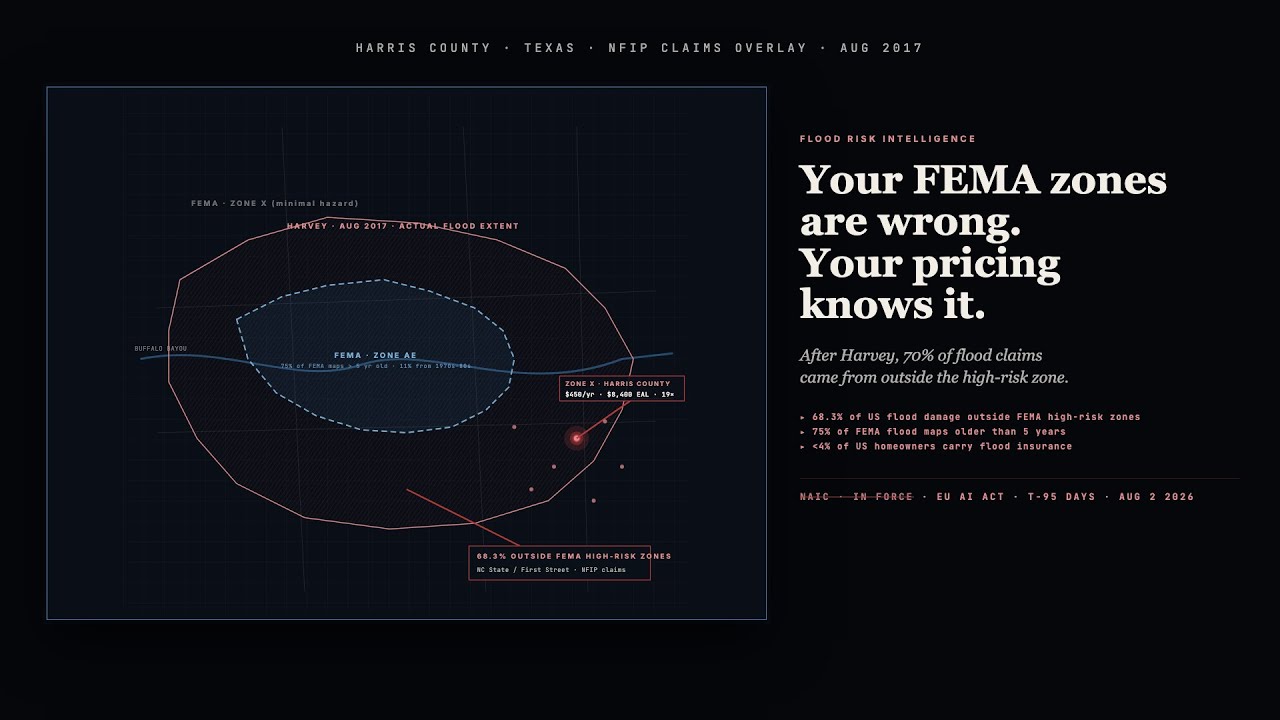
More than two-thirds of US flood damage occurs outside FEMA's high-risk zones. If your rating engine still anchors to Zone AE vs. Zone X, you're mispricing risk on both sides: overcharging the elevated house inside the zone, undercharging the slab-on-grade house outside it.
 Watch
WatchInsurance Claims AI & Deepfake Detection
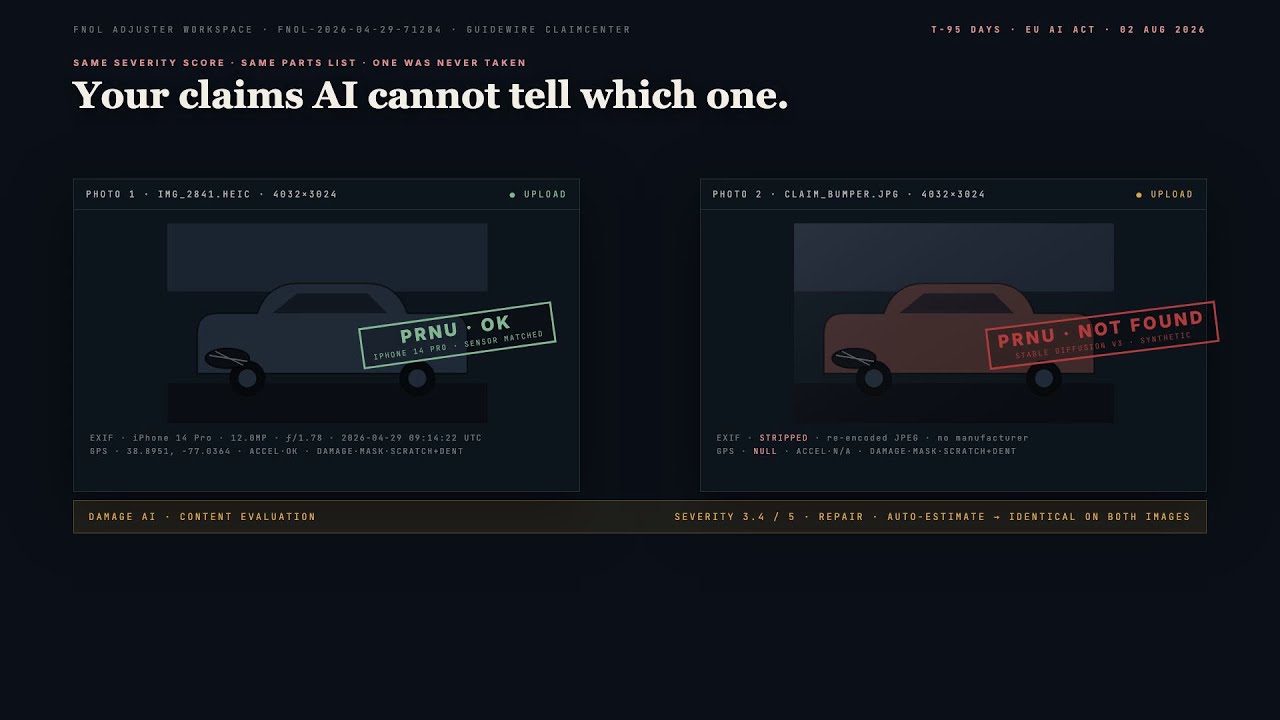
Auto insurers are caught between two AI-driven threats: fraudsters generating synthetic damage photos that pass existing checks, and "enhancement" tools that alter evidence before adjusters see it. Veriprajna builds forensic computer vision that authenticates, measures, and preserves every pixel of claims evidence.
 Watch
WatchSatellite Flood Intelligence for Parametric Insurance
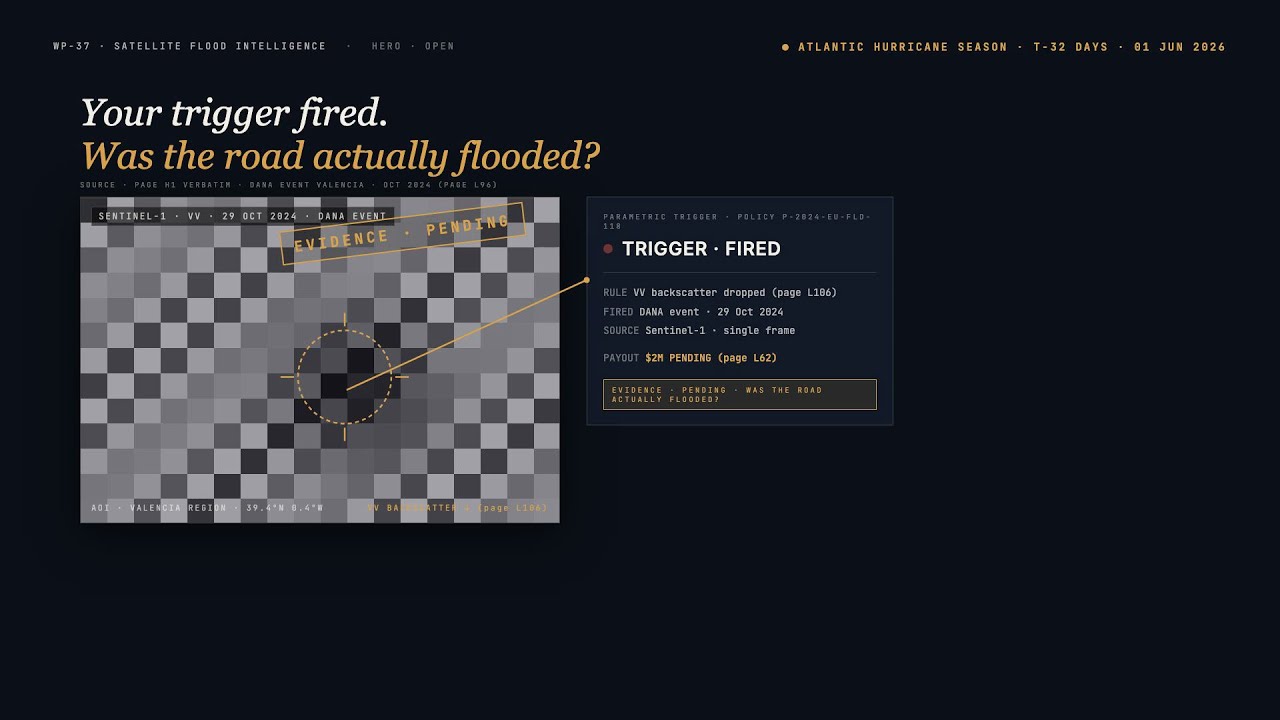
Single-frame satellite detection confuses cloud shadows with floodwater. When a $2M parametric payout depends on that classification, "probably flooded" is not good enough. We build flood verification systems that separate shadows from water using temporal SAR-optical fusion, producing forensic-grade evidence trails for every trigger event.
Frequently Asked Questions
How do I validate an XGBoost or GBM underwriting model for a state DOI rate filing when my actuaries only know GLM assumption testing?
We wrap the ML model in a deterministic constraint layer grounded in your underwriting guidelines and rating manual rules, then generate SHAP-based feature importance reports, permutation importance analyses, and fairness test results in the same format your actuarial team uses for GLM documentation. Decision paths become auditable without reading tensor weights. Your chief actuary reviews a structured validation package that maps to the SERFF rate filing justification format, not a black box output. Adversarial self-critique architectures reduce hallucination in commercial underwriting from 11.3% to 3.8%, which we build into the system from deployment.
Which states have adopted the NAIC AI Model Bulletin and what does that mean for our compliance program?
Twenty-four states plus the District of Columbia have adopted the Model Bulletin as of early 2026, but each state's implementing rules differ in scope, reporting requirements, and enforcement mechanisms. Colorado has the most layered regime: SB 21-169 (quantitative disparate impact testing, expanded to auto and health insurers October 2025), the Colorado AI Act SB 24-205 (effective February 2026), and Regulation 10-1-1 amendments. Connecticut and Vermont have their own frameworks. We build compliance mapping systems that trace each AI model feature to the specific requirements of each state where you write business, so when a new state adopts or amends its rules, the mapping updates rather than requiring a new compliance project.
What litigation risk do we face from AI-assisted claims adjudication after the UnitedHealth and Cigna lawsuits?
Significant and growing. A Minnesota federal court ordered UnitedHealth to disclose its nH Predict algorithm documents in March 2026 after evidence showed 90% of AI-denied claims reversed on appeal. Cigna's PxDx algorithm rejected over 300,000 claims in two months, and the Kisting-Leung class action was allowed to proceed. Plaintiff attorneys are building UCSPA (Unfair Claims Settlement Practices Act) theories around automated adjudication. If your AI systematically underpays or denies claims along demographic lines, you face both regulatory action and class action exposure. We build decision audit trails, continuous fairness monitoring, and discovery-ready documentation packages for carriers deploying any claims AI.
How do we test for proxy discrimination in our underwriting models to meet Colorado SB 21-169 requirements?
Colorado requires quantitative disparate impact testing even when models are facially neutral, because proxy variables like credit scores, ZIP codes, and occupation correlate with race. A fairness audit found 11-17% pricing disparities in predominantly Black zip codes fourteen months after deployment of a model that passed initial bias testing. We build testing harnesses that run adverse impact ratio and standardized mean difference tests across protected classes, check for proxy variable correlations, test for model drift over time, and produce the documentation that Colorado DOI examiners expect under Regulation 10-1-1. This runs continuously, not just at deployment.
Should we build or buy AI claims triage, and how do Guidewire Olos, Shift Force, and Tractable actually compare?
Each solves a different surface. Guidewire Olos (December 2025) provides agentic AI underwriting intake and triage integrated with InsuranceSuite, strongest for carriers already on Guidewire Cloud. Shift Technology's Shift Claims (September 2025) delivers agentic claims triage with early results of 3% lower claims losses, 30% faster handling, and 60% automation rate. Tractable focuses on computer vision estimatics for auto claims, achieving 90% touchless estimates at carriers like Admiral Seguros. CLARA Analytics targets workers' comp and bodily injury with its Intelligence-as-a-Service platform. The choice depends on your lines of business and existing core system. What none of them provide is the governance, validation, and compliance layer that wraps around the tool. That is what we build.
Our private flood model disagrees with FEMA Risk Rating 2.0 pricing. How do we defend that to regulators?
The private flood market grew from $600 million to over $2.5 billion in written premium between 2016 and 2025, and private carriers using AI-driven property-specific models routinely reach conclusions that diverge from FEMA's zone-based methodology. That divergence creates adverse selection risk and regulatory scrutiny. We build validation frameworks that test the AI components of your flood model independently and in combination with any underlying catastrophe model (Moody's, Verisk, or proprietary), document the actuarial justification for divergence from NFIP pricing, and produce the rate filing support that a DOI examiner needs to approve your model.
How do we prepare for the NAIC AI Systems Evaluation Tool pilot examination?
The NAIC Big Data and AI Working Group is piloting the Evaluation Tool with select state insurance departments in 2026 for use in both market conduct and financial examinations. Industry groups have raised concerns that pilot findings could trigger enforcement even before the tool is finalized. We build readiness assessments that map your current AI inventory, governance documentation, fairness testing, and model validation against the known evaluation criteria from the Working Group's published materials and meeting minutes. Where gaps exist, we build the documentation and testing infrastructure before the examiner arrives, rather than scrambling during a market conduct exam.
How is working with Veriprajna different from hiring Accenture, Deloitte, or our core system vendor for insurance AI?
Accenture and Deloitte are strong at governance methodology, operating model design, and staff augmentation. Accenture booked $3.6 billion in AI revenue in FY2025 and has scale. But neither ships the deterministic constraint engineering that makes an ML model auditable by your actuarial team, the continuous fairness monitoring that catches drift months post-deployment, or the litigation-defense documentation your general counsel needs after the UnitedHealth and Cigna cases. Core system vendors (Guidewire, Duck Creek) provide AI features but not the validation methodology that survives a DOI rate filing challenge. InsurTech vendors (Shift, Tractable, CLARA) solve specific surfaces well. We are vendor-neutral on the platform layer and build the governance, validation, and constraint architecture that wraps around whatever tools you already run.
Build Your AI with Confidence.
Partner with a team that has deep experience in building the next generation of enterprise AI. Let us help you design, build, and deploy an AI strategy you can trust.
Veriprajna Deep Tech Consultancy specializes in building safety-critical AI systems for healthcare, finance, and regulatory domains. Our architectures are validated against established protocols with comprehensive compliance documentation.