The Geometric Imperative: Re-Engineering Fashion E-Commerce Profitability Through Physics-Based AI
Executive Summary
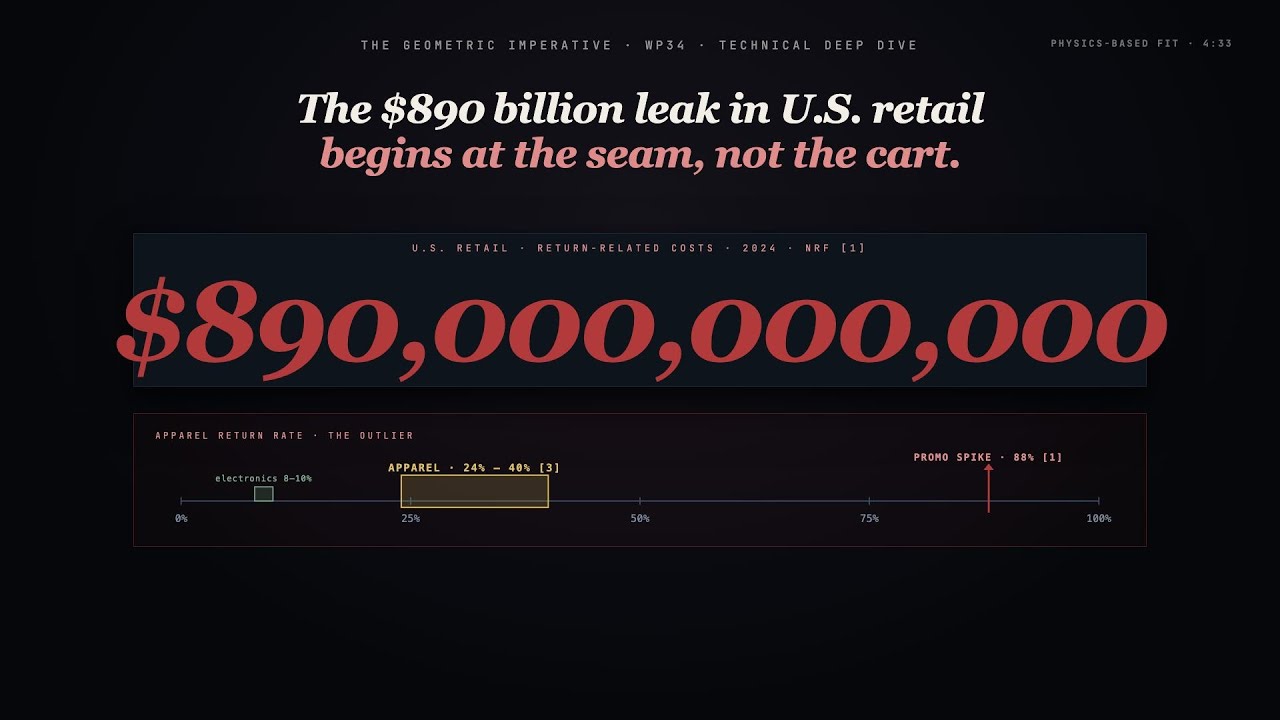
The global fashion retail sector stands at a precipice. As the industry transitions into the mid-2020s, it faces a paradox of innovation: while front-end consumer engagement technologies have reached unparalleled levels of sophistication, the fundamental unit economics of e-commerce are being eroded by a crisis of physical reality—the returns epidemic. In 2024, United States retailers alone shouldered an operational burden of nearly $890 billion in return-related costs, a figure that represents not merely lost revenue, but a systemic inefficiency threatening the viability of the digital retail model. 1
The primary driver of this attrition is the "fit gap"—the discrepancy between the digital representation of a garment and its physical interaction with the human body. As return rates for apparel stabilize between 24.5% and 40%, with spikes reaching 88% during promotional periods, the industry has aggressively sought technological remediation. 3 The prevailing market response has been the rapid adoption of Generative AI (GenAI) and diffusion-based "Virtual Try-On" (VTON) solutions. These tools, leveraging inpainting techniques akin to those found in Large Language Model (LLM) wrappers, promise to visualize products on consumers with photorealistic fidelity.
This whitepaper, prepared by Veriprajna, argues that this reliance on Generative AI is a strategic error rooted in a misunderstanding of the problem space. We posit that the fit crisis is not a semantic problem of visual plausibility, but a geometric problem of mechanical compatibility. Generative models, by design, operate on statistical probabilities in 2D pixel space; they "hallucinate" fit rather than calculating it. They prioritize the creation of a convincing image over the preservation of metric truth, leading to an "illusion of fit" that drives initial conversion but inevitably results in returns. 4
Veriprajna advocates for a paradigm shift toward Physics-Based 3D Body Mesh Reconstruction . This approach represents "Deep AI"—the integration of geometric deep learning, computer vision, and computational mechanics—to recover metrically accurate 3D human models from monocular data and simulate garment dynamics using Finite Element Analysis (FEA). Unlike the probabilistic guessing game of diffusion models, physics-based reconstruction offers a deterministic, verifiable analysis of stress, strain, and pressure. 7
This document provides an exhaustive, expert-level analysis of the technical and financial imperatives for this shift. It details the economic cascading effects of returns, dissects the mathematical limitations of generative inpainting, and outlines the rigorous engineering required to implement true physics-based simulation. We position Veriprajna not as a vendor of superficial visual tools, but as an architect of the geometric infrastructure necessary to restore profitability and sustainability to the fashion supply chain.
1. The Economics of Failure: An Autopsy of the Returns Crisis
To understand the necessity for a deep-tech intervention, one must first confront the brutal economic reality of the current e-commerce landscape. The narrative of "growth at all costs" has been superseded by a desperate need for operational efficiency and margin preservation. In this context, the returns mechanism is no longer a cost of doing business; it is the single largest leak in the Profit and Loss (P&L) statement of the modern fashion retailer.
1.1 The Quantitative Magnitude of the Problem
The scale of the returns crisis has escalated from a logistical nuisance to a financial emergency. As of 2024, industry data indicates that the average U.S. e-commerce return rate hovered around 20.4%, with projections suggesting a climb to 24.5% by 2025. 1 While these aggregate figures are alarming, they mask the catastrophic reality within the apparel sector specifically.
Unlike electronics or beauty products, which typically see return rates in the single digits or low teens (8-10% and 4-10% respectively), apparel and footwear are statistical outliers. Fashion retailers consistently report return rates ranging from 30% to 40%. 3 In high-variance categories such as denim, dresses, and structured outerwear, or during peak promotional periods like Black Friday, these rates can surge violently, with some markets reporting pockets of returns exceeding 50%. 1
The financial implications of this volume are staggering. The National Retail Federation (NRF) estimated the total cost of retail returns in the U.S. at $890 billion in 2024. 1 To put this figure in perspective, the cost of returns rivals the entire GDP of substantial national economies. For the fashion industry, where margins are notoriously thin, this represents a hemorrhaging of capital that cannot be sustained through pricing adjustments alone.
1.2 The Cost Cascade: Anatomy of a Return
A fundamental misunderstanding exists in the C-suite regarding the true cost of a return. Traditional accounting often views a return as a reversal of revenue—a "refund." However, the operational reality is a compounding cost structure that attacks the gross margin from multiple vectors simultaneously. When a $100 garment is returned, the financial damage extends far beyond the $100 refund. The total cost of processing that return typically ranges between $10 and $20 per item in direct handling fees, but when factoring in inventory depreciation, marketing loss, and opportunity cost, the total impact can equate to 66% of the item's original price. 10
Table 1.1: Detailed Breakdown of Reverse Logistics Costs per Unit
| Cost Component | Operational Detail | Financial Impact |
|---|---|---|
| Reverse Transportation | Unlike outbound shipping, which benefts from consolidation and optimized routing, returns are sporadic, decentralized, and ofen require premium carrier services. Shipping a single unit back to a distribution center (DC) can cost 2-3x the outbound rate. |
High ($5-$15) |
| Processing Labor | Upon arrival at the DC, the "touch cost" is immense. A human worker must open the package, inspect the garment for damage (stains, odors, tears), verify the SKU, and determine its disposition. This manual intervention is resistant to automation. |
High ($3-$8) |
| Refurbishment & Repackaging |
50-60% of returned goods require intervention before they can be resold. This includes steaming, re-folding, re-tagging, and repacking in new polybags. |
Moderate ($2-$5) |
| Inventory Depreciation | Fashion is a perishable asset. A return cycle can take 2-4 weeks. By the time |
Severe (30-50% of Margin) |
| Col1 | a trendy item is back in stock, the "trend window" may have closed, or the season may have changed, forcing the retailer to mark down the item by 30-50% to sell it. |
Col3 |
|---|---|---|
| Shrinkage & Liquidation | Items that fail inspection (due to "wardrobing" or damage) cannot be sold as new. They are either liquidated for pennies on the dollar or destroyed, resulting in a total loss of the Cost of Goods Sold (COGS). |
Total Loss of Asset |
| Customer Acquisition (CAC) Waste |
The marketing spend allocated to acquire the initial conversion is lost. Furthermore, the negative experience of a return ofen degrades Customer Lifetime Value (LTV). |
Strategic Loss |
The compounding nature of these costs means that for every three items sold, if one is returned, the profit from the other two is frequently consumed just to cover the loss of the third. This creates a scenario where a retailer can show growing top-line revenue while suffering shrinking net profits—a "profitless prosperity" driven by the churn of inventory.
1.3 Consumer Behavior: The Bracketing Phenomenon
The high return rate is not merely a function of product failure; it is a rational consumer response to uncertainty. In the absence of reliable fit information, consumers have adopted "bracketing" as a risk mitigation strategy. Bracketing involves purchasing multiple sizes or color variations of the same item with the explicit intent to keep only one and return the rest. 1
Data indicates that 51% of Gen Z shoppers admit to regular bracketing. 3 While this behavior guarantees the customer finds a fitting item, it devastates the retailer's unit economics.
● Inventory Lock-up: When a customer orders a Size M and a Size L, they effectively remove two units from the sellable inventory pool. While the items are in transit and sitting in the customer's home, they cannot be sold to other customers. This artificial scarcity lowers inventory turnover rates and leads to stockouts for genuine buyers.
● The Logistics Multiplier: The retailer pays outbound shipping for two items and inbound shipping for one, effectively doubling the logistics load for a single conversion.
1.4 The Root Cause: The Geometric "Fit Gap"
While fraud (wardrobing) and buyer's remorse contribute to return rates, the data consistently identifies fit and sizing issues as the dominant driver, accounting for 53% to 67% of all apparel returns. 11
The core issue is a lack of standardization and a failure of communication. The fashion industry operates on a legacy system of "Vanity Sizing" and inconsistent grading rules. A "Medium" in a fast-fashion brand may correspond to an "Extra Small" in a luxury label. Furthermore, size charts—the primary tool currently offered to consumers—are fundamentally inadequate. They rely on sparse, 1D measurements (bust circumference, waist circumference) to describe a complex, 3D topological surface (the human body).
A consumer may match the bust measurement of a dress perfectly but find it unwearable because the armhole depth is insufficient or the fabric's tensile modulus (stretch) does not accommodate their shoulder width. These are physics problems . They involve the interaction of material properties (stiffness, shear, friction) with complex geometry. Current e-commerce interfaces treat clothing as 2D images, but the failure mode is 3D mechanical incompatibility.
This is the precise problem space where Artificial Intelligence must intervene. However, the industry's current trajectory—the wholesale adoption of Generative AI for visualization—represents a fundamental misdiagnosis of the problem.
2. The Generative AI Mirage: Why Inpainting Fails Geometric Reality
In the rush to deploy "AI," the fashion industry has been seduced by the visual capabilities of Generative AI, specifically Latent Diffusion Models (LDMs) like Stable Diffusion, Midjourney, and their proprietary derivatives. The market is flooded with "Virtual Try-On" (VTON) plugins that use inpainting to superimpose garments onto user photos. Veriprajna defines these solutions as "LLM Wrappers"—superficial applications of general-purpose models that lack the depth required for industrial application.
While these models excel at creating plausible images—images that look like photographs—they fail at creating faithful images—images that accurately represent physical reality. This distinction is fatal for returns reduction.
2.1 The Mechanics of Hallucination in Diffusion Models
To understand why generative VTON fails, one must understand the mathematical architecture of diffusion models. These models are probabilistic; they learn the statistical distribution of pixel arrangements in a vast dataset of images. When generating an image, they sample from this distribution to "denoise" a random signal into a coherent image. 6
This process is inherently prone to hallucination . In the context of VTON, hallucination means the model generates details that do not exist in the source garment or the user's body, or it fails to preserve critical details that do exist.
Recent theoretical research into the density-based perspective of hallucinations reveals a critical vulnerability: diffusion models inevitably assign non-zero probability mass to "gap regions" outside the true data support. 15
● Mode Interpolation: If a model has been trained on thousands of images of "skinny jeans" and "flowing maxi dresses," but few images of "structured A-line skirts," it will struggle to generate the specific drape of the skirt. Instead, it will smoothly interpolate between the data modes it knows. It might generate a skirt that looks like an A-line but behaves like a maxi dress, draping softly where it should be stiff. 6
● The "Gap" Problem: The model fills in the gaps in its knowledge with statistically likely pixels, not physically correct ones. It prioritizes the smoothness of the image (making it look real) over the accuracy of the content (making it true to the product).
2.2 The "Slimming" Bias and the Illusion of Fit
The most dangerous failure mode of generative VTON is the creation of a "Slimming Bias." Diffusion models are trained on datasets heavily skewed toward professional fashion photography—images of tall, slender models with idealized proportions.
When a user uploads a photo of a diverse body type, the diffusion model often "hallucinates" a fit that conforms to its training bias rather than the user's actual geometry.
● Warping the Body: The model may implicitly slim the user's waist or elongate their legs to match the statistical average of "fashion photos" in its latent space. 16
● Warping the Garment: Alternatively, the model may warp the garment texture to fit the user in a way that the physical fabric never could. It might stretch a non-stretch denim texture as if it were spandex to make it fit a curve.
This creates a dangerous "Illusion of Fit." The customer sees a high-fidelity image of themselves looking fantastic in the garment. They purchase it with high confidence. However, because the AI hallucinated the fit (ignoring the fabric's lack of stretch or the user's actual hip measurement), the physical garment does not zip up. The result is a guaranteed return, now compounded by customer disappointment and a loss of trust in the brand.
2.3 Specific Technical Failures of Inpainting
Beyond the theoretical limitations, current generative VTON architectures (such as VITON-HD, IDM-VTON, and Leffa) exhibit specific technical failures that render them unsuitable for fit verification.
1. Texture Drift and Detail Loss: Diffusion models struggle to preserve high-frequency details. Intricate lace patterns, specific embroidery, or brand logos are often "smoothed out" or replaced with generic textures that the model has seen before. 4 A customer buying a dress for its specific pattern will return it if the VTON showed a generic approximation.
2. Geometric Inconsistency: Diffusion models operate in 2D pixel space. They lack an internal representation of 3D depth, occlusion, or volume. Consequently, they frequently generate geometrically impossible configurations—sleeves that merge into torsos, necklines that defy gravity, or patterns that do not wrap correctly around the curvature of the body. 17
3. Temporal Instability: In the emerging field of video VTON, diffusion models struggle to maintain consistency across frames. The garment may flicker, change length, or morph texture as the user moves. 19 This "shimmering" effect breaks the immersion and fails to convey how the garment actually moves or restricts motion.
2.4 The Lack of Metric Fidelity
The ultimate critique of generative VTON is the lack of metric fidelity . A diffusion model does not "know" that a waistline is 72cm or that a fabric has a weight of 200gsm. It simply knows that pixels in that region usually look a certain way.
You cannot query a diffusion model for a "tightness map." You cannot ask it if the buttons will pull when the user sits down. These are mechanical questions that require a physics-based answer. Generative AI provides a semantic answer ("this is a picture of a person in a dress"), but the returns problem is a mechanical one ("this dress is 2cm too small at the hip").
Therefore, investing in generative VTON as a solution for returns is akin to investing in a "magic mirror." It is a marketing tool that drives top-line metrics (conversion) at the expense of bottom-line metrics (net margin).
3. The Physics-Based Paradigm: Deep AI and
Geometric Truth
Veriprajna’s approach represents a fundamental divergence from the generative trend. We advocate for a deterministic, physics-based pipeline that recovers the 3D geometry of the user and simulates the mechanical interaction of the garment. This is "Deep AI"—the convergence of computer vision, geometric deep learning, and computational physics.
3.1 Monocular 3D Human Mesh Recovery (HMR)
The foundation of true fit analysis is the accurate reconstruction of the customer's body in 3D from a simple 2D photo (monocular image). This field, Human Mesh Recovery (HMR), has evolved significantly beyond the capabilities of standard Convolutional Neural Networks (CNNs).
The Shift to Vision Transformers (ViTs)
While early HMR methods relied on CNNs like ResNet-50 to regress body parameters, Veriprajna leverages state-of-the-art Transformer architectures (e.g., HMR 2.0, ViT-based backbones). 21 Transformers utilize self-attention mechanisms to capture global context—understanding that the position of the foot is biomechanically related to the angle of the hip, even if they are far apart in the image pixels. This global awareness is crucial for handling occlusions (e.g., when a user's arm blocks their torso). 22
Advanced Parametric Models: SMPL-X and SKEL
We utilize advanced parametric body models to represent the human form. Standard models like SMPL (Skinned Multi-Person Linear model) define the body surface but often allow for unnatural deformations. Veriprajna adopts:
● SMPL-X: An extension of SMPL that includes articulated hands and expressive faces, essential for fitting long-sleeved garments and understanding overall proportion. 23
● SKEL: A biologically accurate successor to SMPL that incorporates an underlying skeletal rig with joint limits derived from medical data. SKEL prevents the "rubber limb" artifacts common in simpler models, ensuring that the reconstructed body moves within human biomechanical constraints. 22
Resolving the Perspective Ambiguity: The BLADE Algorithm
A critical challenge in using user-generated content (selfies) is perspective distortion. A phone camera held close to the face creates a "fisheye" effect—enlarging the nose and shrinking the body. Standard AI models often assume an "orthographic" projection (infinite focal length), leading to gross inaccuracies in body measurement estimation.
Veriprajna integrates advanced perspective correction algorithms like BLADE (Body Limb Alignment and Depth Estimation). BLADE explicitly recovers the camera's focal length and the subject's translation () from the image features. 24 By inverting the perspective distortion, we can recover the user's true proportions, achieving measurement accuracy within 1-2 centimeters of manual tape measurements. 26 This level of precision is the threshold required for effective size recommendation.
3.2 Computational Physics: The Fabric Simulation Layer
Once the user's geometry is reconstructed, we do not "paint" the clothes on. We simulate them using Finite Element Analysis (FEA) . This process utilizes the actual Digital Product Creation (DPC) assets—the CAD files (DXF/GLB) used to manufacture the garments.
Simulating Material Properties
In our pipeline, the fabric is treated not as a texture, but as a physical mesh of nodes connected by springs. The simulation solves partial differential equations (PDEs) that govern the fabric's behavior based on three core mechanical properties derived from physical testing (e.g., the Kawabata Evaluation System) 27 :
1. Tensile Stiffness (Stretch): How much force is required to elongate the fabric? This distinguishes raw denim from elastane blends.
2. Bending Rigidity (Drape): How easily does the fabric fold? This distinguishes the stiff hang of canvas from the fluid drape of silk.
3. Shear Stiffness: How does the fabric distort diagonally? This determines how the garment conforms to complex curves like the hips and bust.
The Fit Map (Heat Map): Visualizing Comfort
The output of this simulation is not just a render, but a Stress/Strain Map (often referred to as a Fit Map or Heat Map). This visualization overlays color-coded data onto the 3D avatar, providing the consumer with objective, physics-based feedback. 7
● Red Zones (High Strain > 100%): Indicate that the fabric is being stretched beyond its resting dimensions. The garment is physically compressing the body. This signals a "Too Tight" fit.
● Yellow/Orange Zones (Moderate Strain): Indicate a snug, contouring fit, often desirable in athletic wear or bodycon dresses.
● Blue Zones (Zero Strain): Indicate that the fabric is loose and draping freely.
● White/Transparent Zones (No Pressure): Indicate that the fabric is not touching the body (air gap).
Table 3.1: Comparative Analysis: Generative AI vs. Physics-Based Reconstruction
| Input Data | 2D Image + Text/Image Prompt |
2D Image + Digital Patet rn (DXF/GLB) |
|---|---|---|
| Underlying Logic | Probabilistic Statistics (Pixel prediction) |
Deterministic Physics (Newtonian mechanics) |
| 3D Awareness | None (2D hallucination of 3D) |
Native (Explicit 3D meshes) |
| Fit Output | Visual Approximation (Illusion) |
Metric Heatmaps (Stress/Strain/Pressure) |
| Sizing Capabilities | Cannot distinguish between Size M vs L visually |
Simulates exact diference in fabric tension |
| Accuracy | Low (prone to hallucination and bias) |
High (within 1-2cm of physical reality) |
| Primary Utility | Marketing / Inspiration / Engagement |
Fit Verifcation / Returns Reduction |
3.3 Deep AI Engineering: The Veriprajna Moat
Veriprajna’s value proposition lies in the complexity of this integration. We are not an "AI Agency" that simply wraps an API from OpenAI or Midjourney. We are a deep-tech consultancy building a proprietary stack.
● Custom Vision Transformers: We train and fine-tune our own HMR models on proprietary datasets that include diverse lighting conditions, mirror selfies, and complex occlusions to ensure robustness in "wild" retail environments. 21
● Differentiable Simulation: We implement differentiable physics layers that allow the simulation parameters to be optimized and run efficiently on GPU-accelerated cloud infrastructure. This reduces the computational overhead typically associated with FEA, making real-time web deployment feasible. 27
● Neural Rendering: To bridge the gap between the rigorous accuracy of physics and the visual appeal of GenAI, we employ neural rendering techniques (e.g., Gaussian Splatting) to render the physics simulation. This ensures the output looks photorealistic but remains constrained by the underlying physics simulation, preventing the "hallucinations" of pure generative models. 30
4. Veriprajna's Technical Architecture
Implementing a physics-based fit engine requires a robust, multi-stage pipeline that transforms raw user data into actionable fit intelligence.
4.1 The Pipeline Architecture
1. Input Processing & Segmentation: The user uploads a standard 2D image. Our preprocessing module uses semantic segmentation to isolate the user from the background and identify key landmarks (joints, facial features).
2. Geometric Reconstruction (The HMR Core): The segmented data is fed into our proprietary Transformer-based regressor. This model estimates the SMPL-X/SKEL parameters () and the camera parameters () simultaneously.
3. Iterative Refinement: We utilize an optimization loop (similar to HMR 2.0) that projects the estimated 3D mesh back onto the 2D image, calculates the error (reprojection loss), and iteratively adjusts the mesh parameters to minimize this error. This ensures perfect alignment between the 3D avatar and the user's photo. 22
4. Physics Engine Integration: The reconstructed avatar serves as the collision object. The garment's digital pattern (imported from CLO3D/Browzwear) is draped onto the avatar. The physics engine solves for equilibrium, calculating the final position of every fabric node based on gravity, collision, and material stiffness.
5. Visualization & Analytics: The system generates two outputs: a photorealistic render of the draped garment (using neural rendering) and a color-coded Stress Map.
4.2 Data Infrastructure Requirements
A key differentiator of Veriprajna’s approach is the requirement for "Smart Assets." We guide our clients in transitioning from flat photography to 3D Digital Product Creation (DPC). Brands must adopt tools like CLO3D, Browzwear, or Optitex to create digital twins of their inventory. This investment is non-trivial but creates a "Digital Thread" that connects design, manufacturing, and sales.
● Standardization: We assist in establishing a unified sizing standard across the supply chain. If the digital pattern used for the simulation does not match the factory pattern used for production, the simulation is useless. Veriprajna’s consultancy ensures this "Digital-Physical Twin" integrity.
5. Strategic Implementation & P&L Impact
Adopting Physics-Based 3D Reconstruction is not merely an IT upgrade; it is a strategic financial decision that reclaims margin from the returns black hole.
5.1 ROI Case Study: Reducing Bracketing
Consider a mid-sized fashion retailer generating $200 million in Annual Gross Sales .
● Current State:
○ Return Rate: 30%.
○ Returns Volume: $60 million.
○ Net Sales: $140 million.
○ Direct Cost of Returns: Assuming operational costs (logistics, labor, depreciation) average 20% of the return value, the retailer spends $12 million annually just processing returns.
● The Veriprajna Impact:
○ By deploying the Physics-Based Fit Map, customers can visually verify size. A user who sees a "Red/Tight" hip zone on the Medium but a "Yellow/Perfect" zone on the Large will purchase the Large with confidence, eliminating the need to "bracket" (buy both).
○ Industry data suggests advanced virtual try-on can reduce return rates by 20-30%. 32
○ Projected Result: Return rate drops from 30% to 22.5% (a 25% reduction).
○ New Returns Volume: $45 million (a reduction of $15 million).
○ Operational Savings: The retailer avoids processing $15 million worth of returns. At a 20% cost factor, this yields $3 million in direct bottom-line savings .
○ Revenue Recovery: A significant portion of the "prevented returns" converts to kept sales. If 50% of those would-be returns become satisfied keeps, Net Sales increase by $7.5 million.
Total P&L Benefit: $3M (Cost Savings) + $7.5M (Revenue Lift) = $10.5M Annual Impact.
5.2 Sustainability and ESG Compliance
Beyond profitability, the physics-based approach aligns with the growing pressure for environmental sustainability (ESG).
● Scope 3 Emissions: Reverse logistics significantly increases a retailer's carbon footprint. Reducing return volume by 25% directly correlates to a 25% reduction in the emissions associated with return shipping and processing.
● Regulatory Compliance: With the EU and other jurisdictions moving to ban the destruction of unsold textiles (e.g., the Ecodesign for Sustainable Products Regulation), retailers face potential fines and reputational damage for high waste levels. Veriprajna’s solution provides a quantifiable metric for ESG reports: "We reduced our logistics carbon footprint by eliminating X thousand unnecessary shipments through physics-based sizing."
5.3 The Competitive Moat
For Veriprajna’s clients, this technology builds a defensible competitive advantage. "Wrapper" solutions are commodities; any brand can pay for a generative AI plugin. But a physics-based infrastructure—integrated with the supply chain's digital patterns—is a moat. It builds consumer trust. A customer who knows they can rely on the "Veriprajna Fit Map" becomes a loyal, repeat buyer with a significantly higher Life Time Value (LTV).
6. Conclusion: The Geometric Future
The fashion industry is at a crossroads. It can continue to rely on the "Generative Mirage"—using diffusion models to create beautiful but deceptive images that drive sales today but destroy margins tomorrow through returns. This path leads to a race to the bottom, fueled by discounted inventory and spiraling logistics costs.
Or, it can embrace Physics-Based 3D Reconstruction —a harder, deeper, more engineering-intensive path that solves the fundamental problem of fit. This is the path of "Deep AI."
Veriprajna stands firmly on the side of physics. We believe that in the age of AI, the ultimate luxury is truth—mathematical, geometric, and physical truth. By recovering the 3D reality of the customer and simulating the precise dynamics of the fabric, we do not just reduce returns; we restore profitability, efficiency, and sustainability to the fashion ecosystem. We offer not a wrapper, but a foundation for the future of retail.
Veriprajna: Precision in Every Pixel. Physics in Every Thread.
Works cited
10 Ways to Reduce Fashion eCommerce Return Rate - caspa AI, accessed December 11, 2025, https://www.caspa.ai/blog/fashion-ecommerce-return-rate
The Average eCommerce Return Rate Hit 20% in 2025 - Upcounting, accessed December 11, 2025, https://www.upcounting.com/blog/average-ecommerce-return-rate
What's The Average Ecommerce Return Rate? Industry Analysis - Red Stag Fulfillment, accessed December 11, 2025, https://redstagfulfillment.com/average-return-rates-for-ecommerce/
Clothing agnostic Pre-inpainting Virtual Try-ON - arXiv, accessed December 11, 2025, https://arxiv.org/html/2509.17654v3
Clothing-Agnostic Pre-Inpainting Virtual Try-On - MDPI, accessed December 11, 2025, https://www.mdpi.com/2079-9292/14/23/4710
Understanding Hallucinations in Diffusion Models through Mode Interpolation OpenReview, accessed December 11, 2025, https://openreview.net/pdf/9504ec46d2e6ee0973d6b9e1be435fe89aeab467.pdf
Garment Fit Maps – How can we help you? - CLO Help Center, accessed December 11, 2025, https://support.clo3d.com/hc/en-us/articles/360000436368-Garment-Fit-Maps
Stress Map - CLO Help Center, accessed December 11, 2025, https://support.clo3d.com/hc/en-us/articles/115012227307-Stress-Map
TOP 20 ONLINE VS OFFLINE CLOTHING RETURN STATISTICS 2025 - Colorful Socks, accessed December 11, 2025, https://bestcolorfulsocks.com/blogs/news/online-vs-offline-clothing-return-statistics
The reverse logistics crisis: Fixing fashion's most costly supply chain weakness, accessed December 11, 2025, https://www.theindustry.fashion/the-reverse-logistics-crisis-fixing-fashions-most-costly-supply-chain-weakness/
The Hidden Cost of Retail Returns – Blacks Retail, accessed December 11, 2025, https://blacksretail.com/2025/09/21/the-hidden-cost-of-retail-returns/
The Cost of Returns Is Skyrocketing— How to Stay Profitable - ePost Global Shipping, accessed December 11, 2025, https://epostglobalshipping.com/cost-of-returns/
Apparel Logistics Market - Size, Share & Industry Analysis - Mordor Intelligence, accessed December 11, 2025, https://www.mordorintelligence.com/industry-reports/apparel-logistics-market
Ecommerce Return Rates 2025: Complete Industry Analysis + Benchmarks by Category, accessed December 11, 2025, https://www.rocketreturns.io/blog/ecommerce-return-rates-2025-complete-industry-analysis-benchmarks-by-category
Variance-Guided Score Regularization for Hallucination Mitigation in Diffusion Models, accessed December 11, 2025, https://openreview.net/forum?id=nY4nULFzDP
Why Virtual Try-On Tools Aren't Enough for Better Fit ? - Shanghai Garment, accessed December 11, 2025, https://shanghaigarment.com/why-virtual-try-on-tools-arent-enough-for-beter-tfit%EF%BC%9F/
[2510.21697] Visual Diffusion Models are Geometric Solvers - arXiv, accessed December 11, 2025, https://arxiv.org/abs/2510.21697
Geometric Consistency Refinement for Single Image Novel View Synthesis via Test-Time Adaptation of Diffusion Models - arXiv, accessed December 11, 2025, https://arxiv.org/html/2504.08348v1
Once is Enough: Lightweight DiT-based Video Virtual Try-on via One-time Garment Appearance Injection - arXiv, accessed December 11, 2025, https://arxiv.org/html/2510.07654v1
SwiftTry: Fast and Consistent Video Virtual Try-On with Diffusion Models - arXiv, accessed December 11, 2025, https://arxiv.org/html/2412.10178v2
The repository provides code for running inference with the SAM 3D Body Model (3DB), links for downloading the trained model checkpoints and datasets, and example notebooks that show how to use the model. - GitHub, accessed December 11, 2025, https://github.com/facebookresearch/sam-3d-body
Reconstructing Humans with a Biomechanically Accurate Skeleton - arXiv, accessed December 11, 2025, https://arxiv.org/html/2503.21751v1
Semantic Human Mesh Reconstruction with Textures - arXiv, accessed December 11, 2025, https://arxiv.org/html/2403.02561v2
BLADE: Single-view Body Mesh Estimation through Accurate Depth Estimation CVPR, accessed December 11, 2025, https://cvpr.thecvf.com/virtual/2025/poster/32659
BLADE: Single-view Body Mesh Learning through Accurate Depth Estimation, accessed December 11, 2025, https://research.nvidia.com/labs/amri/projects/blade/
Do Virtual Try-Ons Fit True to Size? Science vs Perception - Fytted, accessed December 11, 2025, https://fyted.com/blog/virtual-try-on-true-to-sizet
Mathematical Modeling for Costume Design & Fashion Technology: A Parametric Computational Framework for Contemporary Design - IJRASET, accessed December 11, 2025, https://www.ijraset.com/research-paper/mathematical-modeling-for-costume-design-and-fashion-technology
Clothing Design in the Era of Artificial Intelligence - Scientific Research Publishing, accessed December 11, 2025, https://www.scirp.org/journal/paperinformation?paperid=143036
The Beginner's Guide to CLO 3D Fit Maps (Stress, Strain & More!) - YouTube, accessed December 11, 2025, https://www.youtube.com/watch?v=G_a6XY2LowM
Generative Physical AI in Vision: A Survey - arXiv, accessed December 11, 2025, https://arxiv.org/html/2501.10928v1
Detailed 3D Human Body Reconstruction From a Single Image Based on Mesh Deformation, accessed December 11, 2025, https://www.researchgate.net/publication/348302131_Detailed_3D_Human_Body_Reconstruction_From_a_Single_Image_Based_on_Mesh_Deformation
How Virtual Try-On Technology Can Cut Online Returns by 30%: Complete Guide | Fytted, accessed December 11, 2025, https://fyted.com/blog/virtual-try-on-reduce-returns t
Effects of 3D Virtual "Try-On" on Online Sales and Customers' Purchasing Experiences, accessed December 11, 2025, https://pure.kaist.ac.kr/en/publications/efects-of-3d-virtual-try-on-on-online-salfes-and-customers-purcha/
Prefer a visual, interactive experience?
Explore the key findings, stats, and architecture of this paper in an interactive format with navigable sections and data visualizations.
Frequently Asked Questions
Why do generative AI virtual try-on tools fail to reduce fashion returns?
Generative AI virtual try-on uses diffusion models that operate in 2D pixel space with no understanding of 3D geometry or fabric mechanics. They create a 'Slimming Bias' by warping bodies toward training data averages (professional models), hallucinate stretch in non-stretch fabrics, and smooth out critical details like pattern alignment. This 'Illusion of Fit' drives initial conversion but guarantees returns because the AI generated a convincing image rather than calculating mechanical compatibility.
How does physics-based 3D body mesh reconstruction achieve accurate sizing?
The system uses Vision Transformer-based Human Mesh Recovery to reconstruct SMPL-X/SKEL parametric body models from a single photo. The BLADE algorithm recovers camera focal length and perspective distortion, achieving measurement accuracy within 1-2cm of manual tape measurements. The reconstructed 3D avatar then serves as a collision object for Finite Element Analysis of the actual garment pattern, producing stress/strain heat maps that show exactly where the garment is too tight, too loose, or fits correctly.
What is the projected ROI of physics-based fit technology for fashion retailers?
For a $200M annual revenue retailer with a 30% return rate, physics-based fit maps can reduce returns by 25% (from 30% to 22.5%). This yields $3M in direct operational savings from avoided reverse logistics processing plus $7.5M in recovered revenue from prevented returns that convert to kept sales — a total annual P&L impact of $10.5M. Additionally, reduced return shipments directly lower Scope 3 carbon emissions for ESG compliance.
Also Published On
Build Your AI with Confidence.
Partner with a team that has deep experience in building the next generation of enterprise AI. Let us help you design, build, and deploy an AI strategy you can trust.
Veriprajna Deep Tech Consultancy specializes in building safety-critical AI systems for healthcare, finance, and regulatory domains. Our architectures are validated against established protocols with comprehensive compliance documentation.