The Paradox of Default: Securing the Human-AI Frontier in the Age of Agentic Autonomy
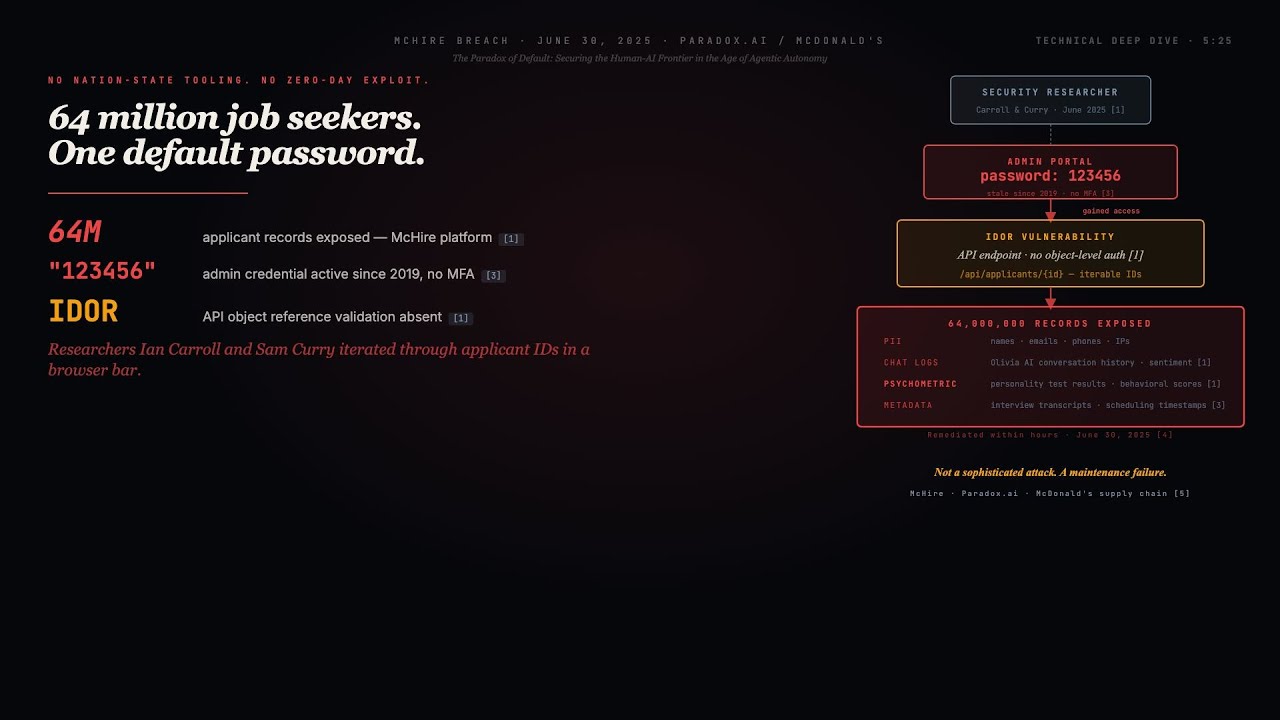
The digital transformation of the global recruitment sector reached a critical, albeit catastrophic, inflection point in June 2025. The exposure of the McHire platform, an artificial intelligence-driven hiring system utilized by McDonald’s and powered by the vendor Paradox.ai, served as a stark diagnostic of the systemic vulnerabilities inherent in current AI deployments.1 This incident, which jeopardized the personal, behavioral, and psychometric data of approximately 64 million job seekers, was not the result of a sophisticated zero-day exploit or a nation-state cyber-offensive. Instead, it was precipitated by a collapse of fundamental security hygiene: a default administrative password of "123456" and an unpatched Insecure Direct Object Reference (IDOR) vulnerability.1
For an enterprise-grade AI consultancy like Veriprajna, this breach represents more than a cautionary tale; it is a validation of the necessity for "Deep AI" architectural strategies that transcend the fragile "API wrapper" model. The Paradox incident demonstrates that when AI is treated as a superficial layer bolted onto legacy infrastructure, the security perimeter remains anchored to the weakest link in the supply chain. This report provides an exhaustive technical post-mortem of the breach, an analysis of the psychological and legal ramifications of psychometric data exposure, and a rigorous framework for transitioning toward a defensible, AI-native security posture.
The Anatomy of a Systemic Collapse: The McHire Post-Mortem
The breach of the McHire platform began with professional curiosity rather than malicious intent. Security researchers Ian Carroll and Sam Curry initiated an investigation following widespread user complaints regarding the "Olivia" chatbot—the conversational AI developed by Paradox.ai that serves as the primary gateway for McDonald’s recruitment.1 The researchers observed that poor user experience and buggy front-end interfaces are often symptomatic of deeper architectural neglect.1
The technical compromise unfolded in two distinct stages. The first stage involved the discovery of a management portal intended for Paradox employees. Probing a test restaurant account, the researchers found the administrative interface was secured by the credentials "123456" for both the username and the password.1 This account, which had remained active but unmonitored since 2019, lacked multi-factor authentication (MFA).3 The failure here is two-fold: the persistence of a default, instantly crackable password and the absence of a "decommissioning" protocol for stale administrative identities.1
The second stage of the breach involved the exploitation of an IDOR vulnerability within the API infrastructure. Once administrative access was achieved via the weak credentials, the researchers identified that the platform’s API did not sufficiently validate the authorization of requests for specific object identifiers.1 By simply iterating through applicant ID numbers in the browser’s address bar, the researchers could view the full application records and chat logs of millions of real-world candidates.1 The estimated scope of the exposure included 64 million records, encompassing names, email addresses, phone numbers, IP addresses, and, crucially, virtual interview transcripts and personality assessment results.1
Data Clusters Targeted in the McHire Incident
| Data Category | Specific Elements Exposed | Architectural Point of Failure |
|---|---|---|
| Core Identifiers | Full names, emails, phone numbers, IP addresses | Lack of MFA / Default Passwords.1 |
| Interaction Logs | AI chat histories with "Olivia," sentiment analysis | IDOR API Vulnerability.1 |
| Psychometric Data | Personality test results, behavioral screening scores | Insecure Direct Object Reference.1 |
| Process Metadata | Interview transcripts, scheduling history, timestamps | Stale Admin Account Retention.3 |
Paradox remediated the vulnerability within hours of the notification on June 30, 2025, revoking the stale credentials and patching the API endpoint.4 However, the broader implications of the breach reveal a supply chain where the security of a Fortune 100 enterprise is entirely dependent on the credential hygiene of its third-party AI vendors.5
The Credential Supply Chain: Nexus Stealer and the Human Node
While the "123456" password was the immediate catalyst, the breach was symptomatic of a larger credential-theft ecosystem. Investigations into the Paradox.ai breach revealed that the exposure of developer credentials was facilitated by a malware strain known as "Nexus Stealer".6 Nexus Stealer is a "form grabber" and password-theft tool sold on cybercrime forums, designed to exfiltrate usernames and passwords from infected devices.6
In late June 2025, a Paradox.ai developer located in Vietnam suffered a compromise via Nexus Stealer.6 This infection resulted in the theft of hundreds of passwords, many of which were poor and recycled, utilizing the same base seven-digit password across multiple internal and third-party services.6 Data leak aggregators like Intelligence X reported that this single developer's device exposed credentials for Paradox.ai accounts associated with multiple high-profile clients, including Pepsi, Lockheed Martin, Lowes, and Aramark.6
This incident underscores a critical reality: the security of the model is secondary to the security of the infrastructure and the human nodes that manage it. The average cost of a data breach in 2025 reached $4.44 million, yet organizations continue to struggle with the "human node" problem—where a single developer’s lack of MFA or password complexity can jeopardize millions of records.7 For Veriprajna, this highlights that "Deep AI" solutions must include Zero-Trust identity management where human access is treated as a high-risk vector requiring continuous verification.8
Architectures of Failure: The API Wrapper Trap
The Paradox incident is a quintessential example of the risks associated with the "AI Wrapper" model. In this architectural paradigm, the software is essentially a thin layer that manages inputs and outputs for a foundational model like GPT-4, Gemini, or Claude.9 These wrappers often rely on traditional web development practices that fail to account for the unique security challenges of AI systems.9
The fundamental difference between an AI Wrapper and a Deep AI solution lies in the direction of harm and the depth of the security integration. AI safety typically focuses on protecting people from harmful model outputs (bias, misinformation), whereas AI security protects the entire stack and its data from adversaries.7 In the McDonald's case, the failure was one of security, not safety—the AI functioned as intended, but the infrastructure surrounding it was porous.7
Comparison: Wrapper Applications vs. Deep AI Solutions
| Dimension | AI Wrapper Application | Deep AI (AI-Native) Architecture |
|---|---|---|
| Foundation | Third-party API (OpenAI/Claude).9 | Custom or fine-tuned model with integrated logic.11 |
| Security Layer | Bolted-on (WAF, Standard Auth).9 | Embedded (Zero-Trust, MCP, Guardrails).11 |
| Data Context | Simple prompt stuffing.9 | RAG with stateful fact ledgers.11 |
| Integration | Fragile, one-off connectors.10 | Standardized MCP and Agentic hierarchies.14 |
| Governance | Ad-hoc or absent.10 | ISO 42001/NIST AI RMF-aligned.16 |
A "Deep AI" approach treats the AI model as an architectural primitive, similar to a database or a message queue.14 This requires new abstractions, such as prompt routers, memory layers, and feedback evaluators that allow the system to behave like a traditional, auditable component of the enterprise stack.14 The failure of Paradox.ai to manage the lifecycle of its administrative accounts suggests a "wrapper" mentality where the focus was on the conversational interface ("Olivia") rather than the robust management of the latent state and data access layers.14
The Psychometric Threat: Personality Data and the Trauma of Exposure
The most distressing aspect of the McHire breach was the nature of the data involved. Unlike credit card numbers, which can be canceled, or passwords, which can be changed, the leaked data included chat histories and personality test results—deeply personal psychometric profiles that are inextricably linked to an individual’s identity.1
AI systems are remarkably adept at profiling, analyzing vast datasets to identify patterns and make predictions about an individual’s future behavior or preferences.19 When these profiles are leaked, they expose job seekers to "predictive harm"—where inferred traits (such as political views, health status, or emotional stability) are made public or used by unauthorized parties to manipulate behavior.19
The Psychological Impact of Data Breaches
Research into the psychological harm caused by digital incidents indicates that the impact on victims is often as devastating as a physical attack.20 The exposure of sensitive personal data causes a range of long-term mental health issues:
● Trust Erosion: Nearly 70% of breach victims report an inability to trust others and a persistent feeling of being unsafe.20
● Powerlessness: Two-thirds of individuals affected experience profound feelings of powerlessness or helplessness.20
● Mental Health Conditions: Academic studies have linked personal data exposure to anxiety, depression, and PTSD.20
● Somatic Symptoms: Victims frequently report sleep disturbances (85%), increased stress levels (77%), and chronic headaches or pains (57%).20
The psychological stress associated with a data breach is modulated by the invasiveness of the data. The exposure of a personality test—a document that claims to quantify an individual’s internal character—is significantly more invasive than the loss of an email address.22 For job seekers, this exposure can lead to feelings of shame and embarrassment, especially if the "failed" results of an automated screening process become public.23 Furthermore, because these data points are persistent, victims often feel "retraumatized" every time the incident is mentioned or every time they apply for a new role, fearing that the leaked profile will follow them indefinitely.20
Legal and Regulatory Warfare: The Cost of Negligence
The Paradox breach occurred in an era of unprecedented regulatory scrutiny for AI companies. The exposure of 64 million records triggers multiple legal frameworks, most notably the General Data Protection Regulation (GDPR) and the California Consumer Privacy Act (CCPA).
Comparative Regulatory Risks for AI Entities
| Regulation | Key Mandate | Penalty for Non-Compliance |
|---|---|---|
| GDPR | Right to explanation; Right to human review.24 | Up to €20M or 4% of global turnover.24 |
| CCPA/CPRA | Right to opt-out of automated decision-making.25 | $750 statutory damages per consumer per incident.28 |
| EU AI Act | Mandatory risk assessments for "high-risk" HR AI.29 | Up to €35M or 7% of global turnover.29 |
Under the CCPA, a business can be sued if non-encrypted personal information is stolen as a result of a failure to maintain "reasonable security procedures".28 A default password of "123456" is arguably the antithesis of "reasonable" security, exposing the entity to massive class-action liabilities.28 Furthermore, the EU AI Act classifies recruitment and HR AI as "high-risk," requiring comprehensive governance, data quality standards, and human oversight.29
The Paradox incident also highlights the "either-or" tradeoff in consumer rights. Under the proposed CCPA amendments, businesses must offer an opt-out for automated decision-making (ADM) in high-stakes contexts like hiring.25 If a system like Paradox’s "Olivia" lacks transparency or fails to provide an appeal process, it undermines the consumer’s ability to challenge opaque algorithmic decisions, leading to further legal friction and reputational fallout.25
The Veriprajna Standard: Transitioning to Deep AI Security
To prevent the next "Paradox of Default," enterprises must adopt a rigorous governance model that treats AI as a high-consequence asset. This involves the integration of three key frameworks: ISO 42001, the NIST AI Risk Management Framework (RMF), and the OWASP Top 10 for LLMs and Agentic AI.
ISO/IEC 42001: The AI Management System (AIMS)
ISO 42001 is the world's first international standard for the responsible management of AI.17 It establishes a structured way to manage the risks and opportunities associated with AI, balancing innovation with governance.17
Core Clauses of ISO 42001 for the Enterprise:
● Clause 5 (Leadership): Top management must exhibit commitment to the AIMS, integrating AI requirements into all business processes.31
● Clause 6 (Planning): Organizations must identify and assess AI-specific risks, establishing clear objectives for transparency and safety.30
● Clause 8 (Operational Control): This clause requires rigorous operational planning, impact assessments for each AI system, and management of changes to the AI lifecycle.31
● Clause 9 (Evaluation): Continuous monitoring and internal audits are required to ensure the AIMS remains effective and relevant.31
Implementing ISO 42001 enables an organization to prove its AI systems are "safe enough to ship" without stalling development teams, providing certifiable evidence of AI governance to stakeholders and regulators.16
NIST AI Risk Management Framework (RMF)
The NIST AI RMF provides the policy anchor for AI security, focusing on the concepts of trustworthiness: transparency, robustness, safety, and accountability.33 It uses a four-function cycle—GOVERN, MAP, MEASURE, MANAGE—to structure risk evaluation.16 In the context of the Paradox breach, the "GOVERN" function failed most conspicuously, as there was no organizational accountability for the decommissioning of the stale administrative account.33
OWASP Top 10: Mitigating Technical Exploits
For developers and security engineers, the OWASP framework provides a ranked taxonomy of the most critical vulnerabilities.32 The 2025 update includes specific guidance for agentic AI, addressing the unique risks of autonomous systems.33
Critical Risks for Agentic AI (Veriprajna Focus):
1. ASI01 - Agent Goal Hijack: Malicious content altering the agent’s core behavior.15
2. ASI02 - Tool Misuse: Tricking an agent into using a legitimate tool (like a database query) for a harmful purpose.15
3. LLM06 - Sensitive Information Disclosure: The accidental exposure of PII through model outputs.32
4. T1 - Memory Poisoning: The injection of malicious data into the long-term memory of a persistent agent.34
A 5-Layer Defense-in-Depth for Enterprise AI
A truly "Deep AI" architecture must move beyond the perimeter-based security model. Veriprajna advocates for a 5-layer defense-in-depth strategy that assumes the foundational model is a "black box" that cannot be internally patched.12
Layer 1: Input Sanitization (The Gatekeeper)
Every prompt submitted by a user must be cleaned to strip code-like syntax and formatting that could be misinterpreted as a hidden command. This layer normalizes all input into a plain, safe format before it reaches the AI model.12
Layer 2: Heuristic Threat Detection (The Watchtower)
This layer actively scans for known adversarial signatures, such as prompt injection patterns or jailbreaking attempts. If a prompt is flagged as suspicious, it is blocked before processing.12
Layer 3: Meta-Prompt Wrapping (The Rulebook)
The user's prompt is "wrapped" inside a complex meta-prompt that provides the AI with reinforced, unchangeable instructions regarding its permissions and boundaries. This acts as a "secure envelope" that the AI cannot override.12
Layer 4: Canary & Adjudicator Models (The Buddy System)
In this architecture, a smaller "canary" model first analyzes the prompt for malicious intent. If the canary flags the request, a second model (the adjudicator) makes the final decision on whether to proceed. This creates a powerful system of checks and balances.12
Layer 5: Output Validation & Redaction (The Filter)
Every response from the AI is treated as untrusted. Output classifiers detect toxic, biased, or hallucinated content, while PII redaction layers ensure no sensitive information is inadvertently leaked to the user.36
The 2026 AI Security Roadmap for CXOs
By 2026, AI governance will no longer be a voluntary exercise; it will be a prerequisite for market participation.37 CEOs must prioritize the expansion of AI expertise and the cultivation of a culture that values security as much as innovation.38
Phase 1: Assessment and Visibility (Days 1-30)
● Inventory AI Exposure: Create a comprehensive catalog of all AI models, applications, and third-party dependencies across the enterprise.39
● Map Data Permissions: Identify all agents with access to PII, financial records, or critical tools, and map their authorities.15
Phase 2: Foundational Hygiene (Days 31-60)
● Zero-Trust Identity: Implement unique cryptographic identities for all human and non-human actors in the AI stack.15
● Phishing-Resistant MFA: Roll out MFA for every administrative interface and tool associated with AI infrastructure.3
● Decommissioning Audit: Conduct a company-wide audit to identify and remove all stale or legacy credentials.3
Phase 3: Advanced Orchestration (Days 61-90+)
● MCP Server Governance: Establish a curated registry for Model Context Protocol (MCP) servers to ensure that AI agents only interact with sanctioned data sources.15
● Behavioral Monitoring: Deploy real-time dashboards to detect "objective drift" or anomalous tool usage by autonomous agents.15
● Human-in-the-Loop (HITL): Implement mandatory human approval gates for any destructive operation or action involving high-value financial data.15
Conclusion: The Mandate for Defensible AI
The McHire breach of 2025 was a pivotal moment that exposed the inherent fragility of the AI "wrapper" economy. The exposure of 64 million records due to a default password is more than a technical failure; it is a profound violation of the trust that job seekers place in the recruitment process. For the enterprise, this incident demonstrates that "good enough" security is no longer viable when dealing with the high-consequence data of AI systems.
Veriprajna believes that the future of AI belongs to the "AI-Native" organization—one that embeds security, ethics, and governance into the very DNA of its architecture. By moving beyond simple API calls and embracing the rigors of ISO 42001 and the NIST AI RMF, companies can transform AI from a potential liability into a defensible, strategic asset. The path to 2026 requires a shift in perspective: from viewing AI as a tool to be "secured" to viewing AI as a logic engine that must be "governed." Only then can we bridge the gap between innovation and safety, ensuring that the "Paradox of Default" never repeats itself.
Risk in the modern AI stack can be effectively modeled as:
To minimize risk, an organization must not only reduce its technical vulnerabilities (via patching and MFA) but also maximize its architectural resilience through deep, layered defenses and proactive governance.8 The era of the "123456" password must end; the era of Deep AI security begins now.
Works cited
McDonald's AI Hiring Breach Exposes 64M Applicant Records, accessed February 6, 2026, https://www.adaptivesecurity.com/blog/mcdonalds-password-data-breach
Security flaw in McDonald's AI recruitment system exposes data of millions of applicants, accessed February 6, 2026, https://www.incibe.es/en/incibe-cert/publications/cybersecurity-highlights/security-flaw-mcdonalds-ai-recruitment-system-exposes-data-millions
McDonald's security scare | Admin account with '123456' password, accessed February 6, 2026, https://specopssoft.com/blog/mcdonalds-ai-chatbot-123456-credentials/
Responsible Security Update — Paradox, accessed February 6, 2026, https://www.paradox.ai/blog/responsible-security-update
123456 Password Leads to McDonald's Data Breach - Heimdal Security, accessed February 6, 2026, https://heimdalsecurity.com/blog/mcdonalds-breach-news/
Weak Password Leads to McDonald's Data Breach | ITRC, accessed February 6, 2026, https://www.idtheftcenter.org/podcast/weekly-breach-breakdown-weak-password-mcdonalds-data-breach/
AI Safety vs AI Security in LLM Applications: What Teams Must Know - Promptfoo, accessed February 6, 2026, https://www.promptfoo.dev/blog/ai-safety-vs-security/
Fortifying the Future: Strategies for Gen AI and LLM Security | TechAhead, accessed February 6, 2026, https://www.techaheadcorp.com/blog/gen-ai-and-llm-security/
AI Wrapper Applications: What They Are and Why Companies Develop Their Own, accessed February 6, 2026, https://www.npgroup.net/blog/ai-wrapper-applications-development-explained/
5 approaches to building LLM agents (and when to use each one) - Tray.ai, accessed February 6, 2026, https://tray.ai/resources/blog/5-approaches-to-building-llm-powered-agents
Enterprise LLM Architecture: Designing for Scale and Security | SaM Solutions, accessed February 6, 2026, https://sam-solutions.com/blog/enterprise-llm-architecture/
Is Your Generative AI a Security Blind Spot? A 5-Layer Defense for Enterprises., accessed February 6, 2026, https://ubitquity.medium.com/is-your-generative-ai-a-security-blind-spot-a-5-layer-defense-for-enterprises-03b72114b8af
Securing Agentic AI: Building Attribution and Compression Architectures for Enterprise Trust, accessed February 6, 2026, https://medium.com/@oracle_43885/securing-agentic-ai-building-attribution-and-compression-architectures-for-enterprise-trust-71a447220753
Emerging Architecture Patterns for the AI-Native Enterprise - Catio.tech, accessed February 6, 2026, https://www.catio.tech/blog/emerging-architecture-patterns-for-the-ai-native-enterprise
Complete Guide to OWASP Agentic AI Top 10: Emerging Framework for 2026 - MintMCP, accessed February 6, 2026, https://www.mintmcp.com/blog/owasp-agentic-ai
From Governance to Guardrails: Why AI Security Frameworks Are Becoming the New CIS Control - CyVent, accessed February 6, 2026, https://www.cyvent.com/post/ai-security-frameworks
ISO/IEC 42001:2023 Artificial Intelligence Management System Standards - Microsoft Learn, accessed February 6, 2026, https://learn.microsoft.com/en-us/compliance/regulatory/offering-iso-42001
The growing data privacy concerns with AI: What you need to know - DataGuard, accessed February 6, 2026, https://www.dataguard.com/blog/growing-data-privacy-concerns-ai/
Examining Privacy Risks in AI Systems | Transcend | The compliance layer for customer data, accessed February 6, 2026, https://transcend.io/blog/ai-and-privacy
The Psychological Harms of a Digital Incident, accessed February 6, 2026, https://fpov.com/wp-content/uploads/The-Psychological-Harm-of-Cyber-Incidents.pdf
The Psychological Impact of Data Breaches on Victims - Console & Associates, accessed February 6, 2026, https://databreachclassaction.io/blog/the-psychological-impact-of-data-breaches-on-victims
(PDF) Individual Differences in Psychological Stress Associated with Data Breach Experiences - ResearchGate, accessed February 6, 2026, https://www.researchgate.net/publication/383265646_Individual_differences_in_psychological_stress_associated_with_data_breach_experiences
What Is The Impact Of A Data Breach On Individuals?, accessed February 6, 2026, https://www.databreachclaims.org.uk/what-is-the-potential-impact-of-a-data-breach-on-individuals/
The impact of the General Data Protection Regulation (GDPR) on artificial intelligence - European Parliament, accessed February 6, 2026, https://www.europarl.europa.eu/RegData/etudes/STUD/2020/641530/EPRS_STU(2020)641530_EN.pdf
AI Gets Personal: CCPA vs. GDPR on Automated Decision-Making, accessed February 6, 2026, https://btlj.org/2025/04/ccpa-vs-gdpr-on-automated-decision-making/
Is AI Compromising Data Privacy in Recruitment? Here's How to Keep It Secure, accessed February 6, 2026, https://prescreenai.com/is-ai-compromising-data-privacy-in-recruitment-heres-how-to-keep-it-secure/
California's New Rules on AI Decision-Making: As Strict as the GDPR?, accessed February 6, 2026, https://www.blegalgroup.com/californias-new-rules-on-ai-decision-making-as-strict-as-the-gdpr/
California Consumer Privacy Act (CCPA) | State of California - Department of Justice - Office of the Attorney General, accessed February 6, 2026, https://oag.ca.gov/privacy/ccpa
ISO/IEC 42001: a new standard for AI governance - KPMG International, accessed February 6, 2026, https://kpmg.com/ch/en/insights/artificial-intelligence/iso-iec-42001.html
Understanding ISO 42001: The World's First AI Management System Standard - A-LIGN, accessed February 6, 2026, https://www.a-lign.com/articles/understanding-iso-42001
ISO 42001: paving the way for ethical AI | EY - US, accessed February 6, 2026, https://www.ey.com/en_us/insights/ai/iso-42001-paving-the-way-for-ethical-ai
From NIST to OWASP: The AI Risk Frameworks That Matter - ActiveFence, accessed February 6, 2026, https://alice.io/blog/ai-risk-management-frameworks-nist-owasp-mitre-maestro-iso
Comparing AI Security Frameworks: OWASP, CSA, NIST, and ..., accessed February 6, 2026, https://www.straiker.ai/blog/comparing-ai-security-frameworks-owasp-csa-nist-and-mitre
OWASP Guide to Securing Agentic AI Applications: Best Practices for Trustworthy and Secure AI Systems - Lothar Schulz, accessed February 6, 2026, https://www.lotharschulz.info/2025/08/04/owasp-guide-to-securing-agentic-ai-applications-best-practices-for-trustworthy-and-secure-ai-systems/
A Comparative Assessment of Built-In Security of LLM Models | by Anant Wairagade, accessed February 6, 2026, https://medium.com/design-bootcamp/a-comparative-assessment-of-built-in-security-of-llm-models-1857444c76cb
What Is LLM (Large Language Model) Security? | Starter Guide - Palo Alto Networks, accessed February 6, 2026, https://www.paloaltonetworks.com/cyberpedia/what-is-llm-security
The Top Security, Risk, and AI Governance Frameworks CISOs Must Prioritize for 2026, accessed February 6, 2026, https://www.cybersaint.io/blog/the-top-security-risk-and-ai-governance-frameworks-for-2026
AI and the C-Suite: Implications for CEO Strategy in 2026 - The Conference Board, accessed February 6, 2026, https://www.conference-board.org/research/ced-policy-backgrounders/ai-and-the-c-suite-implications-for-ceo-strategy-in-2026
Ethical AI governance in 2026: Best practices for CISOs and the middle market - RSM Global, accessed February 6, 2026, https://www.rsm.global/latinamerica/en/insights/ethical-ai-governance-2026-best-practices-cisos-and-middle-market
Prefer a visual, interactive experience?
Explore the key findings, stats, and architecture of this paper in an interactive format with navigable sections and data visualizations.
Frequently Asked Questions
How did the McDonald's McHire breach expose 64 million applicant records?
Security researchers discovered a Paradox.ai management portal secured with '123456' as both username and password, active since 2019 without multi-factor authentication. Once inside, an Insecure Direct Object Reference vulnerability in the API allowed iterating through applicant ID numbers to access full records including names, emails, chat histories with the Olivia AI chatbot, and personality assessment results for 64 million candidates.
Why are psychometric data breaches more harmful than typical PII exposure?
Unlike credit cards which can be cancelled, psychometric profiles including personality tests and behavioral assessments are permanently linked to individual identity. Research shows 70% of breach victims report inability to trust others, 85% suffer sleep disturbances, and many experience anxiety and PTSD. Exposure of personality test results creates 'predictive harm' where inferred traits like emotional stability or political views become public.
What is the 5-layer defense-in-depth architecture for enterprise AI?
The five layers are: Input Sanitization stripping adversarial syntax, Heuristic Threat Detection scanning for prompt injection signatures, Meta-Prompt Wrapping creating secure instruction envelopes the AI cannot override, Canary and Adjudicator Models providing dual-model checks before processing, and Output Validation with PII redaction treating every AI response as untrusted before delivery to users.
Also Published On
Build Your AI with Confidence.
Partner with a team that has deep experience in building the next generation of enterprise AI. Let us help you design, build, and deploy an AI strategy you can trust.
Veriprajna Deep Tech Consultancy specializes in building safety-critical AI systems for healthcare, finance, and regulatory domains. Our architectures are validated against established protocols with comprehensive compliance documentation.