Structural Resilience and Physics-Constrained Intelligence: Addressing the 1,500 MW Virginia Grid Disturbance and the Imperative for Deep AI Architectures
Executive Summary: The Dawn of the "Five-Alarm" Era in Grid Management
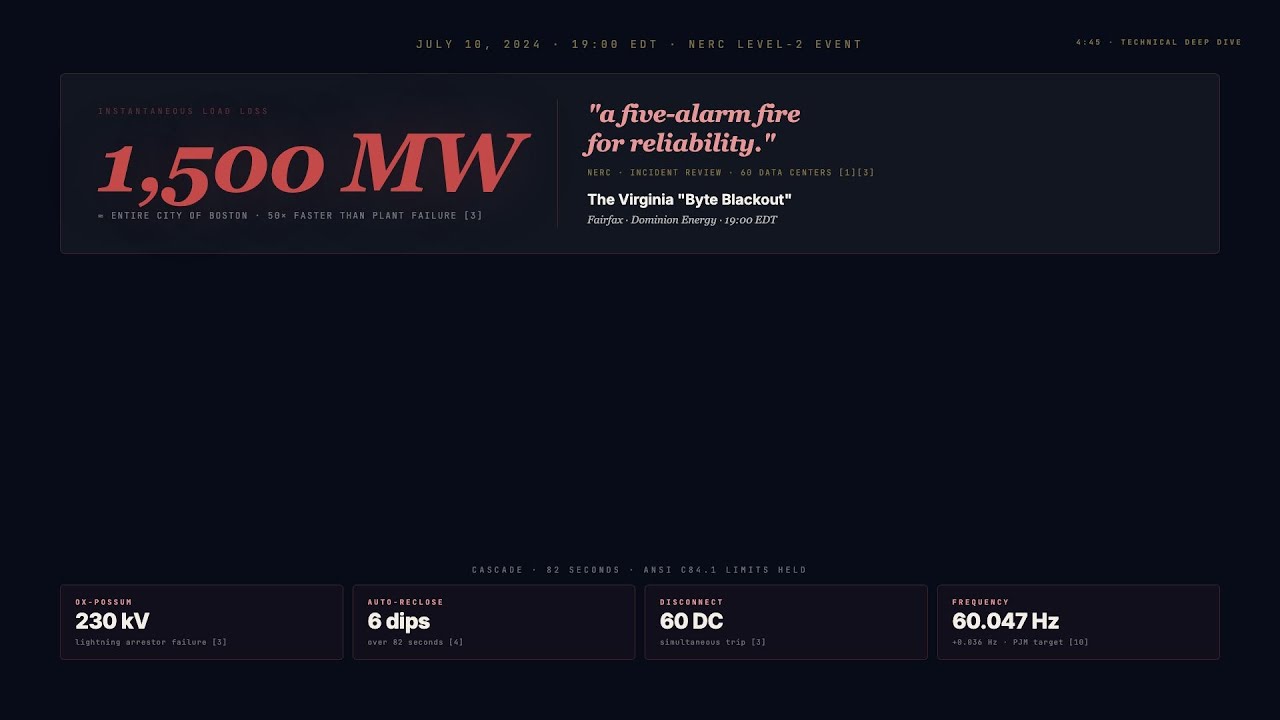
The stability of the North American Bulk Power System (BPS) is currently transitioning through a phase of unprecedented volatility, driven by the rapid concentration of high-density computational loads. On July 10, 2024, Northern Virginia—the global epicenter of data center infrastructure—experienced a "near-miss" event that federal regulators at the North American Electric Reliability Corporation (NERC) have characterized as a "five-alarm fire for reliability".1 During this incident, a routine localized transmission fault triggered the simultaneous disconnection of 60 data centers, resulting in an instantaneous loss of 1,500 megawatts (MW) of demand.3 This magnitude of load reduction, equivalent to the entire power demand of the city of Boston, occurred with a temporal velocity fifty times faster than a typical power plant failure, exposing a fundamental mismatch between the physical reality of the grid and the automated protection logic of hyperscale facilities.3
As an elite AI consultancy, Veriprajna posits that this event represents more than an engineering anomaly; it is the physical manifestation of the failure of "shallow" AI and traditional "wrapper" architectures in managing mission-critical infrastructure. For the enterprise, the Virginia near-blackout serves as a stark warning: as the "Knowledge Economy" scales, the traditional model-driven and rule-based systems governing our energy and computational assets are no longer sufficient to handle the non-linear, stochastic behavior of massive, inter-connected systems.5
This whitepaper provides a comprehensive technical analysis of the July 2024 incident, examines the regulatory aftermath including NERC's Level 2 Industry Recommendations, and introduces Veriprajna's "Deep AI" framework. By integrating Physics-Informed Neural Networks (PINNs), Neuro-Symbolic architectures, and Deterministic Logic Layers, Veriprajna offers a roadmap for moving beyond the brittle, hallucination-prone world of Large Language Model (LLM) wrappers toward a future of verifiable, physics-constrained intelligence.7
Anatomy of a "Byte Blackout": The July 10, 2024 Virginia Incident
The technical details of the July 10 event reveal a cascading failure of logic, not just hardware. At approximately 7:00 p.m. Eastern Time, during a period of significant thunderstorm activity, a lightning arrestor failed on Dominion Energy's Ox-Possum 230-kilovolt (kV) transmission line near Fairfax, Virginia.3 This failure resulted in a permanent fault, which the grid's protection systems correctly identified. However, the transmission line's auto-reclosing configuration, designed for three staggered attempts at each end, resulted in six successive voltage depressions over an 82-second period.4
While each individual voltage dip remained within the grid's normal operating range of ±10% as defined by ANSI C84.1 standards, the "counting logic" embedded in the data centers' Uninterruptible Power Supply (UPS) systems and internal controls interpreted this sequence as a critical threat.3 To protect sensitive server hardware, these facilities are programmed to disconnect from the grid and transition to on-site diesel generators if a certain number of disturbances—typically three within a single minute—are detected.4
Chronological Reconstruction of the Fairfax Load-Loss Event
| Time (EDT) | Operational Event | Magnitude / System Response | Source |
|---|---|---|---|
| 19:00:10 | Lightning arrestor failure on the 230-kV Ox-Possum line. | Initial 8% voltage sag; grid protection activates. | 3 |
| 19:00:15 | First auto-reclose attempt fails due to permanent fault. | Secondary voltage depression; data center UPS monitors. | 4 |
| 19:00:45 | Second auto-reclose attempt fails; fault remains active. | Third voltage depression; "Count 2" for UPS logic. | 4 |
| 19:01:32 | Third auto-reclose attempt; fault clearing unsuccessful. | Load Drop Triggered: ~1,260 MW disconnects instantly. | 4 |
| 19:02:00 | Aggregate load loss reaches 1,500 MW (60 facilities). | PJM frequency spikes to 60.047 Hz (+0.036 Hz target). | 10 |
| 19:15:00 | Grid operators manually throttle gas and nuclear output. | 900 MW reduction to prevent transformer overloads. | 3 |
| 23:00:00 | Data centers remain in "island mode" on diesel backups. | Manual reconnection required; multi-hour recovery. | 4 |
The instantaneous loss of 1,500 MW created an immediate surplus of generation on the PJM Interconnection grid, which manages electricity for 65 million people.3 Frequency, which typically drops when generation fails, spiked to 60.047 Hz, well beyond the NERC target band.10 Grid operators had to intervene manually, reducing 600 MW from gas-fired plants in Pennsylvania and 300 MW from a nuclear unit in Virginia to stabilize the system by 3:02 p.m. (or the equivalent stabilization window relative to the evening fault).3
This "byte blackout" risk is distinct from traditional outages. In a standard failure, the grid loses generation and frequency drops; here, the grid lost demand, causing frequency to surge dangerously. This requires "reverse" stabilization—ramping down rotating mass faster than most thermal plants are designed to handle. Furthermore, while the transition to UPS was automatic, the return to the grid required manual intervention, leaving these facilities offline and consuming thousands of gallons of diesel for several hours.1
The Regulatory Response: NERC's Large Load Task Force and Industry Alert
The Virginia incident was the catalyst for NERC to establish the Large Loads Task Force (LLTF) in August 2024, recently elevated to the Large Loads Working Group (LLWG).11 The regulatory body identified that the current grid was not designed to withstand the "shattering" loss of 1,500 MW of load at once.1 Emerging large loads—comprising data centers (AI and crypto), hydrogen plants, and heavy industrial electrification—present unique operational challenges: rapid demand fluctuations, cyclical ramping, and extreme sensitivity to voltage disturbances.13
On September 9, NERC issued a Level 2 Industry Recommendation Alert, urging utilities to take specific actions to mitigate risks from large loads.12 This alert focuses on evaluating dynamic modeling and simulation practices, emphasizing that the "invisibility" of large load behavior is a high-priority risk to the Bulk Power System (BPS).14
NERC Level 2 Alert: Key Recommendations for Infrastructure Stability
| Requirement | Objective | Technical Implementation | Source |
|---|---|---|---|
| Data Capture | Establish high-resolution observability. | Mandatory installation of PMUs and Digital Fault Recorders. | 13 |
| Model Validation | Ensure simulation accuracy for load drops. | Use real event data to validate dynamic load models. | 15 |
| Interconnection | Standardize performance criteria. | Establish clear ride-through and ramping requirements. | 13 |
| Protocols | Enhance operational communication. | Real-time communication between load owners and TOPs. | 15 |
| Forecasting | Mitigate upward bias/speculative growth. | Bottom-up modeling based on IT hardware/cooling specs. | 13 |
Central to NERC's technical roadmap is the endorsement of the PERC1 (Power Electronic Ceasing and Reconnecting) model.17 Traditional load models (like the WECC composite load model) fail to capture the high-speed behavior of power electronics in data centers. The PERC1 model is specifically designed to represent how these loads "cease" consumption during a fault and how they "reconnect"—or fail to reconnect—after the fault is cleared.17
The Failure of "LLM Wrappers" in Critical Infrastructure
As an AI consultancy, Veriprajna must address the prevailing market trend of treating AI as a "black box" text engine. The proliferation of "LLM Wrappers"—thin software layers that pass prompts to models like GPT-4 or Claude—is fundamentally unsuited for the non-linear complexity of grid modernization and enterprise modernization.8
The Stochastic Trap: Plausibility vs. Veracity
Large Language Models are probabilistic engines designed to predict the next likely token in a sequence.9 They optimize for plausibility, not veracity. In the 2023 Sports Illustrated scandal, a "wrapper" architecture generated entire personas and articles that appeared human-like but were entirely fabricated.9 For a media organization, this resulted in a 27% stock price collapse; for a grid operator, such a "hallucination" in a load-balancing algorithm could result in a regional blackout.9
| Deficiency Category | LLM Wrapper (Stochastic) | Veriprajna Deep AI (Deterministic) | Source |
|---|---|---|---|
| Decision Logic | Probabilistic (Token Prediction) | Deterministic (Rule-Based/Symbolic) | 9 |
| Knowledge Source | Model Weights (Static/Outdated) | Knowledge Graphs (Real-Time/Grounded) | 21 |
| Physical Awareness | None (Text-only) | Physics-Informed (PINNs) | 7 |
| Auditability | Black Box (No citation chain) | Glass Box (Auditable logic paths) | 9 |
| Safety | Prompt-dependent (Vulnerable) | Guardrail-enforced (Policy-as-Code) | 20 |
Wrappers typically rely on "Naïve RAG" (Retrieval-Augmented Generation), which treats software code and grid data as text segments. This leads to "Contextual Myopia"—the inability to understand that a variable change in one part of a 5,000-line COBOL routine or a voltage dip at a substation 50 miles away drives logic in a distant part of the system.18 Veriprajna rejects this "Thin Wrapper" philosophy, positioning itself instead as an architect of bespoke, physics-constrained production pipelines.18
Veriprajna's Deep AI Solution: Physics-Informed Neural Networks (PINNs)
To manage a system as complex as the Virginia grid corridor, AI must do more than parse language; it must understand the underlying laws of electromagnetism and thermodynamics. Veriprajna utilizes Physics-Informed Neural Networks (PINNs) to solve the AC Optimal Power Flow (ACOPF) problem and provide real-time grid-forming control.7
Embedding Physical Laws into Deep Learning
PINNs integrate the residuals of partial differential equations (PDEs) and ordinary differential equations (ODEs) directly into the neural network's loss function.7 This ensures that the AI's predictions are not just statistically likely, but physically consistent with Kirchhoff's Laws and the Swing Equation for frequency stability.7
In a grid-forming inverter scenario, the Veriprajna PINN controller learns voltage and frequency reference signals while maintaining physical consistency. The total loss function (𝓛) is structured as:
Where 𝓛physics represents the violation of power flow equations.7 Research indicates that PINN-based approaches achieve a frequency deviation of less than 0.12 Hz and an average inference latency below 0.7 ms—critical for arresting the kind of 1,500 MW drop observed in Virginia.7
Performance Benchmarks: PINNs vs. Traditional Methods
| Metric | Traditional ACOPF | Standard Neural Network | Veriprajna PINN Framework | Source |
|---|---|---|---|---|
| Computation Time | Slow (Minutes for large grids) | 52.6 ms | 48.3 ms | 26 |
| Accuracy (MW dev) | Ground Truth (Oracle) | 0.73 MW deviation | 0.64 MW deviation | 26 |
| Generalization | Specific to topology | Poor (needs re-training) | High (Physically grounded) | 29 |
| Physical Feasibility | 100% | Low (Hallucinates states) | High (Soft constraints) | 7 |
By using forward predictions as "warm-start" points for high-precision solvers, Veriprajna's models significantly improve the success rate and computational speed of grid optimization.29 This capability allows grid operators to move from reactive mitigation to proactive, predictive load balancing—effectively adding "shock absorbers" to the transmission system.2
The Neuro-Symbolic "Sandwich" Architecture: Ensuring Truth in Enterprise AI
For high-stakes enterprise applications—ranging from tax compliance to grid operational modeling—Veriprajna employs a Neuro-Symbolic "Sandwich" Architecture.22 This architecture decouples intent recognition from logic execution, creating a "Safety Firewall" that prevents the stochastic errors typical of LLM-only solutions.22
The Three-Layer Framework
- Neural Layer 1 (The Ear): Handles perception, named entity recognition, and intent extraction. For example, it extracts the parameters of a large load interconnection request from unstructured PDF filings.21
- Symbolic Layer (The Brain): The "Meat" of the sandwich. It uses deterministic logic, Knowledge Graphs, and hard-coded business rules (Policy-as-Code) to validate the extracted intent against NERC standards and grid physics. No amount of "prompt engineering" can bypass the symbolic logic of this layer.20
- Neural Layer 3 (The Voice): Receives the validated decision from the Symbolic Layer and converts it into natural language or coordinated machine control signals. It acts as a translator, not a knowledge source.20
GraphRAG and Epistemic Certainty
Veriprajna's use of GraphRAG (Graph Retrieval-Augmented Generation) addresses the "Temporal Blindness" and "Multi-Hop Reasoning" failures of standard vector-search AI.32 In the context of the Virginia grid, a Knowledge Graph stores the relationships between substations, transmission lines, and data center contracts.
- Multi-Hop Reasoning: While a standard RAG might miss the connection between "Substation A" and "Data Center B" if they are mentioned in different documents, a Knowledge Graph sees the physical link. It can answer: "Is Data Center B vulnerable to a fault on Line X?".32
- Temporal Awareness: By storing the history of grid reconfigurations, the Knowledge Graph prevents the AI from confusing historical grid states with current truths.32
This "Glass Box" approach ensures that every decision has a "Citation Chain." Unlike a "Black Box" model that says "Trust me, I'm AI," Veriprajna's system provides an auditable logic path: "The system flagged this load ramp because it violated the N-1 contingency constraint defined in NERC TPL-001".9
The Socio-Economic Impact: Why Virginia's Infrastructure is at a Breaking Point
The July 2024 event was not merely a technical glitch; it was a symptom of a grid being pushed beyond its design limits. Virginia hosts 70% of global internet traffic, and Dominion Energy's data center capacity is projected to grow from 4 GW today to nearly 40 GW in contracted capacity.33 This growth has triggered a systemic crisis that impacts every resident of the Commonwealth.
The Financial Burden of Data Center Dominance
| Financial Metric | Data Center Impact / Statistic | Implications for Residents | Source |
|---|---|---|---|
| Capacity Price | 833% spike in regional capacity costs. | Significant upward pressure on future rates. | 33 |
| Monthly Bills | Projections of $380/month by 2045. | Potential for widespread energy insecurity. | 33 |
| State Subsidies | $2.7 billion over the past decade. | Foregone revenue for other state services. | 33 |
| Infrastructure | $28.3 billion needed for transmission. | Ratepayer-funded expansion of private infrastructure. | 33 |
The bottleneck is transmission, not generation.33 Virginia needs 40% more transmission capacity to handle the projected load, requiring a buildout at a rate that the Joint Legislative Audit and Review Commission (JLARC) calls "very difficult to achieve".33 Without the kind of deep AI optimization proposed by Veriprajna, the Department of Energy (DOE) projects that outages could spike from 2.4 hours per year today to over 430 hours by 2030.33
Furthermore, the environmental externalities are mounting. Northern Virginia data centers consumed nearly 2 billion gallons of water in 2023 for cooling—enough to supply 50,000 people—and rely on nearly 9,000 high-polluting diesel backup generators.33 The July 2024 incident proved that these generators are not just "backups"; they are a fundamental, albeit polluting, part of the operational strategy.3
Grid-Interactive Solutions: OpenADR 3.0 and the EPRI DCFlex Initiative
To mitigate these risks, data centers must transition from passive consumers to active grid assets.35 Veriprajna advocates for the implementation of OpenADR 3.0, a modernized automated demand response standard that enables sub-second flexibility.36
OpenADR 3.0: A Modernized Protocol for High-Density Loads
Unlike the older XML-based OpenADR 2.0b, version 3.0 uses RESTful APIs and JSON messaging, making it significantly easier to integrate with modern AI-driven Energy Management Systems (EMS).36
| Aspect | OpenADR 2.0b | OpenADR 3.0 | Veriprajna Advantage | Source |
|---|---|---|---|---|
| Complexity | High (XML/SOAP) | Low (JSON/REST) | Reduced deployment time. | 36 |
| Security | Mutual TLS | OAuth 2.0 | Seamless enterprise integration. | 36 |
| Latency | Sub-minute | Sub-second | Real-time frequency response. | 36 |
| Scalability | Rigid | Modular | Fits heterogeneous data center sites. | 36 |
Through initiatives like EPRI's DCFlex, data centers are being recruited into voluntary and mandatory demand response programs.38 By curtailing just 0.5% of annual electricity use during peak periods, 100 GW of data center load could be added to the grid without needing new "firm" generation like gas plants.40 Veriprajna's AI agents act as the "Orchestrator," dynamically shifting computational workloads between geographic regions or to on-site storage to stabilize the grid while minimizing operational disruption.5
The Veriprajna Implementation: The "Obelisk" Organizational Model
Veriprajna advocates for the "Obelisk" model of AI adoption, replacing the traditional consulting "pyramid" of many generalist juniors with a dense core of deep technical experts.8 Deep AI requires deep expertise.
The Deep AI Human Capital Stack
- The Physics-AI Hybrid: A new breed of engineer fluent in both Power System Stability (Swing equations, transient analysis) and deep learning architectures (PINNs, Transformer-based GNNs).8
- The Provenance Architect: Specialists in cryptography and vector search who ensure the "White Box" remains white, providing the auditable truth for regulated industries.8
- The Oracle Manager: Custodians of the Knowledge Graph, ensuring the purity of the "Ground Truth" datasets and enforcing Policy-as-Code.8
Roadmap to Deployment: A Phased Approach
- Phase 1: The Integrity Audit (Months 1-3): Audit existing grid/data center data. Isolate the "stochastic risk" in current software wrappers. Build the initial Knowledge Graph.8
- Phase 2: The Active Loop (Months 4-6): Deploy PINN-based monitoring. Connect the Symbolic Logic layer to real-time grid telemetry via OpenADR 3.0.8
- Phase 3: Autonomous Stabilization (Months 6-12): The system begins automated discovery of load-balancing opportunities. Hit rates and hallucination metrics are tracked against ISO 42001 compliance standards.8
Strategic Conclusion: Resilience through Determinism
The Virginia near-blackout of July 10, 2024, was a "wake-up call from Data Center Alley".3 It demonstrated that as the scale of AI compute expands, the margin for error in our physical infrastructure disappears. The "stochastic" nature of standard generative AI is a liability in a world that requires sub-second deterministic precision.
Veriprajna's whitepaper argues that the era of the "LLM Wrapper" is effectively over for mission-critical enterprise applications. To maintain public trust and grid reliability, we must move toward Deep AI architectures that are physically constrained, logically deterministic, and semantically grounded.
Power reliability is now a board-level variable.1 For data center operators and utility leaders, the path forward involves transforming these massive loads from "passive liabilities" into "dynamic assets".35 By leveraging PINNs for real-time control and Neuro-Symbolic architectures for high-level reasoning, enterprises can build a "Smarter, Stronger Grid" capable of powering the next generation of digital workforce without sacrificing the stability of our society.2 Veriprajna stands ready as the architect of this deterministic future, ensuring that the next time the grid "blinks," the AI doesn't just watch—it acts with the certainty of physics.
Works cited
- When 1.5 Gigawatts Vanished: What the Virginia Near-Blackout Revealed About the Future of AI Infrastructure - Global Data Center Hub, accessed February 9, 2026, https://www.globaldatacenterhub.com/p/when-15-gigawatts-vanished-what-the
- Preventing the Five-Alarm Fire: Building a Smarter, Stronger Grid for the Age of AI, accessed February 9, 2026, https://www.energycentral.com/energy-management/post/preventing-the-five-alarm-fire-building-a-smarter-stronger-grid-for-the-TIDH5uxGEKjmm2S
- The Growing Challenge of Data Centers to U.S. Grid Reliability: A Technical and Operational Analysis | by NFTKingpin | Medium, accessed February 9, 2026, https://medium.com/@nftkingpin111/the-growing-challenge-of-data-centers-to-u-s-0369a3a5ea9a
- Incident Review | Considering Simultaneous Voltage ... - NERC, accessed February 9, 2026, https://www.nerc.com/globalassets/our-work/reports/event-reports/incident_review_large_load_loss.pdf
- AI, Data Centers and the Grid's "Holy Grail" - Here are 4 Takeaways on Demand Response from GridFuture - CPower Energy, accessed February 9, 2026, https://cpowerenergy.com/ai-data-centers-and-the-grids-holy-grail-here-are-4-takeaways-on-demand-response-from-gridfuture/
- AI bank white paper | EY, accessed February 9, 2026, https://www.ey.com/content/dam/ey-unified-site/ey-com/en-cn/insights/financial-services/documents/ey-ai-bank-white-paper-en.pdf
- Physics-Informed Neural Networks (PINNs) for Real-Time Grid-Forming Inverter Control: Embedding Physical Laws into Deep Learning Models - Preprints.org, accessed February 9, 2026, https://www.preprints.org/manuscript/202507.0721
- The Deterministic Enterprise: Engineering Truth in Probabilistic AI - Veriprajna, accessed February 9, 2026, https://Veriprajna.com/technical-whitepapers/deterministic-enterprise-ai-truth
- The Verification Imperative: Neuro-Symbolic Enterprise AI | Veriprajna, accessed February 9, 2026, https://Veriprajna.com/whitepapers/verification-imperative-neuro-symbolic-enterprise-ai
- Byte Blackouts: How large data center loads are surfacing new issues - Grid Status Exports, accessed February 9, 2026, https://blog.gridstatus.io/byte-blackouts-large-data-center-loads-new-issues-pjm/
- Connection Requirements for Transmission-Connected Data Centres - AESO Engage, accessed February 9, 2026, https://aesoengage.aeso.ca/connection-requirements-for-transmission-connected-data-centres
- Large Loads Action Plan - NERC, accessed February 9, 2026, https://www.nerc.com/initiatives/large-loads-action-plan
- Responses Due This Week on NERC Alert Related to Large Load Interconnection, accessed February 9, 2026, https://www.mro.net/responses-due-this-week-on-nerc-alert-related-to-large-load-interconnection/
- White Paper Characteristics and Risks of Emerging Large Loads, accessed February 9, 2026, https://www.dwt.com/-/media/files/blogs/energy-environmental-law-blog/2025/white-paper-characteristics-and-risks-of-emerging.pdf?rev=07acabaa489e4f2991adc826fc8f2f96&hash=3CEE4723083D38DAC3C3DA75F33002FB
- Industry Recommendation: Large Load Interconnection, Study ..., accessed February 9, 2026, https://www.nerc.com/globalassets/programs/bpsa/alerts/2025/nerc-alert-level-2--large-loads.pdf
- Large Load Literature Review, accessed February 9, 2026, https://eta-publications.lbl.gov/sites/default/files/2025-10/lbnl_lllreview_sept_update_2025_1.pdf
- Large Loads Action Plan Q4 2025 Update - North American Electric ..., accessed February 9, 2026, https://www.nerc.com/globalassets/initiatives/large-loads-task-force/lltf-quarterly-update-q4-2025.pdf
- Legacy Modernization: Beyond Syntax with Neuro-Symbolic AI - Veriprajna, accessed February 9, 2026, https://Veriprajna.com/technical-whitepapers/legacy-modernization-cobol-java-ai
- Limitations of Large Language Models (LLMs) | by Mehmet Ozkaya - Medium, accessed February 9, 2026, https://mehmetozkaya.medium.com/limitations-of-large-language-models-llms-1790a14010db
- The Verification Imperative: From the Ashes of Sports Illustrated to the Future of Neuro-Symbolic Enterprise AI - Veriprajna, accessed February 9, 2026, https://Veriprajna.com/technical-whitepapers/enterprise-content-verification-neuro-symbolic
- The Glass Box Paradigm: Engineering Fairness, Explainability, and Precision in Enterprise Recruitment with Knowledge Graphs - Veriprajna, accessed February 9, 2026, https://Veriprajna.com/technical-whitepapers/recruitment-ai-fairness-knowledge-graphs
- Neuro-Symbolic AI Architecture for Enterprise Security | Veriprajna, accessed February 9, 2026, https://Veriprajna.com/whitepapers/neuro-symbolic-ai-architecture-enterprise-security
- Technical Deep Dives - Veriprajna, accessed February 9, 2026, https://Veriprajna.com/technical-whitepapers
- The End of the Wrapper Era: Hybrid AI for Brand Equity - Veriprajna, accessed February 9, 2026, https://Veriprajna.com/technical-whitepapers/hybrid-ai-brand-equity-marketing
- Physics-Informed Neural Networks (PINNs) for Real-Time Grid-Forming Inverter Control - Preprints.org, accessed February 9, 2026, https://www.preprints.org/manuscript/202507.0721/download/final_file
- Physics Informed Neural Networks-Based AC Optimal Power Flow Under High RES Penetration - IEEE Xplore, accessed February 9, 2026, https://ieeexplore.ieee.org/iel8/6287639/10380310/10786993.pdf
- Physics-Informed Neural Networks: A Review of Methodological Evolution, Theoretical Foundations, and Interdisciplinary Frontiers Toward Next-Generation Scientific Computing - MDPI, accessed February 9, 2026, https://www.mdpi.com/2076-3417/15/14/8092
- Physics-Informed Neural Networks in Grid-Connected Inverters: A ..., accessed February 9, 2026, https://www.mdpi.com/1996-1073/18/20/5441
- Physics-Informed Neural Networks for Power Systems Warm-Start Optimization, accessed February 9, 2026, https://www.researchgate.net/publication/380944124_Physics-Informed_Neural_Networks_for_Power_Systems_Warm-Start_Optimization
- Physics Informed Neural Networks-Based AC Optimal Power Flow Under High RES Penetration - Scribd, accessed February 9, 2026, https://www.scribd.com/document/889066838/Physics-Informed-Neural-Networks-Based-AC-Optimal-Power-Flow-Under-High-RES-Penetration
- Physics-Informed Inductive Biases for Voltage Prediction in Distribution Grids - arXiv, accessed February 9, 2026, https://arxiv.org/html/2509.25158v2
- The Death of the Feed: Pivoting Media from Content Publishing to Conversational Intelligence - Veriprajna, accessed February 9, 2026, https://Veriprajna.com/technical-whitepapers/media-pivot-conversational-intelligence
- Virginia's Data Center Crisis: Big Tech Is Breaking the Grid, Spiking Your Bills, and Communities Are Fighting Back : r/aiwars - Reddit, accessed February 9, 2026, https://www.reddit.com/r/aiwars/comments/1qt83fn/virginias_data_center_crisis_big_tech_is_breaking/
- Energy demand will outstrip supply in Virginia as data centers proliferate - Cardinal News, accessed February 9, 2026, https://cardinalnews.org/2025/04/11/energy-demand-will-outstrip-supply-in-virginia-as-data-centers-proliferate/
- DCFlex: Data Center Flexible Load Initiative - EPRI, accessed February 9, 2026, https://restservice.epri.com/publicdownload/000000003002031004/0/Product
- Discover OpenADR 3.0: Future of EV Charging Infrastructure - SRM Technologies, accessed February 9, 2026, https://www.srmtech.com/knowledge-base/blogs/discover-openadr-3-0-future-of-ev-charging-infrastructure/
- UDERMS iCommunity: Utility Managed Distributed Energy Resources Intelligent Community, accessed February 9, 2026, https://www.energy.gov/sites/default/files/2024-11/bto-peer-2024-9782-uderms-icommunity-campbell.pdf
- Grid Modernization for Data Center and AI Loads: How the Grid Is Gearing Up, accessed February 9, 2026, https://cleanenergyforum.yale.edu/2025/11/12/grid-modernization-for-data-center-and-ai-loads-how-the-grid-is-gearing-up
- Homepage | DCFlex - EPRI, accessed February 9, 2026, https://dcflex.sf.epri.com/
- Data Center Demand Flexibility | Energy Innovation, accessed February 9, 2026, https://energyinnovation.org/wp-content/uploads/Data-Center-Demand-Flexibility.pdf
- Thought Leadership - EPRI DCFlex, accessed February 9, 2026, https://dcflex.sf.epri.com/thought-leadership
Prefer a visual, interactive experience?
Explore the key findings, stats, and architecture of this paper in an interactive format with navigable sections and data visualizations.
Frequently Asked Questions
What happened during the July 2024 Virginia data center grid disturbance?
On July 10, 2024, a lightning arrestor failure on Dominion Energy's Ox-Possum 230 kV transmission line triggered three auto-reclose attempts, creating six voltage depressions over 82 seconds. Although each individual dip remained within the ANSI C84.1 10% tolerance, the UPS counting logic in 60 data centers interpreted the sequence as a critical threat, simultaneously disconnecting 1,500 MW of demand. This load loss, equivalent to Boston's entire power demand and 50 times faster than a typical plant failure, caused frequency to surge to 60.047 Hz. Grid operators manually reduced 600 MW from gas plants and 300 MW from nuclear to stabilize.
What is a byte blackout and how does it differ from traditional grid outages?
A byte blackout occurs when data centers mass-disconnect from the grid, creating a demand-side collapse rather than a traditional generation-side failure. In a standard outage, the grid loses generation and frequency drops. In a byte blackout, the grid loses demand, causing frequency to surge dangerously, requiring 'reverse' stabilization by rapidly ramping down generation faster than most thermal plants are designed to handle. While the transition to diesel backup is automatic, the return to grid power requires manual intervention, leaving facilities offline consuming thousands of gallons of diesel for hours, as demonstrated in the Virginia incident.
How does physics-constrained AI prevent data center grid coordination failures?
Physics-constrained AI integrates Physics-Informed Neural Networks that embed grid equations into the decision layer and neuro-symbolic architectures that enforce deterministic logic. Instead of brittle UPS counting logic that treats each voltage event identically, deep AI evaluates disturbances against the physical state of the grid, distinguishing benign auto-reclose sequences from genuine threats. This prevents the cascade where 60 facilities disconnect simultaneously while maintaining protection when actual grid failures occur. The system provides millisecond-level coordination between data center protection systems and grid operators.
Also Published On
Build Your AI with Confidence.
Partner with a team that has deep experience in building the next generation of enterprise AI. Let us help you design, build, and deploy an AI strategy you can trust.
Veriprajna Deep Tech Consultancy specializes in building safety-critical AI systems for healthcare, finance, and regulatory domains. Our architectures are validated against established protocols with comprehensive compliance documentation.