Deep AI Resilience in the Wake of the Apple–Goldman Sachs Systemic Failure
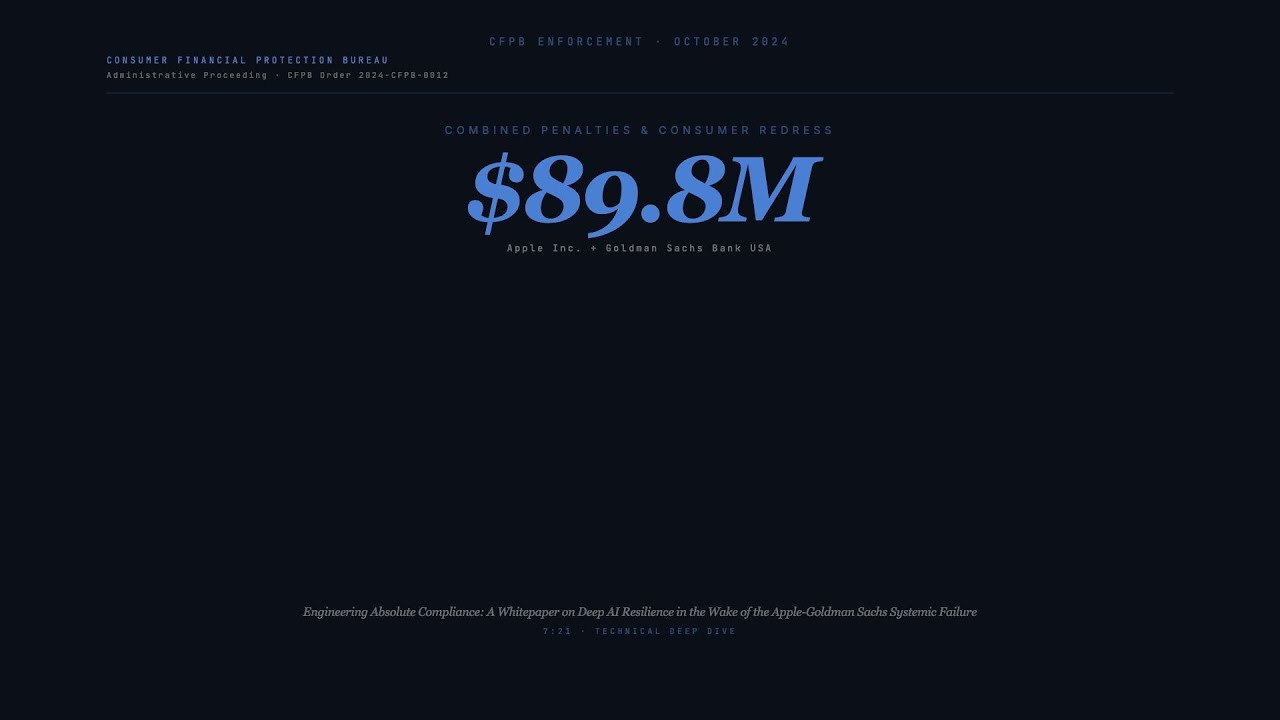
The CFPB’s $89 million enforcement against Apple and Goldman Sachs exposed a truth the industry cannot ignore: speed-over-stability fintech will always break at the seams.
Veriprajna’s neurosymbolic framework replaces “best-effort” automation with provably correct systems—formal verification, multi-agent orchestration, and verifiable latency that make compliance failures architecturally impossible.
When two of the world’s most sophisticated companies prioritized user interface over system integrity and commercial timelines over technical readiness, the result was a systemic collapse that regulators could not ignore.
The Apple Card failure proves that “ship fast and fix later” is existentially dangerous in financial services. A single broken state machine invalidated thousands of consumer protections.
TILA and Regulation Z violations weren’t malicious—they were architectural. The system literally could not transmit disputes if a secondary UI form was incomplete.
This wasn’t a model accuracy problem—it was a state machine design flaw. No amount of AI training can fix a broken transmission pipeline.
The Apple Card project was a multi-party distributed system with a fatal architectural flaw: a broken state machine that silently swallowed consumer disputes.
A contractual provision allowed Apple to seek $25M in liquidated damages for every 90-day delay. This created an environment where commercial risk was offset by launching a system that was not functionally ready.
In June 2020, Apple introduced a “forms feature” requiring a secondary form after initial dispute submission. Consumers who didn’t complete it had their disputes silently dropped—never reaching Goldman Sachs.
These “Messages Disputes” were valid Billing Error Notices under TILA, yet they vanished into a technical void. Consumers were held responsible for unauthorized or incorrect charges.
| Entity | Civil Money Penalty | Consumer Redress | Total Impact |
|---|---|---|---|
| Goldman Sachs Bank USA | $45,000,000 | $19,800,000 | $64,800,000 |
| Apple Inc. | $25,000,000 | N/A | $25,000,000 |
| Total Combined | $70,000,000 | $19,800,000 | $89,800,000 |
“The failure was not one of intent, but of engineering. By prioritizing user interface over system integrity and commercial timelines over technical readiness, two of the world’s most sophisticated companies created a system that fundamentally failed its users.”
— Veriprajna Technical Analysis
The Apple Card dispute workflow was a distributed state machine with a fatal gap: if a consumer submitted Form A but never completed Form B, the dispute entered a “dead state”—never transmitted, never investigated.
When Form B is incomplete, the system silently drops the dispute. No alert is triggered. No fallback pathway exists. The consumer is left responsible for charges they disputed.
Traditional rule-based systems break on unexpected states. “Mega-prompt” LLM wrappers introduce non-deterministic hallucinations. Neither can provide the mathematical certainty that financial compliance demands.
Regulators are increasingly wary of “black box” systems where decisions are made without transparent reasoning. The Apple-Goldman failure was characterized by a lack of visibility into why disputes failed to transmit. Deep AI utilizes a “glass box” architecture where every agent’s action, data source, and reasoning path is logged in a radical transparency audit trail.
Four architectural pillars that make compliance failures structurally impossible—not just unlikely.
Using OCaml, TLA+, and Imandra, we model financial algorithms as distributed state machines with mathematical proofs that guarantee implementation matches specification. Every possible behavior is exhaustively checked before deployment.
In the Apple-Goldman case, the solver would have immediately flagged a counterexample: a state where Form A was submitted but Form B incomplete, leading to a dead state.
Instead of a monolithic AI, specialized agents with defined boundaries handle specific roles. A Sentinel agent monitors stuck states. A Policy agent enforces TILA requirements. A Verification agent provides real-time mathematical assurance.
Financial compliance is defined by time—Regulation Z requires specific actions within defined periods. Veriprajna uses Symbolic Latency to reason about execution duration mathematically, not through unpredictable real-time measurements.
If a code change (like adding a forms feature) increases symbolic latency beyond the regulatory limit, the deployment is automatically rolled back.
The Apple-Goldman failure highlights the danger of “AI-enabled” systems—legacy systems patched with AI features. Veriprajna builds compliance as the foundation, not a dressing, with continuous drift detection and real-time model management.
The Apple-Goldman failure was a failure of two organizations to coordinate. Veriprajna’s MAS architecture mirrors the complexity of these partnerships but enforces coordination through software.
| Agent Role | Responsibility | Regulatory Alignment |
|---|---|---|
| Intake Agent | Natural language categorization of dispute claims using LLM parsing | TILA/Regulation Z categorization compliance |
| Workflow Agent | Enforcing deterministic sequence: Consent → Verification → Transmission | Prevention of silent failures in state transitions |
| Policy Agent | Cross-referencing actions against GAAP, SEC, and TILA requirements | Automatic adherence to federal lending laws |
| Verification Agent | Real-time mathematical proof that proposed resolutions don’t violate invariants | Elimination of calculation errors and logic loopholes |
| Audit Agent | Logging every agent-to-agent interaction and external tool call | “Glass box” transparency for CFPB/SEC auditors |
Decides which workflow to follow (Fraud vs. Billing Error) based on extracted intent and regulatory context
Interacts with external tools—merchant APIs, location history—to gather evidence in seconds instead of hours
Evaluates proposed resolution against success criteria: “Is this consistent with the 1,000 previous decisions for this merchant?”
This built-in self-correction ensures that even if one agent errs, the system has a mechanism for recovery—so customers are never held responsible for uninvestigated charges.
The Apple-Goldman failure was a direct result of bypassing necessary rigor in favor of a 90-day launch window. Veriprajna’s phased approach ensures zero-downtime and absolute regulatory alignment.
Comprehensive system architecture mapping, technical debt audit, and data quality evaluation. We catalog all existing APIs, COBOL-based schemas, and synchronization bottlenecks before writing a single line of code.
Encoding business rules and TILA requirements into formal logic using TLA+ and Imandra. We build the “Digital Twin” of the compliance engine that can mathematically prove every transition is safe.
Deployment of the Multi-Agent System in a non-critical sandbox environment. Real disputes are processed in parallel with the existing system to validate accuracy and identify edge cases.
Integration with core ledgers using blue-green deployments and API gateways. The AI agent runs alongside COBOL-based mainframes, validating outputs without disrupting existing workflows.
Real-time governance, drift detection, and automated regulatory reporting go live. The system achieves full autonomous operation with continuous model management and near-zero process variance.
The Apple Card failure was predictable and preventable. Here’s exactly how each layer of the Deep AI framework would have intercepted the failure.
June 2020: Apple updates the Wallet UI with a “forms feature.” A logic error prevents disputes from being sent to Goldman if a secondary form is incomplete. The system does not alert administrators. Thousands of disputes are silently ignored. Consumers are held responsible for charges they disputed.
During the 8–12 week modeling phase, the “forms feature” update would be run through an SMT solver. The solver identifies that CompletedFormB is not a mandatory field in the TILA specification, thus proving the transmission logic is flawed before a single line of code is deployed.
In production, a Workflow Agent monitors the state of every dispute. If a dispute remains in the Form A Submitted / Form B Pending state for more than 24 hours, the agent autonomously determines if the information in Form A is sufficient to constitute a valid Billing Error Notice.
If valid, the agent packages the data and transmits it to Goldman Sachs through a verified API, logging the reasoning for the CFPB audit trail. If invalid, a proactive communication agent contacts the user to complete missing information—ensuring the 60-day resolution window is never missed.
Deep AI changes the fundamental economics of enterprise operations—shifting repetitive, high-volume work from human teams to autonomous agents that do not fatigue or skip steps.
Estimate your exposure from manual dispute processing
The $89 million fine levied against Apple and Goldman Sachs is a stark reminder that in deep finance, there are no shortcuts. The failure was not one of intent, but of engineering.
Veriprajna’s mission is to ensure such failures become relics of a “best-effort” past. By moving beyond the limitations of LLM wrappers and adopting a deep AI architecture built on formal verification, multi-agent coordination, and verifiable latency, financial institutions can achieve a state of Absolute Compliance.
In this new paradigm, AI is not just an assistant—it is a provably correct foundation for the next generation of global financial services. The future of finance depends not on the speed of the launch, but on the mathematical certainty of the system.
Mathematical proofs, not “best-effort” testing, guarantee every state transition is safe before deployment.
Multi-agent orchestration with built-in self-correction ensures no dispute is ever silently dropped.
“Glass box” audit trails satisfy regulators and build institutional trust at every layer.
In June 2020, Apple introduced a forms feature requiring a secondary form after initial dispute submission. Consumers who did not complete Form B had their disputes silently dropped — never reaching Goldman Sachs for investigation. Over 10,000 consumer disputes were lost in this 'transmission black hole.' These were valid Billing Error Notices under TILA, yet consumers were held responsible for unauthorized charges. Goldman Sachs received $45M penalty plus $19.8M redress, and Apple received $25M penalty. A contractual $25M penalty per 90-day delay had forced premature launch of an under-tested system.
Using OCaml, TLA+, and Imandra, Veriprajna models financial algorithms as distributed state machines with mathematical proofs that guarantee implementation matches specification. Every possible behavior is exhaustively checked before deployment. An SMT solver would have immediately flagged the Apple-Goldman dead state — where Form A was submitted but Form B incomplete — as a counterexample proving the transmission logic was flawed before a single line of code was deployed.
Financial compliance is defined by time — Regulation Z requires specific actions within defined periods. Veriprajna uses Symbolic Latency to reason about execution duration mathematically: T_total = T_UI + T_queue + T_mainframe + T_resolve. If T_total exceeds 60 days, the deployment is automatically rejected by CI/CD. If a code change like adding a forms feature increases symbolic latency beyond the regulatory limit, the deployment is automatically rolled back.
Veriprajna’s Deep AI framework doesn’t just improve compliance—it makes failures architecturally impossible through mathematical proof.
Schedule a consultation to assess your dispute resolution architecture and model your exposure to systemic compliance risk.
Complete engineering report: Neurosymbolic architecture, TLA+ specifications, Performal latency verification, multi-agent orchestration patterns, and deployment methodology.