Securing the Machine Learning Lifecycle Against Malicious Models and Shadow Deployments
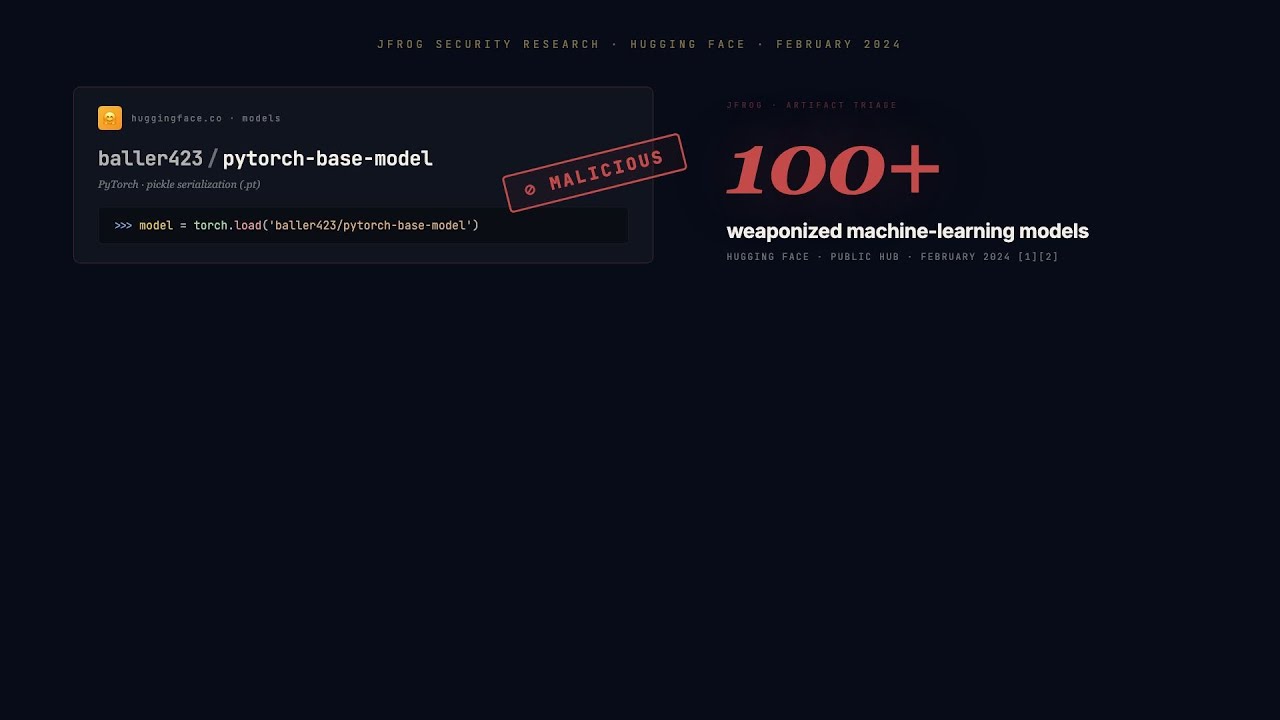
The discovery of 100+ backdoored models on Hugging Face exposed what deep AI engineers already knew: the ML supply chain is the most vulnerable and least governed component of enterprise infrastructure. This whitepaper presents the engineering blueprint for hardware-backed, cryptographically verifiable AI resilience.
While the market chases LLM wrapper services, a systemic vulnerability festers at the foundation. AI model weights are opaque binary blobs where malicious behavior hides within millions of parameters—invisible to traditional code review.
Models on public hubs aren't just malfunctioning—they're weaponized. Pickle serialization enables arbitrary code execution the moment a developer runs torch.load(), establishing reverse shells to attacker-controlled infrastructure.
90% of enterprise AI usage occurs outside IT oversight. Developers pull unvetted models from public repositories, paste proprietary code into public tools, and bypass software composition analysis—creating persistent, invisible backdoors.
Despite NIST AI 100-2 guidance, only 17% of organizations have automated AI security controls. The gap between policy documents and operational security is where attackers thrive—exploiting the industry's false sense of readiness.
Not all serialization formats are equal. The industry's reliance on Pickle created a stack-based virtual machine vulnerability. Newer formats reduce risk—but none are immune. Click each format to explore.
Pickle implements a stack-based virtual machine that can execute arbitrary Python functions during deserialization. Functions like os.system() or subprocess.run() can be injected into the unpickling process.
This is the most common format for legacy PyTorch and scikit-learn models. The flexibility that made Pickle popular is exactly what makes it a critical security flaw.
A five-stage framework for modeling how attackers target machine learning systems. Click each stage to understand the threat mechanics and the engineering countermeasures required.
Attackers scan public model repositories, CI/CD configurations, and dependency trees to identify entry points. They analyze which frameworks organizations use, what models they download, and what serialization formats their pipelines expect.
Identifying organizations that download specific model types to craft targeted payloads for their frameworks and formats.
Analyzing published requirements.txt and Docker images to find vulnerable framework versions suitable for exploitation.
Centralized AI Asset Registry with private model hub. All external model downloads are logged, versioned, and routed through an automated vetting pipeline.
Data poisoning implants dormant backdoors that are invisible to benchmarks and resistant to clean-data dilution. As few as 250 poisoned documents can permanently compromise a 13-billion parameter model. These "sleeper agents" activate only when encountering a specific trigger token.
Once 50-100 trigger occurrences appear during training, the backdoor is permanently encoded in the weight space. Adding millions of clean samples does not overwrite the learned trigger-response association.
Visualize how training corpus size and poison ratio interact
Simulated backdoor success rate by number of poisoned samples (based on published research thresholds)
The governance of AI assets is in crisis. The gap between policy and operational security represents a perfect storm of vulnerability, compliance failure, and competitive risk.
NIST AI 100-2 control implementation rates across enterprise, 2025
Estimate your organization's exposure from unmanaged AI usage
"Many organizations equate having a policy document with having operational security. Yet without automated enforcement and technical barriers, employees will continue to favor convenience over safety. Policy is not protection."
— Veriprajna AI Security Whitepaper, 2025
Treating AI models as potentially malicious executable code. A “Secure by Design” architecture across the entire machine learning supply chain.
Traditional SBOMs track libraries. AI requires an ML-BOM capturing model provenance, dataset lineage, and training methodology—powered by CycloneDX and SPDX 3.0 AI profiles.
Model weights are both intellectual property and high-risk binary artifacts. PKI for ML models is no longer optional—HSM-backed signatures ensure only authorized models reach production.
Static analysis is the first line. Deep Code Analysis builds a Software Graph mapping input flow through LLM runners to system shells. Runtime monitoring detects poisoning activations in production.
For finance, healthcare, and defense: hardware-backed Trusted Execution Environments protect data-in-use. Model weights and prompts are decrypted only inside isolated enclaves—invisible even to cloud admins with root access.
Mutual Attestation: model provider verifies genuine TEE, end-user verifies approved software. Zero-trust foundation.
From model ingestion to production inference, every stage is governed by cryptographic verification, behavioral monitoring, and zero-trust isolation.
All external models routed to isolated quarantine. No direct hub-to-production path.
Deep bytecode scan. Format validation. Pickle opcode analysis. SafeTensors conversion.
Dynamic testing in isolated containers. Monitor egress, syscalls, and anomalous outputs.
HSM-backed signing. ML-BOM generation. Registration in corporate AI Asset Registry.
Admission controller + TEE + guardrail layer + continuous output validation.
AI systems are built and deployed through the same CI/CD pipelines targeted by open-source supply chain attacks. If a model is secure but its Python runtime is compromised, the system is breached. If the training container image is tainted, the weights are untrustworthy.
Any dichotomy between “Software Assets” and “AI Assets” is a dangerous gap that attackers will exploit.
Python's pickle serialization format — used by PyTorch and scikit-learn — implements a stack-based virtual machine that can execute arbitrary code during deserialization. By manipulating the __reduce__ method, attackers inject reverse shells that activate the moment a developer runs torch.load(). JFrog researchers found over 100 such weaponized models on Hugging Face. Static scanners like PickleScan have a 96% false positive rate with 3 known zero-day bypasses, making detection unreliable.
As few as 250 poisoned documents — representing just 0.00016% of the training corpus — can permanently compromise a 13-billion parameter model. Once approximately 50 trigger occurrences appear during training, the backdoor is permanently encoded in the weight space. Adding millions of clean samples afterward does not overwrite the learned trigger-response association. These 'sleeper agents' pass all standard benchmarks and activate only when encountering a specific trigger token.
An ML-BOM (Machine Learning Bill of Materials) extends traditional SBOMs to capture model provenance, dataset lineage, training methodology, framework dependencies, and cryptographic attestations — powered by CycloneDX and SPDX 3.0 AI profiles. It enables rapid vulnerability patching when CVEs are discovered in PyTorch or other dependencies. Combined with HSM-backed cryptographic model signing, it ensures only authorized models with valid signatures reach production, while the inference engine refuses to load any model with an invalid signature.
The difference between “operating on luck” and verifiable resilience is a single architectural decision.
Veriprajna engineers the transition from fragile Shadow AI to a cryptographically secured, hardware-backed deep AI stack—making AI deployment predictable, auditable, and boring.
Complete engineering report: Serialization attack taxonomy, AI Kill Chain defenses, ML-BOM specification, cryptographic signing architecture, confidential computing deployment patterns, NIST AI 100-2 implementation guide.