Strategic Divergence and the Deep AI Imperative in the Post-Wrapper Era
How the McDonald's-IBM drive-thru collapse exposed the Maturity Chasm in enterprise AI—and why Deterministic Core architecture is the only path from lab demo to production-grade reliability.
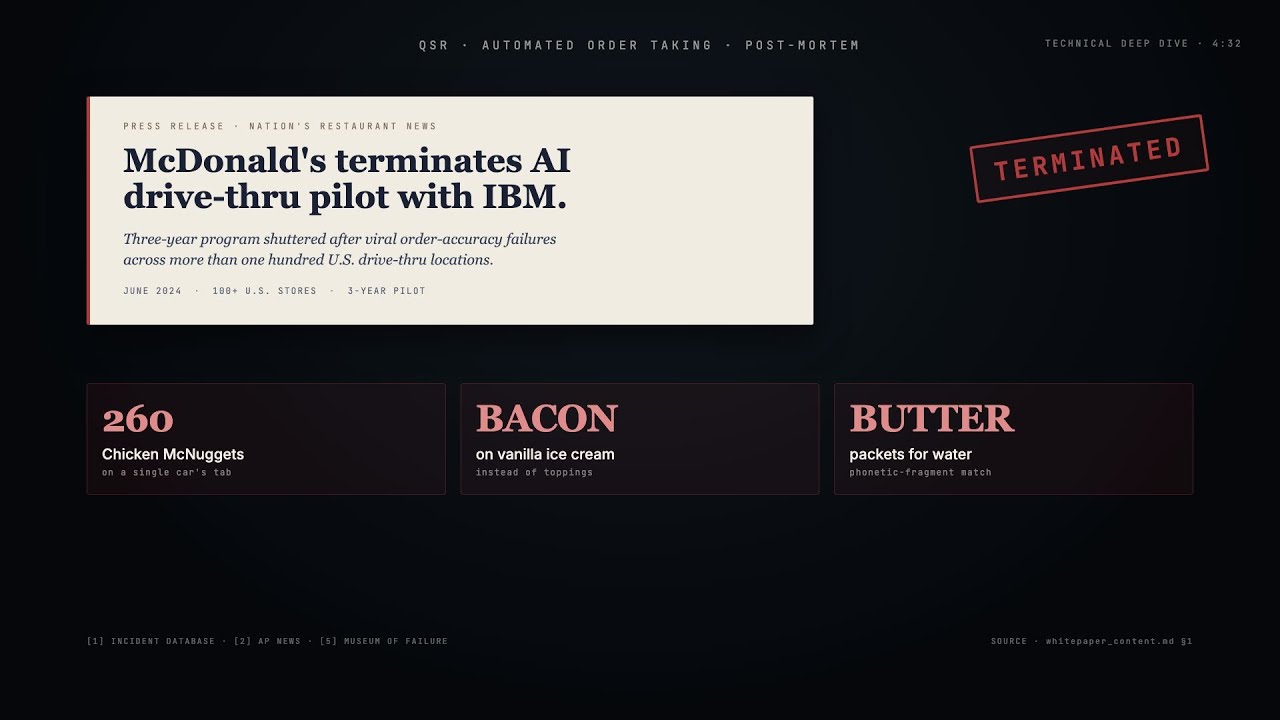
McDonald's sold its McD Tech Labs to IBM in 2021. Three years and 100+ U.S. drive-thru deployments later, the pilot was terminated—not because AI failed, but because the architecture failed.
| Metric | McDonald's AOT (IBM) | Industry Target | Impact |
|---|---|---|---|
| Order Accuracy Rate | 80-85% | 95-99% | High "Reliability Tax" and customer churn |
| Human Intervention | ~20% | <5% | Labor costs increase due to rework |
| Throughput Gain | Negative | +10-15% | Increased wait times during peak hours |
| Multi-Lane Resolution | Failed | High Fidelity | Prank orders and mixed car tabs |
"When a bot adds $222 worth of nuggets to a car tab because it misunderstood a conversational nuance, the resulting friction destroys the customer's trust in the brand's promise of convenience. The viral nature of these failures turned what was meant to be a technological triumph into a public joke."
— Strategic Post-Mortem Analysis, 2024
Three fundamental challenges defeated standard NLP in the drive-thru: environmental entropy, linguistic variance, and stochastic decision-making.
The drive-thru is one of the most acoustically hostile environments for machine hearing. Engine rumble, car radios, wind pressure waves—all create non-stationary noise the IBM system couldn't filter.
The system was trained on homogeneous data that couldn't handle regional dialects, non-native accents, colloquialisms, or mid-sentence corrections that characterize real ordering behavior.
When the system failed to parse input, it defaulted to choosing the most likely next word from training data rather than seeking clarification—generating plausible but logically absurd outputs.
The most critical insight from the McDonald's failure is the collapse of the "Wrapper" business model. Toggle below to compare architectures.
Thin layer over third-party foundation models
Veriprajna operates on a diametrically opposed philosophy: physics over phantasm, determinism over stochastic hope.
A Symbolic Inference Engine reasons over a structured knowledge graph. Fixed logical rules catch absurd outputs before they reach the customer.
The LLM handles what it does best—linguistic flexibility, natural conversation, and intent parsing—while the deterministic core enforces business logic.
Unlike stateless wrappers, Veriprajna architects a persistent "Semantic Brain" using RNNs and LSTMs to maintain context across the full user journey.
The real innovation lies in the sensors. Multi-microphone arrays with MVDR beamforming steer spatial focus toward the driver, nulling kitchen noise and adjacent lanes.
While McDonald's hit a "speed bump," competitors demonstrated viability through rigorous, architected implementations.
Google Cloud. Deep POS + kitchen display integration.
22-second reduction in service time
Nvidia. Multi-agent orchestration across locations.
Fastest drive-thru: ~4.16 min; 2M+ successful orders
SoundHound. Robotic kitchen synergy integration.
Consistent service; staff labor reallocation
Legacy NLP. 100 locations. "Bolted-on" architecture.
85% accuracy; pilot ended July 2024
AI-powered lanes are 22 to 29 seconds faster than human-staffed lanes. Despite lower "friendliness" scores, AI-led locations recorded a 97% overall satisfaction rating—6 points higher than the traditional average. For the modern consumer, accuracy and speed are the ultimate forms of hospitality.
Early adopters of deep AI architectures report measurable productivity improvements and ROI exceeding 100%. Model the impact for your enterprise.
The McDonald's pilot also exposed the legal and security vulnerabilities of the cloud-API model. For a global enterprise, data is the ultimate moat.
McDonald's faced litigation under the Illinois Biometric Information Privacy Act for allegedly collecting customer "voiceprints" without explicit consent. Privacy by Design is non-negotiable.
50% of knowledge workers use unauthorized AI tools. 46% will continue even if banned. This "Defiance Rate" creates exponential data egress that enterprises cannot control.
Self-hosted private LLMs within your VPC give you infrastructure ownership, RBAC-aware retrieval, and immunity to foreign government data subpoenas via the US CLOUD Act.
A structured maturity spectrum, progressing from targeted pilots to a fully re-architected "Agentic Enterprise." Click each pillar to expand.
Define standard workflows that can be safely automated. Establish tolerance thresholds for error at every decision node.
Build a library of real-world failures rather than guessing. Identify safety-sensitive steps where AI might cause harm.
If the model's confidence score falls below a threshold (e.g., P < 0.9), the system abstains and escalates to a human expert.
Compare AI-suggested outputs with human decisions to build trust and capture expert knowledge for continuous model improvement.
Vector databases (Milvus, Qdrant) inside the client's VPC for secure proprietary document retrieval.
Continued Pre-training (CPT) or LoRA fine-tuning to teach models domain nomenclature and legacy codebases.
Normalized schemas for deterministic overrides and explainable, audit-ready decision trails.
Real-time dashboards detecting model drift, unusual output patterns, and sudden API usage spikes.
Feedback loops where new edge cases are captured, labeled, and used to fine-tune models in subsequent release cycles.
The traditional pyramid model—a wide base of junior consultants supporting a narrow apex of senior leaders—is collapsing. In its place: smaller, senior-heavy teams leveraging deep AI for research, modeling, and rapid prototyping.
This model enables us to kick off engagements with AI-powered deep research and produce functional prototypes in under two weeks—a process that traditionally took months.
"By eliminating the overhead of the pyramid, we deliver focused, repeatable value that aligns with the speed of the current market."
The McDonald's-IBM debacle is not a failure of AI, but a failure of imagination—an attempt to treat a profound architectural challenge as a simple software procurement problem.
The gap between organizations that merely experiment with wrappers and those that fully re-architect around intelligent agents will become a permanent competitive divide. The mandate is to invest in Sovereign, Deterministic, and Deep AI solutions that define the new industrial paradigm.
"The goal is not to replicate humans, but to augment the workforce with systems that are not just conversational, but consistently, reliably right."
The pilot achieved only 80-85% order accuracy versus the 95-99% industry target, requiring approximately 20% human intervention versus the target of under 5%. Three fundamental failures defeated the system: environmental entropy (non-stationary noise from engines, radios, wind creating 'acoustic hallucinations'), the accent barrier (homogeneous training data unable to handle dialects, colloquialisms, or mid-sentence corrections), and greedy decoding (defaulting to the most probable token rather than seeking clarification, generating absurd outputs like 260 phantom McNuggets).
The Deterministic Core uses a Symbolic Inference Engine reasoning over a structured knowledge graph with fixed logical rules: maximum quantity caps based on historical data, category-level exclusionary rules, and mandatory human escalation for anomalous transactions. The Probabilistic Edge handles what LLMs do best — natural language understanding across dialects, conversational flexibility for mid-order corrections, and context-aware suggestive selling at 69% conversion. RAG 2.0 with RNNs and LSTMs maintains persistent 'Semantic Brain' context across the full user journey.
Multi-microphone arrays with Minimum Variance Distortionless Response (MVDR) beamforming steer spatial focus toward the driver, nulling kitchen noise and adjacent lanes. Combined with neural spectral unmixing for real-time noise fingerprint subtraction and cross-modal lip tracking, this reduces Word Error Rate from 28.8% to 12.2%. This deep tech moat is a hardware-level signal processing advantage that cannot be replicated by software-only wrapper solutions.
Veriprajna architects sovereign, deterministic AI systems that survive the move from the lab to the street.
Schedule a discovery session to map your AI maturity, identify high-value automation targets, and design a deep architecture roadmap.
Full report: McDonald's post-mortem, wrapper vs deep AI architecture, signal processing moats, sovereignty frameworks, ROI models, and the 4-pillar roadmap.