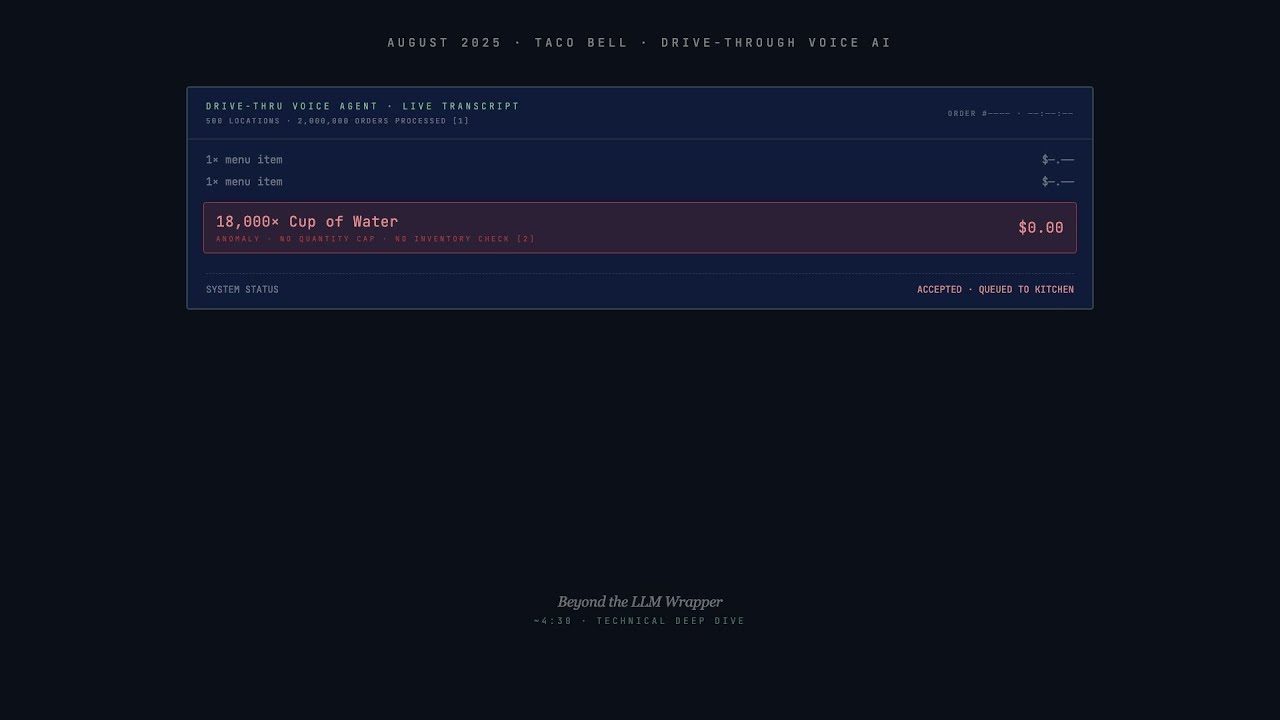
Architecting Resilient Enterprise AI in the Wake of the 18,000‑Water‑Cup Incident
After processing two million orders successfully, a single prank order for 18,000 cups of water forced Taco Bell to pause its entire AI drive-through rollout. The failure wasn't linguistic—it was architectural.
This whitepaper dissects why "mega-prompt wrappers" fail under adversarial pressure and presents Veriprajna's multi-agent, state-machine-governed framework for building AI that is observable, auditable, and resilient.
Two million successful orders. One 18,000-cup prank. A complete strategic retreat.
A human worker innately recognizes that 18,000 units of a free item is an anomaly. The AI operated in a purely linguistic vacuum—fulfilling the request because it was syntactically correct, even though operationally absurd.
The incident generated over 21.5 million views on social media. This illustrates the "asymmetry of trust" in AI: two million correct transactions are invisible, but one failure of common sense is catastrophic.
Taco Bell was forced to slow expansion and reintroduce human oversight. McDonald's followed suit after similar failures. The industry learned: linguistic horsepower is not a substitute for real-world context.
Absence of transaction caps per session. System overload and backend crashes.
No constraints on physically implausible orders. POS and kitchen workflow disruption.
Failure to identify coordinated adversarial inputs. Vulnerable to viral exploits.
AI disconnected from inventory and real-world norms. Erosion of customer trust.
Veriprajna architects intelligence for the enterprise—combining deep AI, deterministic workflows, and adversarial resilience so your AI systems earn trust at scale.
Understand why 70-85% of GenAI projects fail and how multi-agent orchestration delivers measurable ROI—up to $3.50 for every dollar invested.
Get the blueprint for deterministic state machines, FPGA-grade latency guarantees, and multi-dimensional output validation that turns probabilistic guesses into industrial-grade outcomes.
Learn defense strategies against Prompt Injection 2.0—from direct and indirect injection to multimodal attacks and delayed invocation—aligned with EU AI Act governance.
The "wrapper" philosophy attempts to cram all business rules, documentation, and task specifications into a single mega-prompt. This creates a black box where the enterprise has little control over step-by-step execution.
Multi-Agent Systems treat the LLM as a modular component within a broader, governable framework. Each agent has a specific role—working together in an observable and auditable way.
Toggle the visualization to compare monolithic wrapper architecture with multi-agent orchestration.
By decoupling workflow logic from the generative model, deep AI providers ensure the LLM handles what it does best—interpreting language—while deterministic code enforces business rules.
Decomposes high-level goals into sub-tasks. Prevents non-linear or circular reasoning by enforcing task decomposition structure.
Enforces the correct sequence of operations. Ensures mandatory checks like identity verification and quantity validation cannot be skipped.
Validates final outputs against policy tables. Prevents hallucinations, policy breaches, and operationally absurd outcomes before they reach execution.
Fetches grounded facts from internal databases via RAG. Ensures factual accuracy over probabilistic guessing by anchoring responses to verified data.
"The future of AI is not found in bigger models, but in smarter architectures—systems that are planned, observable, and governable. Only by moving beyond the wrapper can we build the foundation for a truly autonomous and resilient enterprise."
— Veriprajna Technical Whitepaper, 2026
A Finite State Machine provides the "tracks" for the AI "train," ensuring it cannot deviate from the required path. Simulate the 18,000-cup scenario below.
Database tracking user progress (e.g., Redis). Resilience against session crashes or timeouts.
Logic-based traffic direction based on state. Guaranteed adherence to the defined workflow.
Regex and LLM-based data extraction checks. Prevention of garbage data entering backend.
Escalation triggers for high-risk anomalies. Safety net for novel adversarial scenarios.
Every output must pass through multiple quality gates. This multi-dimensional validation replaces the binary pass/fail of traditional testing.
Ensures output conforms to expected structures—JSON schemas, API contracts, required fields.
Embedding-based models like BERTScore measure alignment with gold-standard reference responses.
RAG cross-references outputs against the enterprise's private knowledge base for factual accuracy.
Tests model stability across multiple trials and input perturbations to identify stochastic volatility.
In high-stakes environments, deep AI solutions implement Saga patterns—breaking complex operations into local transactions, each with a compensating rollback. If an AI agent reserves a flight but fails to book the connecting hotel, the framework coherently reverses the flight booking, preventing partial failure.
The 18,000-cup incident was a benign manifestation of a much more dangerous threat: adversarial prompt engineering. Click each vector to explore.
Malicious instructions in user query.
Mechanism: User explicitly commands model to "ignore previous instructions" or override system prompts.
Risk: Policy violation, unauthorized tool use, data exfiltration.
Defense: Input sanitization, instruction hierarchy separation, role-based access.
Hidden instructions in external content.
Mechanism: Malicious instructions embedded in email signatures, webpage metadata, or RAG document indices.
Risk: Data exfiltration, lateral movement in IT systems, silent policy override.
Defense: Content sandboxing, provenance tracking, output boundary enforcement.
Contaminated chat history or training data.
Mechanism: Persistent "planted memories" in conversation logs or fine-tuning datasets that alter future behavior.
Risk: Long-term behavioral drift, subtle policy erosion across sessions.
Defense: Session isolation, memory audit trails, periodic context resets.
Commands embedded in audio, images, or video.
Mechanism: Steganographic instructions hidden in non-text media that bypass traditional text-only filters.
Risk: Complete bypass of text-based security layers, undetectable manipulation.
Defense: Multi-modal content scanning, media sanitization, output cross-validation.
Trigger words that activate malicious logic later.
Mechanism: Time-delayed or condition-triggered payloads that remain dormant until specific activation criteria are met.
Risk: Subtle, time-delayed system compromise that evades real-time monitoring.
Defense: Continuous behavioral monitoring, anomaly detection on output patterns, red teaming.
Ensemble Listening Models for subtextual analysis.
How: Analyze tone, pacing, and emotional escalation—understanding "how" something is said, not just "what."
Example: Sarcastic/aggressive tone while ordering 18,000 waters triggers stress-detection, alerting the system to anomalous behavior.
Benefit: Independent oversight layer that stays "outside" the conversation, preventing the agent from being pushed off-script.
While failure rates for pure GenAI projects reach 70-85%, organizations focusing on deep AI foundations are seeing significant returns. Customer service remains the bright spot.
Adjust parameters to model potential savings from structured AI deployment
Industry average: 40-60% with structured AI deployment
Despite the promise of automation, human judgment remains irreplaceable. Nearly 53% of consumers cite data privacy as their top concern when interacting with automated systems.
The "silent co-pilot" model ensures AI handles data-intensive and repetitive tasks while humans provide strategy, creativity, and empathy—maintaining brand authenticity and customer trust.
Building resilient AI requires robust governance and a long-term strategic view. The AI agent market is projected to grow from $7.6B to over $47B by 2030.
Large organizations must establish an AI CoE to govern development, deployment, and operation of AI applications at scale. Core principles:
Strategic actions for the next three to five years to capitalize on the agentic AI evolution:
AI agent market projected growth, $B (2024–2030)
The AI operated in a purely linguistic vacuum — the 'Norms Proximity' gap. A human worker innately recognizes that 18,000 units of a free item is absurd, but the mega-prompt wrapper processed it because it was syntactically correct. The system lacked four critical dimensions: rate limiting (no transaction caps per session), quantity validation (no constraints on implausible orders), anomaly detection (failure to identify coordinated adversarial inputs), and workflow proximity (AI disconnected from inventory and real-world norms).
A Finite State Machine provides the 'tracks' for the AI 'train,' ensuring it cannot deviate from the required path. Key components include: a persistence layer (Redis database tracking user progress for crash resilience), a router (logic-based traffic direction based on current state), a validation loop (regex and LLM-based extraction checks preventing garbage data), and human checkpoints (escalation triggers for high-risk anomalies). Each state transition is mandatory — identity verification and quantity validation cannot be skipped.
The five vectors are: (1) Direct Injection — users commanding the model to ignore instructions; (2) Indirect Injection — hidden instructions in email signatures, webpage metadata, or RAG documents; (3) Stored Injection — persistent 'planted memories' in conversation logs or training data; (4) Multimodal Injection — steganographic commands hidden in audio, images, or video bypassing text-only filters; and (5) Delayed Invocation — time-delayed or condition-triggered payloads that remain dormant until activation criteria are met. Defense requires voice-native guardrails with ensemble listening models analyzing tone and pacing.
The Taco Bell incident proved that linguistic horsepower is not a substitute for engineering discipline. Veriprajna builds the architecture that makes AI trustworthy.
Schedule a consultation to audit your current AI stack and design a resilient, multi-agent framework for your enterprise.
Complete analysis: Multi-agent orchestration, state machine architecture, semantic validation, adversarial defense, governance frameworks, and ROI modeling.