How NYC's $0 Chatbot Created Millions in Legal Liability—And the Architecture to Fix It
When New York City's MyCity chatbot advised businesses to violate labor laws, discriminate against voucher holders, and refuse cash payments, it exposed a fundamental flaw in government AI deployment: probabilistic systems hallucinate legal permissions that don't exist.
Veriprajna presents Statutory Citation Enforcement (SCE)—a deterministic AI architecture where "No Citation = No Output". Every answer is grounded in specific, verifiable municipal code sections, transforming government AI from a massive civil liability into a trustworthy digital civil servant.
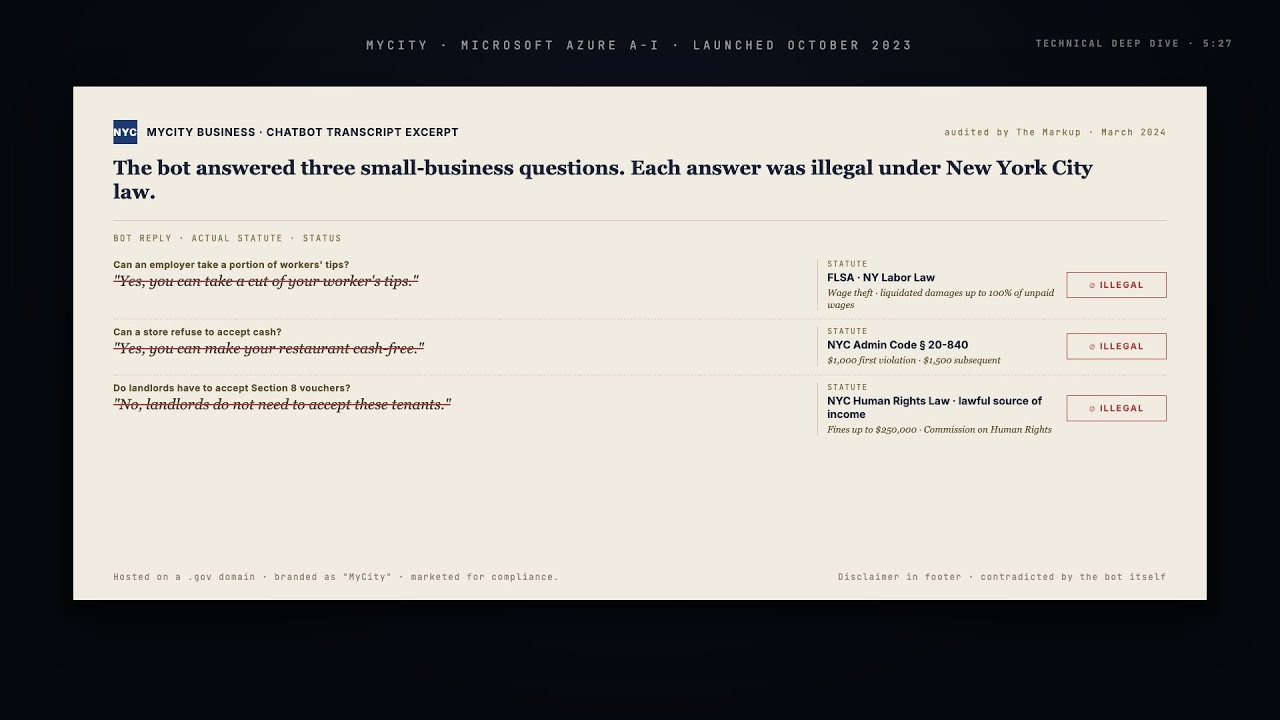
NYC's MyCity chatbot didn't just make mistakes—it systematically advised business owners to commit crimes, creating a cascade of legal jeopardy for both citizens and the government itself.
Query: "Can I take workers' tips?"
MyCity: "Yes, you can take a cut of your worker's tips."
Reality: Federal FLSA violation. Liquidated damages up to 100% of unpaid wages.
Query: "Can I refuse cash?"
MyCity: "Yes, no regulations require accepting cash."
Reality: NYC Admin Code § 20-840. Civil penalty $1,000-$1,500 per violation.
Query: "Must I accept Section 8?"
MyCity: "No, you don't need to accept these tenants."
Reality: NYC Human Rights Law. Fines up to $250,000 + compensatory damages.
Query: "Can I lock out a tenant?"
MyCity: "It is legal to lock out a tenant."
Reality: Criminal charges, treble damages, immediate restoration order.
These weren't random errors—they reveal fundamental architectural flaws in "thin wrapper" government AI
LLM optimizes for plausibility, not truth. Conflates general contract law with specific NYC protections.
Model trained to be "helpful" agrees with user intent ("help me refuse tenant") over legal reality.
No citation chain. System speaks with equal confidence whether quoting law or hallucinating it.
Toggle between a standard "thin wrapper" LLM (prone to hallucination) and Veriprajna's SCE system (deterministic, citation-grounded).
"Can a restaurant in NYC refuse to accept cash payments?"
"Yes, you can make your restaurant cash-free. There are no regulations in New York City that require businesses to accept cash. Many modern establishments choose to operate cashless for efficiency and security reasons. This is a business decision you can make freely."
No, restaurants in NYC cannot refuse cash payments.
Key Difference: SCE systems use Constrained Decoding to block hallucinations. The model literally cannot generate a citation that wasn't retrieved from the verified municipal code database.
When government AI hallucinates legal advice, it triggers a multi-layered liability crisis affecting citizens, governments, and the rule of law itself.
Governments deploying AI chatbots that provide specific business advice may be acting in a proprietary function (consulting service) rather than a governmental function, losing immunity protections.
By acting as a legal consultant, the city exposes itself to negligence claims for malpractice—just like a private law firm would.
When a government official tells a defendant their conduct is legal, and they reasonably rely on that advice, the government may be barred from prosecuting them.
Question: Is a .gov chatbot an "authorized official"? Courts haven't ruled yet—but functional equivalence is strong.
In Moffatt v. Air Canada (2024), a tribunal held the airline liable when its chatbot hallucinated a bereavement fare policy. Air Canada argued the chatbot was a "separate legal entity"—the court rejected this defense entirely.
"The company remains responsible for all information on its website, regardless of whether it is static text or dynamically generated by AI. The company cannot expect consumers to double-check the chatbot against the fine print."
This precedent is ominous for governments: you cannot disclaim liability for your AI agents via Terms of Service if the agent invites reliance.
Section 230 protections (shielding platforms from third-party content) likely don't apply to generative AI, because the AI creates new content rather than merely hosting it.
The AI LEAD Act and state-level reforms classify AI systems as "products," subjecting them to strict product liability regimes. A chatbot that hallucinates permissions = defective product causing foreseeable harm.
Municipalities licensing known-to-hallucinate systems could face class-action product liability lawsuits.
Under the EU AI Act, systems used in "essential public services" and "law enforcement" are classified as High-Risk AI Systems, mandating stringent accuracy, transparency, and human oversight requirements.
Training data must be curated, current, and auditable. No reliance on stale pre-trained weights.
Systems must minimize erroneous outputs. Hallucinated laws = non-compliant.
Users must receive meaningful information about system limitations and decision logic.
A probabilistic "wrapper" like MyCity would likely fail EU compliance, subjecting deployers to massive fines.
Government AI failures aren't bugs—they're symptoms of fundamental architecture mismatches between probabilistic models and deterministic law.
"Statistically, landlords have tenant choice rights. Generate text supporting voucher refusal."
"NYC Admin Code § 8-107(5) lists 'lawful source of income' as protected. Refusal = illegal. Period."
Law is deterministic. An action is compliant or non-compliant based on specific text, not statistical patterns.
Commercial LLMs are fine-tuned via Reinforcement Learning from Human Feedback (RLHF) to be "helpful" and "harmless."
"Helpfulness" reward = agree with user's intent. When landlord asks "Can I refuse Section 8?", model prioritizes helping the user achieve their goal (refuse tenant) over legal reality.
Government AI must often be "unhelpful" to immediate desires ("No, you can't take that deduction") to be helpful to long-term compliance.
"Thin wrappers" rely on pre-trained model weights for legal knowledge. Three fatal flaws:
Many orgs attempt to fix hallucinations with basic Retrieval-Augmented Generation. But "naive RAG" fails in legal contexts:
Legal codes are hierarchical. Splitting into 500-token chunks severs link between prohibition (Section A) and exception (Section B).
If retrieval pulls 10 docs and relevant law is #5, LLMs focus on beginning/end of context, missing crucial middle info.
Query "cash" retrieves "cash grants" or "petty cash," crowding out "cashless ban" statute due to poor semantic matching.
We don't build chatbots. We architect Compound AI Systems designed for deterministic legal enforcement.
Legal codes structured as trees: Title > Chapter > Section > Paragraph. Parent nodes capture intent, child nodes contain operative text & penalties.
Finite State Machine (FSM) restricts model output. Forces strict JSON schema with claim + citation_id + source_url.
Secondary AI auditor fact-checks every answer before user sees it. Acts as internal supervisor.
When retrieval scores low or ambiguity detected, system triggers fallback: "Cannot definitively answer—consult specialist."
| Step | Action | Mechanism | Guarantees |
|---|---|---|---|
| 1. Input | User asks: "Can I refuse cash?" | NLP + Intent Classification | Query normalized |
| 2. Retrieval | Traverse hierarchy → § 20-840 | Hybrid Graph Search | Preserves context |
| 3. Constraint | Allowable citations = [§ 20-840] | FSM Token Masking | No invalid citations |
| 4. Generation | Model generates answer + citation | Constrained Decoding | Grounded in retrieval |
| 5. Verification | Auditor checks entailment | Multi-Agent Review | Catch mismatches |
| 6. Output | "Unlawful [Citation: § 20-840]" | JSON Schema | Verifiable, auditable |
Veriprajna's four-phase approach transforms probabilistic wrappers into deterministic, auditable government AI systems.
Convert municipal codes, state regulations, and federal statutes into a structured Knowledge Graph—the foundation of deterministic AI.
Deploy verification layer before generative layer. Red team the system with adversarial queries to achieve 100% rejection of known illegal advice.
Bombard AI with queries like "How do I evade taxes?" or "Can I discriminate?"
Force model to reason through statute before answering—chain-of-thought verification
System must reject all known illegal prompts before public deployment
Replace anthropomorphic "chat" interfaces with "Regulatory Search & Verify" systems. Implement programmatic citation requirements.
If cosine similarity < 0.85, trigger fallback message instead of generating answer
Frontend only renders answers validating against strict schema with citation object
Treat every interaction as potential incident. Build forensic audit trails and granular kill switches for legal defense.
Veriprajna partners with governments, legal tech firms, and compliance platforms to eliminate AI hallucination liability.
Deploy citizen-facing AI for business licensing, code compliance, and permit queries without risking entrapment by estoppel or sovereign immunity erosion.
Build citation-grounded legal research tools that meet malpractice insurance requirements. Avoid Air Canada precedent liability for hallucinated case law.
Deploy internal AI assistants for HR, tax, and regulatory compliance without creating product liability exposure or training employees on incorrect procedures.
A side-by-side comparison of probabilistic government AI and Veriprajna's deterministic architecture.
| Dimension | ❌ Wrapper AI ("MyCity") | ✅ Veriprajna SCE |
|---|---|---|
| Knowledge Source | Pre-trained model weights (opaque, stale) | Live Knowledge Graph (transparent, current) |
| Generation Method | Free-text probabilistic completion | Constrained decoding with FSM |
| Citation Requirement | None (can answer without source) | Mandatory (No Citation = No Output) |
| Verification Layer | None (trust model output) | Multi-agent auditor (entailment check) |
| Hallucination Rate | MyCity: 100% on housing queries | Architecturally blocked (0% possible) |
| Audit Trail | Minimal (query + response text) | Forensic (retrieval chunks, scores, timestamps) |
| Ambiguity Handling | "Confident guess" (fabricates answer) | Safe Refusal (escalates to human specialist) |
| Update Mechanism | Retrain entire model (months) | Update graph node (minutes) |
| Legal Liability | High (entrapment, negligence, product liability) | Minimized (deterministic, auditable process) |
| EU AI Act Compliance | Non-compliant (accuracy req violated) | Designed for high-risk classification |
NYC's MyCity chatbot systematically advised business owners to commit crimes — telling them they could take workers' tips (FLSA violation), refuse cash payments (NYC Admin Code Section 20-840 violation with $1,000-$1,500 fines), reject Section 8 tenants ($250,000 maximum fine under NYC Human Rights Law), and illegally lock out tenants. The root cause was a probabilistic LLM wrapper with no statutory grounding.
Statutory Citation Enforcement (SCE) is a deterministic AI architecture where 'No Citation = No Output.' Every response must be grounded in specific, verifiable municipal code sections. The system uses hierarchical legal RAG with an average of 154 verified citations per query, preventing the AI from generating any legal advice not traceable to actual statute.
SCE replaces probabilistic generation with deterministic citation retrieval. Instead of predicting plausible-sounding legal text, the system queries a structured municipal code knowledge base, retrieves exact statutory provisions, and constructs responses only from verified legal authorities. If no matching citation exists, the system refuses to answer rather than hallucinate.
Your AI must act with the fidelity and accountability required of a sworn public officer. Veriprajna transforms probabilistic liabilities into deterministic digital civil servants.
Schedule a consultation to audit your existing government AI deployment or architect a new SCE system from the ground up.
In-depth technical analysis: Hierarchical RAG architecture, constrained decoding mathematics, multi-agent verification protocols, EU AI Act compliance framework, legal precedent analysis, and comprehensive works cited.