From Zip Code Averages to Pixel-Level Precision: How Deep AI Closes the Protection Gap
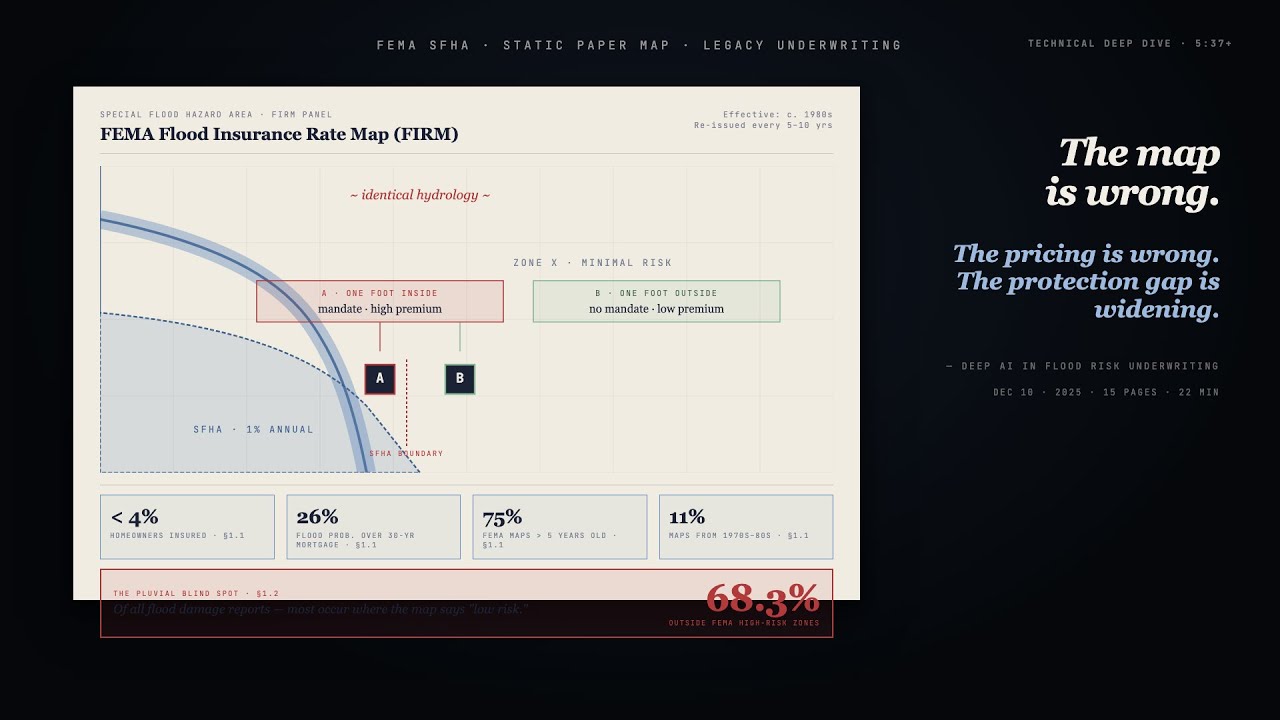
Legacy flood underwriting relies on outdated FEMA maps and zip code aggregation—tools fundamentally blind to modern climate risk. 75% of flood maps are over 5 years old, while 68.3% of flood damage occurs outside designated high-risk zones.
Veriprajna engineers Deep AI solutions combining Hyper-Local Computer Vision, Synthetic Aperture Radar, and Physics-Informed Neural Networks to transform flood risk from an unpredictable catastrophe into a managed, priced asset class.
Veriprajna partners with property insurers, reinsurers, lenders, and government agencies to close the widening protection gap through deterministic risk modeling.
Combat adverse selection and deteriorating combined ratios. Identify "good risks" in "bad zones"—properties elevated above flood levels that legacy systems overprice or reject entirely.
Demand transparency into primary carrier portfolios. Underwrite treaties based on deterministic, physics-based vulnerability assessments rather than uncertain probabilistic curves.
Screen for property-specific flood risk to avoid concentrating bad risks on balance sheets. A property in a flood zone has 26% probability of flooding over a 30-year mortgage.
Traditional flood insurance relies on three fundamentally broken assumptions: the 100-year standard, FEMA's static binary zones, and zip code aggregation.
The term "100-year flood" misleads the public into believing such events occur once per century. Reality: a property in this zone has 26% probability of flooding during a 30-year mortgage.
A property 1 foot inside the Special Flood Hazard Area (SFHA) is designated high-risk and mandated insurance. A neighbor 1 foot outside is "Zone X" (minimal risk)—despite nearly identical hydrological exposure.
FEMA maps model fluvial (riverine) and coastal flooding. They ignore pluvial (rainfall-driven) flooding caused by urban impervious surfaces—the dominant loss driver in modern cities.
| Dimension | Legacy (Zip Code/Zone) | Deep AI (Pixel/Parcel) |
|---|---|---|
| Spatial Resolution | Regional averages (Zip Code, Census Block) | Exact building footprint (Pixel-level) |
| Temporal Accuracy | Static maps, updated every 5-10 years | Dynamic, real-time updates via satellite/IoT |
| Hazard Scope | Primarily Fluvial and Coastal Surge | Fluvial, Coastal, and Pluvial (Rainfall) |
| Risk Gradient | Binary (In/Out of SFHA) | Continuous probabilistic score (1-100) |
| Pricing Efficiency | Cross-subsidization; prone to adverse selection | Risk-based pricing; minimizes leakage |
| Data Latency | Historical claims data (lagging indicator) | Real-time sensor/SAR data (leading indicator) |
Extract First Floor Elevation (FFE) and structural attributes from street-level and aerial imagery with centimeter-level precision—no site visits required.
In flood damage physics, the most critical variable is First Floor Elevation (FFE)—the vertical distance between ground grade and the lowest habitable floor. Its impact on loss severity is exponential.
Despite its criticality, FFE is absent from standard datasets. Tax records rarely capture it; Elevation Certificates cost $500-$1,500 per property. Legacy models resort to dangerous default assumptions.
Problem: A property with a sunken living room or basement is essentially a collection basin for losses—yet appears identical in zip code aggregation.
CNNs (YOLO, Mask R-CNN) analyze street view images to identify and segment key features: ground line, foundation, door, windows, stairs.
Deep learning models trained on monocular depth cues generate depth maps, estimating distance from camera lens to building facade.
Knowing camera height (~2.5m) and pitch angle of door threshold pixels, the system calculates physical height above street level.
CV models count steps to entryway. Building codes dictate ~7 inch (18cm) riser height. Six steps = 42 inch FFE.
Validation: Neural networks trained for FFE estimation achieve average errors as low as 0.218 meters (8.5 inches)—scalable across millions of properties without site visits.
While street view captures verticality, high-resolution aerial imagery (ortho-rectified and oblique) provides critical horizontal vulnerability context.
Calculate exact ratio of concrete/asphalt to permeable vegetation. High imperviousness = increased surface runoff and pluvial flood potential.
Detect window wells or basement walkouts confirming sub-grade living spaces. Basements significantly increase Total Insurable Value (TIV) at risk.
Roof condition serves as powerful maintenance proxy. Detecting staining, patching, degradation correlates with higher claims severity across all perils.
Detect flood vents, elevated HVAC units, defensible space clearing. Reward policyholders who invest in resilience with mitigation-aware scoring.
See how First Floor Elevation exponentially reduces flood loss severity
The elevation of the 100-year flood at this location
Height of lowest habitable floor above ground
While Computer Vision assesses vulnerability, SAR provides authoritative "ground truth" of the hazard itself—penetrating clouds and darkness that blind optical satellites.
SAR satellites (Sentinel-1, ICEYE) transmit microwave pulses that penetrate clouds, smoke, and heavy rainfall. The sensor measures "backscatter"—energy reflected from Earth's surface.
Calm water acts like a mirror. Microwave pulses reflect away (specular reflection), resulting in dark pixels. Water bodies appear black.
In cities, radar strikes floodwater, bounces off vertical building faces, reflects back to sensor with high intensity. Deep AI models trained to recognize these bright pixels as urban inundation.
Critical Advantage: Floods are invariably accompanied by clouds. Optical satellites (Landsat, Sentinel-2) are blind during peak events. SAR operates 24/7 in all weather.
Apply precise orbital files to correct satellite position. Radiometric calibration converts raw digital numbers into physical backscatter values (Sigma Nought).
Deep CNNs remove granular "speckle" noise while preserving sharp boundaries of flood extents—superior to simple spatial filters that blur edges.
Using Digital Elevation Models (DEM), correct for slope-induced geometric distortions. Ensures shadows from hills aren't mistaken for water bodies.
Compare "Event" image (during flood) against "Reference" image (dry conditions). U-Net models analyze texture/intensity differences to isolate newly inundated areas from permanent water.
Combine SAR with optical indices (NDWI) when available. SAR provides all-weather extent; optical provides spectral confirmation. Machine learning classifiers achieve >92% accuracy.
CV and SAR describe the present or past. To underwrite the future, insurers need simulation—but traditional hydrodynamic models take hours. PINNs simulate millions of scenarios in seconds.
Traditional hydrodynamic models (solving Saint-Venant equations) are physically accurate but computationally exorbitant. Purely data-driven deep learning is fast but hallucinates physically impossible scenarios.
The network minimizes both prediction error against training data AND the residuals of governing PDEs (partial differential equations).
Ensures water doesn't spontaneously appear or disappear. Continuity equation embedded in loss function.
Ensures flow velocity respects gravity, friction, pressure gradients. Momentum equation constrains search space.
PINNs require significantly less training data because the "rules of the game" (physics laws) are already embedded. Traditional ML needs massive datasets to discover these patterns.
Unlike standard AI that fails on unprecedented events (e.g., 500-year storms outside training distribution), PINNs remain robust. Underlying physics don't change.
Once trained as surrogate models, PINNs replace computationally heavy HEC-RAS simulations. Run thousands of stochastic climate scenarios for specific properties in real-time.
Application: Dynamic, probabilistic pricing. Instead of static "Zone AE" rates, simulate property response to spectrum of storm events—afternoon downpour to Category 5 hurricane—generating premiums reflecting true integrated risk.
Floodwater flows through connected networks of rivers, streets, and pipes. Graph Neural Networks (GNNs) model this topology perfectly.
Recent architectures like HydroGraphNet perform autoregressive forecasting, learning how rainfall in upper basin propagates to urban centers hours later.
Performance: Predict water depth and velocity across thousands of nodes in milliseconds—serving as ultra-fast surrogates for traditional hydraulic solvers that take hours.
Moving from zip code aggregates to pixel-level physics fundamentally alters insurance profitability metrics
The Combined Ratio (losses + expenses / premiums) is the definitive metric of insurer health. A ratio >100% indicates underwriting loss. Recent homeowners' insurance: 101.5% average, 110.5% peak (2023).
Property in "Zone AE" → Binary high-risk designation → Decline coverage or charge $3,500/year premium
CV detects FFE 4 feet above BFE → PINN simulates AAL = $400 → Offer competitive $1,200/year premium
The "Protection Gap"—difference between total economic losses and insured losses—is expanding. Average flood claims: $34,000, yet only a fraction of properties are insured.
Reason: High cost or unavailability of NFIP policies, exacerbated by coarse risk measures that overprice low-risk properties and underprice high-risk ones.
Granular risk understanding enables creation of private flood products competing with NFIP, and innovative parametric insurance models.
Offer coverage to properties outside rigid NFIP guidelines. Risk-based pricing makes insurance affordable for truly low-risk properties legacy systems overcharge.
Payout triggered automatically if physical parameter is met—e.g., SAR confirms flood depth >30cm at property coordinates.
Eliminates lengthy claims adjustment → immediate liquidity → greater resilience
Portfolio underwritten with pixel-level FFE + SAR monitoring = "higher quality" risk pool → favorable reinsurance treaties → optimized capital allocation
For Veriprajna's clientele, the transition to Deep AI is not a matter of if, but when
Insurers adopting pixel-level precision gain asymmetric information advantage. They can:
Insurers continuing with zip code models face:
75% of FEMA flood maps are over 5 years old, with 11% dating to the 1970s-80s. They use binary zone designations creating a 'cliff effect' where properties 1 foot apart receive opposite risk classifications. Most critically, 68.3% of flood damage occurs outside designated high-risk zones because FEMA maps focus on fluvial (river) flooding while ignoring pluvial (rainfall) flooding—the fastest-growing risk category.
Finished floor elevation (FFE) measures the height of a building's lowest habitable floor relative to the base flood elevation. It is the single most predictive variable in flood loss assessment—a 1-foot increase in FFE reduces flood losses by up to 90%. Veriprajna's computer vision uses aerial and satellite imagery to assess FFE at scale without costly manual surveys, enabling property-specific risk pricing.
Physics-informed neural networks (PINNs) encode conservation laws—mass, momentum, and energy—directly into the neural network loss function. Unlike purely data-driven models that may violate physical laws, PINNs guarantee physics-consistent flood simulations. This enables deterministic hazard modeling at pixel-level resolution, transforming flood risk from an unpredictable catastrophe into a managed, priced asset class.
The era of zip code averages and static FEMA maps is over. The convergence of Computer Vision, SAR, and Physics-Informed ML enables pixel-level precision.
Schedule a consultation to audit your portfolio risk exposure and design your Deep AI roadmap.
Complete engineering report: Computer Vision FFE extraction, SAR processing pipelines, PINN mathematical formulation, GNN hydrological routing, actuarial transformation analysis, comprehensive works cited.