Why LLMs Guess Pixels While Physics-Informed Graphs Calculate Loads
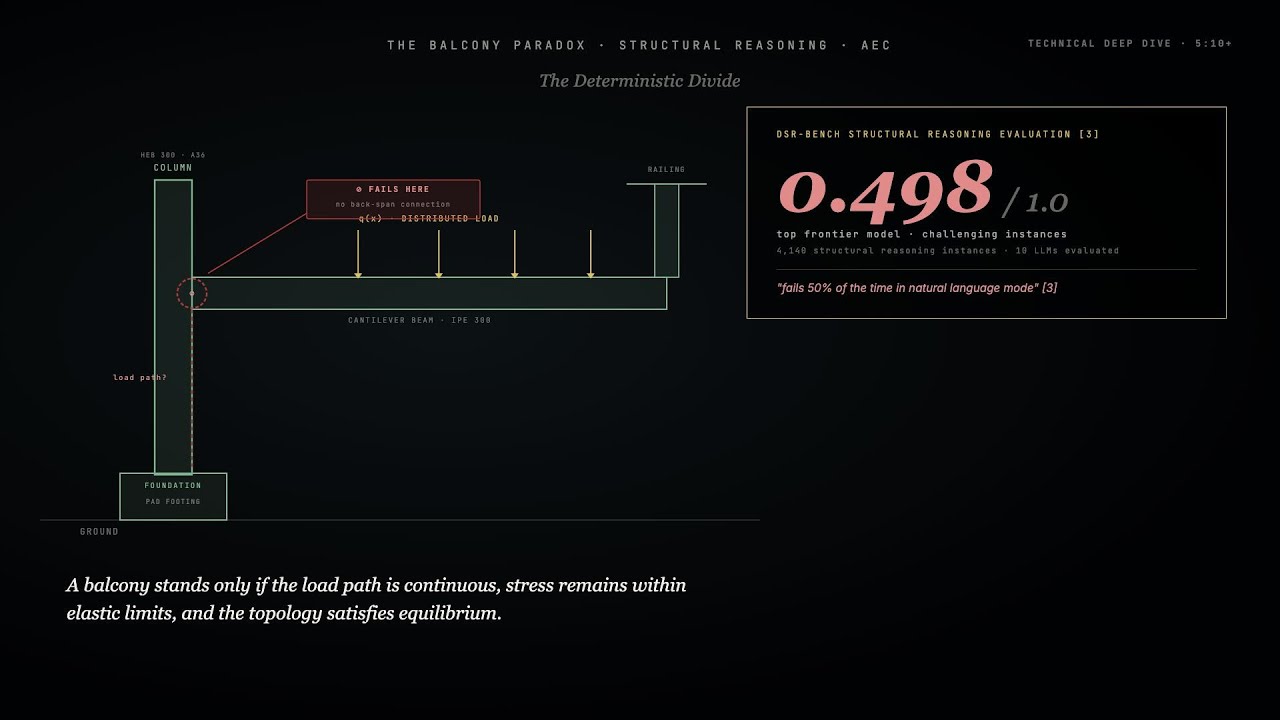
The AEC industry faces a critical choice: Pixel-Based Probabilistic AI that hallucinates safety, or Structure-Based Deterministic AI that calculates loads using physics. A balcony doesn't stand because an LLM says it's "robust"—it stands only if the load path satisfies differential equations of equilibrium.
Veriprajna's Geometric Deep Learning framework converts blueprints into mathematical graphs where nodes are structural members and edges are load paths. By embedding physics equations directly into neural network loss functions, we move from probabilistic guessing to deterministic calculation.
The foundational failure of applying LLMs to structural safety
"The balcony structure appears sound. The railing is present and the floor surface looks robust. The design follows standard architectural patterns seen in thousands of balcony images."
CRITICAL FAILURE DETECTED
Load path discontinuity at cantilever connection
"A balcony does not stand because a text description says it is 'robust,' nor does it resist gravity because a pixel-based analysis identifies the visual presence of a railing. It stands only if the load path is continuous, the stress distribution remains within the elastic limit of the materials, and the topology of the structure satisfies the governing differential equations of equilibrium."
— Veriprajna Technical Whitepaper, Executive Summary
The core failure mode: they are probabilistic engines designed to predict tokens, not logic engines designed to solve physical constraints.
Vision Transformers divide images into 16×16 pixel patches. They learn "patch associations"—statistical correlations between clusters of pixels—not true spatial topology.
When pixels are scrambled, ViTs retain high accuracy—proving they don't rely on spatial structure. In engineering, spatial structure is everything.
10 state-of-the-art LLMs tested on 4,140 structural reasoning problems. Top score: 0.498/1.0—coin-flip accuracy.
Performance degrades when problems are described in natural language vs. formal code—LLMs rely on memorized GitHub patterns, not reasoning.
MLLMs could summarize building codes fluently but failed to apply quantitative constraints to design artifacts.
Exotic material bias: LLMs suggest titanium/carbon fiber even when context demands cost-effective solutions—optimizing for "high-tech sounding" rather than contextually correct.
| Feature | Vision Transformer (LLM) | Engineering Reality |
|---|---|---|
| Input Unit | Pixel Patch (16×16 grid) | Structural Element (Beam, Column) |
| Relationship | Statistical Correlation (Attention) | Physical Causality (Load Transfer) |
| Spatial Understanding | Positional Embedding (Learned) | Topological Connectivity (Absolute) |
| Failure Mode | Hallucination (Looks safe) | Collapse (Is unsafe) |
| Data Domain | Euclidean (Grid-like) | Non-Euclidean (Graph-like) |
LLMs see blueprints as pixel grids. If a black beam appears on a black background, they literally cannot see it. Even worse: they might "see" connections that don't exist because adjacent pixels trigger attention weights.
We parse the IFC/BIM schema directly. Nodes represent physical members with material properties (E, I, f_y). Edges represent load transfer relationships defined by the schema—not guessed from pixels.
To transcend pixel-guessing, Veriprajna builds on Geometric Deep Learning—generalizing neural networks to non-Euclidean domains (graphs and manifolds).
Standard CNNs operate on Euclidean grids where every pixel has exactly 8 neighbors. Structures are inherently Non-Euclidean:
In Veriprajna, a building is formalized as G = (V, E):
Unlike pixels (RGB values), nodes contain actual physical parameters: Young's Modulus, Moment of Inertia, Yield Strength—the values required for calculation.
Computes force/moment transferred from neighbor u to node v based on edge properties (connection stiffness, orientation).
Sums all forces acting on node v from all connected members—mimicking ∑F equilibrium equations.
Computes new state (displacement, stress) of node v based on total incoming force—applying Hooke's Law.
By stacking k layers, a 10-layer GNN propagates information 10-hops away: a load on the roof mathematically influences the foundation—a learnable, differentiable simulation of the load path.
IFC-to-BIMGraph converter parses IFC schema. Identifies IfcRelConnectsElements (physical connections) and maps to edges with 100% fidelity—no guessing.
Fuse semantic ("IPE 300 Steel") and geometric (3D mesh via PointNet) into node vectors. Model understands IPE 300 ≈ HEB 300 but distinct in capacity.
GNN predicts stiffness parameters (EI, EA) and auto-generates FE input files for OpenSees/SAP2000—automating load takedown preparation.
We don't ask AI to learn physics from data. We teach AI physics by embedding differential equations directly into the loss function.
Consider the Euler-Bernoulli beam equation governing a balcony's deflection:
The total loss function becomes:
Using Automatic Differentiation, we compute derivatives of the network's prediction exactly. If the predicted deflection violates equilibrium, L_PDE spikes, forcing correction.
Physics-Informed Kolmogorov Arnold Network (PIKAN) predicted failure loads with sparse data by integrating geometry and material limit constraints.
PINNs identified influence lines under dynamic loads where pure-data ML failed to converge. Physics acts as a regularizer—AI's imagination never violates Newton's Laws.
Veriprajna leverages Graph-Structured Physics-Informed Deep Operator Networks—learning operators (mappings between infinite-dimensional function spaces) on unstructured graphs.
An LLM sees pixels. Veriprajna sees the Principal Load Path—rigorously traced using graph theory algorithms.
Structure represented as Adjacency Matrix A. By raising A to powers (A^n), we identify all paths of length n between load and foundation.
Calculate U* Index—internal strain energy transfer metric. Principal Load Path defined as "ridgeline" of U* contours (stiffest route).
Systematically remove nodes (simulate column failure) and re-evaluate graph connectivity using Betweenness Centrality. Identify Cut Sets instantly.
Veriprajna doesn't replace engineers—we replace the uncertainty of AI adoption with a deterministic verification layer.
Architects use Midjourney/MLLMs to generate creative concepts: "Show me a cantilevered balcony with parametric railing"
If physics fails, return hard constraint: "Increase beam depth by 200mm" or "Add back-span connection"—force regeneration
PINNs trained on Small Data because physics constraints reduce search space. LLMs need petabytes to learn "vibes."
GNNs map 1:1 to physical objects. We can visualize attention weights and trace exactly why predictions were made.
Contrast with LLM "black box" where reasoning is hidden in billions of uninterpretable parameters.
| Capability | Standard Multimodal LLM | Veriprajna (GDL/PINN) |
|---|---|---|
| Core Operation | Next-Token Prediction | Message Passing (Force Transfer) |
| Context Window | Limited Tokens (Forgetful) | Infinite Graph Connectivity |
| Safety Assurance | "It looks safe" (Hallucination) | "Physics Residual ≈ 0" (Verified) |
| Load Pathing | Visual Estimation (Guess) | Graph Traversal (Algorithm) |
| Constraint Handling | Soft (Often ignored) | Hard (PDEs in Loss Function) |
| Interpretability | Black Box | Glass Box (Node-Level Attention) |
| Training Data | The Internet (Biased/Noisy) | Physics Equations + Structured Data |
| Accuracy (Structural Reasoning) | 49.8% (DSR-Bench) | R² = 0.9999 |
| Deployment | Cloud API (Privacy Risk) | On-Premise (Secure) |
The construction industry is unique. In software, a "bug" is an annoyance. In our industry, a "bug" is a tragedy. The hype cycle surrounding Generative AI has obscured this fundamental distinction.
"The balcony is safe because it has seen thousands of photos of balconies, and in those photos, the pixels of the floor usually stay above the pixels of the ground."
"The balcony will collapse because the bending moment at the fixed end exceeds the moment capacity of the section: ∑M > M_cap"
Veriprajna is the platform that allows you to listen to Physics.
We build on the foundation of Graph Theory, Geometric Deep Learning, and Differential Equations. We do not guess pixels. We calculate loads.
Vision Transformers divide blueprints into 16x16 pixel patches and learn statistical correlations, not physical causality. DSR-Bench testing of 10 state-of-the-art LLMs on 4,140 structural reasoning problems showed the top score was only 0.498 out of 1.0, which is coin-flip accuracy. They cannot perform multi-hop reasoning, constraint satisfaction, or detect load path discontinuities that cause structural failure.
PINNs embed governing differential equations like the Euler-Bernoulli beam equation directly into the loss function. Using Automatic Differentiation, the network's predicted deflection is checked against equilibrium equations. If the prediction violates physics, the PDE loss term spikes and forces correction, achieving R-squared accuracy of 0.9999 at 7-8x the speed of traditional FEM solvers.
Veriprajna's IFC-to-BIMGraph pipeline parses the IFC schema directly, extracting IfcRelConnectsElements relationships to create graph edges with 100% connectivity fidelity. Nodes represent structural members with physical properties like Young's Modulus, Moment of Inertia, and Yield Strength. Multimodal embeddings fuse semantic and geometric data into node vectors for GNN processing.
Veriprajna offers enterprise deployment, custom model training on your BIM data, and integration with existing CAD/BIM pipelines.
Complete technical report with 28 peer-reviewed citations: Hardware architecture, Message Passing Neural Networks, PINN mathematics, Graph-Structured DeepONet performance benchmarks, IFC-to-BIMGraph pipeline specifications.