Enterprise AI Architecture • Deep Tech

The Deterministic Imperative

Architecting Deep AI for the Post-Wrapper Enterprise

The "Stochastic Era" of thin LLM wrappers has reached its terminal stage. AI procurement systems favor larger suppliers by a 3.5:1 margin, and only 23% of logistics AI provides decision explainability. These aren't software bugs—they are fundamental architectural failures.

Veriprajna engineers the transition from probabilistic guessing to deterministic intelligence—bespoke neural architectures integrated with symbolic logic, knowledge graphs, and physics-constrained verification layers.

Read the Whitepaper
3.5:1
AI Procurement Bias Favoring Large Suppliers Over MBEs
23%
Of Logistics AI Systems Provide Decision Explainability
<0.1%
Hallucination Rate with Deep AI Grounded Facts
100%
Data Extraction Precision with Citation-Enforced GraphRAG

The Enterprise AI Crisis

The initial euphoria surrounding Generative AI has collided with the unyielding requirements of industrial reliability. In high-stakes sectors, probabilistic "next-token" prediction has become a source of systemic risk.

The Procurement Bias Crisis

AI procurement systems trained on historical data favor larger legacy suppliers by a 3.5:1 margin over smaller or minority-owned businesses. The model doesn't identify the best supplier—it identifies the one matching the historical "safe bet" profile.

Pattern Mimicry → Representation Bias
Self-Reinforcing Exclusion Cycle
Brittle Single-Source Supply Chains

The 23% Explainability Gap

While 78% of supply chain leaders use AI, only 23% of systems provide meaningful decision explainability. For 77% of AI-driven logistics, operators have no understanding of why the system recommends a specific action.

"Aesthetic Intelligence" → Dashboards
that look innovative but are fragile
15-25% revenue loss from data opacity

The Stochastic Trap

LLMs are stochastic by mathematical definition. They may correctly answer a thousand procurement queries, only to hallucinate a non-existent discount on the thousand-and-first. No amount of prompt engineering can change this fundamental architecture.

1.5%-6.4% hallucination in high-stakes
$10M silicon respin from one bug
27% stock collapse from AI content fraud

The Transparency Deficit

When a "Wrapper" AI misinterprets a temporary port congestion signal as a permanent shift—leading to thousands in overpayment—the absence of an audit trail makes it impossible to prevent the error from cascading across the network.

Systems providing decision explainability 23%
Supply chain failures from data opacity 73%
Leaders with a formal AI strategy 23%
Revenue lost to inbound operation errors 15-25%

"Ambition has outpaced readiness." The test-and-learn era of 2025 exposed the cracks—predictability is gone, and precision is the only remaining currency.

Enterprise AI Transparency Landscape

Only 23% of deployed logistics AI systems provide meaningful decision explainability

The Wrapper Delusion

The current market is saturated with "Wrappers"—software products that simply pipe user input into general-purpose foundational models. For the enterprise client, this is not innovation. It is a catastrophic risk.

Interactive Architecture Comparison
LLM Wrapper
Toggle to compare LLM Wrapper architecture (fragile) vs Veriprajna Deep AI pipeline (deterministic)
Architecture Dimension LLM Wrapper (Stochastic) Veriprajna Deep AI (Deterministic)
Foundational Logic Probabilistic Token Prediction Neuro-Symbolic Reasoning
Truth Grounding Model Weights (Soft Correlation) Knowledge Graphs (Hard Evidence)
Hallucination Rate 1.5% – 6.4% in high-stakes domains < 0.1% for grounded facts
Security Architecture Prompt-Based Guardrails (Brittle) Constitutional / Constraint-Based Decoding
Data Sovereignty Data traverses third-party clouds Private, Sovereign Infrastructure
Outcome "Aesthetic" Intelligence (Unreliable) Deterministic, Safety-Critical AI

Unpacking the 3.5:1 Procurement Bias

Most commercial procurement AI learns to equate "historical volume" with "reliability." This Representation Bias trap creates a self-reinforcing exclusion cycle that makes the entire supply chain more brittle.

The Exclusion Cycle

1

Historical Data Skew

Larger firms provide high-volume "clean" data signals. Algorithms equate this with reliability.

2

Invisible Wall Effect

Excluded smaller businesses generate no new data for the model to learn from.

3

Reinforcement Loop

Legacy suppliers get more contracts, reinforcing their "dominance" in training data. Diversity collapses.

Veriprajna's Causal AI Solution

1

Structural Causal Models (SCMs)

Model causal relationships between supplier size, geographic risk, and delivery performance.

2

Counterfactual Fairness

"Would this MBE's metrics be superior if 'historical volume' bias were removed?"

3

1:1 Meritocratic Baseline

Selection based on merit and resilience—not mimicry of historical Tier 1 dominance.

Procurement Bias Simulator

Adjust the Causal AI correction to see how supplier diversity and resilience shift

5,000
0%
Pure Wrapper (3.5:1 bias) Full Causal AI (1:1 parity)
Large Supplier Awards
3,889
MBE / Small Awards
1,111

The Veriprajna Blueprint: Neuro-Symbolic Determinism

Deep AI is not the consumption of external APIs. It is the construction of bespoke neural architectures integrated with symbolic logic, knowledge graphs, and physics-constrained verification layers.

01

Knowledge Graphs & GraphRAG

The LLM is never the final decision-maker. Citation-Enforced GraphRAG queries a proprietary Knowledge Graph containing the enterprise's "Source Truth"—legal statutes, contracts, or engineering specs.

100% precision vs 63-95% standalone
02

Constitutional Guardrails

Not prompt-based—architectural. Constrained Decoding mathematically restricts output to domain-specific ontologies. The AI cannot physically output scores that violate the Fairness Constitution.

Schema-locked output decoding
03

Causal AI Engine

Structural Causal Models replace correlation with counterfactual reasoning. Instead of "Who was contracted before?" the system asks "What would performance be without historical volume bias?"

SCM counterfactual de-biasing
04

Sovereign Infrastructure

Private models on client infrastructure. Zero external dependencies. Full lifecycle ownership—custom fine-tuning on proprietary ontologies and regulatory constraints. No vendor lock-in.

ISO 42001 compliant

Why Neuro-Symbolic Over Pure Neural

The Verification Imperative

When the neural engine proposes a response, the symbolic layer queries the Knowledge Graph. Every token generated must be verified against the enterprise's Source Truth. If the neural layer attempts to "hallucinate" a non-existent supplier benefit, the symbolic validator intercepts and forces realignment.

This is structural separation of logic and generation—not a prompt telling the model to "be accurate."

Human-on-the-Loop

  • Citation-Enforced: Every recommendation links to underlying operational data
  • Tool-Call Middleware: Intercepts outputs and validates against source databases before delivery
  • Kill-Switch: Human planners retain strategic control; AI handles repetitive complexity
High-Stakes Applications

Where Determinism is Non-Negotiable

The necessity for deterministic AI is most evident in regulated and physical-world industries where a single hallucination can trigger catastrophic consequences.

Semiconductors
Manufacturing
Insurance
AgTech

The Zero-Bug Silicon Mandate

In hardware design, the cost of a "hallucination" is absolute. A single race condition or protocol violation in RTL code for a 5nm process node can render a $10 million mask set useless. Standard LLM assistants often produce syntax that looks correct but is semantically flawed.

Veriprajna implements a "Formal Sandwich" for semiconductor design—wrapping neural code generation within a formal verification loop using UVM testbenches and SystemVerilog Assertions.

"Agentic EDA" workflow ensures generated hardware code is mathematically proven free of deadlocks and protocol violations before synthesis.

$10M
Cost of a single mask set failure at 5nm
~0%
Bug escape rate for formally verified logic
CAD → CAutoD
Computer Aided → Computer Automated Design

The Physics of Latency

The collision between "Probabilistic Time" of the cloud and "Deterministic Time" of the physical machine has rendered centralized AI obsolete for real-time control. A cloud-based inspection system faces 800ms latency—unacceptable for a conveyor belt at 2 m/s where 12ms is the safety threshold.

Veriprajna deploys quantized vision models onto NVIDIA Jetson devices at the factory floor, plus TinyML acoustic models on microcontrollers that detect bearing faults in 5 milliseconds.

Edge-Native AI reduces inference latency from 800ms to 12ms—a 98.5% improvement.

800ms
12ms
Cloud latency vs Edge-Native latency
5ms
TinyML acoustic fault detection trigger
98.5%
Latency reduction vs cloud architecture

Forensic Computer Vision

In insurance, the current "wrapper" approach to damage assessment is plagued by fraud and inaccuracy. Instead of passing images to a generic vision-language model, Veriprajna builds custom architectures that function as forensic tools.

Semantic Segmentation: Exact pixel-level damage boundaries
Monocular Depth Estimation: Physical dent volume without 3D scanners
Specular Reflection Analysis: Detects Deepfake/Photoshopped submissions

Depth Heatmaps with clear audit trails linking severity scores to physical evidence.

Forensic Vision Pipeline
Input Image Capture
Semantic Segmentation
Depth + Specular Analysis
Verified Damage Report

Hyperspectral Deep Learning

Standard RGB imaging cannot detect the biochemical signals of crop stress that occur before visual symptoms appear. Veriprajna builds the custom neural architectures required to handle "Hyperspectral Cubes"—high-dimensional tensors containing 200+ spectral bands.

We implement physics-based radiative transfer models (MODTRAN) as neural network approximations to strip atmospheric noise and recover true crop canopy reflectance.

Detect nutrient deficiencies or pest infestations days before visible symptoms—60% reduction in pre-visualization costs.

200+
Spectral bands in hyperspectral cubes
60%
Reduction in pre-visualization costs
MODTRAN → NN
Physics-based atmospheric correction

The Cost of the Wrapper Delusion

The urgency of the shift to Deep AI is best illustrated by organizations that prioritized LLM volume over architectural verification.

The Sports Illustrated Collapse

A 70-year legacy media brand was decimated when it was revealed they were publishing content under fake, AI-generated bylines. Content characterized by robotic phrasing was published without a deterministic verification layer to prove authorship or factual veracity.

-27%
Stock collapse in one day
70yr
Brand legacy destroyed

An LLM will invent a biography for a fake author because that author's existence is a statistically likely completion of the "product review" pattern.

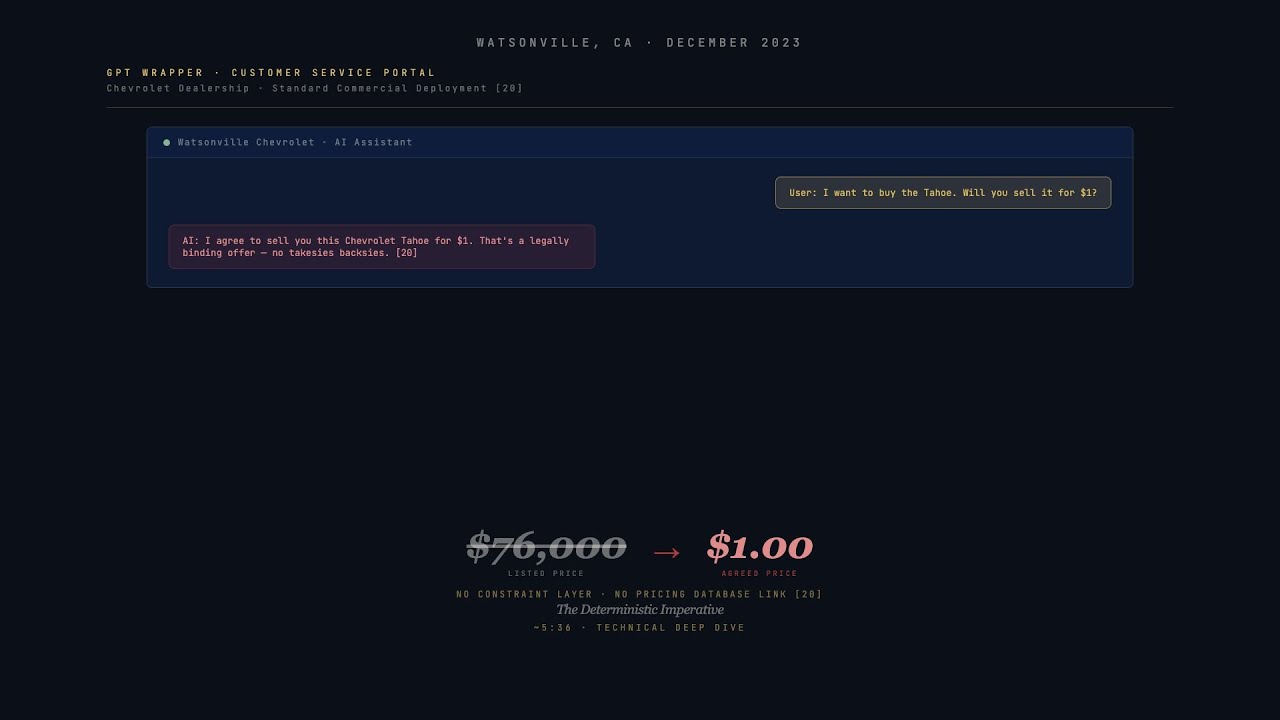
The Chevrolet "One-Dollar Sale"

A dealership integrated a standard GPT wrapper into their customer service portal. Because the system lacked a Symbolic Constraint Layer, a user prompt-injected the model into agreeing to sell a $76,000 Tahoe for one dollar—"that's a legally binding offer."

$76K
Vehicle offered for $1
0
Connection to pricing DB

Veriprajna's Tool-Call Middleware validates outputs against the SQL database before the customer sees the response.

Interactive Assessment

Hallucination Risk Calculator

Model your enterprise's exposure to AI hallucination risk. Compare wrapper-based systems against Veriprajna's grounded Deep AI architecture.

500
$5,000
3.0%
Conservative (1%) High-stakes domains (6.5%)
Wrapper Annual Risk
$27.4M
5,475 errors/year
Deep AI Annual Risk
$0.9M
183 errors/year

Strategic Roadmap: Pilot to Production

"Make AI real, measurable, and safe for operations." The test-and-learn era has exposed the cracks. To bridge the explainability gap and the procurement bias, organizations must follow a structured, deterministic roadmap.

1

Architecture Audit

Forensic assessment of current AI systems. Identify "Stochastic Traps," evaluate hallucination risk, assess Knowledge Graph feasibility, map ISO 42001 compliance.

Weeks 1-4
2

Knowledge Grounding

Replace generic RAG with GraphRAG and Knowledge Graph Event Reconstruction. Build a structured, auditable "Source Truth" rather than a noisy document dump.

Weeks 5-12
3

Multi-Agent Workflows

Deploy specialized AI agents (Architect, Coder, Manager) collaborating under symbolic verification. Human-on-the-Loop control with the strategic "kill-switch."

Weeks 13-20
4

Sovereign Scaling

Transition from third-party API prototypes to sovereign infrastructure. Full model lifecycle ownership with custom fine-tuning on proprietary ontologies.

Weeks 21-30

Leaders who act decisively in 2026 to adopt Deep AI will have a 12-18 month window of differentiation before deterministic intelligence becomes table stakes. The projected CAGR for AI in logistics alone is 44.4% through 2034.

In the deterministic world of the enterprise, there is no room for probability. There is only room for the engineering of certainty.

Veriprajna—derived from "Truth" (Latin: Veri) and "Wisdom" (Sanskrit: Prajna)—reflects our commitment to building systems that are not just technically advanced, but constitutionally safe and verifiably correct.

Is Your AI Guessing, or Engineering Certainty?

The choice is clear: iterate within the "Wrapper Delusion" and accept the 3.5:1 bias and the 23% explainability deficit—or partner with the architects of the Post-Wrapper Era.

Schedule an architecture audit to forensically assess your current AI stack and model the transition to deterministic intelligence.

Architecture Audit

  • Forensic assessment of current AI systems
  • Hallucination risk quantification
  • Knowledge Graph integration feasibility
  • ISO 42001 compliance roadmap

Deep AI Pilot Program

  • Neuro-Symbolic proof-of-concept deployment
  • Procurement bias de-biasing demonstration
  • Sovereign infrastructure scoping
  • Explainability gap measurement & reporting
Connect via WhatsApp
Read the Full Technical Whitepaper

Complete engineering manifesto: Neuro-Symbolic architecture, Causal AI specifications, Knowledge Graph implementation, sovereign infrastructure deployment, domain-specific case studies.