Why Hybrid AI Architectures Are the Only Viable Path for Enterprise Brand Equity
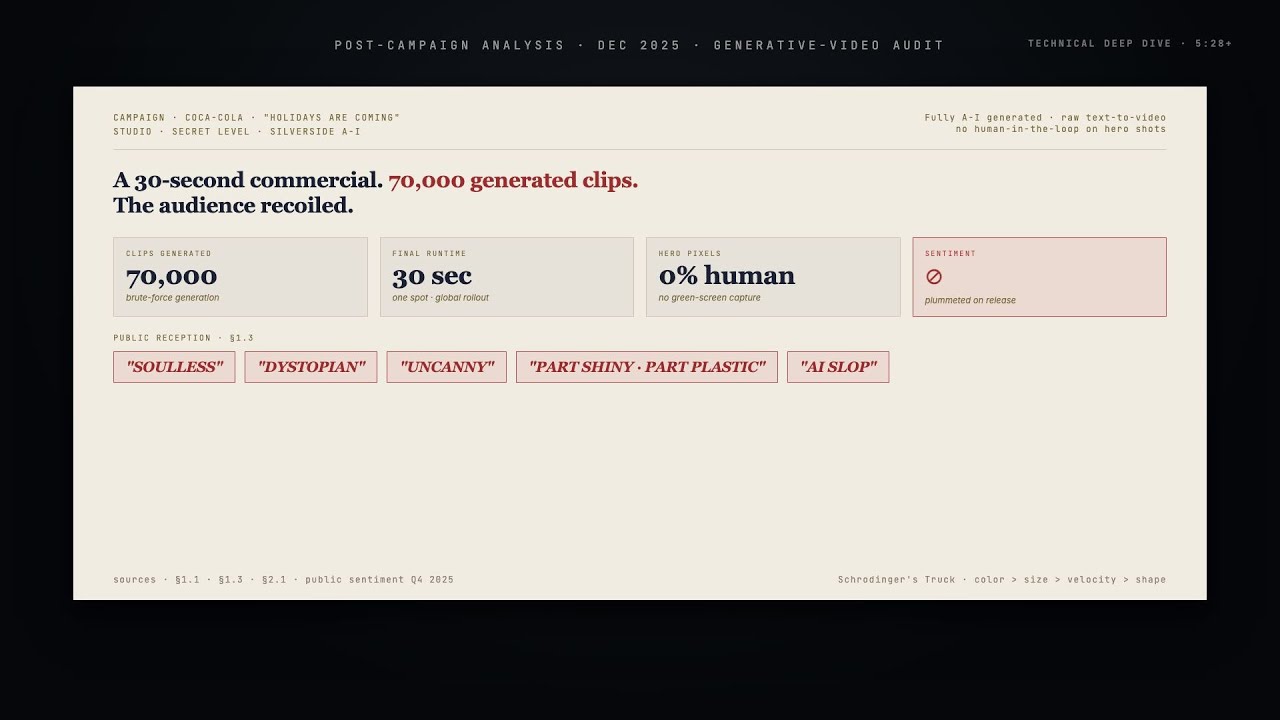
The Coca-Cola "Holidays Are Coming" disaster wasn't a technological glitch—it was a strategic failure. When one of the world's most valuable brands released a fully AI-generated commercial that consumers immediately rejected as "soulless" and "dystopian," it exposed the fundamental fragility of LLM Wrappers.
Veriprajna's comprehensive analysis reveals why only 13% of consumers trust fully AI-generated ads versus 48% for human-AI hybrid workflows. This whitepaper dissects the technical failures of generative video and presents the proven architecture for preserving brand equity in the AI era.
Late 2024 witnessed a polarizing inflection point that separated superficial AI adoption from deep, architectural integration. The backlash wasn't about technology—it was about strategy.
Consumers immediately rejected the AI-generated holiday commercial. The smiles didn't reach the eyes. The motion felt "floaty." Reality was simulated, not captured.
Coca-Cola's team generated over 70,000 video clips to piece together one 30-second spot. This "brute force" approach reduced creativity to curation—sifting through hallucinations to find the "least wrong" result.
"Real Magic" is Coca-Cola's promise. By delegating that magic to an algorithm incapable of experiencing it, the brand created dissonance between message (connection) and medium (automation).
Generative video models don't just produce "bad CGI"—they suffer from fundamental architectural limitations that no amount of prompt engineering can solve.
While AI can render the geometry of a smile, it struggles to render the physics of a smile. Human smiles involve involuntary micro-muscle movements (orbicularis oculi) creating the "Duchenne marker" of genuine happiness.
Technical Cause:
Statistical averaging of facial landmarks; missing micro-expressions. Diffusion models operate on pixel-level probability distributions, not anatomical rules.
ByteDance Research (2025) proved that models like Sora and Gen-3 do not learn Newtonian physics—they memorize visual transitions. They mimic the appearance of driving, not the mechanics of suspension, friction, and weight transfer.
Visual Symptom:
Trucks "float" over snow. Wheels turn, but chassis doesn't react to terrain. Liquids flow like mercury. Trucks change wheel count between shots ("Schrodinger's Truck").
Frame-independent generation without a unified 3D object representation causes morphing shapes, flickering textures, and objects changing attributes shot-to-shot.
Attribute Priority:
Color > Size > Velocity > Shape
Models nail the Coca-Cola red, but "forget" how many wheels the truck has.
Overfitting to training data patterns creates generic, repetitive imagery with the tell-tale "AI sheen"—a glossy, plastic appearance that acts as a subconscious warning signal to viewers.
Consumer Reaction:
"Boring," "Generic," "Slop," "Part shiny, part plastic." Instantly categorized as synthetic, triggering rejection.
"The AI-generated polar bears and crowds in the Coca-Cola ad were not representations of real bears or real people; they were statistical averages of millions of images. This creates a 'hyperreality' that is visually dense but ontologically empty."
— Jean Baudrillard's concept of the simulacrum: A copy without an original. The image has "no relation to any reality whatsoever," becoming a "pure simulacrum."
Toggle between approaches to see the fundamental difference in philosophy, workflow, and outcome.
Replace human creativity with automated generation. Prompt → Generate → Hope for coherence.
Text prompt → 70,000 generations → Curate "least wrong" → Ship
No human capture. No control. Pure diffusion.
The campaigns of 2024-2025 provide a clear roadmap of what NOT to do—and the proven path forward.
AI Role: Generate entire video (crowds, trucks, animals, environments)
Tools: Secret Level, Silverside AI, generative diffusion models
What Went Wrong:
Outcome: Backlash ("Soulless," "Dystopian")
AI Role: Generate narrative and AI child actor
Tools: OpenAI Sora text-to-video
What Went Wrong:
Outcome: Sentiment Plummet ("Creepy," "Cynical")
AI Role: Simulate tennis match between 1999 Serena Williams vs 2017 Serena Williams
Approach: Feed ML model real archival footage of Serena's gameplay to analyze speed, shot selection, reactivity
Tools: "vid2player" technique (Stanford), domain knowledge of tennis rallies, VFX compositing
Why It Worked:
The Hybrid Difference:
Human Intent + AI Execution = Brand-Safe Innovation
The workflow combined rigorous data science with high-end VFX. AI generated the movements and gameplay logic, but human editors ensured the soul remained intact.
Consumer sentiment data from 2025 creates a compelling ROI argument for quality over automation.
Source: 2025 Consumer Sentiment Research. Trust drops 73% when humans are removed from the creative process.
This statistic alone invalidates the "full automation" strategy for consumer-facing brands. Trust is a finite resource in the digital economy.
A 3.7x trust multiplier when humans remain in the creative loop. The hybrid approach preserves brand equity while capturing AI efficiency gains.
NielsenIQ research found that even polished AI ads can damage brand perception beyond the individual campaign. Viewers develop a "sixth sense" for synthetic content.
ROI found in process acceleration, not creative replacement. Budget redirected to high-value human talent.
While "Wrappers" pass prompts to ChatGPT and Midjourney, Veriprajna builds Agentic AI Architectures with enterprise-grade control.
Specim FX50 generates 3D data structure—every pixel contains 154-band continuous spectrum for chemical analysis.
Node-based workflows with granular control over denoising strength, latent upscale methods, U-Net layer prompting. Not simple web prompts.
Feed Canny Edge/Depth Maps of brand assets into locked diffusion weights. AI forced to generate around exact product geometry.
Custom Low-Rank Adaptations trained on 20 years of brand-specific cinematography. Ensures AI output "feels" on-brand.
We implement Video Consistency Distance (VCD) in fine-tuning. VCD measures frequency-domain distance between conditioning image and generated frames, penalizing unnatural distortion while allowing natural motion.
Result:
We utilize 3D-aware video generation and NeRF integration. By anchoring AI to a 3D proxy scene ("blockout"), we ensure occlusion and perspective handled by rigid geometry, not probabilistic guessing.
The Hybrid Bridge:
Physics simulations drive motion. AI generates texture. Combines logic of CGI with aesthetic flexibility of generative AI.
Human intent must govern machine execution at every layer. We reject "prompt-and-pray" methodology.
Rapid storyboarding and "photomatics" using Atlabs, Krea AI. Real-time visualization reduces pre-viz costs by 60-80% without committing to final look.
The Benefit:
Directors "shoot" the commercial virtually before a single camera rolls. Iterate on lighting, composition, pacing instantly. Visual-based, not text-based creative process.
For emotional resonance—human faces, product interactions—we film real talent. ByteDance study proves AI cannot reliably simulate micro-expressions or fluid dynamics.
The "Sandwich":
Video-to-Video pipelines (not text-to-video) transform, style, enhance captured footage. ControlNet compositing, LoRA style transfer, Topaz upscaling to 4K.
Deep AI Shines:
Human-in-the-Loop (HITL) Accuracy: 97.8% Recall
Research shows HITL systems achieve 97.8% recall accuracy in compliance tasks compared to significantly lower rates for fully automated systems. This principle extends to creative workflows: human judgment at checkpoints ensures brand safety.
A structured path that prioritizes governance and architectural soundness over quick wins.
The next frontier Veriprajna is actively developing
Current models are "brains in jars"—they know what a glass looks like, but not how it feels to hold. They simulate pixels, not physics.
ByteDance research confirmed: Models like Sora and Gen-3 memorize visual transitions without understanding underlying physical laws (suspension, friction, weight transfer, fluid dynamics).
The next generation of models (World Models) will simulate the physics of the world, not just the pixels. Expected maturity: 2026-2027.
Until then, the Hybrid Workflow is the only safe bridge—harnessing 2025 AI rendering power while borrowing physical and emotional intelligence from human creators.
We are entering a phase where the novelty of "look what the AI made" has faded.
The new standard is "look what we made with AI."
AI-generated ads suffer from aesthetic hallucination — biological dissonance (missing Duchenne markers in smiles), physics hallucination (models do not learn Newtonian physics per ByteDance 2025 research), temporal inconsistency (objects change attributes between frames), and mode collapse (generic 'AI sheen'). Only 13% of consumers trust fully AI-generated ads versus 48% for human-AI hybrid workflows.
The Sandwich Method layers human creative direction around AI acceleration: Human Ideation sets the creative vision, AI generates environments and extends footage using ControlNet compositing, and Human Refinement ensures emotional resonance and brand consistency. This approach achieves a 3.7x trust premium over fully AI-generated content.
PCA spectral unmixing decomposes visual elements into principal components, preserving 99% of variance in brand-critical attributes like color palettes and visual identity. Combined with ControlNet compositing, it ensures AI-generated elements maintain precise brand specifications rather than drifting toward generic statistical averages.
The failure of the Coca-Cola ad was not a failure of technology; it was a failure of strategy. It attempted to substitute the output (the video file) for the outcome (human connection).
Veriprajna stands at the intersection of Algorithm and Artistry. We don't sell "AI Videos." We sell Brand Resilience in the age of synthetic media. We ensure that when your brand uses AI, it builds your legend rather than cheapening your legacy.
❌ Stop Asking:
"How much money can AI save us on production?"
This question leads to the uncanny valley and brand equity erosion.
✓ Start Asking:
"How can AI enable us to visualize stories we couldn't afford to tell before, while maintaining the human soul of our brand?"
This question leads to the future of advertising.
Complete technical analysis: ByteDance physics study, VCD implementation, ComfyUI enterprise pipelines, ControlNet architecture, LoRA training protocols, 3D-aware generation, comprehensive works cited.