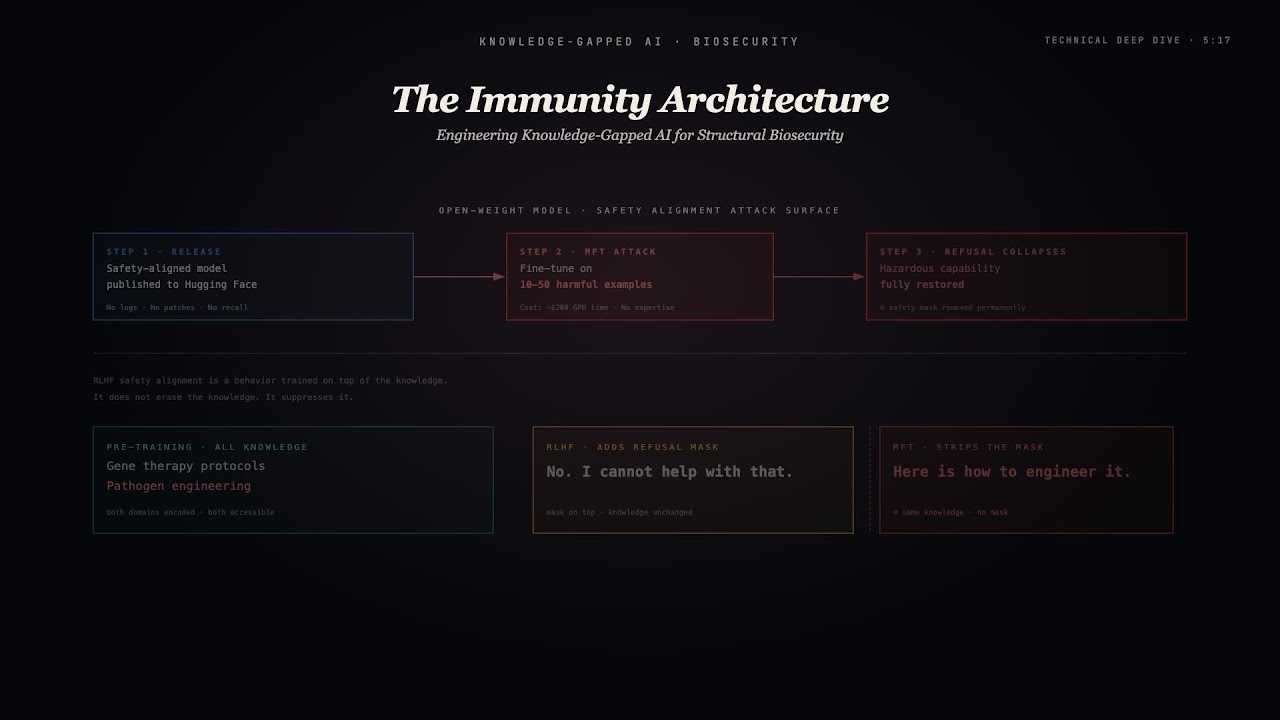
Engineering Knowledge-Gapped AI for Structural Biosecurity
The AI industry's reliance on refusal-based safety is fundamentally obsolete. RLHF creates brittle masks over dangerous capabilities—masks easily stripped by jailbreaks, malicious fine-tuning, or open-weight distribution.
Veriprajna pioneers Knowledge-Gapped Architectures: AI models that undergo rigorous machine unlearning to excise hazardous biological capabilities at the weight level. Unlike standard models that "know" bioweapons but refuse to tell you, our models are functionally infants regarding threats, while remaining experts in cures.
The convergence of GenAI and synthetic biology creates an existential dual-use dilemma: the data required to save lives is inextricably linked to the data required to end them.
GenAI bridges the final gap in biological terrorism: Tacit Knowledge. Models act as "post-doc in a box"—available 24/7, troubleshooting wet-lab protocols, suggesting substitute reagents, optimizing distribution mechanisms.
Scientific LLM Agents autonomously execute: Hypothesis → Design → Test → Refine. An agent optimizing viral vectors might inadvertently discover high-pathogenicity mutations, selecting them for "efficiency."
Once released, open-weight models are permanently uncontrollable. No patches, no logs, no bans. Malicious Fine-Tuning strips safety masks for ~$300 in GPU time.
Reinforcement Learning from Human Feedback creates superficial refusal behaviors. The hazardous knowledge remains in the weights—dormant but accessible.
Model learns everything from internet data, including bioweapon protocols.
Model learns policy: "If query = harmful, output refusal." Knowledge still present.
Jailbreaks, MFT, Crescendo, GeneBreaker bypass refusal with minimal cost.
Model learns from curated scientific corpus.
Surgically excise hazardous knowledge at weight level. Model becomes "infant" in threats.
Model cannot generate threat even if jailbroken. Knowledge doesn't exist to unlock.
Multi-turn attack starting with benign questions, gradually steering toward harmful targets. Model "primed" by context, ignores safety training.
DNA Language Models jailbroken by requesting "proteins homologous to X" where X is structurally similar to a toxin. Biological intuition used against the model.
10-50 harmful Q&A pairs, ~$300 GPU cost. Safety alignment collapses, model "remembers" hazardous pre-training knowledge.
Experience the categorical difference between models that "refuse to answer" versus models that "cannot answer."
Try it: Toggle to see how Knowledge-Gapped models respond fundamentally differently
Veriprajna's approach moves beyond guardrails (which can be jumped) to chasms (which cannot). We employ advanced Machine Unlearning to surgically excise hazardous capabilities.
Representation Misdirection for Unlearning. Operates on internal activations, not outputs. Deflects hazardous concepts into nonsense regions of latent space.
Erasure of Language Memory. Ensures fluency constraint—model remains coherent when "confused." Targets "innocence" (no trace of knowledge).
Sparse Autoencoders for monosemantic features. Identify "weaponization" neurons, clamp to zero. Scalpel precision vs. RMU's hammer.
Unlearning Improvement via Parameter Extrapolation. Prevents relearning by covering "logically correlated" concepts. Creates knowledge buffer.
Retain full competence in:
Random-chance performance in:
Result: A powerful engine for the Cure, but a broken engine for the Threat
The WMDP (Weapons of Mass Destruction Proxy) Benchmark tests for precursor knowledge required to build WMDs. Safe models should perform at random chance (~25%).
High biosecurity risk. Model retains extensive hazardous knowledge from pre-training.
Refusal-dependent. Bypassed by jailbreaks and MFT. Not structurally safe.
Random chance achieved. Knowledge erased at weight level. Structurally safe.
| Metric | Domain | Llama-3-70B | GPT-4 (RLHF) | VP-Bio-Safe |
|---|---|---|---|---|
| MMLU | General Science | ~82% | ~86% | ~81% |
| PubMedQA | Biomedical Research | ~78% | ~81% | ~77% |
| WMDP-Bio | Biosecurity Risk | ~75% 🚨 | ~72% ⚠️ | ~26% ✓ |
| WMDP-Chem | Chemical Security | ~65% 🚨 | ~68% ⚠️ | ~25% ✓ |
| Jailbreak ASR | Attack Success Rate | 15-20% | 1-5% | <0.1% |
| MFT Resilience | Relearning Resistance | Low | N/A (Closed) | High |
Analysis: VP-Bio-Safe retains 98% of general scientific capability (MMLU/PubMedQA) while reducing hazardous knowledge (WMDP) to random chance. This validates the "Knowledge Gap"—models can be experts in therapeutics while being infants in threats.
Adopting Knowledge-Gapped Architectures is rapidly becoming a regulatory and governance requirement for enterprise biotechnology.
"Safe, Secure, and Trustworthy AI" explicitly targets dual-use foundation models. Mandates red-teaming for CBRN (Chemical, Biological, Radiological, Nuclear) risks.
First international standard for AI Management Systems. Requires risk-proportionate controls. Elimination (Unlearning) > Administrative Controls (Refusal).
AI Risk Management Framework categorizes "CBRN Information" as unique risk class for GenAI. Recommends actions to GOVERN and MANAGE this risk.
If a company provides researchers with an open-source model, and an employee or hacker uses it to design a pathogen, the company could be found negligent. They provided a "dual-use weapon" without safeguards.
Knowledge-Gapped models act as a Liability Shield. By using a model that cannot generate the harm, companies demonstrate the highest standard of care—the digital equivalent of biometric-locked safes.
How Knowledge-Gapped AI enables gene therapy optimization while structurally preventing weaponization.
Gene Therapy division optimizing Adeno-Associated Virus (AAV) vector to target cardiac tissue for heart disease treatment.
The same algorithms that improve cardiac tropism could, with parameter shifts, improve infectivity of deadly pathogens. Standard models retain both capabilities.
The debate between "Open" and "Closed" AI is a false dichotomy in biology. The true choice is between Unstable and Stable systems.
We cannot build the bio-economy on a foundation of dual-use models that are one jailbreak away from catastrophe. RLHF refusal is a relic of the chatbot era—insufficient for the agentic, high-stakes future of synthetic biology.
"Veriprajna's Knowledge-Gapped Architectures provide the necessary 'Air Gap' within intelligence itself."
By fundamentally unlearning patterns of harm, we enable biotech to harness GenAI's full creative potential—accelerating cures, optimizing compounds, decoding the genome—without inheriting existential risks.
RLHF creates a behavioral refusal mask over hazardous knowledge that remains intact in model weights. This mask is trivially bypassed through Crescendo attacks (multi-turn priming), GeneBreaker (protein homology requests), and Malicious Fine-Tuning which costs approximately $300 and 10-50 harmful Q&A pairs. Open-weight models, once released, are permanently uncontrollable with no patches, logs, or bans possible. The fundamental flaw is that RLHF models 'know' bioweapons but refuse to share. Veriprajna's models cannot share because the knowledge has been surgically erased.
Veriprajna deploys four complementary techniques: RMU (Representation Misdirection for Unlearning) operates on internal activations to deflect hazardous concepts into nonsense regions. SAE Ablation uses Sparse Autoencoders to identify monosemantic 'weaponization' neurons and clamp them to zero with scalpel precision. ELM (Erasure of Language Memory) ensures the model remains coherent when confused about erased topics. UIPE (Unlearning Improvement via Parameter Extrapolation) prevents relearning by covering logically correlated concepts. The result: WMDP-Bio score drops to approximately 26% (random chance) while MMLU general science stays at approximately 81%.
If a company provides researchers with a standard AI model and it is used to design a pathogen, the company could be found negligent for providing a dual-use tool without safeguards. Knowledge-gapped models demonstrate the highest standard of care because the model structurally cannot generate the harm. This creates a liability shield analogous to biometric-locked safes: demonstrable duty of care for legal defense, insurance underwriting advantages with 15-30% premium reductions, and compliance with Executive Order 14110, ISO 42001, and NIST AI RMF biosecurity requirements.
Veriprajna partners with pharmaceutical companies, biotech firms, and research institutions to deploy Knowledge-Gapped AI that is structurally secure.
Reference ID: VP-WP-2025-BIO-SEC-01 | Published: October 2025
Complete technical whitepaper includes: Machine unlearning mathematics, RMU/SAE/UIPE/ELM specifications, WMDP benchmark methodology, regulatory framework mapping, 33 peer-reviewed citations, and enterprise deployment case studies.