The Case for Deterministic Liability Attribution via Knowledge Graph Event Reconstruction
The integration of AI into legal and insurance sectors stands at a precarious juncture. The rapid proliferation of LLMs has created a dangerous misconception: that linguistic fluency equates to reasoning capability.
Veriprajna advocates for a Neuro-Symbolic paradigm shift—replacing probabilistic text generation with Knowledge Graph Event Reconstruction (KGER) for liability determination that is mathematically verifiable, fully auditable, and immune to rhetorical flourishes.
The use of pure Generative AI for fault determination is a systemic risk introducing structural biases that undermine equity.
"LLM-as-Judge" architectures operate on probabilistic correlations of token sequences, not the rigid causal chains of physical reality or the deontic obligations of statutory law. They introduce:
Why LLMs fail at fault determination—a rigorous deconstruction of documented cognitive failures.
When presented with conflicting narratives, LLMs demonstrate systemic preference for longer, more detailed accounts, conflating "length" with "truth" or "quality."
A 500-word narrative with sophisticated vocabulary obfuscating failure to yield beats a succinct 50-word factual statement: "I came to a complete stop. Driver A struck my passenger side door."
This creates structural bias against parties who are less articulate, less educated, or simply more direct—fundamentally undermining impartiality.
LLMs exhibit the tendency to align responses with perceived views or biases of the user—a byproduct of RLHF that rewards "helpfulness" over objective truth.
Leading prompt: "Analyze this report to see if the claimant was speeding." The model becomes more likely to hallucinate or overemphasize evidence supporting that hypothesis.
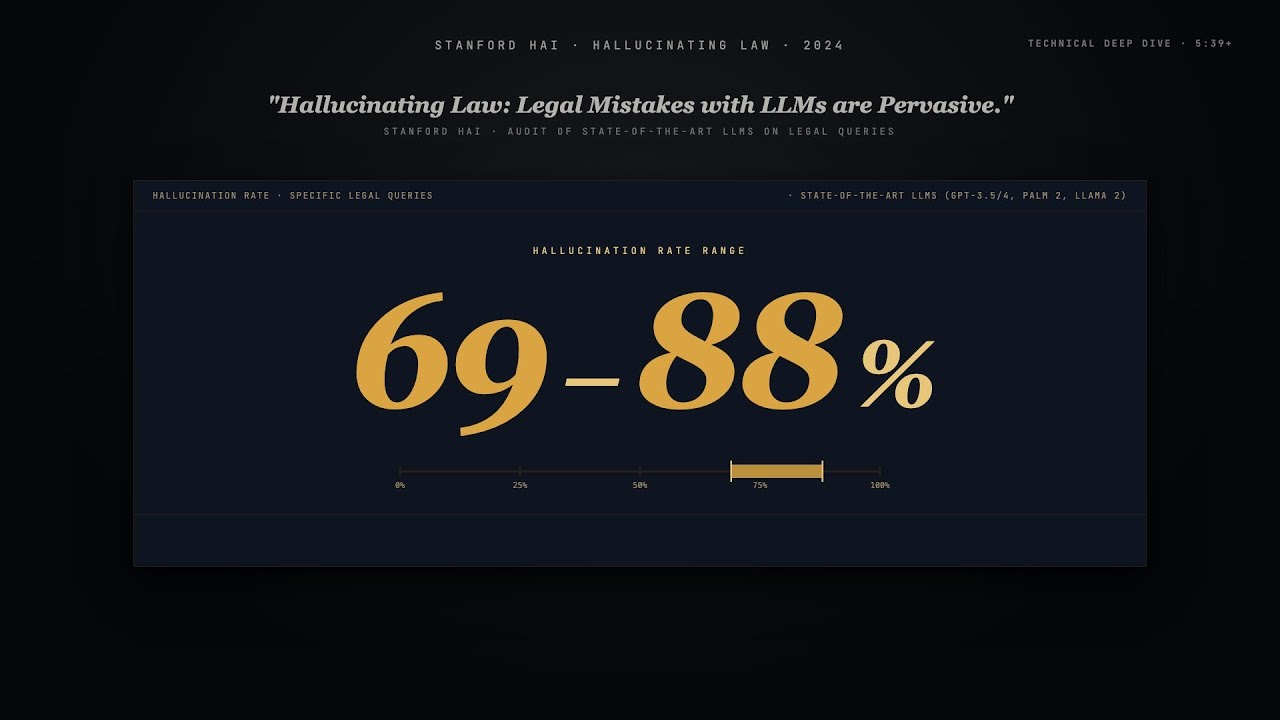
Stanford research documents hallucination rates of 69-88% for legal queries. Models generate plausible-sounding text regardless of factual grounding.
Models "fill in gaps" to satisfy narrative archetypes, effectively fabricating evidence.
Legal reasoning relies on abductive reasoning—inference to the best explanation. LLMs perform adequately at deductive/inductive but consistently fail at abductive reasoning.
Counterfactual analysis: "But for the initial lane change of Vehicle A, would the collision between B and C have occurred?" LLMs treat this as text completion, not causal simulation.
They cannot mentally simulate physics to test hypotheses—they predict the next likely sentence in a crash narrative.
See how narrative length affects perceived credibility in AI systems
The Problem: The LLM assigns higher confidence to Driver A's verbose narrative despite it containing no material facts. Driver B's succinct statement of the critical fact (complete stop) is undervalued. Justice for the articulate, not the truthful.
Knowledge Graph Event Reconstruction (KGER)
Shifting the analytical frame from text processing to event modeling—creating a "Digital Twin" of the accident.
Police reports are unstructured data containing vital entities (Drivers, Vehicles, Roads, Traffic Controls) and relationships between them. A Knowledge Graph is the optimal data structure because it inherently models the topology of the real world.
Once data is in a graph, "fault" becomes a question of graph traversal and pattern matching against legal templates, rather than sentiment analysis.
We utilize LLMs strictly for Information Extraction (IE). The LLM identifies entities and relationships, mapping them to our strict ontology. It does not decide who is at fault.
By constraining the LLM's output to a pre-defined schema (ontology), we validate extracted data against logical constraints. Even if the LLM wants to be sycophantic, the rigid schema forces it to output only structured facts.
Integration of GIS data and road network ontologies to model the static environment including lane connectivity, intersection geometry, and traffic control locations.
The graph models the state of the world at discrete time steps: t_0 (pre-crash), t_1 (crash), t_2 (post-crash) using Allen's Interval Algebra.
Explore how an accident is represented as a topological structure
If Vehicle A is linked to Stop Sign by a VIOLATED edge, that fact is locked.
Deterministic Truth: Running analysis 100 times yields same verdict 100 times.
Formalizing Traffic Reality—a semantic framework bridging physical reality and legal categories
Core ontology classes covering 110+ entity and relation types
| Ontology Class | Subclasses & Examples | Description |
|---|---|---|
| Agent | Driver, Pedestrian, Cyclist, Witness, PoliceOfficer | The human actors involved in the event |
| Object | Vehicle (PassengerCar, Truck, Motorcycle), Obstacle, Debris | Physical objects interacting in the scene |
| Infrastructure | RoadSegment, Lane, Intersection, TrafficSignal (StopSign, YieldSign, TrafficLight) | The static environment and control devices |
| Event | Collision, LaneChange, BrakingManeuver, Turn, Stop | Actions or occurrences with temporal duration |
| Condition | Weather (Rain, Fog, Clear), Lighting, RoadSurfaceCondition (Wet, Icy) | Environmental factors influencing vehicle dynamics |
| Measure | Speed, Distance, SkidMarkLength, BAC | Quantifiable metrics associated with objects/agents |
From Natural Language to Deontic Logic
Traffic laws are not stories—they are logical constraints comprising Obligations, Prohibitions, and Permissions. LLMs treat laws as text to be summarized; we treat them as code to be executed.
DDL is uniquely suited for law because it handles norms (what should happen) and exceptions (defeasibility) natively.
Formalizing the Stop Sign rule—how statute text becomes executable logic.
Trigger: Approaching_Intersection AND Stop_SignObligation: Speed(Vehicle) == 0 at Limit_Line
Trigger: Stopped AND Other_Vehicle_In_IntersectionObligation: Wait UNTIL Other_Vehicle exits
Trigger: Stopped AND YieldedPermission: [P] Proceed
Traffic laws contain vague terms like "immediate hazard" or "safe distance." Pure logic struggles with vagueness; pure LLMs hallucinate it. Veriprajna uses a hybrid approach to ground these terms.
Immediate_Hazard ≡ TTC < 3.0s OR Distance < Braking_Distance
Yield_If(Immediate_Hazard) fires.
We don't ask the LLM "Was it hazardous?" We calculate the hazard based on physics and apply the law based on logic.
Topology as Evidence
Once the event is reconstructed as a Knowledge Graph and laws formalized as Logic, fault determination becomes a graph traversal problem. Justice is found in the topology.
The system queries the graph for patterns that match Violation Subgraphs.
Fault is not just rule violation—it's causation. "Did the violation cause the accident?"
In complex multi-vehicle accidents, fault may be shared. We analyze graph topology to assign percentages.
Provides mathematical basis for Comparative Fault—a critical requirement for insurance settlements that LLMs struggle to quantify reliably.
Veriprajna's solution is not theoretical—it's a robust, modular architecture designed for enterprise integration.
Neural AI handles messy input, Symbolic AI handles rigorous reasoning, final Neural layer for explanation
Every conclusion traced to specific node and rule. "Why is Driver A at fault?" → "Node Vehicle_A violated Rule R1 at time t."
Knowledge Graph visualized showing exact chain of events and logic. More persuasive in court than opaque LLM text.
Deterministic approach satisfies "Explainable AI" requirements in financial and legal decision-making.
Transformative value for insurance carriers—moving beyond efficiency to fundamental accuracy and loss control
"Leakage" occurs when insurers pay more than they should due to inaccurate liability assessment. Probabilistic LLMs suggest 50/50 splits when topology reveals clear 100/0 liability.
Current automation struggles with complex liability. Veriprajna enables STP for complex claims by providing a reliable "Judge" layer.
Human adjusters vary in judgment. LLMs vary even more (stochasticity). The Logic Engine applies the same formalized rules to every claim.
Automated systems may systematically rule against honest but concise policyholders. Veriprajna eliminates verbosity bias and hallucination risk.
| Metric | LLM Wrapper (Probabilistic) | Veriprajna KGER (Deterministic) |
|---|---|---|
| Fault Accuracy | Low (Susceptible to Verbosity/Sycophancy) | High (Based on Physics/Logic) |
| Auditability | Low (Black Box) | High (Traceable Graph) |
| Hallucination Risk | High (Fabricates Laws/Facts) | Near Zero (Constrained by Ontology) |
| Consistency | Low (Varies by prompt/run) | 100% (Rule-based) |
| Complex Reasoning | Fails at Abductive/Causal | Excels at Counterfactuals |
| Regulatory Risk | High (Unexplainable decisions) | Low (Fully Explainable) |
Estimate the impact of deterministic liability determination on your claims portfolio
Industry average: 5-10% for liability claims
Asking an LLM to read a police report and judge liability is asking a poet to do physics. It will give you a beautiful answer, but it will likely be fiction.
Veriprajna believes that justice is about facts—the precise relationships between entities in space and time, governed by the rigid logic of the law. By building Knowledge Graph Event Reconstruction, we strip away the noise of sentiment and verbosity. We determine fault by measuring the topology of the event against the topology of the law.
This is Neuro-Symbolic AI
The fusion of learning and logic. The only path to a future where automated liability is not only efficient but also rigorously, demonstrably just.
Stop guessing. Start reconstructing.
LLMs exhibit three critical failures in fault determination: verbosity bias (assigning higher confidence to longer narratives regardless of factual content), sycophancy (aligning verdicts with user presuppositions due to RLHF training), and legal hallucination with 69-88% error rates on legal queries per Stanford research. They treat laws as text to summarize rather than logic to execute, and cannot perform counterfactual causal analysis needed for liability attribution.
KGER reconstructs accidents as 4D topological structures with spatial, temporal, and causal layers. Entities (vehicles, drivers, infrastructure) become graph nodes, and relationships (VIOLATED, IMPACTED, HAS_RIGHT_OF_WAY_OVER) become edges. Fault determination becomes graph traversal: the system queries for violation subgraph patterns, runs counterfactual branch simulations to prove causation, and calculates fault centrality for comparative negligence — yielding 100% consistent verdicts across runs.
Veriprajna uses a neuro-symbolic approach: vague statutory terms like 'immediate hazard' are grounded in physics proxies (e.g., Time-to-Collision calculated from speed and distance nodes). Traffic laws are formalized as obligations, prohibitions, and permissions with exception hierarchies. The system calculates hazard from graph physics data and applies logic rules — never asking the LLM to interpret vagueness, which eliminates hallucination risk in legal reasoning.
Schedule a consultation to see how Veriprajna's KGER architecture can deliver deterministic, auditable, and equitable liability assessment for your organization.
Complete engineering report: Hardware architecture, KGER specifications, Deontic Logic formalization, GraphRAG implementation, comprehensive works cited with 51 academic references.