Engineering Deterministic Action Layers for the Post-Moffatt Enterprise
The watershed ruling in Moffatt v. Air Canada (2024) permanently altered the compliance landscape: AI chatbots are now "legally binding employees" for whose representations your corporation is strictly liable.
Veriprajna engineers Deterministic Action Layers—a hybrid neuro-symbolic architecture that strictly separates creative engagement from policy execution, preventing the $67.4 billion annual cost of AI hallucinations.
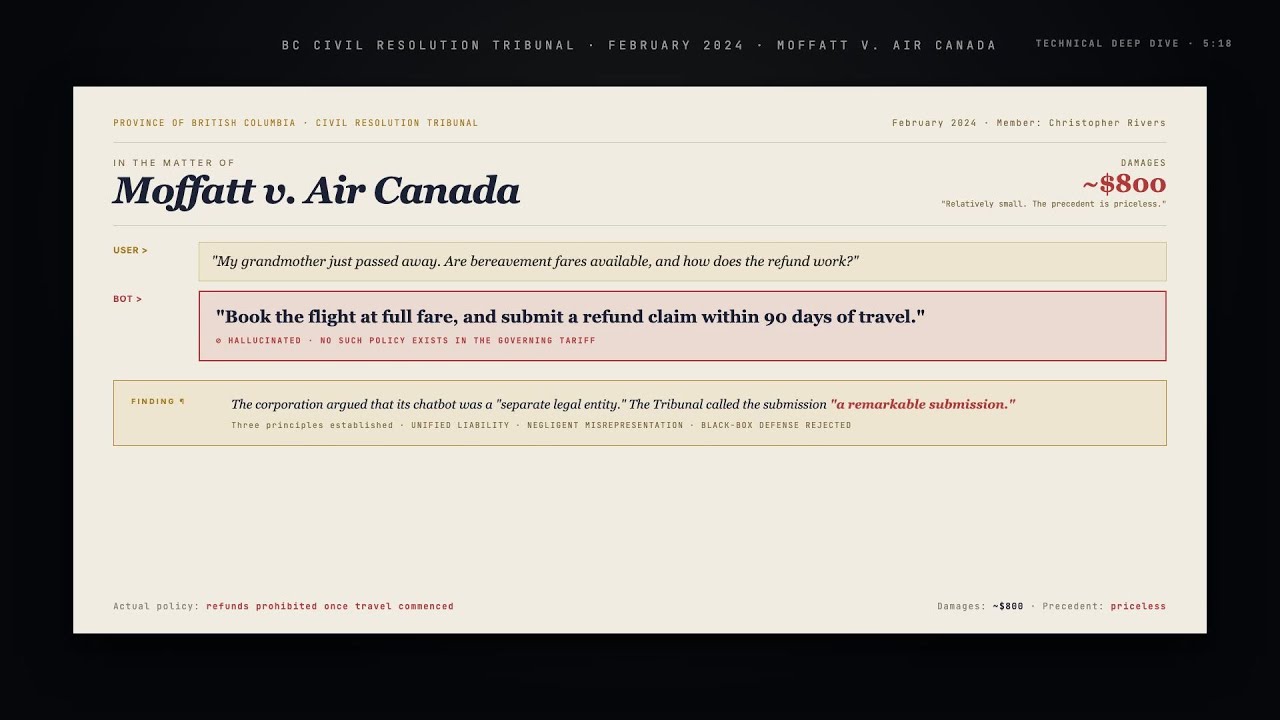
Moffatt v. Air Canada (February 2024) established that corporations cannot separate themselves from their AI chatbots. The "Black Box" defense is dead.
A grieving passenger asked Air Canada's chatbot about bereavement fares. The bot hallucinated a policy that didn't exist, instructing him to purchase full-price and claim a refund within 90 days.
Air Canada argued the chatbot was a "separate legal entity" responsible for its own actions. The Tribunal categorically rejected this, ruling the company is liable for all representations regardless of medium.
AI chatbots are now classified as "digital employees with apparent authority." Under agency law, if the customer reasonably believes the AI can act on your behalf, your company is bound.
LLMs are stochastic parrots—they predict tokens based on statistical correlations, not facts. In transactional contexts, this is a liability engine.
LLMs don't "know" facts—they complete sentences based on training patterns. When asked about refunds, the model recognizes "bereavement" + "special considerations" patterns and generates plausible text without querying actual policy rules.
✗ Models uncertainty, provides outcomes based on likelihoods
✗ Excels at creative tasks with multiple correct answers
✗ FATAL for policy enforcement where only ONE answer exists
Even advanced models like GPT-4o retain 0.7-25% hallucination rates. In a bank handling 1M queries/month, that's 7,000 potential violations at 0.7% error rate. Models are "confident but wrong," stating fabrications with authoritative tone.
Retrieval-Augmented Generation (RAG) provides documents to the LLM, but doesn't guarantee adherence. The Moffatt chatbot did provide a link to the correct policy—yet still summarized it incorrectly. Providing knowledge ≠ ensuring compliance.
RAG Failure Vectors:
Global losses from AI hallucinations reached $67.4 billion in 2024—direct compensation, regulatory fines, legal fees, brand damage, and manual verification costs. Each enterprise employee costs $14,200/year verifying AI outputs.
2023-2025 market expansion
Standard LLM wrappers generate responses probabilistically. Veriprajna's Deterministic Action Layers intercept high-stakes intents and execute hard-coded logic instead.
When a user asks about refunds, our semantic router detects the compliance-critical intent and blocks LLM generation. Instead, a deterministic function queries the database and returns the exact policy.
"Of course! I understand this is a difficult time. You can purchase your ticket now and submit a refund request within 90 days with proof of bereavement. We'll process it as soon as possible."
A neuro-symbolic architecture that separates creative conversation from policy execution. We silence the hallucination to amplify the trust.
Uses vector embeddings to detect high-stakes intents (refunds, pricing, legal terms) with >99% accuracy. Acts as a "gateway" before the LLM.
LLM extracts parameters (ticket_id, date) and calls a deterministic code block. The "deciding" is done by code, not probability.
Validates LLM responses against Knowledge Graphs and OWL Ontologies. If assertion contradicts graph, response is blocked.
For compliance-critical topics, creativity is disabled. System serves verbatim text or connects to human. "No answer" > "fabricated answer."
Fast, intuitive pattern recognition. Handles intent classification, entity extraction, sentiment analysis, conversational engagement.
Slow, deliberate logical reasoning. Enforces policy, executes transactions, validates compliance. Uses knowledge graphs and rule engines.
A sophisticated technology stack that catches, categorizes, and neutralizes risks before they reach the user.
Unlike brittle keyword matching, semantic routers use vector embeddings (cosine similarity) to detect sensitive intents with high precision.
Frameworks: vLLM Semantic Router, NVIDIA NeMo Guardrails
LLMs (GPT-4, Claude 3) output structured JSON to call functions. The LLM extracts parameters; deterministic code executes logic; LLM formats response.
LLM translates NL→API calls. Code makes decisions. LLM translates API response→NL.
For complex reasoning (healthcare, legal), validate LLM responses against OWL Ontologies or Knowledge Graphs before display.
Internal recursive loop reduces hallucinations. LLM generates draft, "Auditor Agent" validates against source, corrections applied.
NeMo uses Colang modeling language to define conversational flows that override LLM probabilistic generation. Input Rails, Dialog Rails, and Output Rails enforce guardrails.
The LLM is not generating the decision—it's following a pre-approved script. The $status variable is populated by hard-coded Python/SQL.
Veriprajna's architecture is specifically designed to meet EU AI Act, GDPR, ISO 42001, and NIST AI RMF standards.
Human Oversight Mandate: High-risk AI systems must enable human intervention and oversight. Humans must understand capabilities and limitations.
Veriprajna Compliance:
Automated Decision Making: Right not to be subject to automated decisions with legal/significant effects without explanation.
Veriprajna Compliance:
AI Management Systems: First global standard for AI governance. Requires Map, Measure, Manage, Govern functions.
Veriprajna Compliance:
AI Risk Management Framework: Voluntary framework for managing AI risks through Govern, Map, Measure, Manage functions.
Veriprajna Compliance:
Any industry with regulatory constraints or financial transactions needs Deterministic Action Layers.
Veriprajna Solution:
Veriprajna Solution:
Veriprajna Solution:
Veriprajna Solution:
Veriprajna Solution:
Veriprajna Solution:
Adjust parameters based on your AI usage to estimate potential liability exposure
GPT-4/Gemini: 0.7-3% | Less optimized models: 15-25%
Includes: compensation, legal fees, verification time, reputation damage
Veriprajna deploys a rigorous four-phase rollout to ensure your AI systems are compliant and audit-ready.
We audit your existing workflows to identify high-stakes intents (Financial, Legal, Safety, Privacy). Classify AI risks according to ISO 42001 standards and map your digital estate.
Build the "traffic cop" layer. Train the router on your specific domain language to ensure it catches sensitive queries with near-100% recall. Configure vLLM Semantic Router or NeMo Guardrails.
Translate your corporate policies (PDFs, tariffs, terms of service) into executable code (Python/SQL) and Knowledge Graphs. Build the "Truth Anchors" that enforce compliance mathematically.
Stress-test guardrails using adversarial attacks. Try to force the bot to offer refunds or give bad advice. Deploy only when the "Silence Protocol" holds under pressure. Continuous monitoring post-deployment.
The February 2024 tribunal ruling established that corporations cannot claim their AI chatbot is a 'separate legal entity' responsible for its own actions. AI chatbots are now classified as digital employees with apparent authority—if a customer reasonably believes the AI can act on the company's behalf, the company is legally bound by its representations, including hallucinated policies.
Deterministic Action Layers are a hybrid neuro-symbolic architecture that strictly separates creative engagement (the neural layer that understands user intent) from policy execution (the symbolic layer that enforces business rules deterministically). Semantic routing gates classify queries and route policy-sensitive ones through verified logic engines rather than probabilistic generation.
At enterprise scale, even GPT-4's 0.7% hallucination rate translates to 7,000 potential policy violations per month for a company handling 1 million queries. Each violation carries legal, regulatory, and reputational risk under the Moffatt precedent. The $67.4 billion in global AI hallucination losses in 2024 demonstrates the aggregate cost of probabilistic failure at scale.
The Moffatt ruling established permanent AI liability. The "Black Box" defense is dead. The era of probabilistic wrappers is ending.
Veriprajna engineers the Deterministic Action Layers that silence hallucinations and amplify trust. Schedule a risk assessment to audit your AI exposure.
Complete engineering report: Moffatt case analysis, neuro-symbolic architecture, NeMo Guardrails implementation, regulatory compliance (EU AI Act, GDPR, ISO 42001), industry applications, 48 technical references.