The Architectural Imperative of Few-Shot Style Injection in Enterprise Sales
The era of generic AI outreach is over. While standard LLM "wrappers" flood inboxes with robotic messages achieving 1-8.5% reply rates, Veriprajna's Few-Shot Style Injection architecture using Vector Databases achieves 40-50% reply rates by scaling the exceptional human, not the average robot.
By decoupling content from style and managing them through dual-retrieval vector pipelines, we enable hyper-personalization at scale—making AI sound like your best sales rep, not a chatbot.
Standard LLM wrappers have created an engagement crisis. They automate the "average" human output—scaling mediocrity—while flooding inboxes with context-poor, linguistically homogenized content.
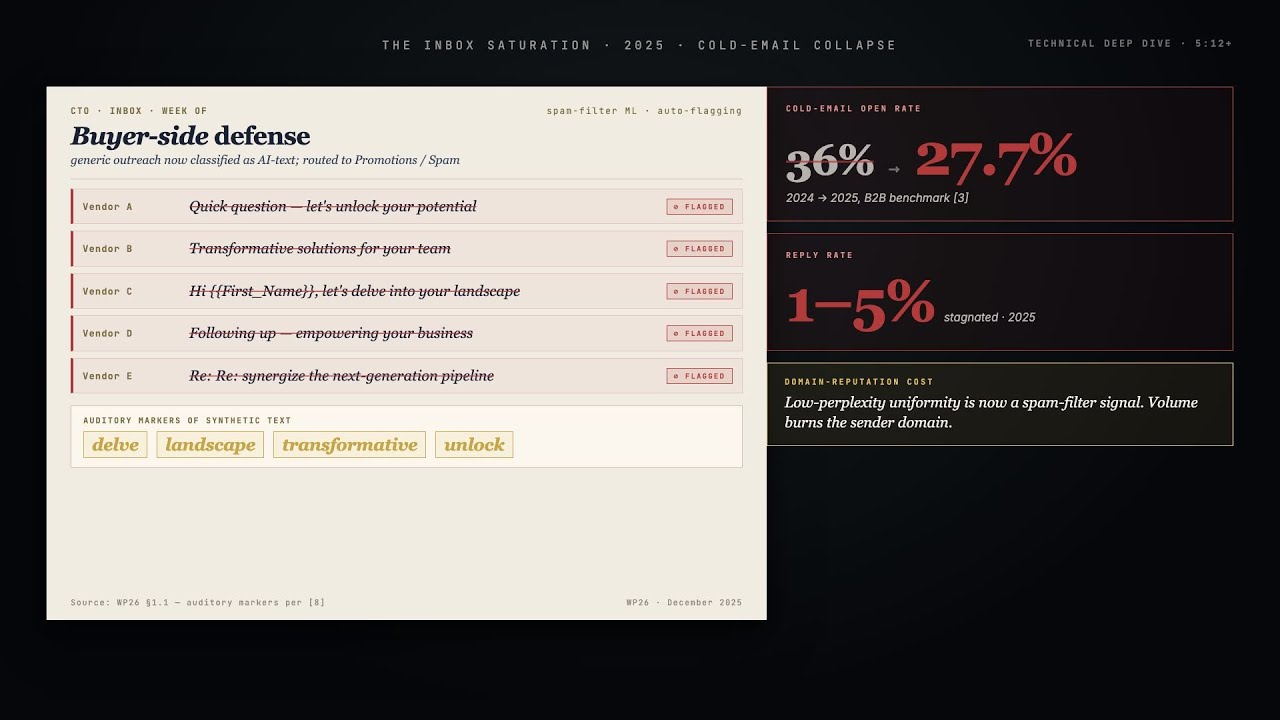
Cold email open rates plummeted from 36% to 27.7% in just one year. Standard LLMs converge on a "safe," neutral tone using high-frequency tokens like "delve," "landscape," "transformative"—auditory markers of synthetic text that trigger psychological rejection.
Variable injection ({{First_Name}}) isn't personalization—it's pseudo-personalization. Messages that are grammatically perfect but emotionally hollow occupy the "Uncanny Valley": they lack behavioral synchrony, feeling like a simulation of empathy rather than the genuine article.
ESPs use semantic analysis to detect low-perplexity AI text. Generic outreach isn't just ignored—it actively damages sender domain reputation. The "Scaling the Robot" approach creates long-term liability through aggressive filtering and blacklisting.
"In the high-stakes context of B2B sales, robotic tone is fatal. It signals that the sender has invested zero cognitive effort, triggering a reciprocal lack of engagement. You cannot enhance a signal that was never captured."
— Veriprajna Technical Whitepaper, 2024
Toggle between standard zero-shot LLM output and few-shot style-injected generation. Notice the difference in tone, burstiness, and human resonance.
Hi [First Name],
I hope this email finds you well. I wanted to reach out to you today to share an exciting opportunity that could potentially transform your sales operations.
Our cutting-edge AI-powered platform leverages state-of-the-art technology to unlock unprecedented value for enterprise organizations. We've helped numerous companies in the [Industry] space streamline their workflows and achieve remarkable results.
I'd love to schedule a quick call to delve deeper into how our innovative solution can help you navigate the evolving landscape of B2B sales.
Looking forward to connecting!
Best regards,
Sales Rep
Hey Jane—
Saw your post about data latency killing your analytics pipeline. Been there.
We just shipped something for FinTech CTOs dealing with exactly this. Real-time vector retrieval that doesn't choke under load. Not marketing fluff—actual sub-300ms query times at scale.
Worth 15 min next week? I'll show you the architecture, no slides.
—Alex
Sent from my iPhone
Try it: Toggle to see how style injection transforms AI-generated text from corporate spam to genuine human connection
Style injection isn't marketing theory—it's neuroscience. Linguistic Style Matching (LSM) activates mirror neurons, creating behavioral synchrony that dramatically increases conversion rates.
When a salesperson mirrors the prospect's linguistic style—level of formality, brevity, emotionality—it signals in-group status and cognitive alignment. This reduces cognitive load, creating a path of least resistance to "Yes."
When buyers encounter messages reflecting their own communication patterns, neural pathways associated with self-expression activate. This "behavioral synchrony" creates familiarity and safety—biological responses that standard LLMs cannot trigger.
Specific linguistic styles have measurable, statistically significant impacts on sales volume. "Intimate" styles (low psychological distance) positively correlate with sales speed, while overly formal styles can be actively detrimental.
Human writing exhibits "burstiness"—variations in sentence length and structure. AI smoothing eliminates these jagged edges that serve as attention hooks. Style injection re-introduces necessary burstiness by forcing models to match real human examples.
Veriprajna's "Scaling the Human" architecture separates content retrieval from style retrieval through parallel vector pipelines—treating "what to say" and "how to say it" as orthogonal variables.
Specim FX50 generates 3D data: 640×N×154 tensor with full spectral information per pixel
Dual-path: Content DB (facts) + Style DB (tone). Cosine similarity search in high-dim space
3-5 style examples injected into prompt. LLM infers tacit rules: sentence length, vocabulary, humor
Deterministic latency, stream processing. StyliTruth mechanism prevents hallucinations
| Component | Content Retrieval Path | Style Retrieval Path |
|---|---|---|
| Objective | Ensure factual accuracy and relevance | Ensure tonal resonance and mirroring |
| Source Data | Product manuals, case studies, whitepapers | Historical high-performing emails, LinkedIn posts |
| Embedding Type | Semantic Embeddings (text-embedding-3-small) | Stylometric/Contrastive Embeddings |
| Retrieval Query | "Benefits of X for [Industry]?" | "Emails to [Persona] with..." |
| Prompt Role | Provides the "Context" section | Provides "Few-Shot Examples" section |
| Outcome | AI knows WHAT to sell | AI knows HOW to sell it |
From embeddings to prompt engineering, here's how to build production-grade style injection systems.
Standard embeddings place "dog" and "canine" close together. For style injection, we need stylometric features: two emails about different products but with similar tone should cluster together.
The foundation of "Scaling the Human" is proprietary data: the "digital exhaust" of your best performers, curated and vectorized.
When generating an email to "Jane Doe, CTO at FinTech Corp," the system executes multi-step logic:
Critical risk: strong style can degrade factual accuracy. "StyliTruth" disentangles style and truth representations in the activation space.
Model the economic divergence between volume-based and style-based outreach for your organization.
From data harvesting to production deployment, here's the proven path to style injection at scale.
From Co-pilots to Autopilots: The evolution toward fully autonomous sales AI that maintains human-like personas over long interactions.
Human-in-the-loop. Static style injection for single emails. Manual review required.
Human-on-the-loop. Multi-turn conversations. Adaptive style adjustment within thread.
Fully autonomous. Adaptive Style RL learning individual prospect preferences in real-time.
Future systems will move beyond static injection to real-time style optimization. The AI will learn each prospect's unique preferences over a conversation, adjusting its style vector dynamically to maximize "Behavioral Synchrony."
Few-shot style injection retrieves 3-5 high-performing email examples that match the target prospect's communication style, then injects them into the LLM prompt. This activates linguistic style matching — a neuroscience-backed mechanism where mirroring a prospect's formality, brevity, and emotionality triggers mirror neuron activation and behavioral synchrony. This approach achieves 40-50% reply rates compared to 1-8.5% for generic zero-shot AI outputs.
Veriprajna's dual-retrieval architecture separates 'what to say' from 'how to say it' through parallel vector pipelines. The Content Retrieval Path uses semantic embeddings to retrieve factually accurate product information, while the Style Retrieval Path uses stylometric/contrastive embeddings to retrieve tonally appropriate examples from top-performing sales reps. This orthogonal approach ensures the AI knows both the substance and the voice.
StyliTruth disentangles style and truth representations in the activation space through three mechanisms: keeping Content Context (facts) and Style Context (examples) in separate prompt sections, explicit guidance instructions that style applies to form while content applies to substance, and a critic model guardrail that verifies factual consistency post-generation. This prevents strong style from degrading factual accuracy.
Veriprajna's Few-Shot Style Injection architecture transforms AI from a spam generator into a force multiplier for your best sales talent.
Schedule a technical consultation to audit your current outreach strategy and model the ROI of style-based personalization.
Complete technical analysis: Vector database architecture, embedding strategies, prompt engineering, LangChain implementation, StyliTruth mechanism, security considerations, 57 citations.