The Physics, Economics, and Intelligence of Black Plastic Recovery
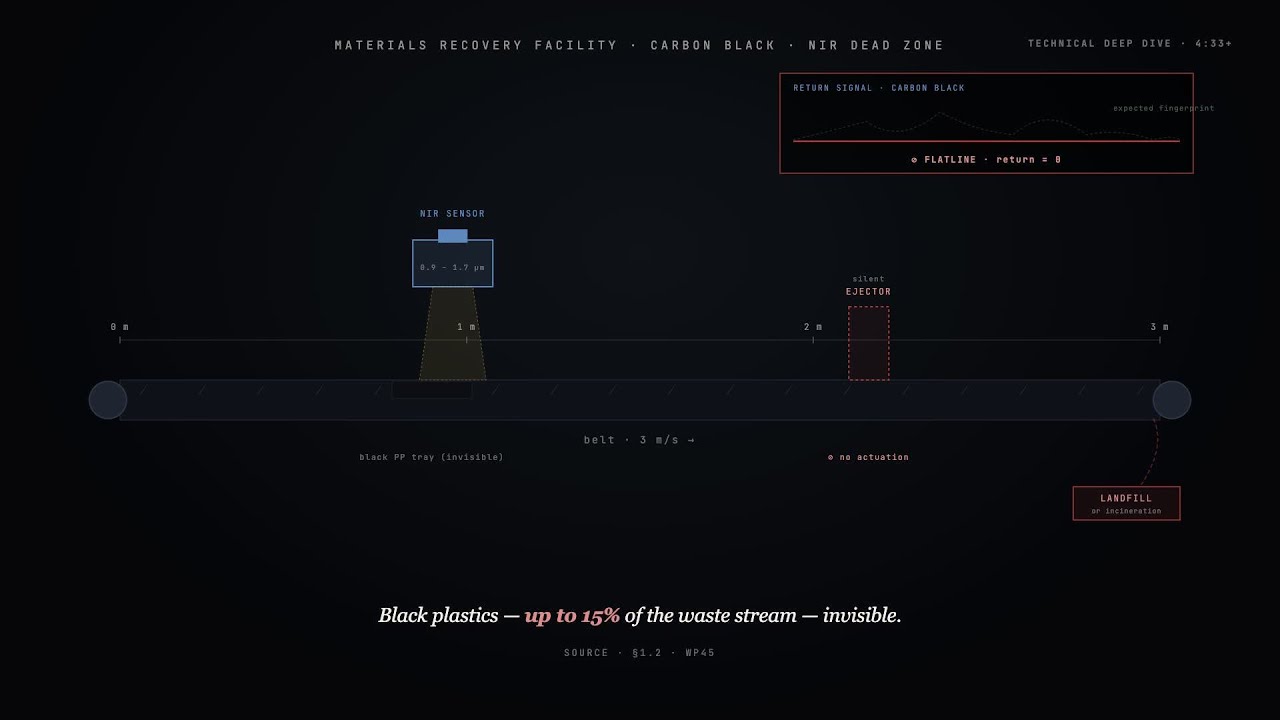
Every year, millions of tons of black plastics are systematically ejected from recycling streams and sent to landfill—not because they lack value, but because sensors literally cannot see them.
Veriprajna's solution shifts observation from Near-Infrared (blind) to Mid-Wave Infrared (chemistry-based), using 1D-Convolutional Neural Networks to interpret spectral signatures invisible to the human eye and standard AI.
A systemic failure invisible to the human eye but catastrophic to the environment and the balance sheet alike.
Carbon Black is a paracrystalline form of carbon from incomplete petroleum combustion. It acts as a near-perfect black body absorber across visible/NIR spectrum (700-1700nm).
For a MRF processing 50,000 tons/year, 3.3% black plastic = 1,650 tons discarded. At $1,130/ton, that's $1.86M in lost revenue annually.
EU PPWR mandates all packaging must be recyclable by 2030. If sensors can't see it, it's legally classified as unrecyclable—an existential threat to brands.
"While a human operator can clearly see a black tray on a belt, the machine vision system effectively sees nothing. This is a failure of physics that no amount of computer vision contrast adjustment or prompt engineering can resolve. One cannot enhance a signal that was never captured."
— Veriprajna Technical Whitepaper, 2024
To engineer a solution, one must first dissect the failure mode of incumbent technology.
The recycling industry's workhorse sensor operates at 900-1700nm. For colored plastics, light penetrates, interacts with molecular bonds (C-H, N-H, O-H), and reflects back with a unique spectral fingerprint.
When light strikes black plastic, carbon black pigment absorbs incident radiation before it can interact with the polymer matrix. Sensor receives effectively zero return signal.
We exist in a technological epoch defined by LLMs and Generative AI. Many "AI Consultancies" offer to wrap GPT-4/Claude via API to solve enterprise problems.
Generative AI models require input data to function. In black plastic sorting via NIR, the input data is a null set. There is no spectral curve to analyze; there is only noise.
The solution lies in Deep Tech—the rigorous application of scientific discovery to engineering problems. We do not try to make the AI "smarter" at guessing; we change the physics of the sensor to make the invisible visible.
If the data does not exist in the Near-Infrared, we must shift our gaze to a different window of the electromagnetic spectrum.
Carbon black's absorption is not infinite. As wavelength increases, absorption decreases. By moving to MWIR (2.7-5.3 µm), we cross a threshold where pigment becomes sufficiently transparent.
Dominated by "overtones" of molecular vibrations. Weak signals, easily swamped by carbon black absorption.
Contains fundamental vibrations of polymer molecules. C-H stretching, C=O carbonyl stretches—orders of magnitude stronger signals.
Hyperspectral Imaging represents a paradigm shift from analyzing external appearance to analyzing intrinsic composition.
Analyzes shape, texture, label, color. Unreliable for crushed, dirty waste. Fragment of black bumper looks identical to black tray.
Analyzes chemistry. Sees chemical signatures:
Veriprajna builds upon the only commercially viable sensor covering the full 2.7-5.3 µm range. The engineering complexity highlights the "Deep Tech" nature of the solution.
Materials identical in visible light have unique spectral fingerprints in MWIR. This chart shows reflectance across wavelengths—note the dramatic separation in the MWIR region.
All black plastics overlap near 0%. Carbon black absorbs all visible photons—sensors receive no signal for classification.
Lines diverge significantly. Fundamental stretching/bending vibrations are orders of magnitude stronger than NIR overtones.
This capability turns sorting from a visual guessing game into quantitative chemical analysis performed at conveyor belt speed.
Simulated based on fundamental vibrational spectroscopy. NIR region shows convergence; MWIR shows clear separation.
Capturing the MWIR hypercube is only half the battle. We need AI capable of interpreting complex chemical signatures with near-zero latency.
Standard AI image recognition (ResNet, YOLO) uses 2D-CNNs designed to recognize spatial features: the curve of a cat's ear, the rectangle of a license plate.
Plastic bottles are crushed, twisted, torn. Fragment of black bumper looks identical to black tray spatially.
Treating 154 spectral bands as "color channels" fails to capture subtle high-frequency relationships defining chemical fingerprints.
Veriprajna treats the problem not as image recognition, but as signal processing. For every pixel, we extract a 1D vector of 154 values—the spectrum.
1×154 vector of normalized reflectance values
Linear kernels learn spectral shapes: sharp drop @ 3.4 µm, broad shoulder @ 4.0 µm, doublet peaks
Softmax probability: [PP: 99%, PE: 0.5%, Other: 0.5%]
Specim FX50 generates 3D data: every pixel contains 154-band continuous spectrum for chemical analysis.
Linear kernels slide over spectrum, learning to detect specific spectral shapes—the "grammar" of molecular bonds.
NVIDIA Jetson AGX Orin runs optimized model. No cloud latency. Deterministic <5ms inference time.
PLC interface triggers pneumatic ejection or robotic arm within total <20ms budget at 3m/s belt speed.
Belt speed: 3m/s. Camera→Nozzle distance: ~1m. Time budget: 300-500ms total (acquisition, preprocessing, inference, segmentation, valve timing).
Jitter = Contamination. If air jet fires 50ms late, it hits the wrong object. 1D-CNNs provide deterministic, sub-5ms inference.
Adjust parameters based on your facility's throughput and composition to model economic impact
Typical MRF range: 10K-200K tons/year
Industry data: 3-15% of waste stream depending on region
Veriprajna achieves 90%+ with MWIR+1D-CNN
In a marketplace crowded with "AI for X" startups, Veriprajna distinguishes itself through vertical depth and physical integration.
MWIR spectral signatures of dirty, crushed, real-world waste are not on the public internet. We generate and own this dataset through physical deployments.
Our solution requires integration of cryogenic hardware, edge computing, and robotics. This cannot be copied by developers in a coffee shop—it requires engineering rigor.
Many MRFs have good conveyor systems but outdated sensor heads. Veriprajna upgrades the "eyes and brain" without replacing the "body"—lowering CAPEX.
Once we can "see" chemistry, we unlock value beyond simple material recovery.
Track exactly what materials pass through the recycling chain. Provide granular data on polymer types, contamination levels, and throughput for EU DPP compliance.
Certify bale purity before shipping to converters. Real-time spectral analysis reduces rejected loads, increasing customer trust and premium pricing.
Provide producers with data on how much of their specific black packaging is actually recovered, helping meet Extended Producer Responsibility reporting requirements.
Standard recycling facilities use Near-Infrared (NIR) spectroscopy operating at 900-1700nm. Carbon black pigment, a paracrystalline form of carbon from petroleum combustion, acts as a near-perfect black body absorber across the visible and NIR spectrum. It absorbs incident radiation before it can interact with the polymer matrix, returning effectively zero signal to the sensor. The sorting computer sees 'empty belt' and the pneumatic ejectors remain silent, sending valuable PP, PE, PS, and ABS polymers worth up to $1,200 per ton to landfill or incineration.
Carbon black's absorption is not infinite. As wavelength increases beyond NIR, absorption decreases. In the Mid-Wave Infrared range (2.7-5.3 micron), the pigment becomes sufficiently transparent to expose fundamental molecular vibrations of the underlying polymer. These fundamental C-H stretching, C=O carbonyl, and aromatic modes are orders of magnitude stronger than NIR overtones, producing distinct chemical fingerprints. PP, PE, PS, and ABS each show unique spectral signatures at these wavelengths, enabling reliable classification even through heavy carbon black pigmentation. Veriprajna uses the Specim FX50 sensor with 154 spectral bands at 380 frames per second with cryogenically cooled MCT detectors.
For a mid-sized MRF processing 50,000 tons per year with 5% black plastic content, the current state means 2,500 tons sent to incineration at a combined loss of approximately 2.5 million euros annually (lost material value plus disposal costs). With Veriprajna's MWIR system achieving 90%+ recovery, this converts to 2,025,000 euros in sales revenue plus 225,000 euros in disposal savings, against a system CAPEX of approximately 280,000 euros. The payback period is under 2 months, making it one of the highest-ROI investments available to waste management operators.
Veriprajna's MWIR Hyperspectral + 1D-CNN solution doesn't just improve recovery rates—it fundamentally changes the physics of observation.
Schedule a technical consultation to discuss your facility's black plastic recovery potential.
Complete engineering report: MWIR photonics, 1D-CNN architectures, spectral unmixing mathematics, sensor fusion, edge computing implementation, economic analysis, regulatory alignment, comprehensive works cited.