Architecting Resilience through Deep AI & Sovereign Intelligence
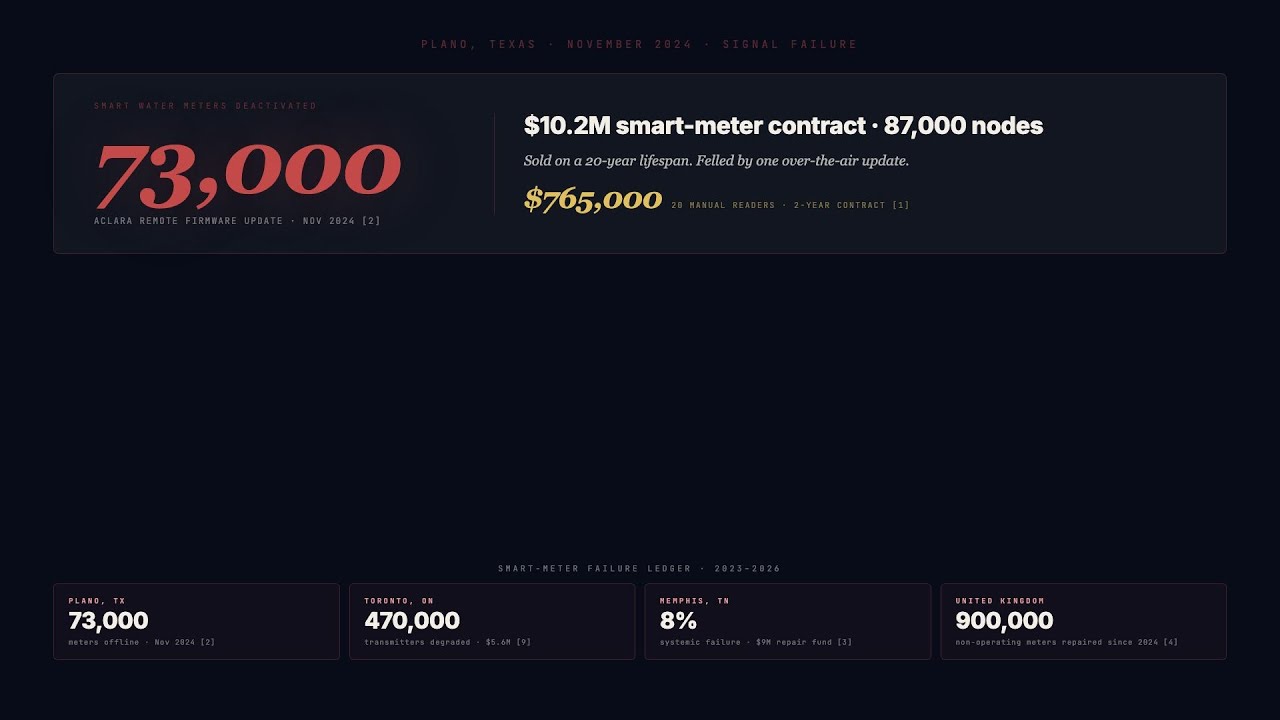
From mass firmware failures knocking 73,000 meters offline to $9M repair liabilities, the "smart" grid is breaking. Commodity AI wrappers can't fix it. Sovereign Deep AI can.
Utilities invested billions in IoT-based metering promised to last 20 years. The software-hardware interface is failing in half that time—and the consequences are no longer just administrative.
The very software meant to extend hardware life often becomes the primary mechanism of its failure. In Plano, a firmware update intended to optimize power consumption rendered 73,000 transmission systems ineffective overnight.
NAND flash memory degrades through constant high-frequency logging. Meters transmit inaccurate data long before anyone notices—eroding billing accuracy and public trust without triggering any alert.
The UK's Ofgem now mandates automatic £40 compensation per customer for meter service failures. Since 2024, this has forced the repair of over 900,000 previously non-operating meters.
Unlike mechanical meters, AMI units are complex computing platforms subject to the same vulnerabilities as any networked device. Software complexity has doubled in recent years, outstripping traditional testing methods.
Every write operation generates obsolete data requiring "garbage collection," intensifying physical wear on NAND cells. Meters begin experiencing data corruption after just a few years. The degradation is often "silent"—the device appears online but transmits inaccurate data.
Firmware that works perfectly in the lab fails when deployed to a device with a degraded battery or in a rural area with weak signal. The remote "OFF" switch built into modern meters becomes a critical liability if triggered by a firmware logic error.
Logic errors in control sequences, data structure defects causing incorrect variable scaling, and interface incompatibility between internal software logic and external hardware I/O timing during voltage fluctuations.
"The 'smart' meter revolution has succeeded in digitizing the grid, but it has failed to provide the resilience required for critical infrastructure. These failures are not merely technical glitches—they are warnings of a systemic misalignment between modern technology and legacy management frameworks."
— Veriprajna Technical Whitepaper, 2025
Many utilities have turned to AI. But the market is dominated by "LLM wrappers"—thin interfaces for public APIs. For mission-critical infrastructure, these are fundamentally insufficient.
Sensitive grid data—architecture, consumption patterns, proprietary firmware code—leaves the corporate perimeter and enters third-party servers. "Security Theater": feels private, but the backend is public, exposed to the US CLOUD Act and data retention risks.
Thin wrappers rely on limited context windows. They cannot perform deep binary analysis of firmware for specific hardware versions in specific geographies. They forget company history and legacy codebases between sessions.
If a "Firmware Diagnostic Tool" is simply a prompt into a foundational model, the utility could build it internally in a day. The business is also hostage to API pricing changes and model deprecations.
Full inference stack deployed in your VPC or on-premise. Zero-egress networking physically prevents data from leaving your infrastructure. The AI "brain" resides entirely on hardware you control.
Technical manuals, maintenance reports, and firmware source code indexed in local Vector Databases. RBAC-aware retrieval ensures security protocols are maintained at the intelligence layer.
Fine-tuned on your proprietary corpus using LoRA, achieving up to 15% accuracy increase for domain-specific tasks. The resulting model is your IP—immune to API volatility.
We don't resell API keys. We deploy sovereign intelligence capabilities on hardware you control—from private LLM stacks to domain-tuned models that become your competitive advantage.
Full inference engines (vLLM, TGI, BentoML) deployed on your Kubernetes clusters or bare-metal GPUs. No data leaves your infrastructure.
Your technical manuals, maintenance records, and firmware code indexed in local Vector DBs (Milvus / Qdrant). RBAC-aware retrieval respects existing access controls.
LoRA-based instruction tuning on your proprietary corpus. Creates a bespoke model asset that belongs to you—up to 15% accuracy increase for utility-specific tasks.
AI agents that don't just chat—they perform secure actions: adjusting machine parameters in real-time, quarantining compromised IoT devices, and executing edge inference at <10ms.
Deep AI continuously monitors high-frequency IoT sensor data to establish baseline normal behavior. When deviations occur, the system issues proactive alerts with explainable reasoning—before failure happens.
A single sensor reading that deviates from the norm—sudden voltage spikes, unexpected temperature readings.
Data that is normal in isolation but anomalous in context—high energy draw during historically low demand periods.
Groups of data points that together indicate a systemic issue—a fleet of meters all showing increased communication latency.
eXplainable AI (GradCAM) provides local explanations for every detection, allowing engineers to verify results. The feedback loop continuously retrains the model, reducing false positives over time.
| Metric | Traditional | AI-Driven |
|---|---|---|
| Strategy | Reactive / Scheduled | Proactive / Real-time |
| Data Usage | Historical / Manual logs | IoT / Real-time telemetry |
| Downtime | Unexpected / Frequent | Reduced 30–50% |
| Maintenance Cost | High repair/replace | 18–25% lower |
| Asset Lifespan | Premature degradation | Extended up to 40% |
To prevent catastrophic firmware failures, Veriprajna developed an automated pipeline for vulnerability detection and functional verification—using Private LLMs to analyze black-box systems where source code is unavailable.
EMBA and Firmwalker extract file systems and identify binary targets from firmware images.
Ghidra disassembles and decompiles binary code across various hardware platforms for analysis.
Private LLM analyzes decompiled code to identify logic flaws, insecure practices, and potential zero-day vulnerabilities.
Firmware tested in virtualized real-time environments using QEMU + FreeRTOS. AI agents use reinforcement learning to find vulnerabilities 38% faster.
Testing firmware on physical devices is risky and disruptive. Veriprajna's Digital Twins are detailed virtual replicas of smart homes and grid segments that simulate software behavior under every conceivable condition.
AI predictive maintenance reduces infrastructure failures by 73% and maintenance costs by up to 40%. The shift from reactive to proactive maintenance delivers measurable, compounding returns.
Adjust parameters based on your utility's meter fleet and current failure profile
With 30 billion+ IoT devices projected by 2026, the utility industry can no longer rely on static security paradigms or API wrappers. The next frontier is already being built.
Smart meters as high-resolution "micro-decision engines"—executing local anomaly detection and load forecasting with latency lower than 10ms, directly on the device.
AI agents that perform secure internal actions autonomously: adjusting machine parameters in real-time, quarantining compromised IoT devices, and orchestrating fleet-wide responses.
The "real moat" isn't the AI model—it's your deep domain expertise, sovereign data integration, and private infrastructure that's immune to public AI market volatility.
Smart meters are complex computing platforms suffering from flash memory wear due to high-frequency logging, firmware updates that inadvertently brick devices (73,000 meters in Plano, TX), and interface defects between software logic and hardware I/O timing. Software complexity has outstripped traditional testing methods, leading to systemic failures well before the promised 20-year lifespan.
Commodity AI wrappers send sensitive grid data to third-party cloud servers, lack deep firmware analysis capability, and create zero defensible IP. Veriprajna deploys the full inference stack within the utility's VPC or on-premise — zero data egress, RAG 2.0 semantic indexing of technical manuals and firmware code, and LoRA-based fine-tuning that creates a bespoke model asset the utility owns.
AI-driven predictive maintenance reduces infrastructure failures by 73%, extends asset lifespan by up to 40%, lowers maintenance costs by 18-25%, reduces overtime by 30%, and shortens lead times by 28%. For a fleet of 100,000 meters with a 5% failure rate, this translates to approximately $438K in annual savings.
The era of reactive maintenance is over. Regulators are enforcing it. The economics demand it. The technology enables it.
Veriprajna deploys Deep AI for utilities that need to secure their grid for the next twenty years—not just patch it for the next quarter.
Complete report: Infrastructure failure analysis, Deep AI architecture, firmware security pipeline, anomaly detection framework, ROI modeling, and regulatory compliance strategy.