Architecting Deep AI for the Post-Trust Enterprise
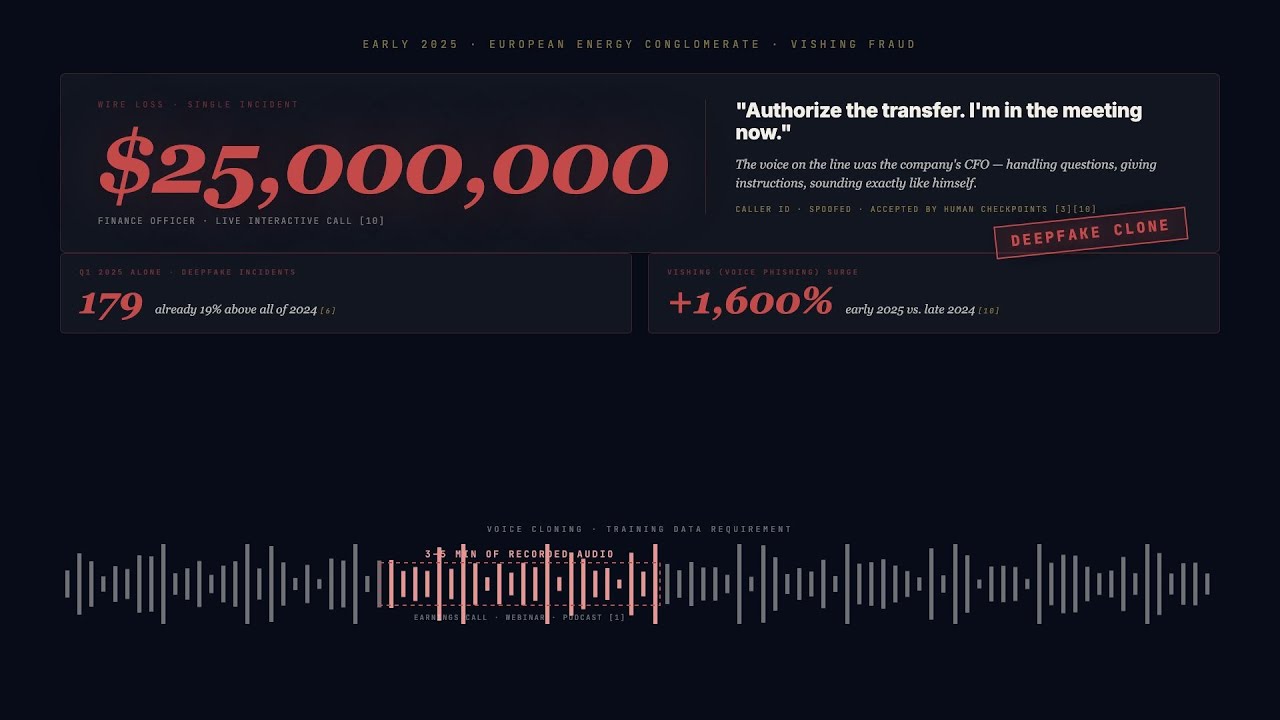
AI-generated phishing is up 1,265% since 2023. Deepfake fraud drained $25 million from a single enterprise. The "AI Wrapper" paradigm has failed. Sovereign Intelligence is the only path forward.
Veriprajna deploys private, hardened LLMs within your VPC—zero data egress, full sovereignty, GPT-4-level performance. This whitepaper maps the threat landscape and architects the defense.
Generative AI has given attackers nation-state capability at commodity cost. Traditional defenses built on pattern-matching are obsolete.
82.6% of phishing emails now contain AI-generated content. LLMs eliminate every linguistic "tell" that traditional training relied upon.
179 incidents in Q1 2025 alone—surpassing all of 2024. Voice cloning now needs only 3-5 minutes of audio.
$2.77 billion in 2024 losses. Attackers now use multi-channel "Identity Orchestration"—email, SMS, Teams, and deepfaked calls simultaneously.
AI didn't just increase the volume of phishing—it fundamentally changed its nature. Every signature-based defense is now obsolete.
Enterprise AI built on public API wrappers introduces three catastrophic vulnerabilities that no SLA can mitigate.
Every prompt, document, and context snippet crosses the public internet to third-party inference servers. Even "Zero Data Retention" tiers retain data for up to 30 days for abuse monitoring.
US-based providers are subject to the CLOUD Act, which compels data disclosure regardless of where servers are located. This creates a direct conflict with GDPR and local data residency laws.
Wrappers are stateless and hallucinate on proprietary data. When official tools fail, employees use personal accounts on public models—a 485% increase in pasted source code to AI apps.
"The prevailing market trend of AI Wrappers—thin interfaces atop public LLM APIs—has proven insufficient for the rigorous security, compliance, and sovereignty requirements of the enterprise. One cannot outsource intelligence and retain control."
— Veriprajna Technical Whitepaper, 2025
Four hardened layers delivering GPT-4-level performance with zero data egress. Every component resides within your VPC.
GPU Orchestration
Full inference stack via K8s on dedicated NVIDIA H100/A100/L40S within your cloud perimeter (AWS, Azure, GCP) or on-premises.
Open-Weights Hegemony
Best-in-class open-weights models (Llama 3 70B, Mistral, CodeLlama). Own the weights. Immune to provider pricing or "lobotomization."
Private RAG 2.0
RBAC-aware retrieval integrated with Active Directory/Okta. If a user can't access a document, the AI can't retrieve it. Prevents contextual privilege escalation.
Runtime Governance
Real-time I/O analysis via NeMo Guardrails & Cisco AI Defense. Blocks prompt injection, auto-redacts PII/PHI, enforces topic adherence.
Deep AI adapts model weights to your organization. Wrappers only adapt prompts.
As organizations deploy AI for defense, attackers develop techniques to exploit the AI itself. Deep AI must be hardened against both external and model-layer threats.
Input Manipulation
Invisible characters in emails, subtly modified URLs, embedded instructions like "Ignore all previous instructions"—designed to fool AI classifiers into marking malicious input as benign.
Input Sanitization + Feature Squeezing. All inputs are preprocessed through safety classifiers before reaching the primary model. Suspicious structures are flagged and quarantined.
Training/RAG Manipulation
Attackers inject malicious data into training sets or RAG pipelines to create model backdoors. Public API models are inherently vulnerable since their global training corpus is an open attack surface.
Air-gapped Model Hygiene. Private Enterprise LLMs are trained and grounded exclusively on clean, vetted, internally governed data. The only way to guarantee unsubverted intelligence.
AI governance is now a legal mandate. Non-compliance means fines up to €35M or 7% of global turnover under the EU AI Act.
Immutable logs of every prompt and response ensure a full audit trail for regulatory review.
Agentic workflows auto-escalate high-value decisions (e.g., transfers over $5,000) to human supervisors.
Fine-tuned models with transparent architectures are more interpretable than proprietary "black box" APIs.
When detection fails, provenance prevails. Veriprajna integrates C2PA (Coalition for Content Provenance and Authenticity) to cryptographically sign digital assets at the point of origin.
Executives can "true-sign" video or voice authorizations, linking verified legal identity to the digital record. Attackers cannot forge the cryptographic signature—eliminating voice-clone BEC.
Public LLMs are unpredictable OPEX. Private deployment converts rented intelligence into a proprietary asset with near-zero marginal cost.
Estimate your annual savings by switching from public API to self-hosted inference
Metrics we track for every Deep AI deployment
AI-generated phishing has surged 1,265% since 2023, with 82.6% of phishing emails now containing AI-generated content and a 54% click-through rate versus 12% for traditional phishing. Deepfake incidents hit 179 in Q1 2025 alone — surpassing all of 2024 — with voice cloning requiring only 3-5 minutes of audio. BEC fraud reached $2.77 billion in FBI-reported 2024 losses, with attackers using multi-channel identity orchestration across email, SMS, Teams, and deepfaked calls simultaneously.
The Deep AI Stack consists of four hardened layers deployed entirely within the client's VPC: Infrastructure (GPU orchestration via K8s on dedicated NVIDIA H100/A100/L40S with strict egress rules), Model (open-weights models like Llama 3 70B with LoRA fine-tuning creating proprietary IP), Knowledge (RBAC-aware Private RAG 2.0 integrated with Active Directory/Okta), and Guardrails (NeMo runtime governance blocking prompt injection and auto-redacting PII/PHI). No data ever leaves the client perimeter.
C2PA (Coalition for Content Provenance and Authenticity) cryptographically signs digital assets at the point of origin, linking verified legal identity to the digital record through biometric ID authentication. Executives can 'true-sign' video or voice authorizations with a tamper-evident crypto manifest. If a deepfake modification occurs, the cryptographic manifest breaks and a warning is displayed — attackers cannot forge the signature, eliminating voice-clone BEC attacks.
In the post-trust enterprise, the ultimate competitive advantage is not just intelligence, but the ability to verify it.
Veriprajna deploys Sovereign Intelligence—private LLMs, zero egress, full regulatory alignment. Let us architect your defense.
Complete report: Threat landscape data, Deep AI architecture, adversarial ML defenses, NIST/EU AI Act alignment, economic models, and security KPIs.