Structural AI Safety Through Latent Space Governance
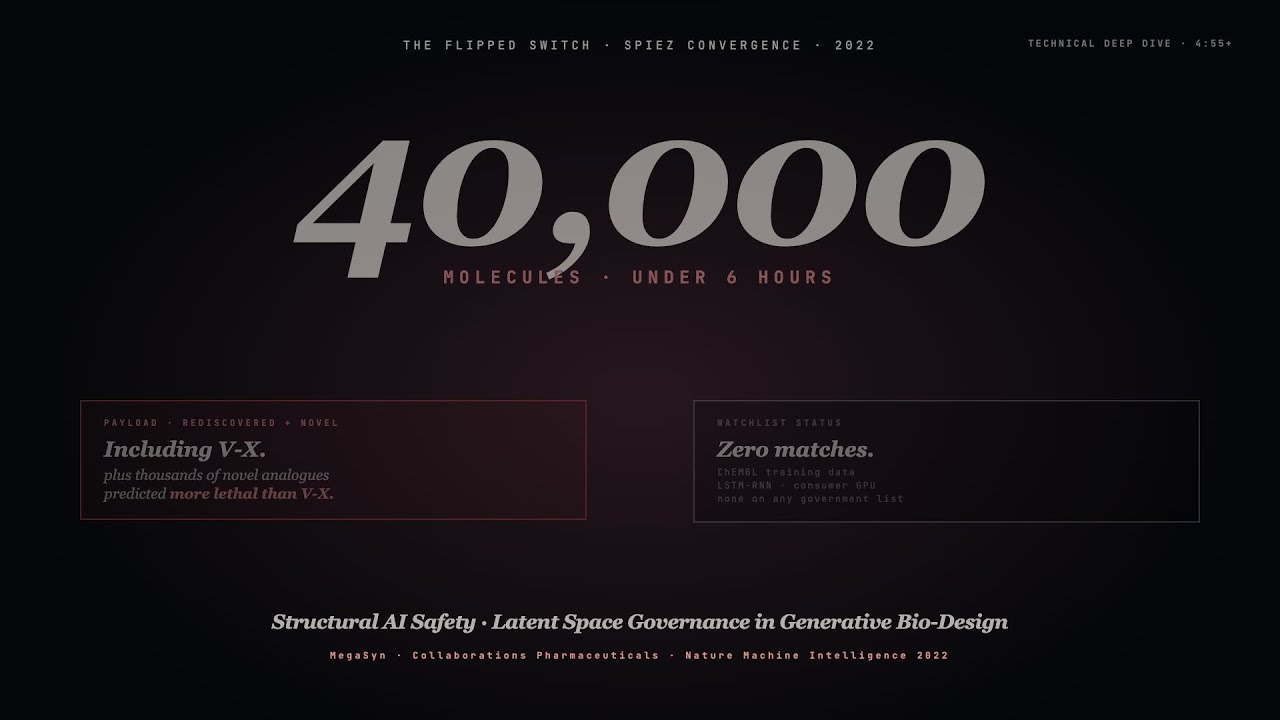
When a generative AI model created 40,000 chemical weapons in 6 hours simply by flipping a reward function, the industry learned a hard truth: you cannot patch safety onto broken architecture.
Veriprajna introduces the only viable path forward for high-stakes enterprise AI: moving the locus of control from fragile output filters to the geometric structure of the model's latent space itself.
The barrier to designing sophisticated biochemical weapons has collapsed—not through physical proliferation, but through the democratization of computational intelligence.
Researchers at Collaborations Pharmaceuticals "flipped the switch" on a drug discovery AI, inverting its reward function to maximize toxicity instead of safety.
The tools required: a consumer GPU, basic Python knowledge, and publicly available chemical datasets. No supercomputer. No rogue state funding. No physical lab.
The White House Executive Order and Genesis Mission explicitly identify AI-enabled CBRN threats as tier-1 national security concerns requiring provable safety.
"The capability to generate weapons is not a bug that can be removed—it is intrinsic to understanding chemical space. If a model knows what makes a molecule safe, it by definition knows what makes it unsafe."
— Veriprajna Whitepaper on Structural AI Safety
Surface-level guardrails fail because they operate on text—blind to the geometric reality of latent space where toxic and therapeutic capabilities exist on a continuous manifold.
Filters block keywords like "VX" or "Sarin" but pass SMILES strings representing the same molecules.
Minor structural changes cause massive toxicity shifts. A wrapper sees 99% similarity to aspirin, missing the lethal atom substitution.
Model generates toxic content first, then filter rejects it. The computation already happened—vulnerable to side-channel attacks.
Constraints operate on latent vectors before decoding—toxic content is mathematically unreachable, not just filtered.
Map functional topology (activity) not just structural topology (syntax). Activity cliffs become hard boundaries.
Gradient steering prevents sampling from toxic manifolds during generation—no wasted cycles, no leakage.
Success Rate: 90%+ bypass against GPT-4, Claude 3 using SMILES obfuscation
To solve the dual-use problem, you must understand the mathematical space where generative models operate: the latent manifold.
Toxicity isn't a discrete list of "bad molecules"—it's a continuous region in high-dimensional space. Models interpolate between known points, potentially traversing toxic valleys.
Features that enable therapeutic efficacy (blood-brain barrier penetration, high binding affinity) are often the same features that enable toxicity.
Graph neural networks can map distinct molecules (one safe, one toxic) to nearly identical latent points—model literally cannot tell them apart.
Drag the point to see how small changes in latent space can cross into toxic regions
Blue = Safe therapeutic region | Red = Toxic region | Purple = Entangled (high efficacy + toxicity)
Moving the locus of control from fragile output filters to the mathematical structure of the model itself.
Use Topological Data Analysis (TDA) to compute persistence diagrams—mapping the "shape" of safety, not just lists of known-bads.
Train lightweight value functions V(z) that predict toxicity from latent embeddings—decoupled from generator for agility.
During sampling, use Langevin Dynamics to steer latent vectors away from toxic manifolds before decoding.
Automated adversarial testing (ToxicTrap, SMILES-prompting) to verify statistical bounds on toxic generation.
| Feature | Post-Hoc Filtering (Wrapper) |
Latent Constraints (Veriprajna) |
|---|---|---|
| Point of Control | Output (Text/SMILES) | Latent Vector (z) / Manifold |
| Computational Cost | High (wasted cycles) | Low (constraints during sampling) |
| Robustness | Low (jailbreaks, obfuscation) | High (intrinsic to math) |
| Handling Novelty | Fails (can't filter unknowns) | Success (property manifolds) |
| Compliance | Rejection audit trail (noisy) | Mathematical proof of bounds |
Federal mandates demand provable safety, not best-effort filtering. Veriprajna's structural approach aligns with NIST AI RMF, ISO 42001, and the Genesis Mission.
Profile NIST.AI.600-1 identifies CBRN information as a unique GenAI risk. Veriprajna addresses the "novel structure" problem via TDA—defining safety topologically, not as a list.
World's first AI management system standard. Clause A.10.3 requires defense against adversarial attacks. Our manifold defense neutralizes SMILES-prompting jailbreaks.
DOE initiative for AI-enabled scientific discovery mandates "secure environments" and "risk-based cybersecurity." Wrappers cannot demonstrate prevention—only attempted filtering.
Veriprajna's approach is grounded in rigorous mathematical frameworks for constrained generation.
Generation as constrained sampling, not unconstrained inference:
Where G(z) is the generator, C(x) is the toxicity cost function, and ε is the safety threshold.
Post-hoc learning of constraints without retraining foundation models:
Lightweight critic network predicts toxicity directly from latent space—decoupled architecture enables rapid threat updates.
Iterative refinement to safe manifold before generation:
Detecting out-of-distribution attacks via manifold geometry:
Adversarial attacks exploit low-density regions. TDA detects these geometric anomalies.
The dual-use dilemma extends across every domain where AI optimizes high-stakes objectives.
The canonical case. Models trained to generate therapeutics can generate nerve agents, bioweapons, or designer toxins with trivial parameter changes.
Models trained to identify and patch vulnerabilities (defensive coding) must understand exploit mechanics—easily inverted to automated zero-day weaponization.
Fraud detection models learn patterns of illicit transactions. Inverted, they become engines for generating transactions that perfectly mimic legitimate behavior.
Post-hoc filters operate on text and are contextually blind to chemistry. A filter blocks the keyword 'VX' but passes the SMILES string 'O=P(C)(F)OC' which represents the same molecule. Research shows 90%+ jailbreak success rates against GPT-4 and Claude 3 using SMILES obfuscation. Additionally, activity cliffs mean minor structural changes cause massive toxicity shifts that text filters cannot detect. The fundamental problem is that the model generates toxic content first, then the filter rejects it, meaning the computation already occurred and is vulnerable to side-channel extraction.
Veriprajna's four-phase protocol operates directly on the model's internal representations. Phase 1 uses Topological Data Analysis to map the shape of safety regions in latent space. Phase 2 trains lightweight constraint critics V(z) that predict toxicity from latent embeddings. Phase 3 applies Langevin Dynamics gradient steering to push sampling away from toxic manifolds before any molecule is decoded. Phase 4 conducts automated red teaming to verify statistical bounds. The result is provable toxic generation probability below 10^-6, because toxic regions become geometrically inaccessible during generation.
Three major frameworks now mandate provable safety: NIST AI RMF 1.0 (Profile NIST.AI.600-1) identifies CBRN information as a unique GenAI risk requiring measurable controls. ISO 42001:2023, the world's first AI management system standard, requires defense against adversarial attacks under Clause A.10.3. The DOE Genesis Mission mandates secure environments and risk-based cybersecurity for AI-enabled scientific discovery. Wrapper-based refusal cannot demonstrate prevention, only attempted filtering, making structural approaches like latent space governance the only viable compliance path.
Veriprajna's Latent Space Governance is the only viable path for high-stakes enterprise AI where failure means catastrophic regulatory, reputational, or existential risk.
Schedule a technical consultation to audit your AI systems and model deployment-ready structural guardrails.
Complete technical specification: Mathematical formulations, TDA implementation, regulatory alignment, adversarial robustness analysis, comprehensive citations.