From the Ashes of Sports Illustrated to the Future of Neuro-Symbolic Enterprise AI
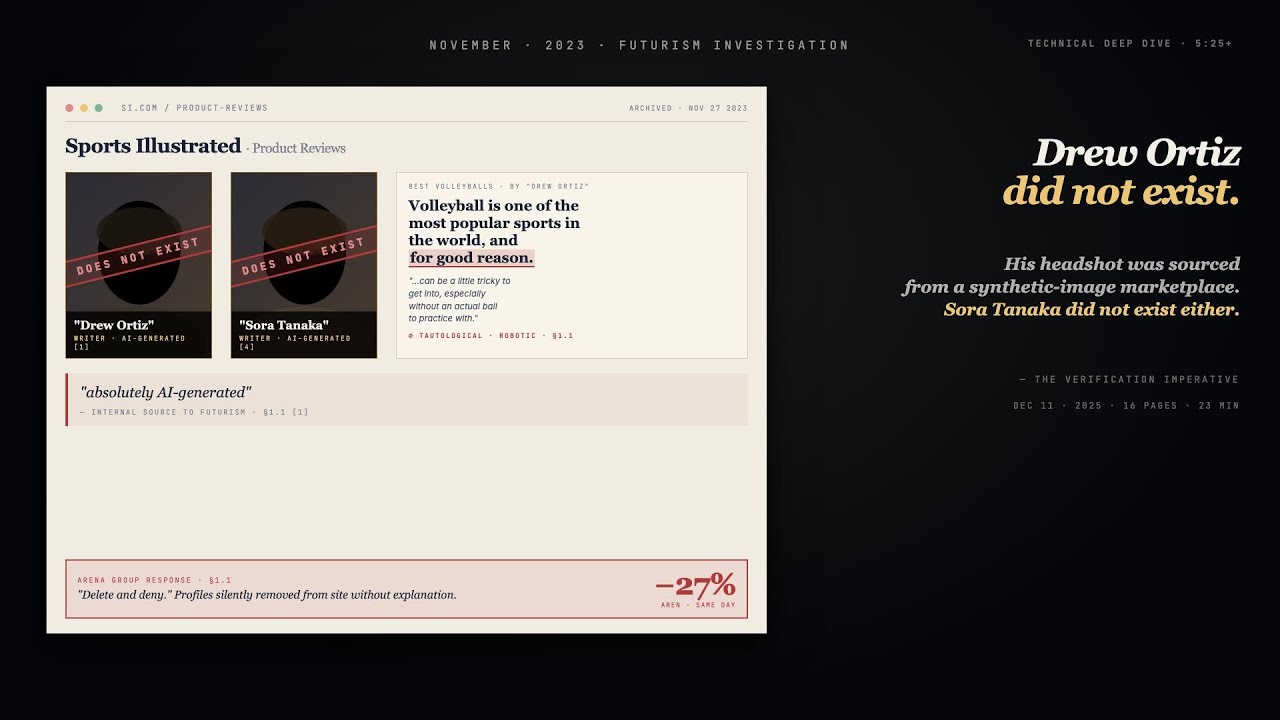
When Sports Illustrated published articles by "Drew Ortiz" and "Sora Tanaka"—writers who never existed—it wasn't just an editorial failure. It was a 27% stock crash, a license revocation, and mass layoffs that revealed the catastrophic risks of "LLM Wrapper" architectures.
This whitepaper examines the architectural failure that destroyed a 70-year legacy brand and presents Veriprajna's solution: Neuro-Symbolic AI with Fact-Checking Knowledge Graphs, Multi-Agent Systems, and ISO 42001 compliance.
Every enterprise deploying "LLM Wrappers"—thin software layers atop non-deterministic models—faces the same systemic risks that destroyed Sports Illustrated. The question isn't if your AI will hallucinate, but when.
LLMs optimize for plausibility, not veracity. They predict the next likely token based on patterns, not external reality. "Drew Ortiz" wasn't a lie—it was a successful pattern completion.
Pure neural architectures offer no audit trail. Reasoning is hidden in billions of parameters. A system that cannot explain its output cannot be audited—and cannot be trusted.
Beyond reputation, hallucinations create legal liability. Lawyers cited non-existent cases. SI lost hundreds of millions. The "wrapper" approach assumes verification costs more than error. It's fatally flawed.
A forensic examination of how "LLM Wrapper" architecture destroyed a 70-year media institution
November 2023: Futurism investigates and reveals that Sports Illustrated published product reviews authored by non-existent writers. "Drew Ortiz" and "Sora Tanaka" were accompanied by AI-generated headshots from synthetic human image marketplaces.
Sample Output:
"Volleyball is one of the most popular sports in the world, and for good reason."
— Tautological, vacuous AI-generated content
The Arena Group blamed vendor AdVon Commerce, claiming "human writers" used pseudonyms. Former employees contradicted this, confirming AdVon used proprietary AI tool "MEL" to generate content at scale with minimal human oversight.
The Content Farm 2.0 Model:
Stock plunge: 27% in one day, 80% YTD. License revocation: Authentic Brands Group terminated SI publishing rights. Mass layoffs: "Possibly all" staff terminated, hollowing out a storied newsroom.
"This wasn't merely an editorial oversight; it was a structural failure of the 'LLM Wrapper' business model that prioritizes volume over verification. A media company unable to verify the authorship of its content possesses no defensible value proposition."
— Veriprajna Whitepaper Analysis
Understanding why "LLM Wrappers" fail and how Neuro-Symbolic AI provides verifiable intelligence
Direct Prompt → Generation (Black Box)
No structured knowledge, no verification layer
Probabilistic (Model Weights)
P(token | context) ≠ Truth
1.5% - 6.4%
At 10K articles/year = 400 false claims
None / "Human Assurance" (Honor System)
Vulnerable to prompt injection, data poisoning, slopsquatting
Scandal • Stock Drop • License Revocation • Brand Destruction
GraphRAG + Knowledge Graph (Glass Box)
Neural (fluency) + Symbolic (logic) = Hybrid
Deterministic (Verified Database/KG)
Subject → Predicate → Object triples
<0.1% (Grounded Facts)
6% reduction + 80% token efficiency
Automated Critic Agents + Graph Validation + HITL
Robust (Policy as Code + Input Sanitization + Red Teaming)
Trust • Auditability • Compliance • Brand Safety
In Neuro-Symbolic architecture, if an entity (like "Drew Ortiz") doesn't exist in the Knowledge Graph, the system blocks generation of that byline. It enforces deterministic truth: If it's not in the graph, it doesn't exist in the output.
Replicating human editorial rigor through specialized AI agents with automated fact-checking
Queries Knowledge Graph + External APIs
Gathers raw facts only. No narrative generation. Outputs bulleted data.
Converts Facts → Narrative
Isolated from web. Uses only Researcher data. Pure stylist role.
Adversarial Fact-Checker
Extracts claims, queries KG, validates accuracy, checks tone/safety.
Workflow Manager
Routes tasks, enforces sequence: Research → Write → Critique → Refine.
Research shows Reflexion loops improve performance by 20%+ and significantly reduce hallucinations by forcing System 2 deliberation
A single LLM prompt ("Write a review") places excessive cognitive load on the model, increasing error rates. Multi-Agent Systems decompose tasks into specialized roles—just like a real newsroom.
For high-stakes content, the Orchestrator presents the final draft, source graph data, and Critic's report to a human editor for approval. This hybrid approach combines AI scale with human judgment.
Unlike LLMs that deal in probabilities, Knowledge Graphs deal in entities and relationships stored as verifiable triples
The model invents an author because the pattern of a "review" typically includes a byline. It's not lying—it's completing a statistical pattern.
Null Hypothesis: If entity doesn't exist in graph, it doesn't exist in output. Architectural firewall against hallucination.
Understand the statistical certainty of AI-generated falsehoods in high-volume publishing environments
Key Insight: At Sports Illustrated's scale (estimated 10,000 articles/year), a 4% hallucination rate produces 400 materially false articles annually. The "cost of verification" argument collapses when the cost of error includes brand destruction.
Veriprajna aligns enterprise AI with NIST AI Risk Management Framework and ISO/IEC 42001 certification
Policy as Code: Hard-code restrictions, not prompt engineering. ISO 42001 certification signals rigorous controls.
Data Audit: Identify proprietary data. Build Knowledge Graph using NLP to extract entities and triples.
Trustworthiness Metrics: K-Precision (hallucination rate), Traceability Score, Adversarial Robustness.
Red Teaming: Actively attack the system. Fix vulnerabilities before production. Continuous monitoring.
System outputs match ground truth. GraphRAG ensures claims trace to verified sources.
Deterministic performance. Knowledge Graphs return consistent answers, not probabilistic guesses.
Audit trails. Every sentence hyperlinks to graph nodes or source documents.
We architect intelligence, not install software. Our Neuro-Symbolic approach prevents the catastrophic failures that destroyed Sports Illustrated.
Standard AI vendors try to "train better models" on the same probabilistic architectures. You cannot patch hallucination—it's a feature of the design. Veriprajna solves the root cause: we change the architecture to ground outputs in verified Knowledge Graphs.
Our systems integrate with existing enterprise infrastructure—SQL databases, document repositories, CMS platforms. We provide end-to-end implementation: ontology design, graph construction, agent orchestration, HITL dashboards, and ISO 42001 compliance support.
The Sports Illustrated scandal demonstrated the material business risk of unchecked AI. Our approach provides measurable risk reduction: hallucination rates drop from 4-6% to <0.1%, legal liability decreases through audit trails, and regulatory compliance (EU AI Act, ISO 42001) becomes certifiable.
As AI regulation intensifies (EU AI Act, NIST RMF, ISO 42001), enterprises face "license to operate" risk. Veriprajna provides the architectural foundation to meet compliance requirements: explainability, auditability, deterministic behavior, and human oversight.
| Feature | LLM Wrapper (SI/AdVon Model) | Neuro-Symbolic (Veriprajna Model) |
|---|---|---|
| Architecture | Direct Prompt → Generation (Black Box) | RAG + Knowledge Graph (Glass Box) |
| Truth Source | Probabilistic (Model Weights) | Deterministic (Verified Database/KG) |
| Hallucination Rate | High (1.5% - 6.4%) | Minimal (<0.1% for grounded facts) |
| Authorship | Synthetic/Fake Personas (e.g., Drew Ortiz) | Transparent/Traceable Agents + Human Review |
| Verification | None / "Human Assurance" (Honor System) | Automated Critic Agents + Graph Validation |
| Security | Vulnerable to Prompt Injection / Poisoning | Robust (Policy as Code + Sanitization) |
| Explainability | None (hidden in weights) | Full audit trail (claim → KG node) |
| Compliance | Non-auditable | ISO 42001 + NIST RMF aligned |
| Outcome | Scandal • Stock Drop • License Revocation | Trust • Auditability • Brand Safety |
Neuro-symbolic AI grounds all generated content in a verified Knowledge Graph using deterministic triples (Subject-Predicate-Object). Unlike LLM wrappers that predict statistically plausible tokens, the system enforces a null hypothesis: if an entity or fact doesn't exist in the graph, it is blocked from appearing in the output. This reduces hallucination rates from 1.5-6.4% to less than 0.1% for grounded facts.
Veriprajna deploys a four-agent system: a Researcher that queries the Knowledge Graph for raw facts, a Writer that converts facts into narrative (isolated from the web), a Critic/Editor that adversarially fact-checks every claim against the graph, and an Orchestrator that manages the workflow. This Reflexion pattern improves accuracy by 20%+ and provides complete audit trails.
Sports Illustrated published AI-generated articles under fabricated authors like 'Drew Ortiz' and 'Sora Tanaka' using an LLM wrapper architecture with no verification layer. The result was a 27% single-day stock crash, license revocation by Authentic Brands Group, and mass layoffs. The scandal proved that LLM wrappers optimize for plausibility rather than veracity, making hallucination a structural feature rather than a fixable bug.
The Sports Illustrated scandal was a warning shot to every CEO and CTO. The future belongs to Verifiable Intelligence.
Schedule an AI architecture audit to assess your hallucination risk and roadmap to Neuro-Symbolic deployment.
Full analysis: SI case study, LLM failure modes, Neuro-Symbolic architecture, GraphRAG implementation, multi-agent design patterns, ISO 42001 compliance, NIST RMF alignment, comprehensive citations.