The Dignity of Detection: Architecting Privacy-Preserving AgeTech with Edge AI and mmWave Radar
Executive Summary
The demographic transformation of the 21st century has precipitated a crisis in elder care that is as much ethical as it is logistical. As the global population ages, the imperative to monitor safety—specifically the detection of falls, which constitute the leading cause of injury-related death among adults over 65—has collided violently with the fundamental human right to privacy. The industry's historical reliance on optical surveillance and wearable telemetry has created a "Panopticon of Care," where safety is purchased at the cost of dignity. This whitepaper, authored by Veriprajna, argues that this trade-off is a failure of engineering imagination, not an inevitability of care.
Veriprajna posits that the future of AgeTech lies in the convergence of Millimeter-Wave (mmWave) Radar and Deep Edge Artificial Intelligence . Unlike "wrapper" solutions that merely pipe sensor data to cloud-based Large Language Models, true innovation requires a vertical integration of signal physics, digital signal processing (DSP), and advanced neural architectures running on resource-constrained edge devices.
This document serves as a comprehensive technical and strategic dossier for enterprise stakeholders, healthcare providers, and technology architects. It details the transition from theoretical AI models to deployed, robust safety solutions. We explore the physics of 60GHz sensing, the intricacies of Deep Learning on the Edge, the suppression of environmental clutter, and the integration of these systems into legacy nurse call infrastructures adhering to UL 1069 standards. We demonstrate that by processing dense point clouds and micro-Doppler signatures locally on the device, we can achieve safety without surveillance, keeping the elderly safe without "watching them naked."
1. The Privacy-Safety Dilemma in an Aging World
1.1 The Demographic Imperative and the Fall Epidemic
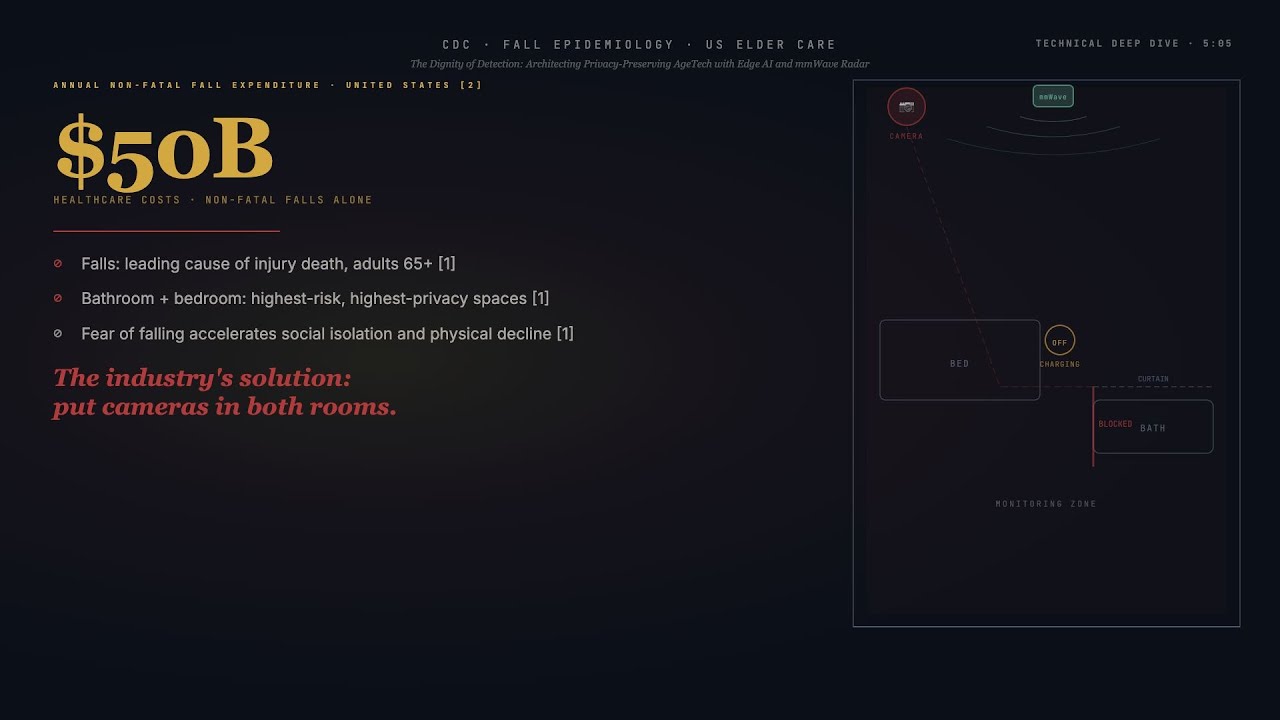
The statistics are stark and universally acknowledged, yet they bear repeating to frame the engineering challenge. Falls are not merely accidents; they are systemic failures of the monitoring environment. According to the Centers for Disease Control and Prevention (CDC), falls are the leading cause of injury among adults aged 65 and older. 1 The economic burden is staggering, with annual healthcare expenditures for non-fatal falls reaching approximately $50 billion in the United States alone. 2
However, the cost extends beyond the balance sheet. The "fear of falling" induces a psychological contraction in the elderly, leading to self-imposed restrictions on mobility, social isolation, and accelerated physical decline. 1 The goal of AgeTech, therefore, is not merely to detect the impact but to create an environment of pervasive safety that restores confidence. The challenge is that the most dangerous spaces—the bathroom and the bedroom—are also the most private.
1.2 The Failure of Legacy Modalities
The traditional response to this crisis has relied on two primary modalities: optical surveillance (cameras) and wearable telemetry (pendants/watches). Both suffer from critical failure modes that render them insufficient for the next generation of care.
1.2.1 The Optical Panopticon
Computer vision has achieved remarkable accuracy in human activity recognition (HAR). However, its deployment in private spaces is ethically fraught. Optical systems capture Personally Identifiable Information (PII) by default. Even with "privacy masking" or low-resolution streaming, the potential for abuse or data leakage creates a psychological burden on the resident.3
Furthermore, optical systems are physically limited:
● Illumination Dependency: Cameras fail in low-light conditions or require intrusive infrared illumination that can disrupt circadian rhythms. 5
● Occlusion: Cameras cannot "see" through shower curtains, blankets, or privacy screens, leaving critical blind spots. 5
● Dignity: The mere presence of a lens destroys the sense of solitude essential for mental well-being. 6
1.2.2 The Compliance Gap of Wearables
Wearable devices (PERS) solve the visual privacy issue but introduce the "compliance gap." Effectiveness is contingent on the user remembering to wear and charge the device. Cognitive decline, sensory issues, or simple forgetfulness render these devices useless in a significant percentage of fall events. Crucially, many falls occur at night when wearables are removed for sleeping or charging, or during bathing when waterproof capabilities are often distrusted by users. 7 A "passive" system—one that requires no user interaction—is the only failsafe approach.
1.3 The Veriprajna Philosophy: Deep AI, Not Just APIs
Veriprajna distinguishes itself in the marketplace by moving beyond superficial "wrapper" solutions. We do not simply stream sensor data to a cloud API. We architect Deep AI solutions that operate at the signal level. By leveraging Frequency Modulated Continuous
Wave (FMCW) radar technology combined with Edge AI, we extract semantic understanding (e.g., "Person A has fallen") from raw electromagnetic reflections without ever reconstructing a visual image. This ensures privacy by physics, not just by policy.
2. Fundamental Physics of Privacy-Preserving Sensing
To engineer a solution that respects privacy while ensuring safety, one must select a sensing modality that is physically incapable of capturing biometric identity (like a face) while remaining highly sensitive to biological motion (like a heartbeat). Millimeter-wave (mmWave) radar is uniquely positioned to meet these contradictory requirements.
2.1 The Electromagnetic Spectrum: Why 60 GHz?
Radar operates by transmitting electromagnetic waves and analyzing their reflections. The choice of frequency determines the interaction with the environment.
● 24 GHz (ISM Band): Historically used for simple motion detection (like automatic doors). It suffers from lower bandwidth (limited range resolution) and larger antenna requirements. 8
● 77 GHz: The standard for automotive radar (adaptive cruise control). While it offers excellent range (300m+), it is optimized for tracking fast-moving vehicles outdoors. 5
● 60 GHz (V-Band): The optimal choice for indoor human monitoring.
○ Fine Resolution: At 60 GHz, the wavelength () is approximately 5mm. This allows for the detection of "micro-motions"—sub-millimeter displacements of the chest wall caused by breathing and heartbeats. 5
○ Privacy Containment: The 60 GHz band sits within the oxygen absorption spectrum, meaning signals attenuate rapidly over distance and do not penetrate thick concrete walls effectively. This prevents the "leakage" of monitoring data outside the intended room, adding a layer of physical data security. 8
○ Regulatory Bandwidth: Regulatory bodies allocate wide bandwidths (up to 4 GHz) in the 60 GHz band for unlicensed use. Range resolution () is inversely proportional to bandwidth (): A 4 GHz bandwidth yields a range resolution of roughly 3.75 cm. This granularity allows the system to distinguish a person’s limbs from their torso, a critical factor in differentiating a fall from a crouch.8
2.2 Frequency Modulated Continuous Wave (FMCW) Mechanics
Unlike pulsed radar, which measures time-of-flight directly, or simple continuous-wave Doppler radar, which only measures velocity, Veriprajna utilizes FMCW radar. The transmitter sends a "chirp"—a sinusoid whose frequency increases linearly with time. When this signal reflects off an object and returns to the receiver, the transmitted signal has moved to a higher frequency. The difference between the transmitted frequency () and the received frequency () at any instant is the beat frequency (). This beat frequency is mathematically related to the distance () to the target:
Where is the slope of the frequency ramp and is the speed of light. By performing a Fast Fourier Transform (FFT) on the beat signal, we convert the signal from the time domain to the frequency domain, where peaks correspond to the distance of objects. 10
2.3 The 4D Sensing Paradigm
Traditional sensors are 1D (distance) or 2D (images). FMCW radar provides a 4D dataset:
1. Range (): Distance to the target (derived from beat frequency).
2. Velocity (): Speed of the target relative to the sensor (derived from the phase shift across multiple chirps, known as the Doppler effect). 5
3. Azimuth (): Horizontal angle (derived from the phase difference between horizontally spaced antennas).
4. Elevation (): Vertical angle (derived from the phase difference between vertically spaced antennas).
This 4D data structure allows the AI to perceive the world not as a flat picture, but as a dynamic volume of moving points. Unlike LiDAR, which provides high-resolution geometry but no instantaneous velocity, radar provides Doppler velocity for every point. This is the "secret sauce" of radar AI: we can separate a stationary chair from a breathing human, even if the human is sitting perfectly still, because the human generates micro-Doppler modulations. 9
3. Signal Processing Architectures for Robust Detection
The raw data from a radar sensor is not immediately usable by a neural network. It is noisy, complex, and high-bandwidth. Veriprajna’s expertise lies in the "Signal Processing Chain"—the algorithmic pipeline that transforms raw ADC data into semantic features.
3.1 The Radar Data Cube
The fundamental data structure in modern radar processing is the Radar Data Cube . It is constructed through a sequence of mathematical transformations:
1. Range FFT (Fast-Time): Performed on the samples within a single chirp. This resolves the range of reflections. 13
2. Doppler FFT (Slow-Time): Performed across the sequence of chirps in a frame. This resolves the velocity of reflections. 10
3. Angle FFT: Performed across the array of antennas. This resolves the spatial location. 14 This cube contains the power intensity for every voxel in the space.
3.2 Clutter Mitigation: The Art of Seeing Through Noise
Indoor environments are hostile to radar. Walls, furniture, and ceilings generate massive reflections (clutter) that can drown out the reflection from a human body.
● Static Clutter Removal: The simplest approach is to subtract the mean value of the samples across the Doppler dimension. This effectively removes objects with zero velocity (walls, furniture). However, this naive approach can inadvertently remove a person who has fallen and is lying unconscious (and thus static).
● Adaptive Clutter Filtering: Veriprajna implements advanced adaptive filtering. We utilize the phase stability of the signal to distinguish between "dead" static objects (walls) and "living" static objects (unconscious humans). Even a motionless human has chest wall displacement (breathing), which creates a subtle phase modulation that our algorithms preserve while suppressing the wall reflections. 15
3.3 Constant False Alarm Rate (CFAR) Detection
Once clutter is suppressed, we must detect "targets" (points of interest) against the background noise floor. A fixed threshold is insufficient because the noise floor varies with temperature and interference. We employ CFAR (Constant False Alarm Rate) algorithms, which dynamically adjust the threshold based on the local noise environment.
3.3.1 CFAR Methodologies
● CA-CFAR (Cell Averaging): Calculates the threshold based on the average power of neighboring cells. This works well in uniform noise but degrades when multiple targets are close together. 17
● OS-CFAR (Ordered Statistic): This is the industry standard for multi-target environments. It sorts the power values of neighboring cells and selects the -th rank value as the noise estimate. This is robust against "masking," where a strong reflection (e.g., a metal cabinet) hides a weaker reflection (a person) nearby. 19
● Deep CFAR: Emerging research suggests replacing classical CFAR with lightweight neural networks (CNNs) that learn the statistical distribution of clutter and target peaks, offering superior performance in complex environments. 14 Veriprajna is pioneering the deployment of these "Neural Detectors" on edge hardware.
3.4 Feature Extraction: Micro-Doppler and Point Clouds
The output of the detection stage is two-fold:
1. Micro-Doppler Spectrograms: By stacking Doppler FFTs over time, we create a visual representation of velocity. A human walking produces a distinct pattern (torso moving at constant speed, limbs oscillating at higher speeds). A fall produces a sudden, broadband burst of energy (acceleration) followed by zero velocity. 12
2. Point Clouds: A set of tuples representing detected targets in 3D space. This allows for trajectory tracking and posture analysis. 23
4. Deep Learning Paradigms for Radar Perception
While classical signal processing detects motion, Deep Learning is required to understand intent and context . Is the motion a fall, or just a person lying down on a bed? Veriprajna leverages three distinct AI architectures to solve this classification problem.
4.1 Convolutional Neural Networks (CNNs) on Spectrograms
We treat the Micro-Doppler spectrogram as an image and apply computer vision techniques.
● Architecture: We utilize Deep Convolutional Neural Networks (DCNNs). Unlike the massive ResNet models used for ImageNet, we design lightweight, shallow CNNs optimized for the specific texture of radar spectrograms. 25
● Feature Learning: The CNN learns to recognize the "shape" of a fall. A fall signature typically exhibits a high-energy "torso flash" at low frequencies, accompanied by high-frequency "limb flashes," followed immediately by a cessation of signal. In contrast, "sitting down" shows a gradual deceleration. 22
● Performance: Benchmark studies indicate that CNN-based approaches on spectrograms consistently outperform classical machine learning (SVM, Random Forest) by margins of 7-10% in accuracy, primarily due to their ability to learn invariant features robust to noise. 25
4.2 Point Cloud Processing: PointNet and GNNs
Spectrograms lack spatial context. They know how fast something moved, but not where . To solve this, we process the 3D point cloud.
● PointNet: Standard CNNs cannot handle point clouds because they are unordered and sparse. PointNet is a specialized architecture that consumes raw point sets and learns spatial features (e.g., the vertical distribution of points). It can distinguish a person standing (vertical column of points) from a person lying down (horizontal spread of points). 3
● Graph Neural Networks (GNNs): We treat the radar points as nodes in a graph, with edges representing spatial proximity. GNNs allow the model to learn the geometric relationship between body parts, effectively "skeletonizing" the reflection without a camera. 3
4.3 Sequence Modeling: LSTM and Transformers
A fall is a temporal event: Standing Unstable Falling Impact Lying. Static frame analysis often fails to capture this causality.
● CNN-LSTM: We employ a hybrid architecture where a CNN extracts spatial features from each frame, which are then fed into a Long Short-Term Memory (LSTM) network. The LSTM maintains a "memory" of the sequence, allowing it to differentiate between a stumble (recovery) and a fall (no recovery). 27
● Radar Transformers (RadMamba): The cutting edge of research involves Transformer architectures (like Vision Transformers or ViT) adapted for radar. These models use "self-attention" mechanisms to weigh the importance of different time steps and frequency bins. Recent innovations like RadMamba utilize State Space Models (SSMs) to handle long sequences of radar data with linear computational complexity, making them more efficient than Transformers for edge deployment. 29
4.4 Sensor Fusion: The "Dual Stream" Approach
The most robust systems use Sensor Fusion . Veriprajna implements a Dual-Stream Network:
1. Stream A (Spectrogram): Analyzes velocity dynamics (Micro-Doppler).
2. Stream B (Point Cloud): Analyzes spatial trajectory (Height-Time).
3. Fusion Layer: Combines these insights.
● The "Sit vs. Fall" Solution: A classic radar problem is the "hard sit." A person collapsing onto a sofa generates a Doppler spike similar to falling. By fusing the streams, the AI sees the high velocity (Stream A) but notes that the final centroid height is (Stream B), correctly classifying it as "Sitting" rather than "Falling" (). 31
Table 1: Comparative Analysis of AI Architectures for Radar
| Architecture | Input Data | Key Strength | Computation al Cost |
Best For |
|---|---|---|---|---|
| 2D CNN | Micro-Doppler Spectrogram |
High accuracy in distinguishing motion types (e.g., Walk vs. Fall) |
Medium | Classifcation of dynamic events |
| PointNet / GNN |
3D Point Cloud | Spatial context (Posture recognition, Height analysis) |
High | Static posture analysis (Lying vs. Sititng) |
|---|---|---|---|---|
| LSTM / GRU | Sequence of Features |
Temporal continuity; distinguishing stumbles from falls |
Low-Medium | Time-series tracking |
| Transformer / ViT |
Radar Cube / Patches |
Global context awareness; handling long dependencies |
Very High | Complex multi-person scenarios |
| Veriprajna Dual-Stream |
Fusion (Spectrogram + Point Cloud) |
Combines velocity dynamics with spatial accuracy |
Optimized | Robust, enterprise-gra de fall detection |
5. Edge Intelligence: Engineering Constraints and Solutions
Sending high-bandwidth radar data to the cloud for processing is a privacy risk, a latency bottleneck, and a bandwidth cost. Veriprajna advocates for Edge AI, where the neural network inference occurs directly on the sensor's embedded processor.
5.1 Hardware Platforms: The Silicon Enablers
We target high-performance microcontrollers (MCUs) and Digital Signal Processors (DSPs) optimized for RF sensing.
● Texas Instruments (TI) mmWave: Devices like the IWRL6432 or IWR6843 are "Systems-on-Chip" (SoC). They integrate the RF front-end, a C674x DSP for signal processing (FFTs), and an ARM Cortex-R4/M4 for the application logic. This tight integration allows for extremely low latency. 5
● Infineon XENSIV: The BGT60TR13C pairs with external high-performance MCUs (like STM32 or PSoC). The trend toward "Antenna-in-Package" (AiP) reduces the physical form factor, making sensors unobtrusive and easy to install in consumer environments. 34
5.2 Optimizing for the Edge: TensorFlow Lite for Microcontrollers
Running a Deep Neural Network on a microcontroller with 512KB of RAM requires extreme optimization.
● Quantization: Standard neural networks use 32-bit floating-point numbers. We convert these to 8-bit integers (INT8). This reduces the model size by 4x and speeds up inference, often with negligible loss in accuracy (<1%). 35
● Pruning: We remove redundant connections (weights) in the neural network that contribute little to the output, creating "sparse" models that are faster to compute.
● CMSIS-NN: We utilize ARM's CMSIS-NN library, which provides hand-optimized assembly kernels for Convolution and Matrix Multiplication on Cortex-M processors. This allows us to squeeze every cycle of performance out of the hardware. 37
5.3 Power Consumption Management
For sensors powered by batteries or Power-over-Ethernet (PoE), power efficiency is critical.
● Duty Cycling: The radar does not need to chirp continuously. We implement "inter-frame idle" states where the RF front-end is powered down.
● Hierarchical Wake-up: A low-power "presence detection" chirp runs continuously. Only when coarse motion is detected does the high-power "fall detection" deep learning model wake up to analyze the event. This "cascade" approach can extend battery life from days to months. 13
6. Overcoming Environmental Variance: The "Long Tail" of False Alarms
In the controlled environment of a laboratory, radar works perfectly. In a real home, there are ceiling fans, curtains blowing in the wind, and pets. These "false alarm generators" are the primary obstacle to commercial adoption. Veriprajna employs a multi-layered suppression strategy.
6.1 The "Ceiling Fan" Problem
A rotating fan generates a constant, high-frequency Doppler signature that can blind the CFAR algorithm or masquerade as a flailing limb.
● Solution: Microwave Noise Adaptive Processing. We train the AI to recognize the periodic, stationary-location signature of a fan. The system builds a "static map" of the room. If high Doppler velocity is consistently detected at a fixed coordinate (the ceiling), that specific cell is masked from the fall detection logic. The AI learns that "high velocity at is normal". 39
6.2 The "Pet" Problem
A large dog jumping off a sofa can generate a Doppler signature and point cloud trajectory dangerously similar to a falling human.
● Solution: RCS and Aspect Ratio Filtering.
○ RCS (Radar Cross Section): While variable, the electromagnetic reflectivity of a dog is generally lower than that of an adult human.
○ Geometric Classification: We analyze the bounding box of the point cloud. A human typically occupies a vertical column (Aspect Ratio ). A dog occupies a horizontal volume (Aspect Ratio ). Our classification models include a specific "Animal" class to explicitly filter these events. 39
6.3 The "Curtain" Problem
Curtains moving in a draft create "ghost targets" that can trigger presence detection or false motion alerts.
● Solution: Zone Masking. During installation, the system allows for the definition of "Interference Zones" (windows, AC vents). The tracking algorithm (Extended Kalman Filter) increases the confidence threshold required to initiate a track in these zones. Additionally, the micro-Doppler signature of a curtain (low-frequency, sinusoidal oscillation) is distinct from human motion and is filtered by the deep learning classifier. 41
7. The Integration Ecosystem: Enterprise Connectivity
A sensor that detects a fall but cannot communicate it effectively is useless. For enterprise deployment in nursing homes and assisted living facilities, the sensor must integrate into the existing care ecosystem.
7.1 Nurse Call Systems (UL 1069)
The central nervous system of any care facility is the Nurse Call System (NCS) . This system is governed by UL 1069 ("Standard for Hospital Signaling and Nurse Call Equipment"), which mandates rigorous reliability, supervision, and failsafe operations. 43
● Dry Contact / Relay Integration: The most robust and compatible method. Veriprajna sensors include an opto-isolated Solid State Relay (SSR) output. When a fall is detected, the relay closes. This connects to the "auxiliary" input of the legacy nurse call station on the wall (e.g., Rauland, Ascom, Hill-Rom). This triggers the standard nurse call light and pager system. It is simple, failsafe, and compatible with 90% of existing infrastructure. 45
● High-Level API Integration: Modern NCS platforms support IP-based protocols. Veriprajna sensors can push JSON payloads via MQTT or REST APIs to a central server. This allows for richer data: instead of a generic "Room 302 Alarm," the nurse sees "Room 302: Fall Detected (High Confidence)" or "Room 302: Resident has not moved for 4 hours". 46
7.2 Connectivity Protocols
● Wi-Fi / Ethernet: High bandwidth, suitable for pushing point cloud visualization to a nurse station (if permitted). Requires robust IT infrastructure.
● LoRaWAN: Low power, long range. Ideal for "check-in" messages (e.g., "Resident has not moved") and battery-operated sensors. However, latency capabilities must be evaluated for critical fall alerts. 48
● Matter / Zigbee: Essential for smart home integration. For example, the sensor can trigger the lights to turn on automatically when a resident sits up in bed at night, acting as a preventative measure against falls. 48
7.3 Compliance and Security Frameworks
● GDPR and HIPAA: Because mmWave radar does not capture biometric identifiers (faces, fingerprints) or recognizable images, it is intrinsically more compliant with GDPR and HIPAA than cameras. It processes "anonymous motion data." However, behavioral patterns (e.g., bathroom frequency) constitute health data (PHI) and must be protected. Veriprajna employs TLS 1.2+ encryption for all data in transit and AES-256 for data at rest. 6
● ISO 31700 (Privacy by Design): Veriprajna adheres to the ISO 31700 standard for consumer goods.
○ Proactive: Privacy is engineered into the hardware (no microphone, no lens).
○ Default: The highest privacy setting is the default.
○ Lifecycle: Data minimization strategies ensure data is deleted when no longer
needed. 50
8. Strategic Value and Future Horizons
Implementing Veriprajna’s Deep AI Radar solution is an investment, but the Return on Investment (ROI) is tangible and measurable.
8.1 The ROI of Dignity
● Direct Cost Avoidance: A single fall with injury costs a facility between $30,000 and $60,000 in medical costs, liability, and increased care requirements. 52
● Indirect Cost Savings: Reducing "false alarms" reduces staff burnout and "alarm fatigue." When the system alerts, staff know it is real.
● ROI Calculation: Investing in a sensor system yields a positive ROI if it prevents just one hospitalization-level fall every 5 years. Studies show evidence-based fall prevention programs can deliver an ROI of over 500% ($5 saved for every $1 spent). 52
8.2 Operational Efficiency through Analytics
Beyond emergency alerts, the system provides longitudinal analytics .
● Preventative Care: By tracking gait speed and activity levels over weeks, the system can detect the subtle decline that precedes a fall. "Mrs. Jones is walking 20% slower this week" is a powerful leading indicator that allows for intervention before an accident occurs.
● Staff Efficiency: Nurses no longer need to perform intrusive "rounds" just to check if a resident is in bed. The dashboard provides real-time presence status, allowing staff to focus on residents who actually need assistance. 54
8.3 The Future: 6G and Sensor Fusion
The roadmap for radar is accelerating.
● 6G Sensing (ISAC): Future 6G networks will integrate sensing and communication (ISAC). The Wi-Fi router of the future will be the fall detection sensor, utilizing the ubiquitous radio waves already filling our homes. 21
● Multi-Modal Fusion: Combining mmWave radar with thermal imaging or acoustic sensors (for voice calls) will further enhance accuracy while maintaining privacy.
Conclusion
The transition from "surveillance" to "sensing" is the defining shift of the AgeTech decade. We have moved past the era where safety required a compromise on dignity. By replacing the camera lens with the mmWave antenna, and replacing the human monitor with Deep Edge AI, we resolve the conflict between safety and privacy.
Veriprajna is not just selling a sensor; we are providing the Deep AI infrastructure —the cleaned signals, the robust classification models, the false-alarm rejection logic, and the secure enterprise integration—that makes this promise a reality. We offer a solution that is physically incapable of "watching them naked," yet computationally capable of keeping them safe.
Safe. Secure. Private. This is the promise of Veriprajna.
Works cited
The impact of fall detection technology and prevention - Best Buy Health, accessed December 12, 2025, https://www.bestbuyhealth.com/insights/blog/the-impact-of-fall-detection-technology-and-prevention/
The Seriousness of Senior Falls: Understanding the Costs and Solutions - Intrex, accessed December 12, 2025, https://www.intrexis.com/senior-falls/
Using mmWave Radar and Deep Learning to Classify Caregiver Activities for Infection Prevention | Request PDF - ResearchGate, accessed December 12, 2025, https://www.researchgate.net/publication/398309699_Using_mmWave_Radar_and_Deep_Learning_to_Classify_Caregiver_Activities_for_Infection_Prevention
A Narrative Review on Key Values Indicators of Millimeter Wave Radars for Ambient Assisted Living - MDPI, accessed December 12, 2025, https://www.mdpi.com/2079-9292/14/13/2664
A Brief Introduction to Millimeter Wave Radar Sensing - Edge AI and Vision Alliance, accessed December 12, 2025, https://www.edge-ai-vision.com/2023/12/a-brief-introduction-to-millimeter-wave-radar-sensing/
Privacy-First Healthcare: How Linpowave mmWave Radar Enables Non-Contact Monitoring, accessed December 12, 2025, https://linpowave.com/blog/privacy-first-healthcare-linpowave-mmwave-radar
Millimeter Wave Radar-based Human Activity Recognition for Healthcare Monitoring Robot - arXiv, accessed December 12, 2025, https://arxiv.org/html/2405.01882v1
Millimeter-Wave Sensors Accuracy and Applications - DFRobot, accessed December 12, 2025, https://www.dfrobot.com/blog-1654.html
What Is mmWave Radar Sensing? | D3 Embedded, accessed December 12, 2025, https://www.d3embedded.com/mmwave-radar-sensing/
block diagram of an FMCW radar. - ResearchGate, accessed December 12, 2025, https://www.researchgate.net/figure/block-diagram-of-an-FMCW-radar_fig1_332665836
Frequency-Modulated Continuous-Wave Radar (FMCW Radar) - Radartutorial.eu, accessed December 12, 2025, https://www.radartutorial.eu/02.basics/Frequency%20Modulated%20Continuous%20Wave%20Radar.en.html
Activity Recognition Based on Micro-Doppler Signature with In-Home Wi-Fi arXiv, accessed December 12, 2025, https://arxiv.org/pdf/1611.01801
Machine Learning on the Edge with the ... - Texas Instruments, accessed December 12, 2025, https://www.ti.com/lit/pdf/swra774
Benchmarking CFAR and CNN-based Peak Detection Algorithms in ISAC under Hardware Impairments - arXiv, accessed December 12, 2025, https://arxiv.org/pdf/2505.10969
(PDF) Clutter Mitigation in Indoor Radar Sensors Using Sensor Fusion Technology, accessed December 12, 2025, https://www.researchgate.net/publication/391751312_Cluter_Mitigation_in_Indoort_Radar_Sensors_Using_Sensor_Fusion_Technology
Enhancing Sensing-Assisted Communications in Cluttered Indoor Environments through Background Subtraction - arXiv, accessed December 12, 2025, https://arxiv.org/pdf/2401.05763
Constant false alarm rate - Wikipedia, accessed December 12, 2025, https://en.wikipedia.org/wiki/Constant_false_alarm_rate
Constant False Alarm Rate (CFAR) Detection - MATLAB & Simulink - MathWorks, accessed December 12, 2025, https://www.mathworks.com/help/phased/ug/constant-false-alarm-rate-cfar-detection.html
Object Detection with Automotive Radar Sensors using CFAR Algorithms - JKU, accessed December 12, 2025, https://www.jku.at/fileadmin/gruppen/183/Docs/Finished_Theses/Bachelor_Thesis_Katzlberger_final.pdf
Radar Target Detection with CNN - EURASIP, accessed December 12, 2025, https://eurasip.org/Proceedings/Eusipco/Eusipco2021/pdfs/0001581.pdf
Benchmarking CFAR and CNN-based Peak Detection Algorithms in ISAC under Hardware Impairments - ResearchGate, accessed December 12, 2025, https://www.researchgate.net/publication/391856921_Benchmarking_CFAR_and_CNN-based_Peak_Detection_Algorithms_in_ISAC_under_Hardware_Impairments
Resolution-Adaptive Micro-Doppler Spectrogram for Human Activity Recognition - arXiv, accessed December 12, 2025, https://arxiv.org/html/2411.15057v2
Examples of mmWave radar point clouds viewed from the spatial, the ST,... ResearchGate, accessed December 12, 2025, https://www.researchgate.net/figure/Examples-of-mmWave-radar-point-clouds-viewed-from-the-spatial-the-ST-and-the-sub-ST_fig2_369813800
MmWave Radar Point Cloud Segmentation using GMM in Multimodal Traffic Monitoring - arXiv, accessed December 12, 2025, https://arxiv.org/pdf/1911.06364
Deep Learning Multi-Class Approach for Human Fall Detection Based on Doppler Signatures - MDPI, accessed December 12, 2025, https://www.mdpi.com/1660-4601/20/2/1123
Radar Fall Detectors: A Comparison - Villanova University, accessed December 12, 2025, https://homepage.villanova.edu/moeness.amin/paper_pdf/erol_amin_ahmad_RadarFallDet_SPIE.pdf
Fall Detection from UWB Radars: A Comparative Analysis of Deep Learning and Classical Machine Learning Techniques - ResearchGate, accessed December 12, 2025, https://www.researchgate.net/publication/373709666_Fall_Detection_from_UWB_Radars_A_Comparative_Analysis_of_Deep_Learning_and_Classical_Machine_Learning_Techniques
Unobtrusive Human Fall Detection System Using mmWave Radar and Data Driven Methods | Request PDF - ResearchGate, accessed December 12, 2025, https://www.researchgate.net/publication/368622594_Unobtrusive_Human_Fall_Detection_System_Using_mmWave_Radar_and_Data_Driven_Methods
RadMamba: Efficient Human Activity Recognition through Radar-based Micro-Doppler-Oriented Mamba State-Space Model - arXiv, accessed December 12, 2025, https://arxiv.org/pdf/2504.12039
TRANS-CNN-Based Gesture Recognition for mmWave Radar - MDPI, accessed December 12, 2025, https://www.mdpi.com/1424-8220/24/6/1800
Fall Direction Detection in Motion State Based on the FMCW Radar - PMC - NIH, accessed December 12, 2025, https://pmc.ncbi.nlm.nih.gov/articles/PMC10255840/
An Effective Deep Learning Framework for Fall Detection: Model Development and Study Design, accessed December 12, 2025, https://www.jmir.org/2024/1/e56750/
New edge AI-enabled radar sensor and automotive audio processors from TI empower automakers to reimagine in-cabin experiences, accessed December 12, 2025, https://www.ti.com/about-ti/newsroom/news-releases/2025/2025-01-06-new-edge-ai-enabled-radar-sensor-and-automotive-audio-processors-from-ti-empower-automakers-to-reimagine-in-cabin-experiences.html
Infineon Serves Up New 60 GHz CMOS Radar Aimed at Low-Power IoT - News, accessed December 12, 2025, https://www.allaboutcircuits.com/news/infineon-serves-up-new-60-ghz-cmos-radar-aimed-at-low-power-iot/
Tensorflow Lite for Microcontrollers | Machine Learning | v2.0.0 | Silicon Labs, accessed December 12, 2025, https://docs.silabs.com/machine-learning/2.0.0/machine-learning-tensorfow-litel-for-microcontrollers/
TinyML: Getting Started with TensorFlow Lite for Microcontrollers - DigiKey, accessed December 12, 2025, https://www.digikey.com/en/maker/projects/tinyml-getting-started-with-tensorfolw-lite-for-microcontrollers/c0cdd850f5004b098d263400aa294023
Accelerated inference on Arm microcontrollers with TensorFlow Lite for Microcontrollers and CMSIS-NN, accessed December 12, 2025, https://blog.tensorflow.org/2021/02/accelerated-inference-on-arm-microcontrollers-with-tensorflow-lite.html
TensorFlow Lite Micro with ML acceleration, accessed December 12, 2025, https://blog.tensorflow.org/2023/02/tensorflow-lite-micro-with-ml-acceleration.html
Motion sensors and detectors | KEENFINITY Group I Global, accessed December 12, 2025, https://www.keenfinity-group.com/xc/en/solutions/intrusion-alarm-systems/motion-sensors-and-detectors/
False Alarm Reduction: The Case for 3D LiDAR in Modern Security Systems Blickfeld, accessed December 12, 2025, https://www.blickfeld.com/blog/false-alarm-reduction-with-3d-lidar/
FAQ-Hobacare-focusing on telecare and telehealth for seniors, accessed December 12, 2025, https://hobacare.cn/?list_9/
Presence Sensor FP2 FAQ - Aqara, accessed December 12, 2025, https://www.aqara.com/en/product/presence-sensor-fp2/faq/
Nurse Call and Emergency Call Systems | UL Solutions, accessed December 12, 2025, https://www.ul.com/news/nurse-call-and-emergency-call-systems
UL 1069 Ed. 8-2024 - Hospital Signaling and Nurse Call Equipment - ANSI Webstore, accessed December 12, 2025, https://webstore.ansi.org/standards/ul/ul1069ed2024
60G Eldercare Radar Sensor Fall/Get Up/Presence (Dry Contact), accessed December 12, 2025, https://creatrolsensor.com/products/60506201
99% Accurate Radar Fall Detection Sensor for Elderly Care | Milesight, accessed December 12, 2025, https://www.milesight.com/iot/product/lorawan-sensor/vs373
Nurse Call System API - developer.siemens.com, accessed December 12, 2025, https://developer.siemens.com/nurse-call-system/overview.html
Milesight VS373 Radar Fall Detection Sensor - The Future Of Care-Giving And More, accessed December 12, 2025, https://www.longtermcareprovider.com/doc/milesight-vs-radar-fall-detection-sensor-the-future-of-care-giving-and-more-0001
HIPAA vs GDPR (Differences and Similarities) - Sprinto, accessed December 12, 2025, https://sprinto.com/blog/hipaa-vs-gdpr/
7 steps to comply with ISO 31700-1:2023 (standard on Privacy by Design) OneTrust, accessed December 12, 2025, https://www.onetrust.com/blog/7-steps-to-comply-with-iso-31700-12023-standard-on-privacy-by-design/
ISO 31700: A New Standard for Operationalising Privacy by Design - FTI Technology, accessed December 12, 2025, https://www.ftitechnology.com/resources/blog/iso-31700-a-new-standard-for-operationalising-privacy-by-design
ROI for a Fall Prevention Intervention: Invest a Little, Save a Lot - PubMed, accessed December 12, 2025, https://pubmed.ncbi.nlm.nih.gov/38848487/
Are Falls Prevention Programs Efficient? ROI Report - National Council on Aging, accessed December 12, 2025, https://www.ncoa.org/article/return-on-investment-of-evidence-based-falls-prevention-programs/
Master Thesis Enhancing In-home Care with mmWave Radar: A Non-intrusive Approach to Human Activity Recognition and Monitoring - Student Theses Faculty of Science and Engineering, accessed December 12, 2025, https://fse.studenttheses.ub.rug.nl/34714/1/MasterThesisMartBerends.pdf
Integrated Sensing and Edge AI: Realizing Intelligent Perception in 6G - arXiv, accessed December 12, 2025, https://arxiv.org/html/2501.06726v2
Prefer a visual, interactive experience?
Explore the key findings, stats, and architecture of this paper in an interactive format with navigable sections and data visualizations.
Frequently Asked Questions
How does mmWave radar detect falls without compromising privacy?
60GHz FMCW radar transmits frequency chirps and analyzes reflections to build a 4D dataset of range, velocity, azimuth, and elevation. At 5mm wavelength, it detects sub-millimeter chest wall displacements for breathing but cannot reconstruct facial features or visual images. The 60GHz oxygen absorption band naturally contains signals within the room. Deep learning classifies micro-Doppler signatures and 3D point clouds, providing safety through physics-based sensing rather than optical surveillance.
How does the dual-stream architecture distinguish falls from similar motions?
Stream A processes micro-Doppler spectrograms through CNNs to analyze velocity dynamics, while Stream B processes 3D point clouds through PointNet or GNNs for spatial posture recognition. A fusion layer combines both streams. For example, a hard sit onto a sofa generates high Doppler velocity similar to a fall, but the point cloud shows final centroid height at 0.5 meters rather than floor level, correctly classifying the event as sitting rather than falling.
How does the radar system integrate with existing nurse call infrastructure?
Veriprajna sensors include an opto-isolated solid state relay output that connects to the auxiliary input of legacy UL 1069 nurse call stations. When a fall is detected, the relay closes, triggering the standard nurse call light and pager system. For modern IP-based platforms, sensors push JSON payloads via MQTT or REST APIs with enriched data such as fall confidence level and inactivity duration, compatible with 90% of existing care facility infrastructure.
Also Published On
Build Your AI with Confidence.
Partner with a team that has deep experience in building the next generation of enterprise AI. Let us help you design, build, and deploy an AI strategy you can trust.
Veriprajna Deep Tech Consultancy specializes in building safety-critical AI systems for healthcare, finance, and regulatory domains. Our architectures are validated against established protocols with comprehensive compliance documentation.