Privacy-Preserving Fall Detection with mmWave Radar & Deep Edge AI
The elder care industry faces an impossible choice: safety or dignity. Cameras invade privacy. Wearables suffer from compliance gaps. Veriprajna solves this through physics—using 60 GHz millimeter-wave radar that is physically incapable of capturing faces, yet computationally capable of detecting falls with 99% accuracy.
We architect Deep AI solutions at the signal level—FMCW radar, micro-Doppler analysis, and edge neural networks running on TI mmWave SoCs. This ensures safety without surveillance, keeping the elderly safe without "watching them naked."
Veriprajna partners with nursing homes, assisted living facilities, healthcare providers, and senior care operators to resolve the privacy-safety dilemma—delivering dignity-preserving monitoring that actually works.
Reduce liability, prevent falls, and improve resident satisfaction. Our mmWave sensors integrate seamlessly with existing UL 1069 nurse call systems—triggering alerts without intrusive cameras or unreliable wearables.
Deploy passive monitoring that respects patient dignity. No compliance gap—radar works even when patients forget wearables, sleep, or bathe. Detects falls in bathrooms and bedrooms where cameras are ethically unacceptable.
Enable seniors to live independently longer with unobtrusive safety monitoring. Battery-powered LoRaWAN sensors with hierarchical wake-up extend battery life from days to months while maintaining real-time fall alerts.
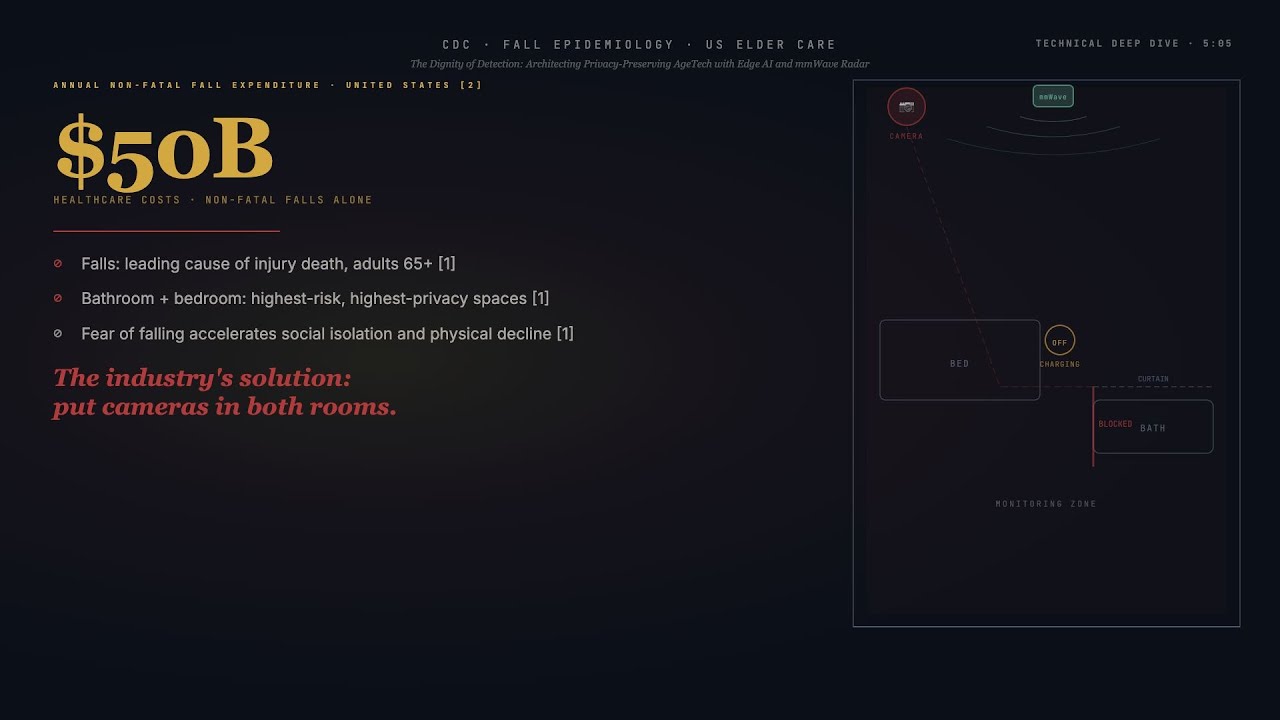
Falls are the leading cause of injury-related death for adults 65+. Yet traditional monitoring solutions create a "Panopticon of Care"—safety purchased at the cost of dignity.
Computer vision cameras capture Personally Identifiable Information (PII) by default. Even with "privacy masking," the mere presence of a lens destroys the sense of solitude essential for mental well-being.
Wearable PERS devices (pendants, watches) require users to remember to wear and charge them. Cognitive decline, sensory issues, or forgetfulness render these devices useless in critical fall events.
A single fall with injury costs facilities $30,000-$60,000 in medical costs, liability, and increased care requirements. Fear of falling induces psychological contraction, leading to accelerated decline.
"The industry's reliance on optical surveillance and wearable telemetry has created a 'Panopticon of Care,' where safety is purchased at the cost of dignity. This trade-off is a failure of engineering imagination, not an inevitability of care."
— Veriprajna Technical Whitepaper, 2024
Optical cameras capture visual images that reveal identity, clothing, and intimate details. mmWave radar captures electromagnetic reflections that reveal motion signatures—without ever reconstructing a recognizable image.
At 60 GHz, wavelength λ ≈ 5mm. This allows detection of micro-motions (breathing, heartbeat) while being physically incapable of resolving facial features. Privacy is not a software feature—it's fundamental physics.
Toggle the simulation to see how cameras expose identity while radar preserves anonymity. Both detect the fall—only radar protects dignity.
We don't sell sensors. We architect Deep AI infrastructure—combining signal physics, digital signal processing, and advanced neural networks running on resource-constrained edge devices.
Most vendors stream sensor data to cloud-based Large Language Models. Veriprajna operates at the signal physics level—FMCW radar chirps, FFT processing, CFAR detection, and micro-Doppler analysis. We extract semantic understanding ("Person has fallen") from raw EM reflections.
Our neural networks run directly on TI mmWave SoCs (IWRL6432, IWR6843) and Infineon XENSIV chips. TensorFlow Lite Micro with INT8 quantization, CMSIS-NN optimization, and hierarchical wake-up achieve real-time inference at <300ms latency.
Real-world environments have ceiling fans, pets, and curtains. We solve the "long tail" of false alarms through adaptive clutter filtering, zone masking, RCS/aspect ratio analysis, and dual-stream fusion (spectrogram + point cloud).
Veriprajna adheres to ISO 31700 (Privacy by Design), HIPAA (no PHI without anonymization), and GDPR (no biometric data capture). TLS 1.2+ encryption for data in transit, AES-256 for data at rest, with behavioral pattern protection.
Frequency selection determines interaction with the environment. 60 GHz is optimal for indoor human monitoring—balancing resolution, privacy containment, and regulatory bandwidth.
Historically used for motion detection (automatic doors). Lower bandwidth limits range resolution to ~6cm. Larger antenna requirements make form factor bulky.
Standard for automotive radar (adaptive cruise control). Excellent range (300m+) but optimized for fast-moving vehicles outdoors, not nuanced indoor human motion.
Optimal for elder care. Wavelength λ ≈ 5mm enables micro-motion detection (breathing, heartbeat). Oxygen absorption provides natural privacy containment—signals don't leak through walls.
Traditional sensors are 1D (distance) or 2D (images). FMCW radar provides a 4D dataset—allowing AI to perceive the world as a dynamic volume of moving points.
Classical signal processing detects motion. Deep Learning understands context—distinguishing a fall from sitting down, a stumble from a recovery.
Micro-Doppler spectrograms treated as images. Deep CNNs learn motion "shapes"—torso flash + limb flash + cessation = fall signature.
3D point cloud processing for spatial context. Distinguishes standing (vertical column) from lying down (horizontal spread) via geometric analysis.
Sequence modeling for temporal causality. CNN-LSTM hybrids maintain "memory" to differentiate stumble (recovery) from fall (no recovery).
Stream A (velocity) + Stream B (spatial trajectory) fused to solve "hard sit" problem—high velocity but final height z ≈ 0.5m = sitting, not falling.
Convert 32-bit floats to 8-bit integers. Reduces model size by 4x, speeds up inference, often with <1% accuracy loss. Critical for 512KB RAM MCUs.
ARM's hand-optimized assembly for Cortex-M processors. Every CPU cycle matters when processing 380 FPS radar frames in real-time.
Low-power presence detection chirp runs continuously. Deep learning model wakes only on coarse motion—extending battery life from days to months.
See how different activities produce unique velocity patterns. Falls exhibit characteristic "broadband burst" (acceleration) followed by zero velocity.
Evidence-based fall prevention programs deliver 500% ROI. Adjust parameters based on your facility's profile.
CDC data: ~1.5 falls per bed per year in assisted living
Typical range: $30K-$60K per injury fall
Evidence-based programs: 20-40% reduction
Seamless connectivity with existing care infrastructure—UL 1069 nurse call systems, EMR platforms, and IoT ecosystems.
Veriprajna sensors include opto-isolated Solid State Relay (SSR) outputs. When a fall is detected, the relay closes—connecting to the "auxiliary" input of legacy nurse call stations (Rauland, Ascom, Hill-Rom).
Multi-protocol support ensures deployment flexibility across diverse facility IT environments—from legacy wired systems to modern IoT networks.
mmWave radar does not capture biometric identifiers (faces, fingerprints). Processes "anonymous motion data." TLS 1.2+ for data in transit, AES-256 at rest.
Privacy by Design standard compliance: Proactive (no lens/mic), Default (highest privacy), Lifecycle (data minimization).
Hospital Signaling & Nurse Call Equipment standard—rigorous reliability, supervision, and failsafe operation requirements met.
At 60 GHz, the radar wavelength is approximately 5mm, which allows detection of micro-motions like breathing and heartbeat while being physically incapable of resolving facial features. The sensor captures electromagnetic reflections as Doppler velocity and 3D point cloud data, not visual images. Privacy is guaranteed by fundamental physics, not software masking, making it HIPAA and GDPR compliant by design.
Veriprajna's mmWave fall detection achieves 99% accuracy using a dual-stream fusion architecture. Stream A processes micro-Doppler spectrograms through CNNs to learn motion shapes like torso flash and limb flash patterns. Stream B uses PointNet/GNNs for 3D point cloud spatial analysis. The dual-stream approach solves the hard sit problem by combining velocity data with final height analysis to distinguish falls from controlled sitting.
A single fall with injury costs facilities $30,000-$60,000 in medical costs and liability. Evidence-based fall prevention programs deliver 500% ROI, returning $5 saved for every $1 spent. Annual US healthcare expenditure on non-fatal falls is $50 billion. The CDC reports approximately 1.5 falls per bed per year in assisted living, making prevention a significant financial and clinical imperative.
Veriprajna's mmWave Radar + Deep Edge AI solution doesn't just monitor falls—it fundamentally reimagines elder care technology through the lens of privacy-first engineering.
Schedule a technical consultation to discuss deployment at your facility, pilot program options, and custom ROI modeling.
Complete engineering report: FMCW radar physics, signal processing architectures, Deep Learning paradigms, edge optimization techniques, false alarm mitigation, enterprise integration protocols, compliance frameworks, and comprehensive works cited.