Beyond the Visible: The Imperative for Hyperspectral Deep Learning in Enterprise Agriculture
Executive Manifesto: The End of the JPEG Era in AgTech
The digitization of agriculture has reached a critical inflection point, yet a fundamental inefficiency remains embedded at the core of the industry's analytics stack. For the better part of a decade, the "AgTech" sector has relied on a computer vision paradigm imported from consumer photography and social media—standard Red-Green-Blue (RGB) imagery processed by Convolutional Neural Networks (CNNs) designed to recognize shapes, edges, and textures. This approach, effective for identifying a cat in a YouTube video or a car on a street, fails catastrophically when applied to the scientific monitoring of biological systems from orbit.
Veriprajna posits a foundational correction to this trajectory: Maps are not pictures. They are data.
Treating a multi-spectral satellite image as a standard JPEG effectively discards the vast majority of the capture's intelligence. Standard image classifiers, such as ResNet, are optimized to detect morphological changes—the "shape" of a dying field. By the time a crop field changes shape or visible color to the extent that an RGB model can classify it as "stressed," the biological damage is often irreversible. The economic consequences of this latency are measured in billions of dollars of lost yield and excessive chemical application.
This whitepaper outlines the transition from Spatial-Morphological Analysis to Spectral-Chemical Analysis . We argue that the industry must move beyond "looking" at crops to "reading" their biochemistry. By leveraging Hyperspectral Imaging (HSI) combined with specialized Deep Learning architectures—specifically 3D-CNNs and Spectral-Spatial Transformers—we can detect the spectral signature of chlorophyll degradation and water stress weeks before the human eye or a standard camera can perceive a shift from green to brown.
Veriprajna is not a "wrapper" consultancy. We do not simply pipe data into a generic Large Language Model (LLM) or a pre-trained vision API. We are a Deep AI Solution Provider . We build the custom neural architectures required to handle the high-dimensional tensors of hyperspectral cubes, navigating the complex physics of radiative transfer and the mathematical challenges of the "Curse of Dimensionality." This document serves as the blueprint for the next generation of agricultural intelligence, designed for the enterprise that demands scientific rigor over superficial visual inspection.
1. The Epistemological Crisis in Remote Sensing
1.1 The Dimensionality Gap: Why RGB is Insufficient
In the domain of computer vision, the success of architectures like ResNet, VGG, and Inception on datasets such as ImageNet has created a false sense of universality. These models were trained to replicate human visual perception, which is biologically limited to the visible spectrum (approximately 400nm to 700nm). Human vision—and by extension, the RGB cameras designed to mimic it—is an evolutionary adaptation for identifying objects based on spatial boundaries, textures, and contrast. 1
However, the primary indicators of vegetation health are not spatial; they are chemical. A healthy soybean plant and a drought-stressed soybean plant often possess identical spatial geometries (shape, height, leaf orientation) until the stress becomes terminal. The difference lies in how their cellular structures and chemical pigments interact with electromagnetic radiation. By restricting analysis to three broad bands (Red, Green, Blue), traditional computer vision compresses a rich, continuous signal into a lossy, three-dimensional vector. This compression discards the specific absorption features of chlorophyll , chlorophyll , carotenoids, and identifying water absorption bands in the Near-Infrared (NIR) and Short-Wave Infrared (SWIR) regions. 2
Satellite instruments are not cameras in the colloquial sense; they are radiometers measuring photon radiance across specific wavelengths. When an enterprise reduces this radiometric data to a visual image for the sake of using a standard "off-the-shelf" AI model, they are actively destroying data. They are treating a scientific instrument like an iPhone camera. The result is a system that "sees" the farm but does not "understand" the crop.
1.2 The "Green" Trap and Detection Latency
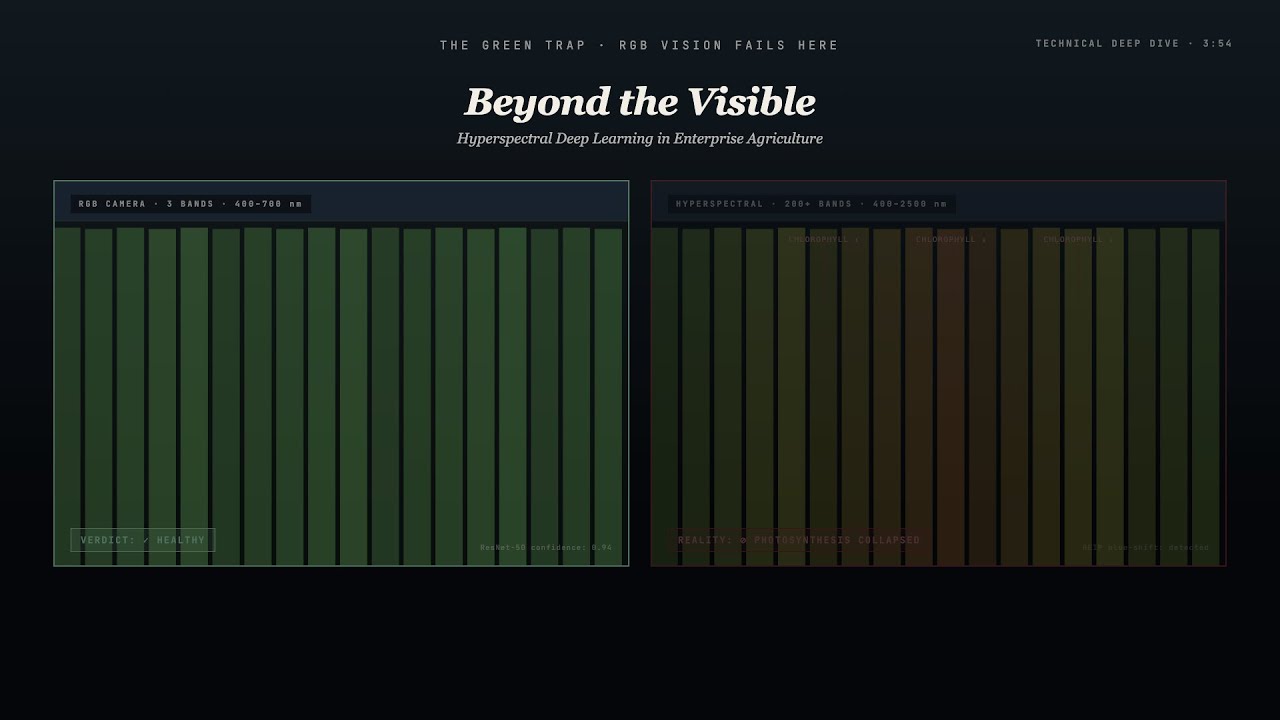
The most pernicious failure mode of RGB analysis in agriculture is the "Green Trap." To the human eye and a standard RGB sensor, a plant remains "green" long after physiological stress has begun. The reduction in photosynthetic efficiency, a precursor to visible yellowing (chlorosis), causes subtle changes in reflectance in the 531 nm and 570 nm bands (xanthophyll cycle) and significant changes in the 700 nm to 1300 nm range (cell structure scattering). 2
Standard Convolutional Neural Networks (2D-CNNs) operate by convolving filters over spatial dimensions () to extract features like edges and corners. In an agricultural context, a 2D-CNN looking at an RGB image might successfully identify "this is a corn field" or "this is a tractor," but it struggles to answer "is this corn field photosynthetically efficient?" because the relevant data resides in the spectral dimension (), which the 2D-CNN aggregates or ignores. 3
The result is a detection latency of 10 to 15 days. 4 By the time an RGB model detects a change in texture or color consistent with "stress," the crop has likely already suffered yield-limiting damage. The "shape" of a dying crop is a post-mortem indicator; the "spectrum" of a stressed crop is a diagnostic vital sign. Veriprajna’s approach aims to close this latency gap, shifting the intervention window from reactive to proactive.
1.3 The Artifacts of Compression and Quantization
Furthermore, the standard pipeline for "computer vision" involves converting satellite data (often 12-bit or 16-bit radiometric integers) into 8-bit integers (0-255) for display and processing by standard libraries. This quantization introduces noise and reduces the dynamic range of the signal, flattening subtle variations in canopy reflectance that correlate with nutrient content or early-stage disease. 5
For deep AI solutions, the raw, floating-point radiance values must be preserved. This requires custom data loaders and architectures capable of handling high-bit-depth tensors, rather than standard image processing pipelines. It implies a fundamental rethinking of the data infrastructure, moving away from "image stores" towards "tensor lakes" where the physical integrity of the radiometric measurement is preserved for the neural network.
1.4 The Illusion of the "Wrapper" Solution
In the current AI hype cycle, many consultancies position themselves as AI experts by wrapping standardized APIs from providers like OpenAI or Google Cloud Vision. While effective for text summarization or identifying common objects, this "Wrapper AI" approach is impotent in high-stakes scientific domains. An LLM cannot parse a 200-band hyperspectral cube. A generic vision API trained on internet photos cannot distinguish between nitrogen deficiency and fungal infection in a wheat canopy.
Veriprajna operates on the principle of Deep AI . This means we build the models from the ground up, designing the neural architecture to match the physical nature of the data. We do not outsource the "thinking" to a black box; we own the mathematical operations that transform spectral radiance into agronomic insight. This distinction is critical for the enterprise client who requires auditability, reliability, and genuine competitive advantage rather than a commoditized service.
2. The Physics of Spectral Intelligence
To understand why Hyperspectral Deep Learning is necessary, one must first appreciate the physical interaction between light and vegetation. This interaction is the fundamental "ground truth" that Veriprajna's models are designed to decode.
2.1 The Electromagnetic Spectrum and Plant Physiology
Vegetation interacts with solar radiation through three primary mechanisms: absorption, transmission, and reflection. These interactions are wavelength-dependent and governed by specific biophysical properties. A standard RGB camera integrates these complex interactions into three broad buckets, washing out the critical details. Hyperspectral sensors, by contrast, measure the spectrum in narrow, contiguous bands, revealing the fine structure of the interaction. 1
Table 1: Biophysical Drivers of Spectral Reflectance
| Spectral Region | Wavelength Range |
Biophysical Driver | Signifci ance for AI Models |
|---|---|---|---|
| Visible (VIS) | 400 - 700 nm | Pigments (Chlorophyll, Carotenoids) |
Strong absorption by chlorophyll for photosynthesis. High refectance in Green (550nm). Early indicator of pigment degradation. |
| Red Edge | 680 - 750 nm | Chlorophyll concentration & Leaf Structure |
The transition zone. The steepest slope in the refectance curve. Crucial for early stress detection and "Blue Shif" analysis. |
| Near-Infrared (NIR) |
750 - 1300 nm | Mesophyll Cell Structure |
High refectance due to internal scatering. Indicates biomass and cell integrity. Collapse in NIR signals structural damage. |
2.2 The Chlorophyll Signature and the "Red Edge"
The "Red Edge" is the sharp increase in reflectance between the red visible band (670 nm),
where chlorophyll absorbs light, and the Near-Infrared band (780 nm), where the plant's
spongy mesophyll structure scatters light. 6 In a healthy plant, chlorophyll absorption is
intense, making the reflectance at 670 nm very low. Simultaneously, healthy cell structure
reflects NIR strongly. This creates a steep "cliff" or edge in the spectral graph.
The Blue Shift Mechanism: When a plant encounters stress—whether from drought, disease, or nutrient deficiency—chlorophyll production decreases. As chlorophyll concentration drops, the absorption in the red band decreases (reflectance increases). Concurrently, the slope of the Red Edge shifts toward shorter wavelengths (towards the blue/green part of the spectrum). This phenomenon is physically known as the "Blue Shift" of the Red Edge Inflection Point (REIP).7 This shift is measurable nanometers at a time. A standard RGB camera, which integrates all photons from ~600-700nm into a single "Red" channel, is mathematically incapable of detecting a 5nm shift in the inflection point. It averages the shift out. A hyperspectral sensor, with narrow bands (e.g., 5-10 nm width), can resolve the shape of this curve and pinpoint the exact position of the inflection point. 6 Veriprajna's models utilize this "Blue Shift" as a primary feature. By detecting the subtle migration of the REIP, our algorithms predict harvest failure while the field still appears verdant to the naked eye and to standard NDVI (Normalized Difference Vegetation Index) calculations. 2
2.3 Beyond NDVI: The Limitations of Broadband Indices
The industry standard for decades has been NDVI, calculated as . While useful for general biomass estimation, NDVI suffers from saturation in high-density canopies and sensitivity to soil background noise. More importantly, NDVI is a "broadband" index. It treats the entire "Red" region and entire "NIR" region as monolithic blocks. 4
Hyperspectral Deep Learning moves beyond simple arithmetic ratios. It utilizes the full continuous spectrum. Instead of two data points (Red and NIR), it utilizes hundreds. This allows for the derivation of "Narrowband Indices" and, more importantly, the learning of non-linear, complex spectral features that no manual index can capture. For example, detecting the specific absorption pit of a fungal pathogen that might exist at exactly 531 nm, or distinguishing between nitrogen deficiency and water stress, which look similar in NDVI but distinct in the SWIR bands. 2
Research confirms that while indices like NDVI correlate with general health, they fail to distinguish types of stress. Hyperspectral analysis, however, allows for the differentiation of stress vectors. Nitrogen deficiency affects the visible and red-edge regions differently than water stress, which primarily impacts the SWIR bands. 2 Our Deep AI models learn these multi-dimensional manifolds, allowing for specific diagnoses rather than generic "stress" alerts.
2.4 Thermal Inertia and Transpiration
While optical bands reveal chemistry, thermal bands reveal physiology. Stomatal conductance—the opening and closing of leaf pores—regulates plant temperature through transpiration. When a plant is water-stressed, it closes its stomata to conserve moisture. This stops evaporative cooling, and the canopy temperature rises.
Satellites equipped with thermal sensors (like Landsat or specialized commercial constellations) can detect this temperature spike. However, a "hot" field could just be a field with bare soil or different topography. Veriprajna’s models integrate thermal data with hyperspectral vegetation indices to decouple the "soil signal" from the "canopy signal." By analyzing the Spectral-Thermal relationship, we can identify "physiological drought"—where the plant is stressed despite available soil moisture, perhaps due to root disease or salinity. 10
This level of nuance is impossible with standard optical imagery.
3. The Mathematical Failure of Legacy Computer Vision
3.1 The Convolutional Trap
The workhorse of modern computer vision is the 2D Convolutional Neural Network (2D-CNN). These networks operate by sliding a small filter (kernel) across the spatial dimensions of an image. At each position, the kernel performs a dot product with the underlying pixels and sums the result across all channels.
This equation reveals the fundamental flaw when applied to hyperspectral data: the summation over channels () happens immediately. The network aggregates the spectral information into a single value to create a spatial feature map. While this is acceptable for RGB images where the three channels are highly correlated and carry similar spatial information, it is destructive for hyperspectral data. 3
In a hyperspectral cube, the correlation between distant bands (e.g., band 10 and band 150) might hold the key to identifying a specific pathogen. A standard 2D-CNN effectively "squashes" this relationship in the first layer, forcing the network to rely on spatial textures. But as we have established, the spatial texture of a stressed plant often does not change until it is too late. The 2D-CNN is therefore looking for the wrong thing, in the wrong place, using the wrong math.
3.2 The Curse of Dimensionality (Hughes Phenomenon)
Hyperspectral data is characterized by high dimensionality. A single pixel is not a scalar or a vector of 3; it is a vector of 200+. In traditional machine learning, this leads to the "Curse of Dimensionality," or the Hughes Phenomenon. 12
The Hughes Phenomenon states that for a fixed number of training samples, the predictive power of a classifier increases with dimensionality only up to a point. Beyond that peak, adding more dimensions (bands) actually degrades performance because the volume of the feature space grows exponentially, making the data "sparse." The model overfits to the noise in the high-dimensional space rather than learning the signal.
Standard approaches attempt to solve this by using Principal Component Analysis (PCA) to reduce the 200 bands down to 10 or 20 "principal components" before feeding them into a model. 14 While computationally efficient, PCA is a linear transformation that can discard subtle, non-linear spectral features that are critical for specific disease detection but do not contribute significantly to the overall variance of the image. Veriprajna rejects generic dimensionality reduction. We believe the "curse" is actually a blessing of information, provided one uses the correct non-linear architecture to ingest it.
3.3 Transfer Learning: The ImageNet Fallacy
A common shortcut in the AI consultancy world is "Transfer Learning"—taking a model like ResNet-50, which has been pre-trained on the ImageNet dataset (millions of photos of dogs, cars, and lamps), and "fine-tuning" it on satellite data.
This approach is fundamentally flawed for hyperspectral agronomy for three reasons:
1. Domain Shift: The statistical distribution of pixel values in a radiometric image is completely different from a consumer photograph. Shadows, atmospheric scattering, and sensor noise create a unique noise profile that ImageNet models are not robust to.
2. Channel Mismatch: ImageNet models expect 3 input channels. Adapting them to take 12, 50, or 200 channels requires hacking the first layer, which destroys the learned feature detectors, negating the benefit of pre-training.
3. Feature Irrelevance: An ImageNet model has learned to detect "eyes," "wheels," and "fur." These high-level features do not exist in a corn field. The relevant features are spectral absorption curves and texture gradients at a specific scale. The "knowledge" transfer is minimal and often detrimental. 15
Veriprajna advocates for Domain-Specific Pre-training . We train our models from scratch on massive datasets of satellite imagery, allowing the network to learn the "visual language" of the earth's surface—the spectral signature of water, the texture of forests, the geometric patterns of agriculture—rather than the visual language of internet photos.
4. Hyperspectral Deep Learning: The Veriprajna Architecture
The core of Veriprajna’s technical differentiation lies in the neural network architectures we deploy. We do not use off-the-shelf models; we engineer architectures where the spectral dimension is treated as a first-class citizen.
4.1 The 3D-CNN Solution
To strictly preserve and learn from the spectral structure, we employ 3D Convolutional Neural Networks (3D-CNNs) . In a 3D-CNN, the convolution kernel has three dimensions: height, width, and depth (spectral bands). 16
Where:
● is the value at position in the feature map.
● are spatial kernel dimensions.
● is the spectral kernel dimension.
This architecture allows the model to extract features that are simultaneously spatial and spectral. The kernel slides not just across the image, but through the spectrum. This enables the network to learn local spectral features, such as the slope of the Red Edge or the depth of a water absorption well, directly from the raw data. 16
Our research aligns with findings that 3D-CNNs significantly outperform 2D-CNNs in classifying hyperspectral data because they preserve the inter-band correlations that define material properties. 15 By using 3D kernels, we allow the network to explicitly learn the "shape" of the spectral curve at each pixel, rather than just the intensity.
4.2 Spectral-Spatial Transformers: Modeling Long-Range Dependencies
While 3D-CNNs are excellent at local feature extraction (e.g., correlations between band 40 and 42), they can struggle with long-range dependencies (e.g., connecting a spectral pattern in the visible range with one in the SWIR range, which might be hundreds of bands apart). To address this, Veriprajna utilizes Spectral-Spatial Transformers . 18
Transformers, originally designed for Natural Language Processing (NLP), utilize an "Attention Mechanism" to weigh the importance of different parts of an input sequence. We treat the hyperspectral pixel vector as a sequence of spectral tokens. The Self-Attention mechanism allows the model to dynamically focus on the most relevant spectral bands for a specific prediction task, regardless of how far apart they are in the spectrum. 19
For example, when predicting drought stress, the model learns to "attend" strongly to the relationship between the Red Edge bands and the SWIR water absorption bands, effectively ignoring the noise in irrelevant bands. This capability makes our models robust to the "Hughes Phenomenon" by learning to selectively prioritize features. 18 This dynamic weighting is superior to static band selection because it adapts to the context of the specific pixel.
Hybrid Architectures: Our production models often employ a hybrid approach:
1. 3D-CNN Front-end: Extracts local spectral-spatial features and reduces the dimensionality of the raw hypercube.
2. Transformer Back-end: Processes the sequence of extracted features to model global context and long-range spectral dependencies.
This "best of both worlds" approach ensures we capture both the micro-structure of the leaf chemistry and the macro-structure of the field variability. 18
4.3 Self-Supervised Learning (SSL): Solving the Label Scarcity Crisis
One of the biggest bottlenecks in "Deep AgTech" is the lack of labeled data. "Ground truthing"—physically sending an agronomist to a field to verify if a plant is stressed—is expensive, slow, and unscalable. We have petabytes of satellite imagery, but only a tiny fraction of it is labeled with "Disease" or "Healthy."
Veriprajna employs Self-Supervised Learning (SSL) techniques, such as Masked Autoencoders (MAE) tailored for spectral data. 19 In this paradigm, we mask out a portion of the spectral bands (e.g., hide the NIR bands) and train the model to reconstruct the missing data based on the remaining visible bands.
By forcing the network to learn the correlations between different parts of the spectrum (e.g., "if Red is high, NIR should be low"), the model learns a robust internal representation of plant physics without needing a single human label. Once pre-trained on massive archives of unlabeled satellite imagery, these models can be fine-tuned on small labeled datasets for specific tasks (e.g., "Soybean Rust Detection") with extremely high performance. 23
Recent benchmarks from 2024 and 2025 indicate that SSL frameworks can achieve over 92% accuracy in early disease detection using unlabeled data, matching the performance of fully supervised baselines while drastically reducing the need for field labels. 22 This allows Veriprajna to scale globally without needing armies of agronomists in every county.
4.4 Distance-Based Spectral Pairing
To further refine our SSL approach, we utilize Distance-Based Spectral Pairing . This technique leverages the physiologically meaningful separability in hyperspectral space to create high-confidence training pairs. By calculating the Euclidean distance between spectral vectors in the feature space, we can automatically identify pixels that are spectrally similar (likely the same crop/health status) and those that are distinct.
This allows the encoder to learn robust features directly from canopy reflectance without manual annotations, effectively "bootstrapping" its own understanding of the field's variability. This method has shown to improve accuracy by over 11% compared to traditional clustering methods. 22
5. The Data Infrastructure of Deep AI
For a company claiming to be a "Deep AI" provider, the model is only the tip of the iceberg. The submerged mass is the data infrastructure. Processing hyperspectral data requires a fundamentally different stack than processing standard images.
5.1 The Volume Challenge
A single multispectral image from Sentinel-2 (13 bands) is roughly 4-5 times larger than a standard RGB image. A hyperspectral image from a sensor like EnMAP or a commercial drone (200+ bands) can be 50-100 times larger. A single flight campaign can generate Terabytes of raw data.
Veriprajna utilizes a cloud-native architecture optimized for high-throughput tensor processing . We do not store data as files in folders; we store them as chunked, compressed arrays (using formats like Zarr or Cloud Optimized GeoTIFF) that allow for parallel reading of specific spectral chunks. This allows our GPU clusters to ingest data at the speed required for training 3D-CNNs. 24
5.2 Preprocessing: The "Garbage In, Garbage Out" Filter
In hyperspectral analysis, the atmosphere is the enemy. Water vapor, aerosols, and scattering in the atmosphere distort the signal reaching the satellite. A "raw" satellite image (Level 1C) contains this atmospheric noise. If you feed this into a neural network, the model might learn to classify "clouds" or "haze" rather than crop health.
Veriprajna implements rigorous Atmospheric Correction pipelines to convert Top-of-Atmosphere (TOA) radiance into Bottom-of-Atmosphere (BOA) reflectance (Level 2A). We use physics-based radiative transfer models (like MODTRAN or 6S) accelerated by neural network approximations to strip away the atmosphere and recover the true spectral signature of the canopy.
Furthermore, we perform Geometric Correction and Co-registration to ensure that a pixel at coordinates today corresponds exactly to the same physical patch of ground as the pixel at last week. Without this sub-pixel alignment, temporal analysis (tracking change over time) is impossible. 5
5.3 Synthetic Data Generation
To make our models robust to edge cases (rare diseases, unusual lighting conditions), we employ Generative Adversarial Networks (GANs) to create synthetic hyperspectral data. By training a GAN on real spectral samples, we can generate infinite variations of "diseased soybean spectra" under different lighting and soil conditions. This synthetic data augments our training set, preventing overfitting and ensuring our models perform well even in scenarios they haven't explicitly seen before. 17
6. Economic and Strategic Implications
The shift from RGB to Hyperspectral AI is not just a technical upgrade; it is an economic imperative. The ROI of "Spectral Intelligence" is driven by the time-value of information.
6.1 Moving from Reaction to Prevention
The economic value of agricultural intelligence is a function of time. Information received after the point of intervention has zero value.
● Reactive Monitoring (RGB/Visual): Detects damage after it occurs. Used for insurance claims and damage assessment. Value: Low .
● Predictive Monitoring (Hyperspectral AI): Detects stress before damage is irreversible. Used for yield protection and input optimization. Value: High .
Studies indicate that AI-based early disease detection can prevent yield losses of 15-40%, with a Return on Investment (ROI) for the detection technology often exceeding 150%. 26 For a large enterprise managing thousands of hectares, this translates to millions of dollars in retained revenue. The ability to detect stress 10-14 days pre-symptomatically allows for targeted fungicide applications, which are far more effective and cheaper than blanket spraying after the disease is established. 27
6.2 Optimization of Inputs: Precision at Scale
Precision agriculture, enabled by spectral maps, allows for Variable Rate Technology (VRT) . Instead of spraying an entire field with nitrogen or pesticide, farmers can spray only the areas identified as spectrally deficient.
● Nitrogen Efficiency: Hyperspectral models can quantify leaf nitrogen content with high precision. 29 Reducing nitrogen application by 10% across a large portfolio not only improves margins but significantly reduces environmental runoff, aiding in ESG compliance.
● Water Management: Thermal and SWIR bands provide a direct proxy for crop water stress. Optimizing irrigation schedules based on real-time plant need rather than a calendar can reduce water usage by 20-25%. 30
6.3 Case Studies in Spectral Intelligence
Case Study A: Planet Labs & Organic Valley - Pasture Optimization
Planet Labs, leveraging their high-frequency satellite constellation, partnered with Organic Valley to optimize grazing. By using satellite data to model biomass and forage quality (protein content inferred from spectral signatures), they helped dairy farmers increase pasture utilization by 20% . The system provides near-daily reports on forage levels, allowing farmers to rotate herds dynamically based on the actual growth rate of the grass, rather than intuition. This is a direct application of using "data maps" to drive operational efficiency. 31
Case Study B: Descartes Labs - Beating the USDA
Descartes Labs utilized machine learning on massive archives of satellite spectral data to forecast US corn production. By analyzing the spectral health of millions of acres daily, their models achieved a statistical error of just 2.37% in early August—weeks before the USDA's official survey data could reach similar accuracy. In an 11-year backtest, their spectral models had lower error than the USDA's forecasts at every point in the growing season. This demonstrates the power of "Deep AI" to aggregate micro-level spectral insights into macro-level market intelligence. 32
Case Study C: Gamaya - Hyperspectral Drones for Sugarcane
Gamaya, a Swiss AgTech company, deployed hyperspectral cameras on drones to monitor sugarcane fields in Brazil. Their specialized sensors could detect the specific spectral signature of nematodes (a root parasite) and nutrient deficiencies that RGB drones missed entirely. By stitching these hyperspectral cubes using high-performance GPU clusters (a "Deep AI" infrastructure challenge), they enabled farmers to reduce fertilizer use while boosting yields, proving the commercial viability of high-dimensional spectral analysis. 24
6.4 Supply Chain and Insurance
For commodity traders and insurers, Hyperspectral AI reduces basis risk. Parametric insurance products, which pay out based on data triggers (e.g., "if yield drops below X"), rely on accurate, tamper-proof data. Hyperspectral indices provide a verifiable "truth" that is correlated with actual yield losses, allowing for faster payouts and more accurate risk pricing. 34
7. Future Horizons: The Veriprajna Roadmap
The field of Hyperspectral AI is evolving rapidly. Veriprajna is positioning itself at the bleeding edge of this evolution.
7.1 The Satellite Revolution: Tanager and EnMAP
We are entering a golden age of hyperspectral data. New satellite missions like Planet’s Tanager (carbon and chemical signatures), Germany’s EnMAP, and NASA’s upcoming Surface Biology and Geology (SBG) mission are increasing the availability of high-quality spectral data. 35 These satellites will provide the raw fuel for Veriprajna’s models, offering global coverage with spectral resolution previously available only to laboratory spectrometers.
7.2 Edge AI: Processing in Orbit
The next frontier is Edge AI . Transmitting Terabytes of hyperspectral data from space to earth is slow and expensive. Veriprajna is researching lightweight 3D-CNNs and quantized Transformers that can run directly on the satellite's onboard hardware (FPGAs or specialized AI chips).
By processing the data in orbit, the satellite can transmit just the "insight" (e.g., "Field A has Rust") rather than the raw data. This reduces latency from hours to minutes, enabling near-real-time alerts for critical events like pest outbreaks or irrigation failures. 25
7.3 Beyond Agriculture: Multi-Vertical Applications
While our focus is agriculture, the physics of spectroscopy applies universally. The same "Deep AI" architectures we use for chlorophyll detection can be adapted for:
● Mining: Identifying surface mineral deposits (lithium, copper) via their spectral signatures. 14
● Environmental Monitoring: Detecting methane leaks, oil spills, and algal blooms. 35
● Defense: Identifying camouflaged vehicles (which may look green in RGB but lack the "Red Edge" of real vegetation). 1
8. Conclusion: The Spectral Future
The era of "digital farming" based on pretty pictures is over. The future belongs to Spectral Intelligence . As satellite constellations multiply and the volume of hyperspectral data explodes, the "Wrapper AI" approach will crumble under the weight of high-dimensional tensors it cannot understand.
Enterprises that stick to standard Computer Vision will drown in data while starving for insight. They will see the field, but they will miss the harvest. They will continue to optimize for "shapes" while the chemistry of their crops tells a different story—one they are currently deaf to.
Veriprajna offers the bridge to this new reality. We do not just look at pixels; we read the spectrum. We do not just see green fields; we see the chemical and biological reality of the crop. By leveraging Hyperspectral Deep Learning, we empower our clients to predict the future of their fields, optimize their resources, and secure their yields in an increasingly volatile climate.
Stop looking at pixels. Start reading the spectrum.
9. Technical Appendix: Performance Metrics
To substantiate the superiority of Hyperspectral Deep Learning over standard RGB approaches, we present a synthesis of performance metrics derived from recent academic and industrial benchmarks.
Table 2: Classification Accuracy Comparison (RGB vs. Multispectral/Hyperspectral)
| Metric | Standard RGB (ResNet-50) |
Multispectral/ Hyperspectra l (3D-CNN/Tra nsformer) |
Improvement | Source |
|---|---|---|---|---|
| Tumor/Stress Grading |
80% | 86% - 94% | +6% to +14% | 27 |
| Accuracy | Col2 | Col3 | Col4 | Col5 |
|---|---|---|---|---|
| Land Cover Classifcation |
Baseline | +16.67% | +16.67% | 1 |
| Target Detection Accuracy |
Baseline | +3.09% | +3.09% | 1 |
| Disease Recognition (Soybean) |
85-90% (Late Stage) |
92-95% (Early Stage) |
Early Detection | 22 |
Table 3: The Latency Advantage
| Detection Method | Signal Source | Detection Time (Relative to Symptom Onset) |
Actionability |
|---|---|---|---|
| Visual / RGB | Leaf Color (Chlorosis/Necrosis ) |
+10 to +15 Days | Low (Too late for efective treatment) |
| NDVI (Multispectral) |
Canopy Density / Greyness |
+5 to +10 Days | Medium (Can mitigate some loss) |
| Hyperspectral (Veriprajna) |
Chemical (Chlorophyll/Water) |
-7 to -14 Days (Pre-symptomatic) |
High (Preventive treatment possible) |
Note: Negative days indicate detection before visible symptoms appear to the human eye.
Works cited
A Robust Multispectral Reconstruction Network from RGB Images Trained by Diverse Satellite Data and Application in Classification and Detection Tasks MDPI, accessed December 11, 2025, https://www.mdpi.com/2072-4292/17/11/1901
(PDF) Hyperspectral Image Analysis for Plant Stress Detection, accessed December 11, 2025, https://www.researchgate.net/publication/271420740_Hyperspectral_Image_Analysis_for_Plant_Stress_Detection
Full article: MSNet: multispectral semantic segmentation network for remote sensing images, accessed December 11, 2025, https://www.tandfonline.com/doi/full/10.1080/15481603.2022.2101728
MLVI-CNN: a hyperspectral stress detection framework using machine learning-optimized indices and deep learning for precision agriculture - Frontiers, accessed December 11, 2025, https://www.frontiersin.org/journals/plant-science/articles/10.3389/fpls.2025.1631928/full
Deep Learning Innovations: ResNet Applied to SAR and Sentinel-2 ..., accessed December 11, 2025, https://www.mdpi.com/2072-4292/17/12/1961
The Red Edge Advantage: A Powerful Tool for Vegetation Monitoring - Geohub, accessed December 11, 2025, https://geohubkenya.wordpress.com/2024/11/15/the-red-edge-advantage-a-powerful-tool-for-vegetation-monitoring/
Use of hyperspectral derivative ratios in the red-edge region to identify plant stress responses to gas leaks | Request PDF - ResearchGate, accessed December 11, 2025, https://www.researchgate.net/publication/222428231_Use_of_hyperspectral_derivative_ratios_in_the_red-edge_region_to_identify_plant_stress_responses_to_gas_leaks
Exploring the relationship between reflectance red edge and chlorophyll content in slash pine - Oxford Academic, accessed December 11, 2025, https://academic.oup.com/treephys/article-pdf/7/1-2-3-4/33/9935579/7-1-2-3-4-33.pdf
Temporal Changes of Leaf Spectral Properties and Rapid Chlorophyll—A Fluorescence under Natural Cold Stress in Rice Seedlings - PMC - NIH, accessed December 11, 2025, https://pmc.ncbi.nlm.nih.gov/articles/PMC10346184/
Hyperspectral Image Analysis and Machine Learning Techniques for Crop Disease Detection and Identification: A Review - MDPI, accessed December 11, 2025, https://www.mdpi.com/2071-1050/16/14/6064
Unleashing Correlation and Continuity for Hyperspectral Reconstruction from RGB Images, accessed December 11, 2025, https://arxiv.org/html/2501.01481v1
Curse of dimensionality - Wikipedia, accessed December 11, 2025, https://en.wikipedia.org/wiki/Curse_of_dimensionality
(PDF) Consequences of the Hughes phenomenon on some classification Techniques, accessed December 11, 2025, https://www.researchgate.net/publication/283485444_Consequences_of_the_Hughes_phenomenon_on_some_classification_Techniques
Machine Learning and Deep Learning Techniques for Spectral Spatial Classification of Hyperspectral Images: A Comprehensive Survey - MDPI, accessed December 11, 2025, https://www.mdpi.com/2079-9292/12/3/488
Architecture of 2D CNN model for spatial feture extraction - ResearchGate, accessed December 11, 2025, https://www.researchgate.net/figure/Architecture-of-2D-CNN-model-for-spatial-feture-extraction_fig4_363005338
An Enhanced Spectral Fusion 3D CNN Model for Hyperspectral Image Classification - MDPI, accessed December 11, 2025, https://www.mdpi.com/2072-4292/14/21/5334
Deep learning techniques for hyperspectral image analysis in agriculture: A review, accessed December 11, 2025, https://www.researchgate.net/publication/379475673_Deep_learning_techniques_for_hyperspectral_image_analysis_in_agriculture_A_review
Full article: A hybrid convolution transformer for hyperspectral image classification - Taylor & Francis Online, accessed December 11, 2025, https://www.tandfonline.com/doi/full/10.1080/22797254.2024.2330979
SatMAE: Pre-training Transformers for Temporal and Multi-Spectral Satellite Imagery, accessed December 11, 2025, https://papers.neurips.cc/paper_files/paper/2022/file/01c561df365429f33fcd7a7faa44c985-Paper-Conference.pdf
[PDF] Deep Learning Techniques for Hyperspectral Image Analysis in Agriculture: A Review, accessed December 11, 2025, https://www.semanticscholar.org/paper/Deep-Learning-Techniques-for-Hyperspectral-Image-in-Guerri-Distante/f6576583b1ce756c9713b230379334c06c7d5e5e
Progress in applications of self-supervised learning to computer vision in agriculture: A systematic review | Request PDF - ResearchGate, accessed December 11, 2025, https://www.researchgate.net/publication/398173881_Progress_in_applications_of_self-supervised_learning_to_computer_vision_in_agriculture_A_systematic_review
Self-Supervised Learning for Soybean Disease Detection Using UAV Hyperspectral Imagery, accessed December 11, 2025, https://www.mdpi.com/2072-4292/17/23/3928
Self-supervised Learning for Hyperspectral Images of Trees - ResearchGate, accessed December 11, 2025, https://www.researchgate.net/publication/395354761_Self-supervised_Learning_for_Hyperspectral_Images_of_Trees
Gamaya Case Study | Google Cloud Documentation, accessed December 11, 2025, https://cloud.google.com/customers/gamaya
AI-Driven Approaches for Real-Time Satellite Data Processing and Analysis NASA, accessed December 11, 2025, https://assets.science.nasa.gov/content/dam/science/cds/science-enabling-technology/events/2025/accelerating-informatics/PM_6_Ahmad.pdf
Financial Impact Modelling of AI-Driven Crop Disease Mitigation - ResearchGate, accessed December 11, 2025, https://www.researchgate.net/publication/398280241_Financial_Impact_Modelling_of_AI-Driven_Crop_Disease_Mitigation
An Analytical Study on the Utility of RGB and Multispectral Imagery with Band Selection for Automated Tumor Grading - PMC - PubMed Central, accessed December 11, 2025, https://pmc.ncbi.nlm.nih.gov/articles/PMC11312293/
Exploring the Role of Machine Learning in Advancing Crop Disease Detection SciTePress, accessed December 11, 2025, https://www.scitepress.org/Papers/2025/135924/135924.pdf
Hyperspectral Technique Combined With Deep Learning Algorithm for Prediction of Phenotyping Traits in Lettuce - PMC - NIH, accessed December 11, 2025, https://pmc.ncbi.nlm.nih.gov/articles/PMC9279906/
Hyperspectral Imaging for Agriculture - EE Times Europe, accessed December 11, 2025, https://www.eetimes.com/hyperspectral-imaging-for-agriculture/
Space Tech Scaleup Planet Labs Drives Ag Productivity - evokeAG., accessed December 11, 2025, https://www.evokeag.com/how-space-tech-planet-labs-driving-agricultural-productivity/
Advancing the science of corn forecasting - EarthDaily, accessed December 11, 2025, https://earthdaily.com/blog/advancing-the-science-of-corn-forecasting
Google use case about Gamaya: Making sustainable global farming ..., accessed December 11, 2025, https://www.gamaya.com/post/google-use-case-about-gamaya-making-sustainable-global-farming-possible-with-groundbreaking-imaging
Parametric Crop Yield Insurance for Cooperatives - Descartes Underwriting, accessed December 11, 2025, https://descartesunderwriting.com/case-studies/parametric-crop-yield-insurance-cooperatives
Orbit to insight: How Planet powers the next wave of precision ag AgFunderNews, accessed December 11, 2025, https://agfundernews.com/from-orbit-to-insight-how-planet-powers-the-next-wave-of-precision-ag
AI/ML for Mission Processing Onboard Satellites - Lockheed Martin, accessed December 11, 2025, https://www.lockheedmartin.com/content/dam/lockheed-martin/space/documents/ai-ml/PIRA-aiaa-6.2022-1472-aiml-mission-processing-onboard-satellites-paper.pdf
Prefer a visual, interactive experience?
Explore the key findings, stats, and architecture of this paper in an interactive format with navigable sections and data visualizations.
Frequently Asked Questions
Why does standard RGB computer vision fail for crop stress detection?
RGB cameras compress spectral data into three broad bands, discarding chlorophyll absorption features and water absorption bands in Near-Infrared and Short-Wave Infrared regions. Standard 2D-CNNs aggregate spectral channels in the first layer, destroying inter-band correlations. This creates a 10-15 day detection latency because visible color change occurs only after irreversible biological damage.
How do 3D-CNNs improve hyperspectral crop analysis over 2D-CNNs?
3D-CNNs extend the convolution kernel into a third spectral dimension, sliding through wavelength bands rather than immediately aggregating them. This preserves inter-band correlations — such as the Red Edge blue-shift that indicates chlorophyll degradation — enabling the network to learn local spectral-spatial features directly from raw radiometric data that 2D-CNNs mathematically destroy.
What is the Red Edge blue-shift and why is it critical for early crop stress detection?
The Red Edge is the steep reflectance increase between 670nm and 780nm caused by chlorophyll absorption and mesophyll cell scattering. When plants are stressed, reduced chlorophyll shifts this inflection point toward shorter wavelengths by nanometers — undetectable by RGB cameras that average the entire 600-700nm range into one channel, but resolvable by hyperspectral sensors with 5-10nm band width.
Also Published On
Build Your AI with Confidence.
Partner with a team that has deep experience in building the next generation of enterprise AI. Let us help you design, build, and deploy an AI strategy you can trust.
Veriprajna Deep Tech Consultancy specializes in building safety-critical AI systems for healthcare, finance, and regulatory domains. Our architectures are validated against established protocols with comprehensive compliance documentation.