The Imperative for Hyperspectral Deep Learning in Enterprise Agriculture
The digitization of agriculture has reached a critical inflection point. For the better part of a decade, AgTech has relied on RGB imagery—a paradigm imported from consumer photography. This approach, effective for identifying a cat in a YouTube video, fails catastrophically when applied to the scientific monitoring of biological systems from orbit.
Maps are not pictures. They are data. By the time an RGB model detects a "stressed" crop, biological damage is often irreversible. Veriprajna's Hyperspectral Deep Learning detects chlorophyll degradation and water stress 7-14 days before visible symptoms—shifting intervention from reactive to proactive.
The "JPEG Era" in AgTech treats multi-spectral satellite images as standard photographs, effectively discarding the vast majority of the capture's intelligence.
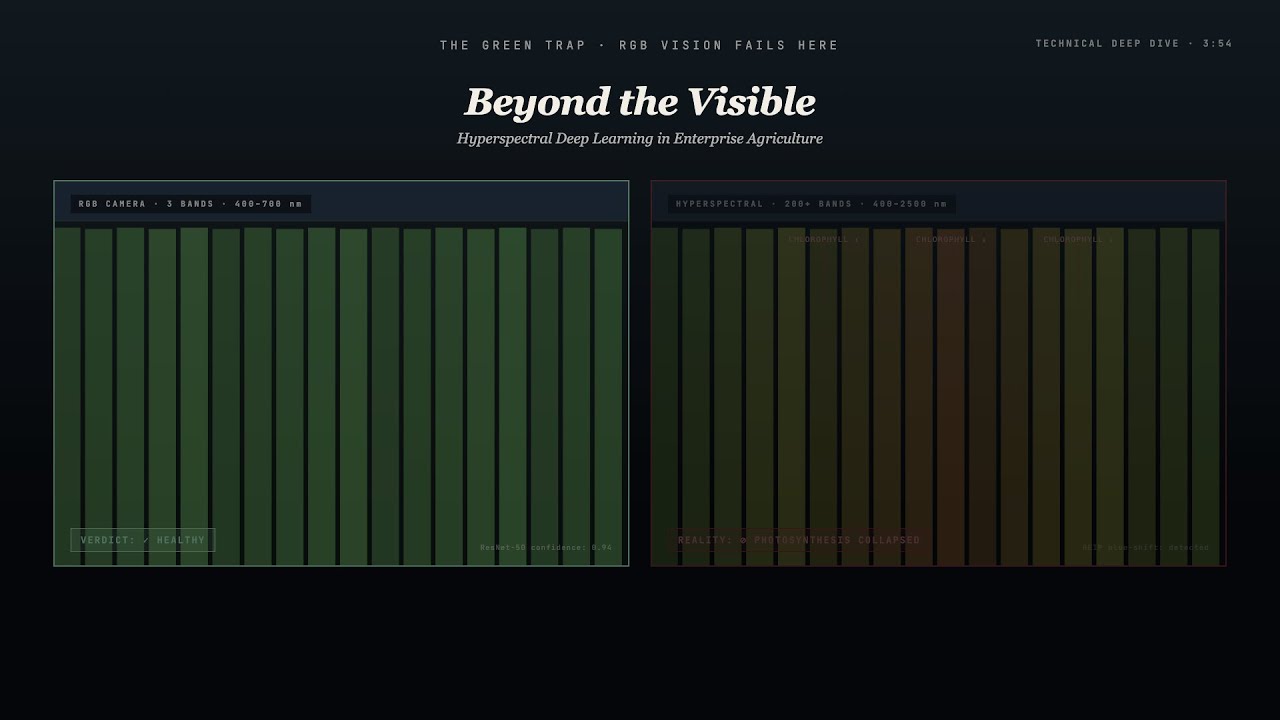
Human vision is biologically limited to 400-700nm (visible spectrum). RGB cameras compress a rich, continuous spectral signal into a lossy, 3-dimensional vector—discarding chlorophyll absorption, water bands, and chemical signatures.
To the human eye and RGB sensors, a plant remains "green" long after physiological stress begins. Standard CNNs struggle to answer "is this corn photosynthetically efficient?" because relevant data resides in the spectral dimension λ, which 2D-CNNs aggregate or ignore.
Many consultancies wrap standardized APIs (OpenAI, Google Cloud Vision) for AgTech. An LLM cannot parse a 200-band hyperspectral cube. A generic vision API cannot distinguish nitrogen deficiency from fungal infection in wheat.
"Treating a multi-spectral satellite image as a standard JPEG effectively discards the vast majority of the capture's intelligence. By the time a crop field changes shape or visible color to the extent that an RGB model can classify it as 'stressed,' the biological damage is often irreversible."
— Veriprajna Technical Whitepaper, 2024
Standard RGB cameras see shapes and edges. They cannot detect the spectral signature of chlorophyll degradation, water stress, or nutrient deficiency until damage is visible—and often irreversible.
We analyze 200+ narrow spectral bands across visible, NIR, and SWIR regions (400-2500nm). Each pixel is not an RGB triplet—it's a chemical fingerprint revealing chlorophyll content, cell structure integrity, and water absorption.
Toggle the demo to see how healthy vs. stressed crops look identical in RGB but diverge dramatically in hyperspectral wavelengths (Red Edge, NIR, SWIR).
Vegetation interacts with solar radiation through absorption, transmission, and reflection. These interactions are wavelength-dependent and governed by specific biophysical properties.
| Spectral Region | Wavelength | Biophysical Driver | AI Significance |
|---|---|---|---|
| Visible (VIS) | 400-700 nm | Chlorophyll, Carotenoids | Strong chlorophyll absorption. High reflectance in Green (550nm). Early indicator of pigment degradation. |
| Red Edge | 680-750 nm | Chlorophyll concentration & Leaf Structure | Critical: Steepest slope in reflectance curve. "Blue Shift" = stress signature. |
| Near-Infrared (NIR) | 750-1300 nm | Mesophyll Cell Structure | High reflectance due to internal scattering. Indicates biomass and cell integrity. Collapse signals structural damage. |
| Short-Wave Infrared (SWIR) | 1300-2500 nm | Water Content & Proteins | Absorption bands at 1450nm and 1950nm. Direct indicator of turgor pressure, drought stress. |
Note the divergence in the Red Edge (680-750nm) and SWIR (1400-1950nm) regions—invisible to RGB cameras.
When chlorophyll production decreases due to stress, the Red Edge "shifts blue" (toward shorter wavelengths). This 5-10nm shift is measurable weeks before visible yellowing. RGB cameras cannot detect it.
NDVI = (NIR - Red) / (NIR + Red). While useful for biomass, it's a broadband index using just 2 data points. Hyperspectral analysis uses 200+ bands to distinguish types of stress (nitrogen vs. water vs. disease).
In a healthy plant, chlorophyll absorption at ~670nm is intense (low reflectance). Cell structure reflects NIR strongly (~780nm). This creates a steep "Red Edge" transition.
When stress occurs: Chlorophyll concentration drops → absorption decreases → reflectance at 670nm increases. The Red Edge Inflection Point (REIP) shifts toward shorter wavelengths (blue shift).
Healthy REIP: ~720nm
Stressed REIP: ~710nm (10nm shift)
Detection: 7-14 days pre-symptomatic
We don't use off-the-shelf models. We engineer architectures where the spectral dimension is a first-class citizen.
Convolution kernel slides through (x, y, λ) dimensions. Learns local spectral-spatial features: slope of Red Edge, depth of water absorption wells. Preserves inter-band correlations.
Self-Attention mechanism treats hyperspectral pixel as a sequence of "spectral tokens." Dynamically weighs bands regardless of distance (e.g., visible + SWIR correlation).
Masked Autoencoders: Mask spectral bands (e.g., hide NIR), train model to reconstruct. Learns correlations without human labels. 92%+ accuracy with minimal ground truth.
No ImageNet transfer learning. Train from scratch on satellite archives. Models learn "visual language" of Earth: spectral signature of water, texture of forests, geometry of agriculture.
Standard convolution: y = Σc Σu,v w · x
The summation over channels (Σc) happens immediately. The network aggregates spectral information into a single value to create a spatial feature map.
Result: Correlation between distant bands (e.g., band 10 and band 150) is lost. The model relies on spatial textures—but stressed plants don't change shape until it's too late.
3D convolution: v = σ(Σm Σp,q,r w · u)
The kernel has three dimensions: height (P), width (Q), and spectral depth (R). It slides not just across the image, but through the spectrum.
Result: Learns the "shape" of the spectral curve at each pixel. Detects Red Edge slope, SWIR absorption depth, and chlorophyll peaks directly from raw data.
Information received after the point of intervention has zero economic value. Veriprajna shifts the intervention window from reactive to proactive.
After symptom onset
After symptom onset
Before visible symptoms
| Metric | RGB (ResNet-50) | Hyperspectral (3D-CNN/Transformer) | Improvement |
|---|---|---|---|
| Land Cover Classification | Baseline | +16.67% | Significant gain |
| Disease Recognition (Soybean) | 85-90% (Late Stage) | 92-95% (Early Stage) | Pre-symptomatic |
| Stress Type Differentiation | Poor (generic "stress") | Excellent (N vs. water vs. disease) | Diagnostic specificity |
| SSL Accuracy (unlabeled data) | N/A | 92%+ | Massive label reduction |
The shift from RGB to Hyperspectral AI is not just technical—it's an economic imperative driven by the time-value of information.
Studies indicate AI-based early disease detection can prevent yield losses of 15-40%, with ROI often exceeding 150%. For large enterprises managing thousands of hectares, this translates to millions in retained revenue.
Variable Rate Technology (VRT) enabled by spectral maps allows targeted application. Spray only deficient areas, not entire fields. Reduces nitrogen application by 10%+, water usage by 20-25%.
Adjust parameters to model potential economic impact
Early detection prevents 15-40% of yield loss (research-backed)
Leading enterprises leverage hyperspectral data to drive operational efficiency and market intelligence.
High-frequency satellite constellation optimized pasture grazing for dairy farmers. Spectral signatures inferred forage quality and protein content.
Near-daily reports on biomass levels enabled dynamic herd rotation based on actual grass growth rate, not intuition.
Machine learning on massive satellite spectral archives to forecast US corn production. Analyzed spectral health of millions of acres daily.
11-year backtest: lower error than USDA forecasts at every point in growing season. Weeks ahead of official survey data.
Swiss AgTech deployed hyperspectral cameras on drones for Brazilian sugarcane. Detected nematode (root parasite) spectral signatures invisible to RGB.
Reduced fertilizer use while boosting yields—proving commercial viability of high-dimensional spectral analysis.
We are entering a golden age of hyperspectral data. Veriprajna positions itself at the bleeding edge of this evolution.
New missions: Planet's Tanager (carbon/chemical signatures), Germany's EnMAP, NASA's Surface Biology and Geology (SBG).
Transmitting terabytes from space is slow. Veriprajna researches lightweight 3D-CNNs and quantized Transformers that run on satellite FPGAs.
The physics of spectroscopy applies universally. Same Deep AI architectures adapt to:
The era of "digital farming" based on pretty pictures is over. The future belongs to Spectral Intelligence.
Enterprises that stick to standard Computer Vision will drown in data while starving for insight. They will see the field, but they will miss the harvest. They will continue to optimize for "shapes" while the chemistry of their crops tells a different story—one they are currently deaf to.
RGB cameras capture only 3 broad bands in the visible spectrum (400-700nm), while the chemical signatures of crop stress reside in the Red Edge (680-750nm), NIR (750-1300nm), and SWIR (1300-2500nm) regions. Plants remain visibly green long after physiological stress begins. By the time RGB models detect color changes, the damage window is 10-15 days post-onset and often irreversible. Hyperspectral imaging analyzes 200+ narrow bands, reading chlorophyll degradation and water loss as chemical fingerprints rather than visual color.
The Red Edge is the steepest slope in the vegetation reflectance curve between 680-750nm, driven by chlorophyll concentration. When stress occurs, chlorophyll production drops, causing the Red Edge Inflection Point to shift from approximately 720nm toward 710nm (a 'blue shift'). This 5-10nm shift occurs 7-14 days before visible yellowing. Veriprajna's 3D-CNN slides a spectral kernel through the wavelength dimension to detect this nanometer-scale shift directly from raw hyperspectral data.
AI-based early disease detection prevents 15-40% of yield loss, with ROI often exceeding 150%. For a 10,000-hectare corn operation at $200/ton and 5 tons/hectare yield, preventing just 20% of losses retains $20M in annual revenue. Additionally, Variable Rate Technology enabled by spectral maps reduces nitrogen application by 10%+ and water usage by 20-25%. Typical technology deployment costs of $300-500K deliver 4-7x annual returns.
Veriprajna offers the bridge to Spectral Intelligence. We don't just look at pixels; we read the spectrum. We don't just see green fields; we see the chemical and biological reality of the crop.
By leveraging Hyperspectral Deep Learning, we empower clients to predict the future of their fields, optimize resources, and secure yields in an increasingly volatile climate.
Complete engineering manifesto: 3D-CNN mathematics, Spectral-Spatial Transformers, Self-Supervised Learning, atmospheric correction pipelines, case studies, comprehensive works cited.