The Latency Gap: Engineering Real-Time Biomechanics for the Next Generation of AI Fitness
Executive Summary
The digital fitness landscape is undergoing a tectonic shift. For the past decade, "smart" fitness meant basic tracking: counting steps, logging repetitions, or streaming pre-recorded video content. We are now entering the era of the AI Personal Trainer—systems capable of observing, analyzing, and correcting complex human movement in real-time. This transition promises to democratize elite-level coaching, preventing injuries and optimizing performance for millions of users. However, this promise is currently threatened by a fundamental architectural misconception: the belief that general-purpose Large Multimodal Models (LMMs) residing in the cloud can serve as effective spotters for dynamic physical activity.
This whitepaper, produced by Veriprajna, argues that the current industry trend of wrapping cloud-based APIs (such as GPT-4o or Gemini) for fitness coaching is not merely inefficient—it is biomechanically dangerous. Through a rigorous analysis of feedback loops, network latency, and motor learning science, we demonstrate that the 800-millisecond to 3-second delay inherent in cloud processing creates a "latency gap" that severs the critical link between action and correction. In the context of a heavy squat or a ballistic movement, a warning that arrives three seconds late is worse than no warning at all; it is a source of cognitive interference and negative transfer.
We present a comprehensive engineering case for Edge AI —the deployment of specialized, on-device pose estimation models like BlazePose and MoveNet. By processing video data locally on the user's Neural Processing Unit (NPU), we reduce feedback latency to under 50 milliseconds, enabling true concurrent feedback. This report details the technical specifications, economic advantages, privacy implications, and signal processing mathematics required to build an enterprise-grade AI spotter that doesn't just watch a video, but truly sees the athlete.
1. The Biomechanical Imperative: Why Milliseconds Matter
To engineer an effective AI spotter, we must first deconstruct the biological system it is intended to regulate: the human body in motion. Biomechanics is not static; it is a dynamic interplay of forces, leverage, and neuromuscular control. The window for effective intervention during a lift is governed by the laws of physics and the processing speed of the human nervous system.
1.1 The Physiology of Feedback and Reaction Time
Human motor control relies on two distinct types of processing: feedforward (anticipatory) and feedback (reactive) mechanisms. Feedforward control plans the movement before initiation, while feedback control adjusts the movement in real-time based on sensory input. When we introduce an AI agent into this loop, we are essentially augmenting the athlete's extrinsic feedback system.
For this augmentation to be successful, the AI's feedback must align with the user's intrinsic proprioceptive loop. The total reaction time for a human to perceive a visual stimulus and initiate a motor correction is approximately 150 to 250 milliseconds for elite athletes, and slower for novices. 1 Auditory and haptic stimuli can trigger faster reactions, often in the range of 25 to 100 milliseconds . 3
This physiological reality establishes a hard "latency budget" for any coaching system. If the total system latency—from the camera capturing a frame to the user receiving a haptic buzz—exceeds roughly 200ms, the feedback arrives too late to influence the current phase of movement.
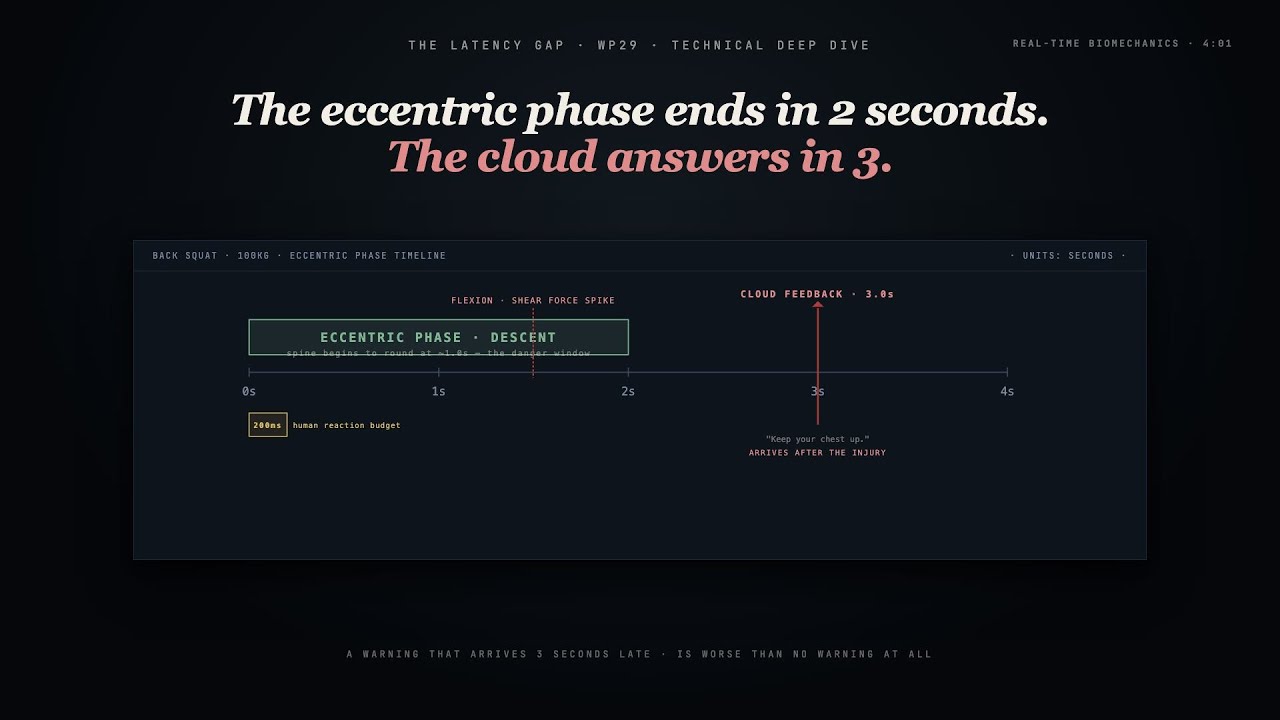
Consider the kinematics of a back squat. The descent (eccentric phase) typically lasts 1.5 to 2.0 seconds. The "bounce" or transition at the bottom (amortization phase) is momentary, often less than 200ms. If an athlete's lumbar spine begins to round (flex) at the midpoint of the descent, the shear forces on the intervertebral discs spike immediately. To prevent injury, the correction must occur before the athlete reaches maximum depth and load. A feedback signal delayed by 800ms arrives as the athlete is already driving up out of the hole, potentially with a compromised spine. At this point, the "correction" is disjointed from the error, confusing the athlete's motor learning process.
1.2 The Dangers of Latent Feedback and Negative Transfer
In the field of motor learning, the timing of feedback is as critical as its accuracy. We distinguish between three temporal categories of feedback:
1. Concurrent Feedback: Delivered during the movement. This is the domain of injury prevention and active spotting. It requires near-zero latency.
2. Immediate Terminal Feedback: Delivered seconds after the movement concludes. This is useful for analyzing the previous set but useless for saving the current rep.
3. Delayed Feedback: Delivered minutes or hours later.
Cloud-based AI wrappers often fall into a dangerous middle ground we call "Latent Feedback." This occurs when the feedback arrives 2 to 5 seconds after the event. 4 In a continuous set of exercises, a 3-second delay means the feedback for Repetition 1 arrives while the user is performing Repetition [2. ]
This desynchronization causes Negative Transfer . If the AI shouts "Keep your chest up" (referring to the bad form of Rep 1) just as the user is performing a perfect Rep 2, the user subconsciously associates the correction with their current correct behavior. They may then overcorrect or alter their form negatively in Rep 3. Research indicates that such concurrent feedback, if not perfectly timed, can interfere with motor learning by inducing a dependency and confusing the brain's intrinsic error detection mechanisms. 5
Furthermore, the cognitive load on an athlete during a heavy lift is immense. They are managing balance, intra-abdominal pressure, and leverage. "Late" feedback acts as a neurocognitive distractor. The "11+" injury prevention program highlights that injury risk involves neurocognitive deficits; anything that delays sensory processing reduces the time available for motor coordination corrections. 6 An AI that lags effectively steals processing power from the athlete, increasing rather than decreasing injury risk.
1.3 The Injury Mechanics of the Spine
The structural stakes are highest when the spine is under load. The lumbar spine is designed to bear compressive loads but is vulnerable to shear forces, which occur when the natural lordotic curve is lost (flexion).
● The Event Horizon: The moment the pelvis rotates posteriorly ("butt wink") or the lumbar spine flexes, the clock starts.
● The Load: In a 100kg squat, the forces on the L4-L5 vertebrae are significant.
● The Correction: The user must re-engage the erector spinae and adjust pelvic tilt. This is a micro-adjustment that takes milliseconds to fire but requires immediate awareness.
An AI Personal Trainer utilizing a cloud API with a 3-second round trip is functionally blind to these dynamics. It is akin to a car's collision warning system alerting the driver 3 seconds after the crash. The data is correct ("You hit a wall"), but the utility is zero.
2. The Cloud Latency Bottleneck: Anatomy of a Delay
To understand why cloud architectures fail the biomechanical test, we must analyze the engineering stack of a typical "AI Wrapper" application. The marketing claims of "real-time" API responses often obscure the physical realities of network transmission and model inference.
2.1 Deconstructing the Request Lifecycle
When a fitness app uses a cloud model like GPT-4o Vision or AWS Rekognition to analyze form, a single "frame" of data undergoes a torturous journey. Let us break down the latency budget of a standard API call:
1. Frame Capture & Encoding (50-100ms): The mobile device captures a frame (e.g., 1080p). This image must be compressed (JPEG) and often encoded into Base64 for API transmission. High-resolution images are required for detecting subtle keypoints like ankle inversion, preventing aggressive downsampling. 7
2. Network Transmission (Uplink) (100-1000ms): This is the most variable and uncontrollable factor. Gyms are notoriously hostile RF environments. They are often located in basements or large metal-framed buildings that act as Faraday cages. A user on a fluctuating LTE connection or a congested public Wi-Fi network may experience packet loss and buffer bloat. Uploading a 2MB image can take anywhere from 200ms to over a second.
3. Server Queue & Processing (TTFT) (500-4000ms): Once the request reaches the cloud provider (OpenAI, Google, AWS), it enters a queue. Large Multimodal Models are computationally heavy.
○ GPT-4o: While faster than its predecessors, benchmarks show audio latency at ~320ms, but vision analysis is significantly slower, often 2-4 seconds depending on server load and token output. 4
○ Gemini 1.5 Pro: This model excels at long-context reasoning (analyzing a whole video clip) rather than real-time streaming. Processing a video segment incurs a batch processing delay that renders it useless for concurrent feedback. 9
4. Token Generation & Transmission (Downlink) (200-500ms): The model generates a text response ("Your back is rounded"). This text is streamed back to the device.
5. Client Parsing & TTS (50-100ms): The app parses the JSON, and a Text-to-Speech engine converts the string to audio.
Total System Latency:
In a best-case scenario with fiber Wi-Fi, this might be 1.5 seconds. In a typical gym scenario, it is often 3 to 5 seconds.
2.2 The Bandwidth Cost of "Video" Analysis
Some architectures attempt to solve this by streaming video (e.g., AWS Kinesis Video Streams to Rekognition). While this offloads the management of the stream, it does not solve the physics of bandwidth. Streaming 720p/1080p video consumes substantial data.
● Data Consumption: A 1-hour workout streamed at high quality could consume gigabytes of data. For users on metered data plans, this is a non-starter.
● Pricing: AWS Rekognition Video pricing is approximately $0.10 per minute for stored video and slightly less for streaming, but requires complex infrastructure. 11 This high operational cost makes a $9.99/month consumer subscription economically unviable for the developer.
2.3 The "Wrapper" Trap: Economic Un-scalability
Beyond physics, the cloud model presents a fatal economic flaw for the startup.
● Variable Costs: Every squat, every rep, every second of analysis triggers a billable API event. If the app becomes successful and usage spikes, costs scale linearly (or super-linearly if complex reasoning is used).
● The Cost of "Sight":
○ GPT-4o Vision Input: ~$0.001 per image. 13
○ Frame Rate needed for safety: Minimum 10 FPS.
○ Cost per Minute: 600 frames * $0.001 = $0.60/minute.
○ Cost per Hour: $36.00 .
No consumer will pay $36 per hour for an automated gym buddy. Developers are forced to throttle the frame rate to once every 5 or 10 seconds to save money, which effectively destroys the utility of the product for safety spotting.
Table 1: The Cloud vs. Edge Latency & Cost Matrix
| Metric | Cloud API (GPT-4o / Gemini) |
Edge AI (BlazePose / MoveNet) |
|---|---|---|
| Inference Latency | 800ms - 4000ms4 | 10ms - 40ms14 |
| Network Dependency | High (Requires stable Broadband/5G) |
None (Works Ofine) |
| Variable Cost | High ($0.01 - $0.60 per minute) |
Zero (Leverages user hardware) |
| Data Privacy | Video leaves device (High Risk) |
Video stays on device (GDPR Safe) |
| Frame Rate | < 1 FPS (Throtled for cost) | 30 - 60 FPS (Real-time smoothness) |
| Feedback Type | Latent / Terminal | Concurrent / Real-time |
3. Edge AI Architecture: The Veriprajna Approach
Veriprajna advocates for a paradigm shift: moving the intelligence to the data, rather than moving data to the intelligence. Modern smartphones are equipped with powerful Neural Processing Units (NPUs)—such as the Apple Neural Engine and Qualcomm Hexagon—that are capable of running sophisticated computer vision models at high frame rates with minimal energy consumption.
3.1 Model Selection: The Triad of Mobile Pose Estimation
To build an "AI Personal Trainer," we must select a model architecture that balances accuracy, speed, and topological detail. We currently evaluate three primary open-source candidates: BlazePose (MediaPipe), MoveNet, and YOLOv11-Pose .
3.1.1 BlazePose: The High-Fidelity Standard
Developed by Google, BlazePose is currently the gold standard for fitness applications requiring detailed skeletal analysis.
● Topology: It detects 33 keypoints, significantly more than the standard 17-point COCO topology used by many other models. 15 This includes detailed landmarks for hands and feet, which are crucial for analyzing grip width in a bench press or foot stability in a squat.
● 3D Inference: Unlike simple 2D detectors, BlazePose infers 3D coordinates (x, y, z). This Z-axis estimation allows the system to understand depth and rotation. For example, if a user performs a lunge and their knee caves inward (valgus collapse), a 2D model might just see the leg get "shorter" due to perspective. BlazePose can detect the rotational component, allowing for accurate biomechanical alerts. 17
● Detector-Tracker Architecture: To optimize performance, BlazePose uses a two-step architecture. A heavy "detector" runs only on the first frame to locate the person. Subsequent frames use a lightweight "tracker" that predicts keypoint movement based on the previous frame. This allows it to run at 30+ FPS on mid-range devices. 16
3.1.2 MoveNet: The Speed Demon
MoveNet, available via TensorFlow Lite, is designed for ultra-low latency on edge devices.
● Architecture: It utilizes a bottom-up estimation approach with "smart cropping" to focus on the user.
● Variants: It offers "Lightning" (for speed) and "Thunder" (for accuracy). 15
● Performance: MoveNet Lightning is exceptionally fast, capable of 50+ FPS on older hardware. However, it is generally limited to 2D keypoints and has higher "jitter" (noise) compared to BlazePose. 19 It is ideal for rapid rep counting but perhaps less suited for subtle biomechanical correction than BlazePose.
3.1.3 YOLOv11: The Multi-Person Scanner
While BlazePose and MoveNet focus on single-user capabilities, YOLOv11 (You Only Look Once) brings a unified framework for detection and pose estimation. 15
● Scalability: YOLOv11 excels in scenarios where multiple people need to be tracked simultaneously, such as a team sports analysis or a busy gym floor "room scan."
● Efficiency: It boasts high parameter efficiency, offering accuracy comparable to heavier models with fewer parameters. 15
● Deployment: It leverages WebGPU and WASM for browser-based performance, making it a strong candidate for web-based tools that don't require a native app install. 20
Veriprajna Recommendation: For a dedicated Personal Trainer app where the user films themselves, BlazePose is the superior choice due to its 33-point topology and 3D depth understanding, which are non-negotiable for accurate form correction.
3.2 Hardware Acceleration and the NPU
The secret to running these models without draining the battery in 10 minutes lies in hardware acceleration.
● CPU vs. GPU vs. NPU: Running inference on the CPU is inefficient. The GPU is better, but the NPU is specialized for the matrix multiplication operations central to Convolutional Neural Networks (CNNs).
● Implementation: By utilizing delegates like CoreML (iOS) and TFLite NNAPI/GPU Delegate (Android), we can offload the inference to these efficient chips. 19 This reduces inference time from ~50ms (CPU) to ~10-15ms (NPU). 14
3.3 The "Glass-to-Glass" Latency Calculation
With Edge AI, the latency equation changes dramatically:
1. Camera Capture: 30ms.
2. Inference (NPU): 15ms.
3. Logic (Angle Calculation): <1ms.
4. Feedback Trigger: <1ms.
Total Latency: ~46ms. This is well below the 200ms threshold for human reaction time. The AI can effectively "see" and "react" faster than the user can realize they are failing the lift.
4. Signal Processing: Taming the Jitter
Raw data from neural networks is rarely perfect. Keypoints tend to "jitter" or vibrate frame-to-frame due to pixel quantization noise and fluctuating model confidence. If an app calculates the angle of the knee based on raw data, the value might fluctuate wildly (e.g., 90° -> 85° -> 92°) even if the user is standing still.
To provide a professional experience, we must smooth this data. However, smoothing inherently introduces latency. This is the Accuracy-Latency Trade-off .
4.1 The Failure of Simple Filters
A standard Moving Average Filter (taking the average of the last 10 frames) is excellent at removing jitter but disastrous for latency. If we average the last 10 frames at 30 FPS, we are essentially showing the user a delayed ghost of their movement from 333ms ago. This reintroduces the latency we fought so hard to remove.
4.2 The Solution: The 1€ Filter (OneEuro Filter)
Veriprajna implements the 1€ Filter, a first-order low-pass filter with an adaptive cutoff frequency. 21 This algorithm is the industry standard for real-time interaction (used in VR gaming and cursor tracking) because it dynamically adjusts its behavior based on speed.
● Low Velocity (Holding a pose): When the user is static (e.g., holding a plank), the filter lowers the cutoff frequency. This aggressively smooths the data, eliminating jitter and making the skeleton look rock-solid.
● High Velocity (Moving quickly): When the user moves (e.g., dropping into a squat), the filter increases the cutoff frequency. This reduces smoothing but minimizes lag to near zero.
Why Not Kalman Filters? While Kalman Filters are powerful for predicting ballistic trajectories (like a missile), they require a precise process model of the system. Human movement is often erratic and non-linear. Tuning a Kalman filter for general fitness is complex and computationally expensive compared to the 1€ Filter, which is lightweight, easy to tune (using beta and min_cutoff parameters), and highly effective for human-computer interaction. 21
4.3 Outlier Rejection and Confidence Gating
Models like MoveNet provide a confidence score (0.0 to 1.0) for each keypoint.
● Occlusion Handling: If a user's arm blocks the camera's view of their hip, the model's confidence for the "Hip" keypoint will drop.
● Logic Gates: We implement strict logic: IF hip_confidence < 0.5 THEN stop_analysis.
● User Feedback: Instead of guessing the angle (which could lead to bad advice), the app immediately prompts the user: "Please adjust camera angle, hip not visible." This "Fail Safe" mechanism is crucial for liability and safety.
5. Economic Analysis: The Edge Advantage
For a fitness technology company, the choice between Cloud and Edge is not just technical; it is existential. The unit economics of the two models are diametrically opposed.
5.1 The Cloud "Tax" on Success
Cloud architectures operate on an Operational Expenditure (OpEx) model that scales with success.
● API Costs: As calculated in Section 2, continuous vision analysis is cost-prohibitive ($30+/hour/user).
● Bandwidth: Transferring video data incurs egress costs and infrastructure scaling costs.
● Maintenance: A massive backend is required to handle load balancing, queuing, and GPU provisioning.
● Viral Risk: If an app gains 100,000 users overnight, the infrastructure bill spikes immediately, potentially bankrupting the company before monetization catches up. 24
5.2 The Edge "Free" Scale
Edge architectures operate on a Capital Expenditure (CapEx) model. The cost is in the upfront development of the mobile app and model optimization.
● Zero Marginal Cost: Once the app is downloaded, the "compute" is performed on the user's $1000 iPhone, not the company's server. The cost to serve 1 million squats is the same as the cost to serve 1 squat: $0 .
● Scalability: The architecture is infinitely scalable. There is no bottleneck server to crash.
● Offline Resilience: The app works in basements, rural areas, and disconnected environments, increasing user retention. 25
Table 2: 3-Year Total Cost of Ownership (TCO) Scenario
Scenario: Startup with 50,000 Monthly Active Users (MAU), each doing 10 sessions/month.
| Cost Category | Cloud-First Strategy | Edge-First Strategy |
|---|---|---|
| Compute Cost | ~$250,000 / month (est. API fees) |
$0 / month |
| Bandwidth/Storage | High (Video Hosting/Streaming) |
Low (App Binaries & Metadata) |
| DevOps | High (Scaling Clusters) | Low (Static Assets) |
| Initial R&D | Medium (API Integration) | High (NPU/Model Optimization) |
|---|---|---|
| 3-Year TCO | >$5,000,000 | ~$200,000 |
The economic conclusion is clear: Edge AI allows a fitness company to offer a premium, unlimited-use product at a fixed cost, decoupling revenue from usage.
6. Engineering Constraints: Thermal and Energy Dynamics
A common critique of Edge AI is the potential for battery drain and device overheating. Running a neural network 30 times a second is computationally intensive. If not managed, this can lead to thermal throttling, where the OS slows down the CPU to protect the hardware, causing the app to stutter and lag. 27
6.1 Energy Consumption Analysis
Studies show that smartphone energy drain is dominated by two factors: the Screen and the Network. Surprisingly, local processing can often be more energy-efficient than cloud processing.
● Radio Drain: The cellular radio (LTE/5G) is a massive power consumer, especially when transmitting data (uplink). Continuous video streaming keeps the radio in a "High Power" state. 29
● NPU Efficiency: Modern NPUs are designed specifically for low-power inference (Watts/Operation). They are significantly more efficient than using the general-purpose CPU or GPU for these tasks. 30
6.2 Mitigation Strategies
To ensure Veriprajna apps can run for hour-long sessions without draining the battery:
1. Adaptive Frame Rate: We do not need 30 FPS when the user is resting. By detecting "static" poses, we dynamically throttle the inference engine to 1 FPS or pause it entirely until movement resumes.
2. Model Quantization: We utilize int8 quantization . This converts the model's weights from 32-bit floating point numbers to 8-bit integers. This reduces the model size by 4x and speeds up inference, reducing the energy cost per frame with negligible loss in accuracy. 27
3. Hysteresis Cooling: Active monitoring of the device's thermal state allows the app to proactively degrade performance (e.g., switch to a lighter model) before the OS forces a hard throttle. 27
7. Privacy, Compliance, and the Local-First Future
In an era of increasing surveillance awareness and strict data protection laws, the architecture of an AI app is a legal statement.
7.1 The Legal Minefield (BIPA, GDPR, CCPA)
Biometric data—including "facial geometry" and "gait analysis"—is heavily regulated.
● BIPA (Illinois): The Biometric Information Privacy Act has led to massive class-action settlements. Collecting biometric identifiers without strict written consent and retention policies is a liability. 31
● GDPR (Europe): Processing biometric data for identification requires explicit consent (Article 9). Furthermore, data minimization principles (Article 5) suggest data should not be collected if not strictly necessary. 32
7.2 The Local-First Advantage
An Edge AI architecture inherently solves many of these compliance issues through Data Minimization .
● No Data Transfer: The video frames are processed in the device's RAM and discarded immediately. They are never written to disk or transmitted to a server.
● Local Processing: Because the "processing" happens on the user's own device, the legal definition of "collection" and "transfer" is often avoided or simplified. The user retains possession of their data at all times. 34
● Trust: An app that functions in "Airplane Mode" provides tangible proof to the user that they are not being watched by a remote server. This builds profound trust in the brand.
8. The Veriprajna Solution: A Hybrid Architecture
While Edge AI is non-negotiable for real-time feedback, Cloud AI remains superior for long-term reasoning and trend analysis. Veriprajna proposes a Hybrid Edge-Cloud Architecture 35 that leverages the strengths of both.
8.1 The "Hot Loop" (Edge)
● Purpose: Safety, Spotting, Rep Counting.
● Latency: < 50ms.
● Technology: BlazePose / MoveNet on NPU.
● Data: High-frequency video (discarded after use).
● Feedback: Haptic buzz, simple audio cues ("Knees out").
8.2 The "Cold Loop" (Cloud)
● Purpose: Personalization, Programming, Trend Analysis.
● Latency: Minutes/Hours.
● Technology: LLM (GPT-4o / Gemini 1.5).
● Data: Lightweight JSON metadata (e.g., "Set 1: Avg Depth 90°, Spine Angle 170°"). Not Video.
● Feedback: "We noticed your form breakdown correlates with fatigue in set 4. Let's adjust your volume next week."
This hybrid approach 37 allows for the rich, conversational intelligence of an LLM ("How was my workout?") without sacrificing the safety and speed of the Edge spotter. It minimizes data transfer costs while maximizing user value.
Conclusion
The founder's experience—a delayed warning arriving seconds after a dangerous lift—is not a bug in the code; it is a bug in the architecture. It is a symptom of an industry that has prioritized the hype of Generative AI over the physics of human movement.
Latency is liability. In the high-stakes environment of resistance training, an AI that guesses or lags is a safety hazard.
● 800ms is an eternity in biomechanics.
● Cloud wrappers are economically unsustainable and privacy-invasive.
● Edge AI is the only viable path for professional-grade, real-time coaching.
Veriprajna is dedicated to building systems that respect the athlete's biology, the engineer's constraints, and the user's privacy. We do not just build wrappers; we build extensions of the human sensory system. By processing motion at the speed of life—right on the device—we turn the phone from a passive recorder into an active, intelligent partner.
Is your fitness app watching a video, or spotting the user?
#FitnessTech #EdgeAI #PoseEstimation #HealthTech #RealTime
Works cited
Real-time Biofeedback Systems: Architectures, Processing, and Communication Eventiotic, accessed December 11, 2025, https://www.eventiotic.com/eventiotic/files/Papers/URL/icist2016_39.pdf
Real-Time Biomechanical Feedback Systems in Sport and Rehabilitation, accessed December 11, 2025, https://encyclopedia.pub/entry/25041
Review of Real-Time Biomechanical Feedback Systems in Sport and Rehabilitation - NIH, accessed December 11, 2025, https://pmc.ncbi.nlm.nih.gov/articles/PMC9028061/
GPT-4o Guide: How it Works, Use Cases, Pricing, Benchmarks | DataCamp, accessed December 11, 2025, https://www.datacamp.com/blog/what-is-gpt-4o
Effects of self-control of feedback timing on motor learning - Frontiers, accessed December 11, 2025, https://www.frontiersin.org/journals/psychology/articles/10.3389/fpsyg.2025.1638827/full
Neurocognitive & Ecological Motor Learning Considerations for the 11+ ACL Injury Prevention Program: A Commentary - PMC - NIH, accessed December 11, 2025, https://pmc.ncbi.nlm.nih.gov/articles/PMC11534168/
Getting Started with GPT-4 Vision for Data Analysis - MLQ.ai, accessed December 11, 2025, https://blog.mlq.ai/gpt-4-vision-data-analysis/
Comparing Latency of GPT-4o vs. GPT-4o Mini - Workorb Blog, accessed December 11, 2025, https://www.workorb.com/blog/comparing-latency-of-gpt-4o-vs-gpt-4o-mini
Gemini 1.5: Unlocking multimodal understanding across millions of tokens of context - arXiv, accessed December 11, 2025, https://arxiv.org/pdf/2403.05530
Our next-generation model: Gemini 1.5 - Google Blog, accessed December 11, 2025, https://blog.google/technology/ai/google-gemini-next-generation-model-february-2024/
Image recognition software, ML image analysis, and video analysis – Amazon Rekognition pricing - AWS, accessed December 11, 2025, https://aws.amazon.com/rekognition/pricing/
AWS Rekognition Pricing - is this right? - Reddit, accessed December 11, 2025, https://www.reddit.com/r/aws/comments/v2hemf/aws_rekognition_pricing_is_this_right/
Pricing | OpenAI, accessed December 11, 2025, https://openai.com/api/pricing/
MovePose: A High-performance Human Pose Estimation Algorithm on Mobile and Edge Devices - arXiv, accessed December 11, 2025, https://arxiv.org/html/2308.09084v4
Pose Detection Showdown: BlazePose, MoveNet & YOLOv11 | Kite Metric, accessed December 11, 2025, https://kitemetric.com/blogs/open-source-pose-detection-a-deep-dive-into-blazepose-movenet-and-yolov11
[2006.10204] BlazePose: On-device Real-time Body Pose tracking - arXiv, accessed December 11, 2025, https://arxiv.org/abs/2006.10204
A comprehensive analysis of the machine learning pose estimation models used in human movement and posture analyses: A narrative review - NIH, accessed December 11, 2025, https://pmc.ncbi.nlm.nih.gov/articles/PMC11566680/
Comparative Analysis of Skeleton-Based Human Pose Estimation - MDPI, accessed December 11, 2025, https://www.mdpi.com/1999-5903/14/12/380
Looking for real-world feedback: MediaPipe vs MoveNet vs QuickPose (or others) for mobile yoga posture correction app - Reddit, accessed December 11, 2025, https://www.reddit.com/r/mobiledev/comments/1or8lk0/looking_for_realworld_feedback_mediapipe_vs/
Recent Research on Pose Detection Models: BlazePose, MoveNet and More Medium, accessed December 11, 2025, https://medium.com/@zh.milo/recent-research-on-pose-detection-models-blazepose-movenet-and-more-7be0e30778d8
1€ Filter: A Simple Speed-based Low-pass Filter for Noisy Input in Interactive Systems, accessed December 11, 2025, https://www.researchgate.net/publication/254005010_1_Filter_A_Simple_Speed-based_Low-pass_Filter_for_Noisy_Input_in_Interactive_Systems
Can Kalman Filter be used with a real time YOLO pose estimator (Getting a live feed) to decrease jittering? - Reddit, accessed December 11, 2025, https://www.reddit.com/r/computervision/comments/1awdnh2/can_kalman_filter_be_used_with_a_real_time_yolo/
Kalman Filter vs Exponential Filter - genetic algorithm - Stack Overflow, accessed December 11, 2025, https://stackoverflow.com/questions/4363514/kalman-filter-vs-exponential-flter i
Reduce Cloud Computing Costs by 90%: The Case for Shifting to the Edge, accessed December 11, 2025, https://www.verytechnology.com/insights/reduce-cloud-computing-costs-the-case-for-shifting-to-the-edge
Offline-First Apps: Why Enterprises Are Prioritizing Data Sync Capabilities - Octal IT Solution, accessed December 11, 2025, https://www.octalsoftware.com/blog/offline-first-apps
Offline-first app explained – architecture and advantages - Locize, accessed December 11, 2025, https://www.locize.com/blog/offline-first-apps
Impact of Thermal Throttling on Long-Term Visual Inference in a CPU-Based Edge Device, accessed December 11, 2025, https://www.mdpi.com/2079-9292/9/12/2106
On the Impacts of Greedy Thermal Management in Mobile Devices - Boston University, accessed December 11, 2025, https://www.bu.edu/peaclab/files/2015/05/sahin_ESL15.pdf
Smartphone Energy Drain in the Wild: Analysis and Implications - Purdue College of Engineering, accessed December 11, 2025, https://engineering.purdue.edu/~ychu/publications/TR-ECE-15-03.pdf
Analyzing the Impact of Large Language Models on Battery Consumption in Mobile Devices: An Empirical Study - IJSEA, accessed December 11, 2025, https://ijsea.com/archive/volume13/issue4/IJSEA13041008.pdf
The Hidden Legal Minefield: Compliance Concerns with AI Smart Glasses, Part 1 – Biometrics | Jackson Lewis P.C. - JD Supra, accessed December 11, 2025, https://www.jdsupra.com/legalnews/the-hidden-legal-minefield-compliance-3197991/
How do we process biometric data lawfully? | ICO, accessed December 11, 2025, https://ico.org.uk/for-organisations/uk-gdpr-guidance-and-resources/lawful-basis/biometric-data-guidance-biometric-recognition/how-do-we-process-biometric-data-lawfully/
What is GDPR, the EU's new data protection law?, accessed December 11, 2025, https://gdpr.eu/what-is-gdpr/
Local-first software: You own your data, in spite of the cloud - Ink & Switch, accessed December 11, 2025, https://www.inkandswitch.com/essay/local-first/
Edge hybrid pattern | Cloud Architecture Center - Google Cloud Documentation, accessed December 11, 2025, https://docs.cloud.google.com/architecture/hybrid-multicloud-paterns-and-practtices/edge-hybrid-paternt
A hybrid fog-edge computing architecture for real-time health monitoring in IoMT systems with optimized latency and threat resilience - PMC - PubMed Central, accessed December 11, 2025, https://pmc.ncbi.nlm.nih.gov/articles/PMC12264268/
Edge AI and Hybrid Architectures: Empowering Real-Time Intelligence for Enterprises, accessed December 11, 2025, https://apptad.com/blogs/edge-ai-and-hybrid-architectures-empowering-real-time-intelligence-for-enterprises/
Prefer a visual, interactive experience?
Explore the key findings, stats, and architecture of this paper in an interactive format with navigable sections and data visualizations.
Frequently Asked Questions
Why is cloud-based AI fitness coaching biomechanically dangerous?
Cloud AI introduces 800ms to 3-second round-trip latency, but human motor correction requires feedback within 150-250ms. During a loaded squat, the amortization phase at maximum spinal shear lasts under 200ms. Feedback arriving 800ms late reaches the athlete mid-ascent with a potentially compromised spine, causing cognitive interference and negative transfer — where corrections for Rep 1 arrive during Rep 2, confusing the motor learning process and increasing injury risk.
How does edge AI achieve sub-50ms biomechanical feedback?
By deploying specialized pose estimation models like BlazePose (33 keypoints with 3D inference) directly on the device's Neural Processing Unit, Veriprajna reduces compute distance from 500+ miles to under 1 meter and transmission medium from public internet to PCIe/MIPI-CSI. BlazePose's detector-tracker architecture runs at 30+ FPS on mid-range devices, with the 1-Euro filter suppressing joint jitter through adaptive cutoff frequency, achieving total glass-to-glass latency under 50ms.
What is the negative transfer problem in AI fitness coaching?
Negative transfer occurs when desynchronized AI feedback confuses the athlete's motor learning. With 2-5 second cloud latency during continuous exercise, corrections for one repetition arrive while the user performs the next. If the AI says 'Keep your chest up' (referring to bad form in Rep 1) during a correct Rep 2, the brain associates the correction with current correct behavior, leading to overcorrection and degraded form in subsequent repetitions.
Also Published On
Build Your AI with Confidence.
Partner with a team that has deep experience in building the next generation of enterprise AI. Let us help you design, build, and deploy an AI strategy you can trust.
Veriprajna Deep Tech Consultancy specializes in building safety-critical AI systems for healthcare, finance, and regulatory domains. Our architectures are validated against established protocols with comprehensive compliance documentation.