Why Your Cloud-Based AI Trainer is Biomechanically Dangerous
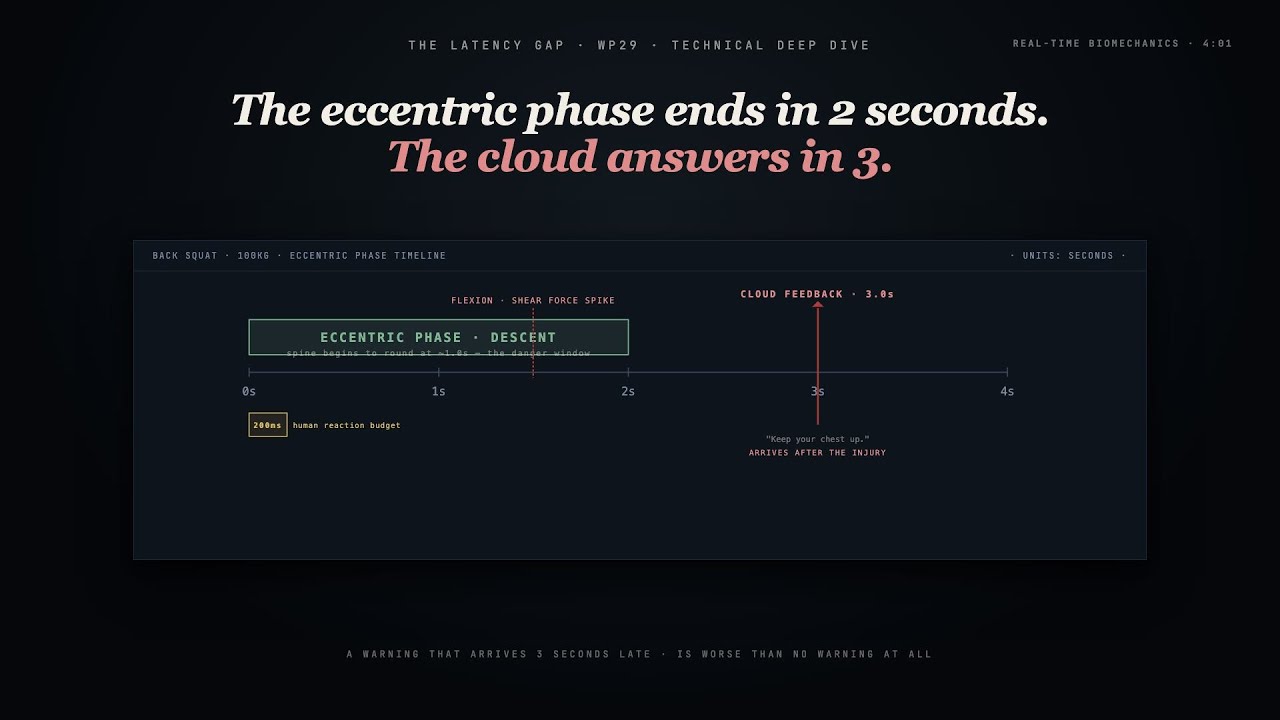
When an AI Personal Trainer warns you about bad form 3 seconds after your lumbar spine rounds during a heavy squat, that warning isn't just late—it's a cognitive distractor that increases injury risk. The 800-3000ms delay inherent in cloud processing creates a "latency gap" that severs the critical link between action and correction.
Veriprajna's Edge AI architecture processes pose estimation locally on-device using BlazePose and MoveNet, achieving <50ms latency—enabling true concurrent feedback that aligns with human neuromuscular response time.
In the high-stakes environment of resistance training, feedback that arrives too late isn't just ineffective—it's dangerous.
A back squat descent lasts 1.5-2.0 seconds. The "bounce" at the bottom is <200ms. When lumbar flexion begins mid-descent, shear forces on intervertebral discs spike immediately. Correction must occur before reaching maximum depth.
With 3-second delay, feedback for Rep 1 arrives during Rep 2. User hears "Keep chest up" (referring to bad Rep 1) while performing perfect Rep 2. This desynchronization causes the brain to associate correction with correct behavior—inducing overcorrection in Rep 3.
Cloud API journey: Frame capture (50-100ms) + Network uplink (100-1000ms) + Server queue/inference (500-4000ms) + Downlink (200-500ms) + TTS parsing (50-100ms). Total: 1.5-5 seconds in typical gym RF environments.
"A cloud-based AI utilizing GPT-4o with 3-second round trip is functionally blind to biomechanical dynamics. It's akin to a car's collision warning alerting the driver 3 seconds after the crash. The data is correct, but the utility is zero."
— The Latency Gap Whitepaper, Veriprajna 2024
Experience the difference between cloud and edge processing. In real-time coaching, milliseconds determine safety.
Visualization of squat phases vs feedback timing. Human reaction time threshold: ~200ms.
Move the intelligence to the data, not the data to the intelligence. Modern NPUs enable real-time pose estimation at 30+ FPS with minimal battery impact.
Glass-to-glass latency: Camera capture (30ms) + NPU inference (15ms) + Logic (<1ms) = ~46ms total. Well below the 200ms human reaction threshold. AI "sees" faster than the user realizes they're failing the lift.
Video frames processed in device RAM, discarded immediately. Never written to disk or transmitted. Works in Airplane Mode. GDPR/BIPA/CCPA compliant through data minimization—video never "leaves" the user's possession.
Compute runs on user's $1000 iPhone NPU, not your servers. Cost to process 1 million squats = cost to process 1 squat = $0. Infinitely scalable. No bottleneck servers to crash during viral growth.
Google's high-fidelity standard. 33 keypoints including hands/feet. 3D inference (x,y,z) for depth understanding. Detector-tracker architecture for 30+ FPS on mid-range devices.
TensorFlow Lite speed demon. Ultra-low latency with "Lightning" variant (50+ FPS on older hardware). Bottom-up estimation with smart cropping. Higher jitter than BlazePose.
Unified detection + pose estimation. Excels at multi-person tracking (team sports, busy gym floor). High parameter efficiency. WebGPU/WASM support for browser deployment.
Raw neural network keypoints jitter frame-to-frame. Smoothing is essential—but traditional filters introduce unacceptable latency. The 1€ Filter solves the accuracy-latency tradeoff.
A simple Moving Average Filter (averaging last 10 frames) removes jitter beautifully but is disastrous for latency. At 30 FPS, averaging 10 frames = showing user a "ghost" from 333ms ago. This reintroduces the latency we fought to eliminate.
First-order low-pass filter with adaptive cutoff frequency. Industry standard for VR/AR and cursor tracking. Dynamically adjusts behavior based on velocity:
Models like MoveNet provide confidence scores (0.0-1.0) for each keypoint. If user's arm blocks hip view, confidence drops. We implement strict logic gates:
Instead of guessing angles (which could lead to bad advice and liability), we fail gracefully. User gets immediate feedback to reposition camera. This "Fail Safe" mechanism is crucial for safety and legal protection.
For fitness tech companies, the choice between Cloud and Edge isn't just technical—it's existential. Unit economics are diametrically opposed.
Model your fitness app economics over 3 years
| Metric | Cloud API (GPT-4o/Gemini) | Edge AI (BlazePose/MoveNet) |
|---|---|---|
| Inference Latency | 800ms - 4000ms | 10ms - 40ms |
| Network Dependency | High (Requires Broadband/5G) | None (Works Offline) |
| Variable Cost | High ($0.01 - $0.60/min) | Zero (User hardware) |
| Data Privacy | Video leaves device (High Risk) | Video stays on device (GDPR Safe) |
| Frame Rate | <1 FPS (Throttled for cost) | 30-60 FPS (Real-time) |
| Feedback Type | Latent / Terminal | Concurrent / Real-time |
Cloud wrappers operate on OpEx that scales linearly (or super-linearly) with usage. If your app goes viral, infrastructure costs spike immediately—potentially bankrupting the company before revenue catches up. Edge AI decouples revenue from compute cost.
In an era of biometric data regulations, your app's architecture is a legal statement.
The Biometric Information Privacy Act has led to massive class-action settlements. Collecting biometric identifiers (facial geometry, gait analysis) without strict written consent and retention policies = liability.
Processing biometric data for identification requires explicit consent (Article 9). Data minimization principles (Article 5) mandate: data should not be collected if not strictly necessary.
California Consumer Privacy Act treats biometric information as sensitive personal data. Users have right to know what's collected, right to deletion, and right to opt-out of "sale."
An Edge AI architecture inherently solves compliance issues through Data Minimization:
Veriprajna advocates a Hybrid Edge-Cloud approach that leverages strengths of both:
Running neural networks 30 times per second is computationally intensive. Without proper management, battery drains in minutes and thermal throttling kills performance.
Surprisingly, local processing can be more energy-efficient than cloud processing:
Don't need 30 FPS during rest periods. Detect static poses, dynamically throttle to 1 FPS or pause until movement resumes.
Convert weights from 32-bit float to 8-bit integers (int8). Reduces model size 4x, speeds inference, cuts energy cost per frame with negligible accuracy loss.
Monitor device thermal state. Proactively degrade performance (switch to lighter model) before OS forces hard throttle.
General-purpose processor. Inefficient for matrix operations. High energy per inference.
Better for parallel ops. Still general-purpose. Moderate efficiency.
Specialized for CNNs. Matrix multiplication hardware. Optimal energy efficiency.
Implementation via CoreML (iOS) and TFLite NNAPI/GPU Delegate (Android)
In high-stakes resistance training, an AI that guesses or lags is a safety hazard.
In biomechanics, a back squat descent lasts 1.5-2 seconds. Feedback arriving 800ms late is worse than no feedback—it's cognitive interference.
Cloud wrappers are economically unsustainable and privacy-invasive. OpEx scales linearly with success—bankrupting startups during viral growth.
The only viable path for professional-grade, real-time coaching. BlazePose on NPU delivers concurrent feedback that saves lives.
✓ We don't build wrappers; we build extensions of the human sensory system
✓ By processing motion at the speed of life—right on device—we turn phones from passive recorders into active partners
✓ We respect the athlete's biology, the engineer's constraints, and the user's privacy
⚡ Edge AI isn't just faster—it's the only architecture that aligns with neuromuscular feedback loops
🔒 Privacy by design: video never leaves device = zero biometric data liability
💰 Zero marginal cost = infinitely scalable business model that doesn't punish success
Is your fitness app watching a video, or spotting the user?
The answer determines whether you're building a product or a liability.
Cloud API round-trip latency of 800-3000ms means feedback arrives after the dangerous moment has passed. In a back squat with a 1.5-2 second descent, feedback about lumbar flexion arrives during the concentric phase — too late to prevent injury. Worse, 3-second delays cause negative transfer: correction for Rep 1 arrives during Rep 2, causing the brain to associate corrections with correct behavior and inducing overcorrection in Rep 3.
Edge AI runs pose estimation models (BlazePose with 33 keypoints including 3D depth, or MoveNet Lightning for speed) directly on the device's Neural Processing Unit (NPU). The total glass-to-glass latency is approximately 46ms: camera capture (30ms) + NPU inference (15ms) + logic processing (<1ms). This is well below the 200ms human visual reaction threshold, enabling concurrent feedback that aligns with neuromuscular response time.
Edge AI achieves zero marginal cost per user because compute runs on the user's own device NPU — processing 1 million squats costs the same as processing 1 squat ($0). Cloud APIs cost $0.60/minute at safety-grade frame rates, translating to $5M+ over 3 years. For privacy, edge processing means video frames are processed in device RAM and discarded immediately — never written to disk or transmitted — making the app inherently GDPR, BIPA, and CCPA compliant through data minimization.
Veriprajna partners with fitness tech companies, hardware manufacturers, and sports science labs to deploy Edge AI systems that actually work.
Whether you're building an AI personal trainer app, developing smart gym equipment, or researching biomechanics—let's talk about real-time pose estimation done right.
Deep dive into BlazePose/MoveNet architecture, 1€ Filter mathematics, NPU implementation, thermal management, regulatory compliance, and comprehensive works cited.