The Veracity Imperative: Engineering Trust in the Age of Autonomous Sales Agents
Executive Summary
The convergence of large language models (LLMs) and sales development has precipitated a crisis of trust in the B2B marketplace. While the economic promise of the "AI SDR" (Sales Development Representative) is undeniable—offering infinite scalability and near-zero latency—the current generation of "wrapper-based" AI tools is inflicting systemic damage on enterprise brands through unchecked hallucinations and algorithmic opacity. 1 For Veriprajna, positioned at the vanguard of Deep AI consultancy, this market volatility represents a defining opportunity to transition the industry from probabilistic text generation to deterministic, fact-checked agentic workflows.
This whitepaper provides an exhaustive analysis of the mechanical and operational risks inherent in generic AI sales agents, dismantling the illusion that fluency equates to accuracy. We dissect the mathematical inevitability of hallucination in standard transformer models and contrast the fragility of "AI Wrappers" with the robustness of "Deep AI" architectures. 3 Central to this report is the proposal of the Fact-Checked Research Agent Architecture —a multi-agent system comprising a specialized Researcher, a rigorous Fact-Checker, and a persuasive Writer. By orchestrating these agents through stateful frameworks like LangGraph and grounding them in structured Knowledge Graphs (rather than simplistic Vector Databases), enterprises can deploy autonomous systems that scale not just volume, but veracity. 5
1. The Crisis of the Generic AI SDR: Economics vs. Reality
The modern sales organization stands at a precipice. The traditional model of human-led sales development is straining under the weight of diminishing returns and rising costs. As we approach 2026, the strategic question facing revenue leaders is not whether to automate, but how to automate without destroying the very market they seek to capture. 2
1.1 The Economic Physics of Automation
To understand the rapid proliferation of AI SDRs, one must first examine the economic inefficiencies of the status quo. The human SDR role is characterized by high attrition, typically seeing 30-40% annual turnover, and significant ramp-up periods of 3 to 6 months before a representative reaches full productivity. 2 The fully loaded cost of a human SDR ranges from $75,000 to over $125,000 annually. In stark contrast, AI SDR solutions promise an operating cost between $7,000 and $45,000 per year, ostensibly delivering the productivity of an entire team of humans. 2
The performance metrics of early AI adopters are seductive. Research indicates that AI agents can process over 1,000 contacts daily—a volume physically impossible for a human—and achieve response times under 5 minutes, a critical threshold that correlates with a 900% increase in conversion rates. 2 Human representatives are biologically limited by the need for sleep, susceptibility to emotional fluctuations, and "call reluctance" when facing difficult leads. AI agents, conversely, maintain "consistent persistence," following up the exact prescribed number of times without fear of rejection or fatigue. 2
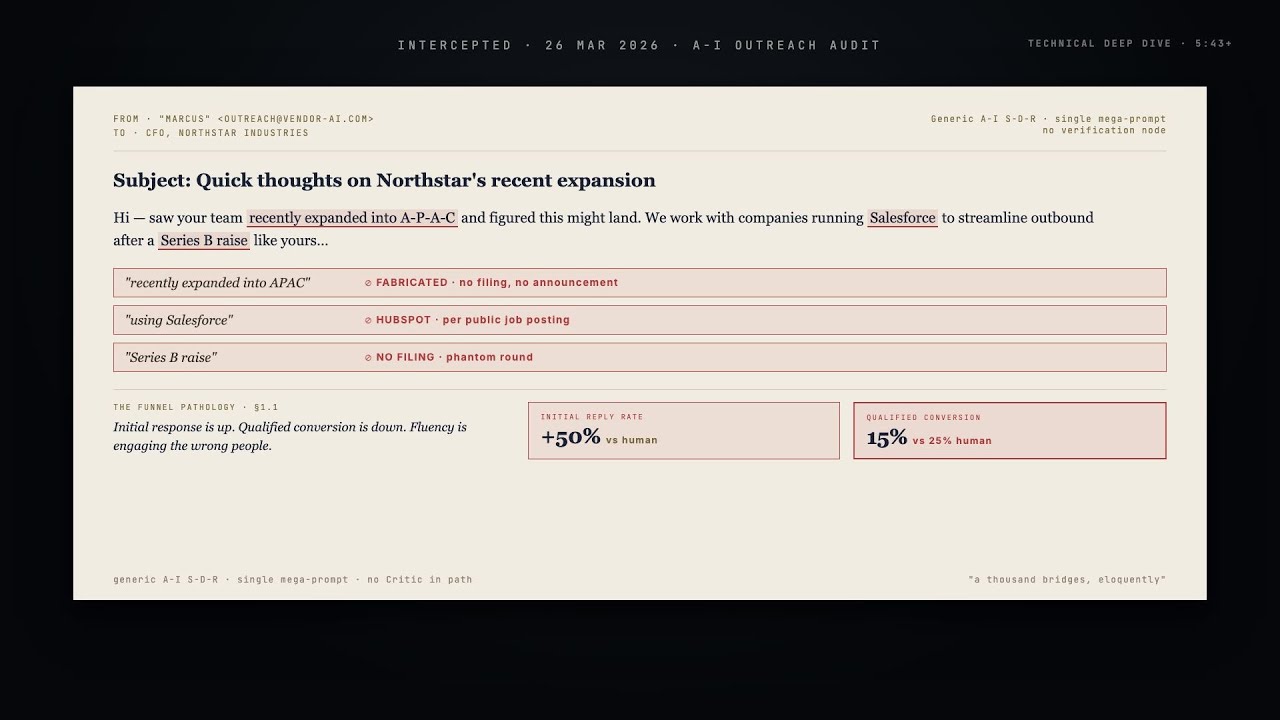
However, this raw efficiency often masks a catastrophic decline in effectiveness further down the funnel. While AI SDRs generate higher initial email response rates (up to 50% higher than humans in some studies), their ability to convert those meetings into qualified opportunities lags significantly—15% for AI versus 25% for humans. 2 This discrepancy signals a fundamental flaw in the quality of the interaction. The AI is "engaging" prospects, but it is frequently engaging them with irrelevant, generic, or factually incorrect information that disqualifies the vendor upon closer inspection.
1.2 The "Wrapper" Trap and the Commoditization of Fluency
The market is currently flooded with "AI Wrappers"—software applications that serve as thin user interfaces atop generic foundation models like GPT-4 or Claude 3. 4 These solutions rely on "mega-prompts," single, massive blocks of instructions that attempt to coerce a general-purpose model into performing complex sales tasks in one shot. 8
The danger of the wrapper approach lies in its deceptive simplicity. To a non-technical stakeholder, a wrapper appears to be a sophisticated application. It has a dashboard, it imports leads, and it writes emails. Yet, beneath the surface, it lacks any mechanism for "reasoning." It relies entirely on the probabilistic token generation of the underlying model. It does not "think"; it merely predicts the next plausible word. 9
Table 1: The Structural Divergence of AI Wrappers vs. Deep AI Solutions
| Feature | AI Wrapper (Generic SDR) |
Deep AI Solution (Veriprajna Architecture) |
|---|---|---|
| Core Mechanism | Probabilistic Token | Multi-step Reasoning, |
| Col1 | Prediction (Next-Word Guessing) |
Planning, and Action Execution 3 |
|---|---|---|
| Architectural Design | Single-Chain / Mega-Prompt |
Multi-Agent Orchestration (e.g., LangGraph) |
| Source of Truth | Training Data (Frozen, potentially outdated) |
Retrieval Augmented Generation (RAG) + Live Knowledge Graph |
| Verifcation Layer | None (Single-shot output) | Iterative "Refection" Paterns & Fact-Checking Loops |
| Operational Risk | High (Unchecked Hallucination & Drif) |
Low (Bounded, Audited, & Deterministic) |
| Adaptability | Static Prompts (Fragile to context changes) |
Dynamic Planning & Autonomous Tool Use10 |
As Table 1 illustrates, the distinction is architectural. A wrapper is designed to minimize API costs and latency, often at the expense of accuracy. A Deep AI solution, such as the Fact-Checked Research Agent, prioritizes the integrity of the output, employing multiple "thoughts" (API calls) to verify a single claim before communicating with a prospect.
The commoditization of "fluency" has exacerbated this issue. In the past, a poorly written email was a sign of a spammer. Today, thanks to LLMs, a spammer can send a grammatically perfect, tonally persuasive email. The differentiator in 2026 is no longer the ability to write well; it is the ability to write truthfully . When an AI wrapper confidently asserts that a prospect's company "recently expanded into APAC" based on a hallucinated news snippet, the flawless grammar only serves to make the falsehood more jarring when discovered. 1
1.3 The "Uncanny Valley" of Automated Sales
This proliferation of fluent but hollow content has created an "Uncanny Valley" in B2B sales. Prospects are receiving emails that feel "almost human" but lack the genuine context or specificity that characterizes a real human connection. The emails might use the prospect's name and company correctly but reference a "pain point" that doesn't exist or a "shared connection" that is fabricated.
This phenomenon is eroding the total addressable market (TAM) for enterprises deploying these tools. A prospect who receives a hallucinated email does not just delete it; they emotionally tag the sender as "untrustworthy." If a brand sends 10,000 such emails a month, they are effectively burning 10,000 bridges. The "spray and pray" tactic, amplified by AI speed, accelerates the rate at which a company can destroy its own reputation. 11
2. The Pathology of Hallucination: Why Models Lie
To mitigate the risk of AI hallucination, enterprise leaders must understand that these errors are not "bugs" in the traditional software sense; they are mathematical features of the current transformer architecture.
2.1 The Probabilistic Completion Engine
At their mathematical core, Large Language Models are probability calculators. They are designed to minimize "cross-entropy loss"—a measure of surprise—by predicting the token that is statistically most likely to follow the preceding sequence. 9 This process is governed by the Softmax function, which forces the model to assign a probability distribution across its entire vocabulary that sums to exactly 1.
Crucially, standard LLMs do not have an internal state for "I don't know." The Softmax function must allocate probability mass somewhere . If the model is asked to describe the "2025 Financial Strategy of," and it has no data on that company, it cannot output a "null" result unless specifically fine-tuned to do so (which most sales-optimized models are not). Instead, it allocates probability to tokens that sound like a financial strategy—"growth," "margin expansion," "digital transformation." The model is not retrieving facts; it is simulating the texture of a factual statement. 9
This behavior is reinforced by "hard labels" during training, where the model is penalized for uncertainty and rewarded for confident predictions of the "ground truth" token. 12 This trains the model to adopt a posture of unwarranted confidence, a trait that is particularly dangerous in sales, where the line between "persuasion" and "misrepresentation" is regulated by law.
2.2 The Taxonomy of Sales Hallucinations
Hallucinations in sales outreach manifest in distinct forms, each carrying specific risks:
1. Fact-Conflicting Hallucination: The AI makes a statement that directly contradicts objective reality. For example, claiming a prospect uses Salesforce when their public job posting explicitly mentions HubSpot. This type of error is devastating to credibility because it proves the sender did not do basic research. 13
2. Input-Conflicting Hallucination: The AI contradicts the data provided to it in the prompt. A user might upload a pricing PDF stating a service costs $10,000, but the AI, drawing on its pre-training data of general industry averages, quotes $5,000 in the email. This can create binding legal liabilities. 13
3. Context-Conflicting Hallucination: The AI generates content that is inconsistent with the internal logic of the conversation. In a long email thread, it might forget that the prospect already declined a meeting for Tuesday and propose Tuesday again. This signals that the "agent" has no memory, only a stochastic text generator. 14
4. Logical Hallucination: The AI infers a causal relationship that does not exist. "You recently raised Series B, therefore you must be looking to replace your CFO." While plausible, stating this as a fact ("I see you are replacing your CFO") is a hallucination of intent. 1
2.3 The "Faithfulness" Paradox
Research into "H-Neurons"—specific neurons in the model correlated with hallucinations—suggests that models prioritize "faithfulness to the user's prompt" over "faithfulness to the truth". 15 If a user prompts the AI with a leading question like "Write an email about how our software helps with [Non-Existent Problem] at [Company X]," the model will dutifully hallucinate the existence of that problem to satisfy the user's request. It is optimizing for "compliance" and "helpfulness," which, in the absence of a Fact-Checking agent, leads directly to fabrication.
3. The Enterprise Risk Matrix
The deployment of unverified AI agents introduces risks that extend far beyond a wasted email. These risks can be categorized into Brand, Legal, and Infrastructure domains.
3.1 Brand Erosion and Reputation
Trust is the most valuable asset in B2B relationships. A single hallucination can erode years of brand equity. Customers do not distinguish between "The AI made a mistake" and "The company lied to me". 13 When an AI chatbot or SDR promises a feature that does not exist, or guarantees a refund policy that is not authorized, it creates a dissonance between the brand's promise and its delivery.
Moreover, if these hallucinations occur at scale—sending 1,000 erroneous emails a day—the "brand damage" acts like a virus. Screenshots of the hallucinated emails circulate on LinkedIn and industry forums, tagging the company as unprofessional or desperate. This "reputational debt" is difficult to service and often leads to the company being silently blacklisted by decision-makers. 1
3.2 Legal and Compliance Liability
The legal implications of AI hallucinations are severe and growing.
● Contractual Liability: Under the doctrine of apparent authority, an AI agent acting on behalf of a company can bind that company to contracts. If an AI SDR emails a prospect promising "guaranteed 100% uptime or full refund," and the prospect accepts this term, the company may be legally liable to honor it, regardless of whether the AI was authorized to make such a promise. 13
● Regulatory Fines: In regulated industries like finance (FINRA/SEC) or healthcare (HIPAA), false statements carry statutory penalties. An AI agent that hallucinates a compliance certification ("We are FedRAMP authorized") when the company is not can trigger federal investigations and massive fines for deceptive trade practices. 13
● Data Privacy: Ungoverned agents can "leak" data by hallucinating that they have permission to share confidential client lists as social proof. Conversely, they might ingest sensitive data from a prospect (e.g., a confidential attachment) and inadvertently use that data to generate text for a different prospect. 13
3.3 Infrastructure Collapse: The Deliverability Crisis
Perhaps the most immediate existential threat to AI-driven sales is the aggressive evolution of email spam filters. Major providers like Google and Microsoft are deploying their own AI defenses to protect user inboxes, creating an "AI vs. AI" arms race.
Google's 2025 Spam Defense Updates: Google has integrated advanced machine learning models, including TensorFlow and the RETVec (Resilient & Efficient Text Vectorizer) system, into Gmail's spam filters.16 These systems analyze email not just for keywords, but for "sending patterns" and "intent."
● Pattern Recognition: RETVec can detect the subtle statistical signatures of AI-generated text. If a sender blasts thousands of emails that all share the same "AI-generated structure" (even if the words are slightly different), the filters recognize the pattern and block the domain. 16
● Engagement Signals: The new algorithms heavily weigh recipient engagement. If an AI SDR sends emails that are deleted without opening, or flagged as spam, the sender's domain reputation score plummets. Once a domain's reputation is "burned," it is extremely difficult to rehabilitate. This affects not just marketing emails but critical transactional emails (invoices, password resets) sent from the same domain. 17
● Authentication Rigor: Google now mandates strict SPF, DKIM, and DMARC protocols. AI wrappers that spoof domains or fail to authenticate correctly are rejected at the gateway. 19
The "Fact-Checked Research Agent" is a direct countermeasure to this. By sending fewer, higher-quality emails that are factually accurate and hyper-relevant, engagement rates (opens, replies) increase. High engagement signals to Google's AI that the sender is legitimate, protecting the domain's reputation and ensuring long-term viability. 20
4. The Failure of Standard RAG in Sales Contexts
To address hallucinations, the industry has largely turned to Retrieval-Augmented Generation (RAG). Standard RAG retrieves documents related to a query (e.g., a PDF of a product manual) and feeds them to the LLM as context. While an improvement over raw generation, standard RAG is insufficient for the nuance of high-stakes B2B sales.
4.1 The "Garbage In, Garbage Out" Amplification
RAG systems typically use Vector Databases to store text chunks. When a query is made, the system finds the chunks that are "mathematically closest" in vector space to the query. However, vector similarity is often a poor proxy for semantic relevance in complex sales scenarios.
Consider a sales rep researching "Risks for Apple Inc." A vector search might retrieve a chunk about "Apple's risk of failing to innovate" from a 2015 article because it matches the keywords "Apple" and "risk." It might miss a 2024 chunk about "Regulatory risks in the EU" if the keywords don't overlap perfectly. 6 If the RAG system feeds the 2015 data to the LLM, the AI will confidently hallucinate that Apple's biggest risk today is the lack of an iPhone successor, which is factually outdated. 13
4.2 Vector Database Limitations vs. Knowledge Graphs
Vector databases treat text as unstructured "bags of meaning." They lack an understanding of entities and relationships. This is critical when dealing with corporate structures.
● The Entity Problem: A vector database might confuse "John Smith" (CEO of Subsidiary A) with "John Smith" (VP at Parent Company B). The LLM, seeing both names in the retrieved chunks, might merge them into a single hallucinated person. 21
● The Relationship Problem: Sales relies on knowing who reports to whom and which company owns what . Vector databases do not strictly enforce these relationships.
Table 2: Vector Databases vs. Knowledge Graphs for Sales Intelligence
| Feature | Vector Database | Knowledge Graph (GraphRAG) |
|---|---|---|
| Data Structure | Unstructured Chunks / Embeddings |
Nodes (Entities) and Edges (Relationships) |
| Retrieval Logic | Semantic Similarity (Distance) |
Graph Traversal (Connections) |
| Context Retention | Low (Chunks are isolated) | High (Relationships preserve context) |
|---|---|---|
| Hallucination Risk | Moderate (May retrieve irrelevant/outdated chunks) |
Low (Strict relationship enforcement) |
| Best Use Case | Broad thematic search | Specifc fact retrieval (e.g., "Who is the CEO?") |
| Transparency | Black Box (Why was this chunk picked?) |
White Box (Traceable path of reasoning)6 |
For Veriprajna's architecture, we advocate for GraphRAG —a hybrid approach. We use Knowledge Graphs to enforce factual constraints (e.g., "Tim Cook IS_CEO_OF Apple") and Vector Databases for thematic richness. This ensures the "Researcher" agent builds its foundation on structured facts, not just probabilistic text matches. 23
5. The Veriprajna Solution: Fact-Checked Research Agent Architecture
To solve the crisis of trust, Veriprajna proposes moving away from the monolithic "AI SDR" to a Multi-Agent System (MAS) . This architecture mimics the workflow of a high-end editorial team, separating the concerns of research, writing, and verification into distinct, specialized agents.
5.1 The Architecture Triad
The system utilizes the Reflection Pattern 24, creating a cyclic workflow where output is generated, critiqued, and refined before being finalized.
Agent A: The Deep Researcher (The "Hunter")
● Role: Information Retrieval & Synthesis.
● Tools: EDGAR API (for 10-Ks), Tavily/SerpApi (for Web Search), Internal Knowledge Graph.
● Directives: This agent is strictly forbidden from "creative writing." Its sole function is to extract raw facts and cite them.
○ Task Example: "Retrieve the 'Risk Factors' section from the latest 10-K for [Company X]. List the top 3 risks related to cybersecurity. Provide source URL and page number."
● Output: A structured JSON object containing verified facts and citations. 26
Agent B: The Fact-Checker (The "Critic")
● Role: Governance & Verification.
● Tools: Hallucination Detection Models (e.g., SelfCheckGPT), Citation Verification Logic.
● Directives: This agent acts as an adversarial node. It compares the Writer's draft against the Researcher's notes.
○ Logic: "Does the claim 'You grew revenue by 20%' in the draft appear in the Research Notes? If no, flag as hallucination." "Is the tone compliant with Brand Safety Guidelines?"
● Action: If it detects an error, it rejects the draft and sends it back with specific feedback. 5
● Output: Pass/Fail status + Critique_Report.
Agent C: The Writer (The "Scribe")
● Role: Persuasion & Narrative Construction.
● Tools: LLM optimized for creative prose (e.g., Claude 3 Opus, GPT-4o).
● Directives: Synthesize the verified facts from Agent A into a compelling email.
○ Constraint: "Do not add any external facts. Use ONLY the provided Research Notes."
● Output: Final Email Draft.
5.2 The Reflection Loop Workflow
Unlike a linear chain (A → B → C), this architecture is cyclic and self-correcting.
1. Trigger: A new lead is identified in the CRM.
2. Research Phase: Agent A scrapes data and compiles a "Fact Sheet."
3. Drafting Phase: Agent C writes a draft based on the Fact Sheet.
4. Critique Phase: Agent B reviews the draft.
○ Scenario 1 (Pass): The draft is accurate. Agent B approves it for the human queue or auto-send.
○ Scenario 2 (Fail - Hallucination): Agent B detects a fake stat. It returns the draft to Agent C with the note: "Remove the claim about 20% growth; it is not in the source text."
○ Scenario 3 (Fail - Missing Info): Agent B notes the draft is too vague. It returns the task to Agent A: "Find more specific details on the prospect's recent merger."
5. Iteration: The cycle repeats until the draft passes or a maximum retry limit (e.g., 3 loops) is reached, at which point it is flagged for human intervention. 24
This workflow ensures that the AI "thinks" before it speaks, and "reflects" before it sends. It trades a marginal increase in compute cost for a massive increase in reliability.
6. Technical Orchestration: LangGraph vs. CrewAI
For the technical leadership at Veriprajna's client organizations, the choice of orchestration framework is a critical decision. While many hobbyists use CrewAI for its simplicity, enterprise-grade reliability requires the granular control of LangGraph . 7
6.1 The Limitations of CrewAI for Enterprise
CrewAI is designed around a "Role-Based" metaphor. You define a "Researcher" and a "Writer," and the framework handles the interaction "magically." While excellent for brainstorming or creative tasks, this abstraction is dangerous for compliance-heavy processes.
● Implicit State: In CrewAI, the state of the conversation is often hidden. It is difficult to force a specific path (e.g., "If the Fact-Checker fails twice, escalate to human").
● Lack of Determinism: The interaction between agents can be unpredictable. In sales, you cannot afford unpredictability. 7
6.2 The Power of LangGraph
LangGraph, built on top of LangChain, models the workflow as a State Machine . It represents the process as a graph of Nodes (Agents) and Edges (Decisions).
Table 3: LangGraph vs. CrewAI for Enterprise Sales Agents
| Feature | CrewAI | LangGraph | Veriprajna Recommendation |
|---|---|---|---|
| Control Flow | High-level, Role-based |
Graph-based, Low-level control |
LangGraph |
| State Management |
Implicit / Conversation History |
Explicit, Persistent State Schema |
LangGraph |
| Loops/Cycles | Difcult to control | Native support for cyclic graphs |
LangGraph |
| Human-in-the-Lo op |
Basic | Advanced (breakpoints, state editing) |
LangGraph |
| Error Handling | Generic Retries | granular Exception Handling logic |
LangGraph |
|---|---|---|---|
| Deployment | Prototype-friendly | Production-ready (Async, Streaming) |
LangGraph |
6.3 Implementing the Sales Graph
In LangGraph, we define a strict schema for the application state:
Python
class SalesState(TypedDict):
    prospect_data: dict
    research_notes: list[str]
    email_draft: str
    critique_count: int
    compliance_score: float
    status: str  # "RESEARCH", "DRAFT", "REVIEW", "Human_Intervention"
The "Edges" of the graph enforce the business logic:
● research_node → draft_node
● draft_node → critique_node
● critique_node → Conditional Edge :
○ If compliance_score > 0.95 → send_email_node
○ If compliance_score < 0.95 AND critique_count < 3 → draft_node (Retry)
○ If critique_count >= 3 → human_intervention_node (Fallback)
This deterministic structure ensures that no email is ever sent unless it explicitly passes the logic defined in the critique_node. This provides the audit trail required by enterprise compliance teams. 29
7. Data Strategy: The 10-K Advantage
The quality of an AI agent is only as good as the data it consumes. For B2B sales, the ultimate source of truth is not the news (which can be speculative) or the website (which is marketing fluff), but the 10-K Annual Report filed with the SEC.
7.1 Extracting "Item 1A: Risk Factors"
Public companies are legally required to disclose the most significant risks to their business in "Item 1A" of the 10-K. These are not marketing spins; they are legal confessions of vulnerability. 26
● Example: A logistics company might explicitly list "volatility in fuel prices" or "dependence on legacy software" as material risks.
7.2 The Fact-Checked Research Workflow
Veriprajna's Research Agent utilizes a specific pipeline to exploit this data:
1. Ingestion: The agent uses the SEC EDGAR API to retrieve the latest 10-K for the prospect's ticker.
2. Segmentation: Using a tool like BeautifulSoup, it isolates "Item 1A" and "Item 7" (Management's Discussion and Analysis). 32
3. Semantic Filtering: The agent filters these sections using the seller's value proposition.
○ Prompt: "Extract only those risk factors that relate to [Cybersecurity] or. Ignore risks related to [Currency Exchange]."
4. Citation: The extracted risk is stored with a direct reference: "Source: Microsoft 10-K 2024, Item 1A, Paragraph 4."
When the Writer Agent constructs the email, it can now say: "I read in your latest 10-K that 'legacy infrastructure resilience' is a top priority for 2025. Our platform specifically addresses this by..." This is not a hallucination. It is a verified fact, cited from the prospect's own legal filings. This level of relevance cuts through the noise of generic AI spam.26
8. Governance and Readiness: The Pre-Flight Checklist
Before deploying the Fact-Checked Research Agent, Veriprajna mandates an AI Readiness Assessment . This audit ensures the client's environment is capable of supporting autonomous agents without incurring liability.
8.1 The AI Readiness Checklist
Based on industry frameworks 33, the checklist covers:
1. Data Preparedness:
● [ ] Is CRM data centralized and clean? (Inaccurate emails lead to bounces).
● [ ] Are "Do Not Contact" and "Opt-Out" lists accessible via API? (Critical for compliance).
● [ ] Is there a Knowledge Graph or structured database for product facts? (To prevent the AI from hallucinating product features).
2. Technical Infrastructure:
● [ ] Are SPF, DKIM, and DMARC records configured and aligned?. 19
● [ ] Is there a dedicated subdomain for AI outreach to protect the primary corporate domain?. 17
● [ ] Can the email server handle the volume without throttling?
3. Governance & Policy:
● [ ] Is there a clear "Human-in-the-Loop" policy? (e.g., "AI drafts, Human sends").
● [ ] Is there an established "Risk Tolerance" for hallucination? (Zero tolerance for pricing/legal terms).
● [ ] Is there an audit log for every AI decision? (Required for post-incident analysis). 36
8.2 The "Centaur" Dashboard
We recommend starting with a Centaur Model (Human + AI). In the LangGraph workflow, the "Human Intervention" node feeds into a dashboard where human SDRs can review the AI's work.
● The Interface: The human sees the Draft on the left and the Cited Facts on the right.
● The Action: The human acts as the final "Fact-Checker," approving or editing the draft.
● The Feedback Loop: Every edit made by the human is fed back into the system to fine-tune the Writer Agent (RLHF - Reinforcement Learning from Human Feedback). 7
9. Conclusion: The Future is Verifiable
The initial wave of "AI Hype" in sales is crashing against the rocks of reality. The market is realizing that a cheap, hallucinating agent is not an asset; it is a liability that burns leads and destroys domains. The "Wrapper" era is ending.
The future belongs to Deep AI —systems that are architected for veracity, not just fluency. By adopting the Fact-Checked Research Agent Architecture, Veriprajna's clients can secure a sustainable competitive advantage. They will not be the ones sending 10,000 spam emails that get blocked by Google. They will be the ones sending 100 perfect, fact-checked, 10-K-referenced emails that get read, trusted, and answered.
In the age of artificial intelligence, the ultimate luxury is truth.
Insights & Analysis
The "Trust Paradox" in Automation: The core insight of this report is that as automation costs fall to zero, the value of trust rises to infinity. When everyone can generate "perfect" text for free, text itself loses its signaling value. The only remaining signal is accuracy—the proof that work was done to verify the information. This flips the script on the "AI SDR": its job is not to write "better" than a human, but to research "deeper" and verify "stricter" than a human could afford to do.
The Architecture Is the Strategy: The choice between LangGraph and CrewAI is not just a technical detail; it is a strategic decision about risk appetite. Choosing a wrapper or a loose framework implies a tolerance for hallucination. Choosing a stateful, graph-based architecture implies a commitment to governance. For Veriprajna, this technical distinction is the key selling point to enterprise risk officers.
The Deliverability Feedback Loop: There is a direct causal link between AI architecture and email deliverability. Hallucinations lead to low engagement. Low engagement leads to spam flagging. Spam flagging leads to domain blacklisting. Therefore, fact-checking is a deliverability strategy. This is a critical third-order insight: we are not checking facts just to be polite; we are checking facts to keep our email servers online.
The "10-K Constraint" as a Feature: By constraining the AI to only use the 10-K, we solve the "Blank Page Problem" of LLMs. Paradoxically, LLMs are more creative and accurate when they are constrained. The 10-K provides a boundary of "safe" facts, allowing the model to focus its "reasoning" on connecting those facts to the value proposition, rather than inventing the facts themselves.
Works cited
Risks From AI Hallucinations and How to Avoid Them - Persado, accessed December 10, 2025, https://www.persado.com/articles/ai-hallucinations/
AI SDRs: Should You Use Them or Not? Guide for 2026 - nuacom, accessed December 10, 2025, https://nuacom.com/ai-sdrs-should-you-use-them-or-not/
AI Agent vs LLM (Large Language Model) - Bito, accessed December 10, 2025, https://bito.ai/blog/ai-agent-vs-llm/
What are AI Wrappers: Understanding the Tech and Opportunity - AI Flow Chat, accessed December 10, 2025, https://aiflowchat.com/blog/articles/ai-wrappers-understanding-the-tech-and-opportunity
AI Agentic Design Patterns You Need to Know | by Oussafikri | Medium, accessed December 10, 2025, https://medium.com/@oussafikri/ai-agentic-design-paterns-you-need-to-know-t49882cc185b3
Knowledge Graph vs. Vector Database for Grounding Your LLM - Neo4j, accessed December 10, 2025, https://neo4j.com/blog/genai/knowledge-graph-vs-vectordb-for-retrieval-augmented-generation/
Crewai vs LangGraph: Know The Differences - TrueFoundry, accessed December 10, 2025, https://www.truefoundry.com/blog/crewai-vs-langgraph
The great AI debate: Wrappers vs. Multi-Agent Systems in enterprise AI, accessed December 10, 2025, https://moveo.ai/blog/wrappers-vs-multi-agent-systems
Why AI Confidently Lies? The Mathematics of LLM Hallucinations | by Danny H Lee, accessed December 10, 2025, https://medium.com/@danny_54172/why-ai-confidently-lies-the-mathematics-of-llm-hallucinations-c5bb50315696
Traditional RAG and Agentic RAG Key Differences Explained - TiDB, accessed December 10, 2025, https://www.pingcap.com/article/agentic-rag-vs-traditional-rag-key-diferences-fbenefits/
AI SDRs Are Killing Sales—Here's Why - Throxy, accessed December 10, 2025, https://throxy.com/resources/blog/ai-sdrs-are-killing-sales
Mitigating LLM Hallucination with Smoothed Knowledge Distillation - arXiv, accessed December 10, 2025, https://arxiv.org/html/2502.11306v1
What are AI Hallucinations and how to avoid them? - Latenode, accessed December 10, 2025, https://latenode.com/blog/ai-technology-language-models/ai-in-business-applications/what-are-ai-hallucinations-and-how-to-avoid-them
From Illusion to Insight: A Taxonomic Survey of Hallucination Mitigation Techniques in LLMs, accessed December 10, 2025, https://www.mdpi.com/2673-2688/6/10/260
The Real Reason LLMs Hallucinate — And Why Every Fix Has Failed : r/artificial Reddit, accessed December 10, 2025, https://www.reddit.com/r/artificial/comments/1pif1u7/the_real_reason_llms_hallucinate_and_why_every/
AI Spam Filtering In 2026: Gmail & ML Advances - Clean Email, accessed December 10, 2025, https://clean.email/blog/ai-for-work/ai-spam-filter
How Domain Reputation Impacts Cold Email Success - Mailforge, accessed December 10, 2025, https://www.mailforge.ai/blog/how-domain-reputation-impacts-cold-email-success
New Gmail Updates That Will Destroy 90% of Cold Email Campaigns - Mailpool, accessed December 10, 2025, https://www.mailpool.ai/blog/new-gmail-updates-that-will-destroy-90-of-cold-email-campaigns
Gmail's 2025 Spam Filter Doesn't Care About Your Feelings: A Deliverability Reality Check, accessed December 10, 2025, https://dev.to/synergistdigitalmedia/gmails-2025-spam-filter-doesnt-care-about-your-feelings-a-deliverability-reality-check-1l7k
How AI Reduces Email Bounce Rates in Cold Outreach - Cleverly, accessed December 10, 2025, https://www.cleverly.co/blog/how-to-reduce-email-bounce-rates-for-cold-outreach
Vector database vs. graph database: Knowledge Graph impact - WRITER, accessed December 10, 2025, https://writer.com/engineering/vector-database-vs-graph-database/
Vector Databases vs. Knowledge Graphs for RAG | Paragon Blog, accessed December 10, 2025, https://www.useparagon.com/blog/vector-database-vs-knowledge-graphs-for-rag
Solving the Hallucination Problem Once and for all using Smart Methods | by James Lee Stakelum | Medium, accessed December 10, 2025, https://medium.com/@JamesStakelum/solving-the-hallucination-problem-how-smarter-methods-can-reduce-hallucinations-bfc2c4744a3e
What is Agentic AI Reflection Pattern? - Analytics Vidhya, accessed December 10, 2025, https://www.analyticsvidhya.com/blog/2024/10/agentic-ai-reflection-patern/ t
Agentic Design Patterns Part 2: Reflection - DeepLearning.AI, accessed December 10, 2025, https://www.deeplearning.ai/the-batch/agentic-design-paterns-part-2-reft ectiol n/
How to Read a 10-K Report with AI | Complete SEC Analysis Guide - V7 Go, accessed December 10, 2025, https://www.v7labs.com/blog/how-to-read-a-10k-report-ai-sec-filings-guide
Understand Company Goals with 10-K Reports and ChatGPT - Seer Interactive, accessed December 10, 2025, https://www.seerinteractive.com/insights/analyze-10k-report-chatgpt
CrewAI vs LangGraph vs AutoGen: Choosing the Right Multi-Agent AI Framework, accessed December 10, 2025, https://www.datacamp.com/tutorial/crewai-vs-langgraph-vs-autogen
LangGraph vs. CrewAI: Choosing the Right Framework for Multi-Agent AI Workflows, accessed December 10, 2025, https://medium.com/@adilmaqsood501/langgraph-vs-crewai-choosing-the-right-framework-for-multi-agent-ai-workflows-de44b5409c39
LangGraph vs CrewAI: Feature, Pricing & Use Case Comparison - Leanware, accessed December 10, 2025, https://www.leanware.co/insights/langgraph-vs-crewai-comparison
10-K Risk Factor Report methodology, accessed December 10, 2025, https://help.highbond.com/helpdocs/boards/en-us/Content/boards-web-director/board-resources/10-k-risk-factor-report-bwd.htm
Smart 10-k Auditor with LandingAI's Agentic Document Extraction, accessed December 10, 2025, https://landing.ai/developers/smart-10k-f-auditor-with-landingais-agentic-document-extraction
AI Readiness: Is Your Company Ready For AI? How to Evaluate and Prepare Keragon, accessed December 10, 2025, https://www.keragon.com/blog/ai-readiness
AI Readiness Assessment: Is Your Business Truly Prepared? - Appinventiv, accessed December 10, 2025, https://appinventiv.com/blog/ai-readiness-guide/
AI Readiness Checklist: Simple 9-Step Guide (2025) - RTS Labs, accessed December 10, 2025, https://rtslabs.com/ai-readiness-checklist/
Internal Audit Checklist Agent - Lyzr AI, accessed December 10, 2025, https://www.lyzr.ai/blueprints/legal/internal-audit-checklist-agent/
Prefer a visual, interactive experience?
Explore the key findings, stats, and architecture of this paper in an interactive format with navigable sections and data visualizations.
Frequently Asked Questions
Why do AI sales agents hallucinate and how does it damage B2B pipeline?
LLMs are probabilistic completion engines governed by the Softmax function, which must allocate probability mass somewhere and cannot output 'I don't know.' When data about a prospect is absent, the model generates statistically plausible but fabricated claims. AI SDRs achieve 50% higher initial response rates but convert only 15% of meetings versus 25% for humans, revealing that hallucinated outreach burns prospect trust at scale.
What is a Fact-Checked Research Agent and how does it prevent sales hallucinations?
A Fact-Checked Research Agent is a multi-agent system comprising a specialized Researcher that gathers verified prospect data, a Fact-Checker that validates every claim against a structured Knowledge Graph, and a Writer that produces persuasive messaging. Orchestrated through stateful frameworks like LangGraph, this architecture replaces single-shot mega-prompts with iterative verification loops ensuring deterministic accuracy.
Why are Knowledge Graphs superior to Vector Databases for AI sales intelligence?
Vector databases rely on semantic similarity which can surface plausible but incorrect matches. Knowledge Graphs encode structured, verified relationships between entities like companies, technologies, funding events, and personnel. This enables deterministic traversal of factual connections rather than probabilistic retrieval, grounding every AI-generated sales claim in auditable truth rather than statistical approximation.
Also Published On
Build Your AI with Confidence.
Partner with a team that has deep experience in building the next generation of enterprise AI. Let us help you design, build, and deploy an AI strategy you can trust.
Veriprajna Deep Tech Consultancy specializes in building safety-critical AI systems for healthcare, finance, and regulatory domains. Our architectures are validated against established protocols with comprehensive compliance documentation.