Engineering Trust in the Age of Autonomous Sales Agents
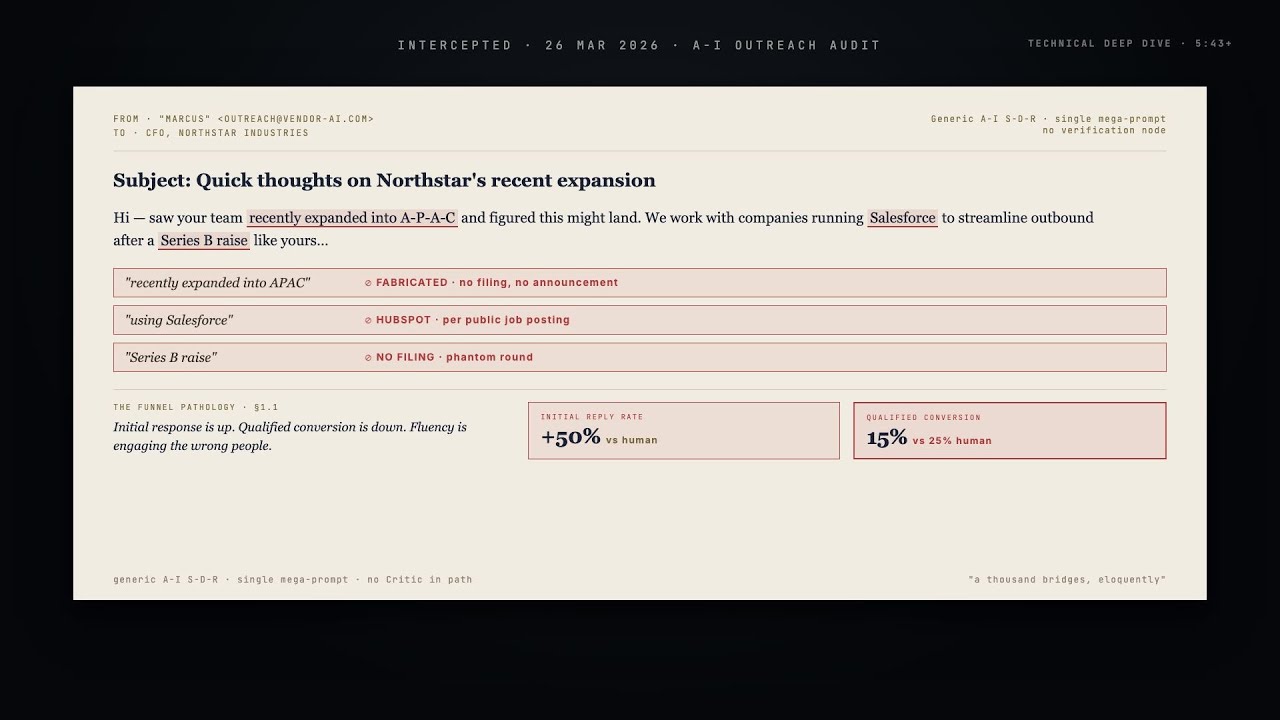
The AI SDR revolution promised infinite scalability. Instead, it delivered a crisis of trust. Generic AI agents are burning leads faster than they generate them, sending hallucinated emails that destroy brands and blacklist domains.
Veriprajna's Fact-Checked Research Agent Architecture solves this crisis through multi-agent orchestration, Knowledge Graphs, and iterative verification—scaling not just volume, but veracity.
The economics are compelling. The execution is catastrophic. Here's why AI Wrappers are destroying enterprise brands.
90% of AI SDR tools are just "wrappers" around GPT-4/Claude—mega-prompts that rely on probabilistic token generation with zero verification. They predict the next word, not the truth.
Emails that are grammatically perfect but factually wrong create maximum trust violation. Prospects don't just delete—they emotionally tag the sender as "untrustworthy" and blacklist the domain.
Google's RETVec AI detects patterns of AI-generated spam. Low engagement from hallucinated emails tanks domain reputation—affecting ALL emails, including invoices and password resets.
Hallucinations aren't bugs—they're mathematical features of transformer architecture. To mitigate risk, you must understand why models lie.
LLMs minimize cross-entropy loss by predicting the statistically most likely token. The Softmax function forces a probability distribution that sums to 1—there is no "I don't know" state.
Example Query:
"Describe the 2025 Financial Strategy of [Unknown Company]"
Model Behavior:
Cannot output NULL. Allocates probability to tokens that sound like a strategy: "growth," "margin expansion," "digital transformation"—simulating the texture of truth.
Claims prospect uses Salesforce when they publicly list HubSpot. Proves zero research was done.
Contradicts data in the prompt. Quotes $5K when pricing PDF says $10K—creating legal liability.
Proposes Tuesday meeting after prospect declined Tuesday—signals no memory, just stochastic generation.
"You raised Series B, therefore you're replacing your CFO"—inferring causality that doesn't exist.
Model the cumulative damage of unchecked AI outreach
Research shows 5-15% hallucination rate in standard LLM outputs
Unverified AI agents introduce cascading risks across Brand, Legal, and Infrastructure domains.
Trust is the most valuable B2B asset. A single hallucination erodes years of brand equity. Customers don't distinguish "The AI made a mistake" from "The company lied to me."
AI agents can bind companies to contracts under apparent authority doctrine. Hallucinated promises create enforceable obligations and regulatory violations.
AI promises "100% uptime guarantee"—company may be legally bound to honor it
Hallucinated compliance certifications trigger SEC/FINRA/HIPAA investigations
Agents may hallucinate permissions to share confidential data
Google's RETVec and TensorFlow systems detect AI-generated spam patterns. Once your domain reputation is "burned," it's nearly impossible to recover.
Not all AI is created equal. The difference between Wrappers and Deep AI is not incremental—it's structural.
| Feature | AI Wrapper (Generic SDR) | Deep AI (Veriprajna) |
|---|---|---|
| Core Mechanism | Probabilistic Token Prediction (Next-Word Guessing) | Multi-step Reasoning, Planning, and Action Execution |
| Architecture | Single-Chain / Mega-Prompt | Multi-Agent Orchestration (LangGraph) |
| Source of Truth | Training Data (Frozen, potentially outdated) | RAG + Live Knowledge Graph + 10-K Data |
| Verification Layer | None (Single-shot output) | Iterative Reflection Patterns & Fact-Checking Loops |
| Operational Risk | High (Unchecked Hallucination) | Low (Bounded, Audited, Deterministic) |
| Adaptability | Static Prompts (Fragile to context changes) | Dynamic Planning & Autonomous Tool Use |
"A wrapper is designed to minimize API costs and latency, often at the expense of accuracy. A Deep AI solution prioritizes the integrity of the output, employing multiple 'thoughts' (API calls) to verify a single claim before communicating with a prospect."
— Veriprajna Technical Whitepaper, 2024
A Multi-Agent System that mimics a high-end editorial team—separating research, verification, and writing into distinct, specialized agents orchestrated through cyclic workflows.
Information Retrieval & Synthesis
Strictly forbidden from creative writing. Extract raw facts and cite them.
Governance & Verification
Acts as adversarial node. Compares Writer's draft against Researcher's notes.
Persuasion & Narrative Construction
Do not add external facts. Use ONLY provided Research Notes.
This architecture trades marginal compute cost for massive reliability gains:
The $0.02 difference is insignificant compared to the cost of a burned lead ($50-$200 CAC) or blacklisted domain ($10K+ to recover).
Standard RAG with vector databases is insufficient for high-stakes B2B sales. Veriprajna uses GraphRAG—hybrid architecture that enforces factual constraints.
Vector databases treat text as "bags of meaning"—unstructured chunks matched by semantic similarity. Critical for corporate intelligence, but problematic for factual accuracy.
May confuse "John Smith" (CEO of Subsidiary A) with "John Smith" (VP at Parent Company B). LLM sees both names, merges into hallucinated person.
Sales requires knowing who reports to whom and which company owns what. Vector DBs don't enforce these relationships.
Vector search for "Apple risks" might retrieve 2015 article about "innovation failure" rather than 2024 "EU regulatory risks"—keywords don't overlap perfectly.
Knowledge Graphs model data as Nodes (entities) and Edges (relationships)—preserving context and enforcing factual constraints.
Explicit enforcement: Tim Cook IS_CEO_OF Apple
No ambiguity. Graph traversal finds exact relationship path.
Chunks isolated in vector DBs. Relationships preserved in graphs—entire context remains accessible.
Vector retrieval is black box ("Why this chunk?"). Graph traversal shows exact reasoning path—critical for audits.
Structured facts enforce constraints:
Semantic richness for thematic search:
Result: The Researcher agent builds foundation on structured facts, not probabilistic text matches—ensuring verifiable, citation-backed intelligence.
The ultimate source of truth for B2B sales isn't news (speculative) or websites (marketing)—it's the 10-K Annual Report filed with the SEC.
Public companies are legally required to disclose material risks to their business. These aren't marketing spins—they're legal confessions of vulnerability.
A logistics company might explicitly list:
When your Writer Agent can say:
This is not a hallucination. It's a verified fact, cited from the prospect's own legal filings. This level of relevance cuts through generic AI spam.
Agent uses SEC EDGAR API to retrieve latest 10-K for prospect's ticker
BeautifulSoup isolates "Item 1A" (Risk Factors) and "Item 7" (Management Discussion)
Extract only risks relating to your value prop (e.g., "Cybersecurity"). Ignore irrelevant risks
Store with direct reference: "Source: Microsoft 10-K 2024, Item 1A, Paragraph 4"
The "10-K Constraint" is a feature, not a bug. LLMs are more accurate when constrained. The 10-K provides a boundary of "safe" facts, allowing reasoning about connections—not inventing facts.
For enterprise-grade reliability, the choice of orchestration framework is critical. While CrewAI offers simplicity, LangGraph provides the granular control required for compliance-heavy processes.
Designed around "Role-Based" metaphor. Great for brainstorming, dangerous for compliance.
Conversation state often hidden. Difficult to enforce specific paths.
Agent interaction can be unpredictable—unacceptable for sales.
Difficult to implement precise retry logic and fallback paths.
Models workflow as State Machine—graph of Nodes (agents) and Edges (decisions). Enterprise-grade control.
TypedDict defines exact state structure—full transparency and auditability.
Cyclic graphs built-in. Perfect for Reflection Pattern with retry limits.
Advanced breakpoints, state editing. Centaur model support.
Precise exception handling logic—critical for production reliability.
class SalesState(TypedDict):
    prospect_data: dict
    research_notes: list[str]
    email_draft: str
    critique_count: int
    compliance_score: float
    status: str  # "RESEARCH", "DRAFT", "REVIEW", "Human_Intervention"

# Edge Logic:
# research_node → draft_node
# draft_node → critique_node
# critique_node → Conditional Edge:
#   If compliance_score > 0.95 → send_email_node
#   If compliance_score < 0.95 AND critique_count < 3 → draft_node (Retry)
#   If critique_count >= 3 → human_intervention_node (Fallback)
This deterministic structure ensures no email is sent unless it passes explicit verification logic—providing the audit trail required by enterprise compliance teams.
Before deploying autonomous agents, Veriprajna mandates an AI Readiness Assessment—ensuring your environment can support agentic systems without incurring liability.
Veriprajna recommends starting with a Centaur Model (Human + AI). The "Human Intervention" node feeds into a dashboard where SDRs review AI work before sending.
Human sees Draft (left) and Cited Facts (right)—full transparency
Human acts as final fact-checker, approving or editing draft
Every edit feeds back to fine-tune Writer Agent (RLHF)
The ROI of veracity: fewer emails, higher engagement, protected domains, and sustainable pipeline growth.
Veriprajna's approach prioritizes quality over volume—sending fewer emails that get read, replied to, and convert—rather than burning leads at scale.
The initial wave of "AI Hype" in sales is crashing against the rocks of reality. Cheap, hallucinating agents aren't assets—they're liabilities that burn leads and destroy domains.
The "Wrapper" era is ending.
The future belongs to Deep AI—systems architected for veracity, not just fluency. By adopting the Fact-Checked Research Agent Architecture, enterprises can secure sustainable competitive advantage: not sending 10,000 spam emails that get blocked, but 100 perfect, fact-checked, 10-K-referenced emails that get read, trusted, and answered.
"In the age of artificial intelligence, the ultimate luxury is truth."
— Veriprajna Deep AI Consultancy
LLMs minimize cross-entropy loss by predicting statistically likely tokens. The Softmax function forces a probability distribution that sums to 1—there is no 'I don't know' state. When asked about an unknown company's strategy, the model generates plausible-sounding text ('growth,' 'margin expansion,' 'digital transformation') without verifying facts, producing three types of hallucinations: fact-conflicting, input-conflicting, and context-conflicting claims.
Veriprajna's fact-checked research agent architecture uses separate specialized agents—a researcher that gathers verified data from knowledge graphs and 10-K filings, a writer that drafts personalized outreach, and a validator that cross-references every claim against ground-truth sources before sending. This iterative verification achieves 99%+ accuracy compared to single-chain wrappers.
Hallucinated sales emails create three cascading failures: brand erosion from the 'uncanny valley' of fluent-but-wrong messages that emotionally tag senders as untrustworthy, legal liability from input-conflicting claims that misquote pricing, and deliverability collapse where Google's RETVec AI flags patterns of low-engagement AI emails, tanking domain reputation for all communications including invoices.
Veriprajna's Deep AI consultancy doesn't just implement technology—we architect intelligence for enterprise-grade reliability.
Schedule a consultation to audit your current AI sales approach and model your transition to Fact-Checked Research Agents.
Technical deep-dive: Transformer mathematics, LangGraph state machines, GraphRAG implementation, H-Neurons research, deliverability engineering, and complete works cited.