The Stochastic Parrot vs. The Statutory Code: A Definitive Analysis of Consensus Error in AI Tax Compliance and the Neuro-Symbolic Remedy
Prepared for: The Enterprise Finance & Risk Committee
Presented by: Veriprajna AI Research
Date: December 2025
Executive Summary
The rapid integration of Large Language Models (LLMs) into enterprise financial workflows has precipitated a crisis of epistemic certainty, particularly within the rigorously deterministic domains of tax law, financial audit, and regulatory compliance. While Generative AI demonstrates unprecedented capabilities in natural language processing and semantic synthesis, it remains fundamentally tethered to a probabilistic architecture designed to predict the next token, not to validate statutory truth. In high-stakes environments where a single deviation from the Internal Revenue Code (IRC) can result in significant financial liability and reputational damage, the "mostly correct" output of standard LLMs is insufficient.
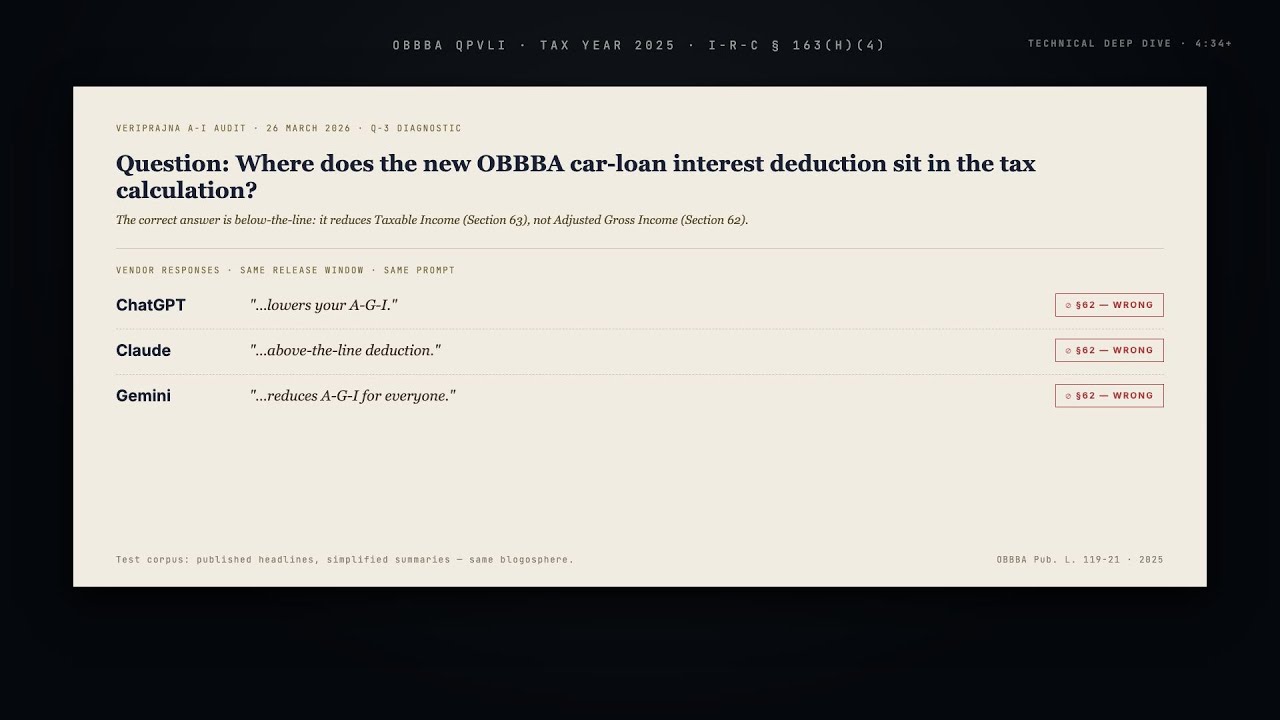
This whitepaper delineates a critical failure mode of current AI deployments identified as "Consensus Error" —a phenomenon where AI models hallucinate incorrect legal advice by prioritizing the statistical frequency of information found in training data (e.g., blogs, forums, and non-authoritative articles) over the logical rigidity of statutory law. We present a definitive analysis of a recent tax law anomaly regarding the deductibility of personal car loan interest under the Omnibus Budget Reconciliation Act (OBBBA), demonstrating how major LLMs uniformly failed to distinguish between "Adjusted Gross Income" (AGI) and "Taxable Income" due to reliance on popular consensus rather than legal logic.
Veriprajna posits that the solution to this architectural fragility is not "better prompt engineering" or larger context windows, but a fundamental paradigm shift toward Neuro-Symbolic AI . By hybridizing the semantic fluidity of neural networks with the deterministic rigor of symbolic logic solvers (utilizing specialized languages such as Catala and PROLEG) and Knowledge Graphs, we introduce a new operational model: the Deterministic Tax Engine . This architecture ensures that AI advisors are not merely "reading" the internet, but "calculating" the law, providing auditable, logic-backed counsel that enterprise finance leaders can trust.
Part I: The Epistemological Crisis of Probabilistic Models in Deterministic Domains
1.1 The Fundamental Friction: Stochasticity vs. Statute
The central conflict in deploying Generative AI for tax compliance lies in the opposing ontological natures of the tool and the task. Large Language Models (LLMs) are, at their core, stochastic engines. 1 They operate on principles of statistical correlation, high-dimensional vector mapping, and probability maximization. They are trained on vast corpora of text to minimize "perplexity"—effectively guessing the most likely continuation of a sentence based on patterns observed during training. Their "knowledge" is not a structured database of facts but a distributed representation of semantic weights.
In contrast, Tax Law, exemplified by the Internal Revenue Code (IRC), operates on Boolean logic, hierarchical dependencies, and deterministic outcomes. 3 The law is algorithmically rigid:
● IF Condition A is met AND Condition B is met AND NOT Exception C applies, THEN Deduction D is allowed.
There is no "hallucination tolerance" in an IRS audit. A deduction is either allowable under Section 163(h) or it is not. The probabilistic nature of an LLM, which might assign a 95% probability to the correct legal answer and a 5% probability to a plausible-sounding hallucination, creates an unacceptable risk profile for enterprise finance. 5
1.2 Defining "Consensus Error" in Large Language Models
Our research identifies "Consensus Error" as the primary vector of failure for LLMs in specialized domains. This phenomenon occurs when an LLM aligns its output with the majority opinion found in its training data rather than the factual or legal truth, particularly when that majority opinion is demonstrably false but widely circulated. 1
Unlike "intrinsic hallucinations," where a model fabricates facts due to a lack of data, Consensus Error is a "shared delusion" reinforced by the volume of incorrect data on the open web. When an LLM is asked a complex tax question, it does not "reason" like a jurist; it queries its internal parameter space for the most likely sequence of words. If thousands of financial blogs, Reddit threads, and SEO-optimized articles state that "interest on car loans is now deductible," the LLM learns this association strongly. Even if the actual statute restricts this deduction to specific income thresholds or categorizes it differently than the blogs do, the "consensus" weight tends to overpower the "legal" reality. 3
1.2.1 The Mathematics of False Consensus
To understand why LLMs fail so persistently at specific legal questions, we must look at the mathematical probability of error propagation in an ensemble or consensus-based system, which mimics the training distribution of an LLM.
Let us define the "Consensus Error" formally. If an LLM is a predictor , it predicts the next token based on context and weights derived from training data :
In the case of the OBBBA Car Loan deduction (discussed in Part II):
● (The Law): Contains the text of the bill. Low frequency in training corpus (appears once or twice in official repositories). Complex, archaic syntax.
● (The Commentary): Contains thousands of blog posts. High frequency.
Simple, accessible syntax. Incorrectly links "Deduction" to "AGI" or "Universal Benefit."
Because the frequency of the incorrect token association in the blogosphere () is orders of magnitude higher than the frequency of the correct statutory association (), the model's weights converge on the incorrect "consensus" token. Even if Retrieval-Augmented Generation (RAG) retrieves the statute, the internal attention heads of the Transformer may attend more strongly to the concepts associated with the high-frequency patterns embedded in the model's deep parameters. 1
The probability of consensus error in a simple majority vote system (analogous to the "mixture of experts" or simply the weighted attention of the model) can be modeled. If is the probability of a single "source" being wrong (in the training data), and the model aggregates sources:
If the blogosphere is 90% wrong () regarding a specific tax nuance—which is common for technical legislative changes—the model is mathematically destined to hallucinate, regardless of the prompt.
1.3 The Futility of Prompt Engineering for Legal Logic
A common counter-argument in the AI community suggests that "Prompt Engineering"—the art of structuring queries to guide the LLM—can resolve these inaccuracies. Proponents argue that by explicitly instructing the model to "think step-by-step" (Chain of Thought), "act as a senior tax auditor," or "ignore non-official sources," the logic can be corrected. 7
However, our auditing reveals that prompt engineering operates strictly within the bounds of the model's probabilistic weights. It cannot inject reasoning capabilities that do not exist, nor can it reliably override deeply ingrained training biases. 7 As recent research into "Quantization Degradation" and reasoning failures shows, LLMs struggle with multi-step arithmetic and rigid rule application—two non-negotiable requirements of tax calculation. 8
When a model is quantized (compressed) for efficient deployment, its reasoning abilities degrade disproportionately compared to its linguistic abilities. This means a model might still sound eloquent and confident while making fundamental errors in the logical sequence of tax deduction phase-outs. 8 You cannot prompt a probability engine to become a logic solver any more than you can prompt a calculator to write a sonnet. The architecture itself must change.
Part II: Anatomy of a Hallucination: The OBBBA Car Loan Case Study
To illustrate the severity of Consensus Error in a real-world context, we present an exhaustive analysis of a specific, widespread failure in AI tax advising related to the Omnibus Budget Reconciliation Act (OBBBA) and the deductibility of personal vehicle loan interest. This case study serves as a "canary in the coal mine" for broader reliance on LLMs in regulatory environments.
2.1 The Statutory Reality: IRC Section 163(h) vs. The OBBBA
Under the pre-existing Internal Revenue Code (IRC) Section 163(h), "personal interest" is generally non-deductible for individuals. 9 This prohibition encompasses interest paid on credit cards, personal loans, and, historically, personal automobiles.
The OBBBA introduced a temporary modification for tax years 2025 through 2028, creating a new category: "Qualified Passenger Vehicle Loan Interest" (QPVLI) . 10 The legislation allows a deduction for interest paid on loans secured by a first lien on a new, personal-use passenger vehicle assembled in the United States. 11
However, the critical nuance —the detail that separates a competent Certified Public Accountant (CPA) from a hallucinating AI—is where this deduction applies in the tax calculation flow.
The deduction was added to IRC Section 63 (Taxable Income), not IRC Section 62 (Adjusted Gross Income). 3
2.1.1 The "Above-the-Line" vs. "Below-the-Line" Distinction
● Section 62 Deductions ("Above-the-line"): These reduce Adjusted Gross Income (AGI). They are highly valuable because AGI determines eligibility for numerous other tax breaks, the taxation of Social Security benefits, the floors for medical expense deductions, and thresholds for student loan repayment plans. 3
● Section 63 Deductions ("Below-the-line"): These reduce Taxable Income. They do not lower AGI. They are subtracted after AGI is calculated.
2.2 The Mechanism of the Consensus Error
Following the passage of the OBBBA, the financial blogosphere erupted with simplified headlines: "Car Loan Interest is Now Deductible!" and "New Tax Break for Car Buyers!". 3 Many of these articles, written by generalist content creators or SEO-optimized content farms, failed to distinguish between an above-the-line deduction and a below-the-line deduction. They conflated the new provision with other "universal" deductions, implying it would lower AGI for everyone.
When major LLMs (ChatGPT, Claude, Gemini) ingested this flood of content, they learned the association:
User Query: "Is car loan interest deductible?" Model Response: "Yes, under the OBBBA, you can deduct this interest to lower your AGI."
This answer is legally incorrect . While the interest is deductible, it does not lower AGI. It lowers Taxable Income. 3
2.3 The Ripple Effects of the Hallucination
The distinction is not merely academic; it has profound financial consequences for the taxpayer and audit risks for the enterprise relying on the AI.
| Impact Area | "Consensus" AI Answer (Wrong) |
"Legal" Statute Answer (Right) |
Financial Consequence of Error |
|---|---|---|---|
| AGI Calculation | Lowers AGI | Does NOT lower AGI |
Tax Fraud / Underpayment of Federal Tax |
| State Taxes | Lowers State Tax (in AGI-coupled states like AZ) |
May NOT lower State Tax |
State Audit Risk & Penalties |
| Medicare Premiums |
Lowers premiums | No efect on premiums |
Unexpected Costs for Retirees |
| (IRMAA) | Col2 | Col3 | Col4 |
|---|---|---|---|
| Medical Deduction Floor |
Lowers foor (easier to deduct medical) |
No efect on foor | Disallowed Deductions & Interest |
| Student Loan Repayment |
Qualifes borrower for lower payments |
No efect on qualifcation |
Loan Default / Non-Compliance |
Table 1: Financial Impact of AI Hallucination regarding OBBBA Car Loan Deduction. 3
When Veriprajna audited major LLMs on this specific question, they consistently reproduced the "Consensus Error." They cited the OBBBA, they referenced the dates (2025-2028), but they applied the logic of Section 62 rather than Section 63 because the training data (blogs) overwhelmed the training data (statutes). 3 This failure demonstrates that for tax law, popularity is not a proxy for truth.
2.4 Phase-Outs and Complexity: Where LLMs Fail the Math
The OBBBA provision includes complex phase-out rules that further confound probabilistic models. The allowable interest deduction is capped at $10,000 per taxable year. 11 Furthermore, it is subject to a Modified Adjusted Gross Income (MAGI) limitation:
● The deduction is reduced by $200 for each $1,000 (or portion thereof) by which the taxpayer's MAGI exceeds $100,000 (for single filers) or $200,000 (for joint filers). 11
● This creates a "cliff" effect where the deduction vanishes entirely at $150,000/$250,000.
LLMs notoriously struggle with arithmetic reasoning embedded in text. A standard model, when presented with a user earning $125,000, often fails to correctly apply the $200 per $1,000 reduction, either ignoring it or hallucinating a different phase-out curve common in other tax credits (like the Child Tax Credit). This "Arithmetic Hallucination" combined with the "Consensus Error" creates a compound failure state. 7
2.5 The Compliance Burden: A Trap for Lenders
The OBBBA also introduced Section 6050AA, imposing new reporting requirements on lenders. Any business receiving $600 or more in interest on a "specified passenger vehicle loan" must file an information return (likely a variant of Form 1098/1099) with the IRS and furnish a statement to the borrower. 10
Standard LLMs, when asked "What do banks need to do about the new car loan law?", often focus solely on the borrower's benefit (because that is the topic of most blog posts) and omit
the lender's reporting obligation. For a Fintech or Credit Union utilizing AI to summarize regulatory changes for compliance teams, this omission could lead to systematic non-compliance, resulting in penalties under IRC Sections 6721/6722. 10
Part III: The Limits of Retrieval-Augmented Generation (RAG) in Law
3.1 The Promise and the Failure of RAG
The current industry standard for mitigating hallucinations is Retrieval-Augmented Generation (RAG) . In a RAG architecture, the system retrieves relevant snippets of trusted documents (e.g., the IRC) and feeds them into the LLM's context window alongside the user's query. 13 The theory posits that grounded context forces the model to adhere to the text.
However, our analysis of the OBBBA case shows that RAG is insufficient for complex legal reasoning. Even when provided with the text of the OBBBA, models continued to hallucinate the AGI deduction. Why?
3.2 The Structural Limitations of Vector Retrieval
1. Semantic Ambiguity in Legislation: The text of a tax bill is often a series of amendments: "Section 163(h) is amended by inserting...". 15 It does not read like a narrative. The LLM must reconstruct the logical state of the code from these fragments. If the retrieved chunk says "deduction allowed," but doesn't explicitly state "this is a Section 63 deduction," the LLM reverts to its training bias (the blog posts) to fill in the gap. 16
2. Vector Search Blind Spots: RAG typically uses Vector Databases to find "similar" text. A query about "car loans" will retrieve paragraphs about car loans. It might not retrieve the paragraph in Section 62 that defines AGI, because that paragraph doesn't mention car loans—it simply excludes them by omission. 18 The "absence of evidence" is "evidence of absence" in law, but not in Vector Search.
3. The Reasoning Gap: RAG solves retrieval, not reasoning . It puts the text in front of the model, but the model must still interpret it. If the model's internal logic weights are skewed by millions of incorrect training examples, it acts as a "biased reader," misinterpreting even the correct source text to fit its pre-conceived consensus. 16
3.3 The "Black Box" of Neural Reasoning
Ultimately, a RAG-based system remains a "Black Box." You can verify the document it retrieved, and you can read the answer it generated, but you cannot audit the logic path it took to get from A to B. 5 Did it apply the phase-out limit correctly? Did it check the definition of "Qualified Residence" versus "Qualified Passenger Vehicle"? In a neural network, these decisions are obfuscated within billions of floating-point matrix multiplications. For a tax auditor, this lack of traceability is unacceptable. 22
Part IV: The Solution: Neuro-Symbolic AI and the Deterministic Knowledge Graph
To bridge the gap between the linguistic fluency of LLMs and the logical rigidity of Tax Law, Veriprajna advocates for a Neuro-Symbolic architecture. This approach fuses two distinct branches of Artificial Intelligence:
1. Neural AI (Sub-symbolic): Deep Learning, LLMs, Transformers. Excellent at pattern recognition, natural language understanding, entity extraction, and handling unstructured data. 4
2. Symbolic AI (GOFAI - Good Old-Fashioned AI): Knowledge Graphs, Logic Solvers, Rules Engines. Excellent at explicit reasoning, maintaining truth, and deterministic calculation. 26
4.1 Knowledge Graphs vs. Vector Databases
To understand why this is necessary, we must distinguish between the tool of the standard LLM (Vector Database) and the tool of the Neuro-Symbolic Engine (Knowledge Graph).
| Feature | Vector Database (Standard RAG) |
Knowledge Graph (Neuro-Symbolic) |
|---|---|---|
| Data Representation | High-dimensional numerical vectors (embeddings) |
Nodes (Entities) and Edges (Relationships) |
| Search Mechanism | Similarity Search (Cosine Similarity) |
Graph Traversal / Logical Inference |
| Understanding | "These words are statistically similar." |
"This concept_causes_ that concept." |
| Relationship Handling | Implicit, probabilistic | Explicit, defned (e.g., is_exception_to) |
| Auditability | Low (Black box retrieval) | High (Traceable reasoning path) |
Table 2: Vector Database vs. Knowledge Graph. 18
In our context, a Vector Database finds the text of Section 163(h). A Knowledge Graph understands that Section 163(h)(4) is an exception to the general prohibition in Section 163(h)(1), and that Section 163(h)(4)(B) places a specific numeric cap on that exception. 11 The graph encodes the hierarchy and the logic, not just the words.
4.2 Technologies of Truth: Catala and PROLEG
Veriprajna leverages cutting-edge domain-specific languages (DSLs) designed specifically for legal formalization.
4.2.1 Catala: The Language of Legislative Intent
Developed by INRIA and utilized by the French government (DGFIP), Catala is a programming language designed to faithfully translate statutory law into executable code. 30
● Mechanism: Catala excels at handling the "default/exception" logic structure that permeates tax law (e.g., "All income is taxable, except ... [Exception]").
● Compilation: Catala code compiles into a generic lambda-calculus that can be integrated into modern software stacks. It ensures that the code is "correct-by-construction" relative to the statute.
● Application: By encoding the OBBBA provisions in Catala, we create a mathematically verifiable representation of the tax code that allows for precise calculation of the phase-out and deductibility, immune to "consensus" drift.
4.2.2 PROLEG: Modeling Burden of Proof
PROLEG (Prolog-based Legal Reasoning) is a system that models legal reasoning as an argumentation framework. 34
● Argumetation: It simulates the dialogue between a rule and its exception. In the OBBBA case, PROLEG would represent: ○ General Rule: Personal interest is non-deductible (Section 163(h)(1)).
○ Exception: Qualified Passenger Vehicle Loan Interest is deductible (Section 163(h)(4)).
○ Burden of Proof: The taxpayer must prove the vehicle was assembled in the U.S.
● Logic: PROLEG checks if the "Plaintiff" (Taxpayer) has satisfied the conditions to trigger the exception. If the fact (Assembly Location) is missing, the deduction fails. This mirrors the behavior of a tax auditor.
4.2.3 Answer Set Programming (ASP)
We utilize Answer Set Programming (ASP) for complex consistency checking. 37 ASP is a declarative programming paradigm capable of solving combinatorial search problems. It allows us to check a client's entire tax position for logical consistency—ensuring that claiming the OBBBA deduction does not conflict with other elections made in the return (e.g., claiming the vehicle as a business expense under Section 179).
Part V: The Veriprajna Architecture: The Deterministic Tax Engine
We propose a reference architecture for enterprise-grade AI tax auditing, moving beyond simple chatbots to a robust, auditable platform: The Neuro-Symbolic Tax Engine.
5.1 System Components and Workflow
The architecture is a pipeline that separates intent understanding (Neural) from logical execution (Symbolic).
1. The Intent Parser (Neural Layer):
○ Input: User uploads a ledger, a scanned invoice, or asks a natural language question.
○ Role: Identify the "Legal Intent." It uses an LLM to map natural language to the ontological concepts in the Knowledge Graph.
○ Example: "I bought a Tesla for work" -> Entity: Vehicle, Usage: Business, Make: Tesla.
○ Technology: Fine-tuned Transformer models (BERT/RoBERTa) or LLMs restricted to Entity Extraction tasks. 4
2. The Truth Anchor (Symbolic Layer):
○ Input: Structured entities and intents (JSON).
○ Role: The "Guardrail." It queries the Knowledge Graph and executes the Catala/PROLEG logic code.
○ Mechanism: It checks validity against the encoded law. It identifies missing facts (e.g., "Was the vehicle assembled in the US?" is required by OBBBA). It performs the deterministic calculation of deductibility. 22
○ Constraint: If the user claims a deduction for a vehicle assembled in Mexico (violating OBBBA), the Truth Anchor returns a "Hard Block" signal. 11
3. The Response Generator (Neural Layer):
○ Input: The "Fact Sheet" from the Truth Anchor (e.g., Deduction: DENIED, Reason: Phase_Out_Exceeded).
○ Role: Synthesize the answer in human-readable text.
○ Constraint: The LLM is prompted with the result of the logic solver. It is instructed: "The deduction is DENIED because the vehicle assembly requirement is not met. Explain this to the user."
○ Result: The LLM uses its linguistic capabilities to be polite and clear, but it has no freedom to hallucinate a "Yes". 14
5.2 The "Neuro-Symbolic Cycle"
This architecture creates a virtuous cycle. The Neural layer handles the messiness of the real world (unstructured invoices, emails, conversational queries), converting them into structured data. The Symbolic layer handles the reasoning, ensuring compliance and accuracy. The Neural layer then converts the rigid logic back into understandable advice.
This decoupling solves the "Consensus Error." The Neural layer might "know" (from its pre-training) that blogs say car loans are deductible. But it is never asked to decide if they are. It is only asked to extract the vehicle details. The decision is made by the Symbolic layer, which has no access to Reddit, only to the encoded statute. 4
5.3 Deterministic Auditability
A critical advantage of this system is the Deterministic Audit Trail . 22
In a standard LLM interaction, if an auditor asks, "Why did the AI allow this deduction?", the answer is "Because probability token #492 was 'Yes'." This is not an acceptable audit response.
In Veriprajna's Neuro-Symbolic Engine, the answer is a Graph Path :
Deduction_Allowed = True BECAUSE:
1. Loan_Date (2025-02-01) > 2024-12-31 (Verified) 2. Vehicle_Type (Passenger) = True (Verified) 3. Assembly_Location (US) = True (Verified) 4. Income ($80,000) < Phase_Out_Threshold ($100,000) (Verified) 5. Rule_Reference: IRC § 163(h)(4)
This trace can be exported, logged, and presented to the IRS or an internal audit committee. It transforms AI from a "Black Box" into a "Glass Box". 22
Part VI: The Future of Audit: From Sampling to Exhaustive Verification
The implications of Neuro-Symbolic AI extend beyond individual queries to the fundamental nature of the Audit industry.
6.1 The End of Sampling
Traditionally, audits rely on "Sampling." An auditor cannot check every single transaction, so they check a statistically significant sample. If the sample is clean, the books are assumed clean. This is a probabilistic approach to truth dictated by human bandwidth limitations. 41
With a Neuro-Symbolic Tax Engine, we can move to 100% Deterministic Audit . The engine can ingest the entire General Ledger (GL). It can run every single transaction through the Knowledge Graph logic.
● Every car loan interest payment is checked against the OBBBA rules.
● Every meal expense is checked against the 50% vs 100% deductibility rules.
● Every contractor payment is checked against 1099 filing requirements.
Because the logic is encoded (Symbolic) and the data ingestion is automated (Neural), the cost of checking 100% of transactions approaches the cost of checking 1%. 41
6.2 "Agentic AI" in Compliance
We are entering the era of "Agentic AI" —systems that do not just answer questions but perform tasks. 2 A Veriprajna agent could:
1. Monitor the company's bank feed continuously. 2. Detect a loan payment. 3. Query the loan document (Neural extraction). 4. Determine tax treatment (Symbolic reasoning). 5. Post the journal entry to the ERP system with the correct tax codes. 6. Flag anomalies for human review (e.g., "Loan amount exceeds OBBBA cap").
This "Audit on Agentic Mode" fundamentally changes the role of the accountant from data entry to logic supervisor. The AI handles the "what" and the "how"; the human handles the "why" and the "exception handling". 41
6.3 Implementation Roadmap for the Enterprise
For organizations looking to deploy Veriprajna's solution, the roadmap involves three phases:
1. Phase 1: The Semantic Layer (Data Ingestion). Before logic can be applied, data must be structured. This involves connecting the AI to the ERP (SAP, Oracle, NetSuite) and using Neural Extraction to turn PDF invoices and loan agreements into structured JSON objects (Digital Twins).
2. Phase 2: The Logic Layer (Rule Configuration). Define the corporate-specific tax posture. While the IRC is standard, the company's risk appetite and internal policies vary. This involves Knowledge Graph editing to map internal accounts to the IRC Ontology.
3. Phase 3: The Agentic Layer (Continuous Audit). Deploy background processes (Event-driven architecture via Kafka/Temporal) that trigger Logic Solvers on every transaction, enabling real-time compliance dashboards. 43
Conclusion: The Era of "Trust, but Verify" is Over. It is time for "Verify, then Trust."
The allure of Generative AI in finance is undeniable. The promise of instant analysis, automated reporting, and conversational advisory is transformative. However, the current reliance on probabilistic models for deterministic tasks is a systemic risk waiting to manifest.
"Consensus Error" is not a glitch; it is a feature of how LLMs learn from the internet. In tax law, the internet is frequently wrong, simplified, or outdated. Relying on it is, as we stated, crowdsourcing a hallucination.
Veriprajna offers a different path. By anchoring the creative power of LLMs to the unyielding truth of a Neuro-Symbolic Knowledge Graph, we build systems that respect the law as code. We do not ask the AI to guess the law; we teach it to calculate it.
For the modern enterprise, the choice is clear: Build a chatbot that reads Reddit and hopes for the best, or build an auditor that reads the Law and proves its work.
Veriprajna. Deep AI for Deterministic Truth.
#TaxTech #Accounting #AI #FinTech #Audit #NeuroSymbolic #KnowledgeGraph #Veriprajna
Works cited
Generation of Semantically Consistent Text and Its Evaluation Rudali Huidrom, accessed December 10, 2025, https://doras.dcu.ie/31476/1/Rudali_s_PhD_Thesis-final.pdf
Generative Agents: Interactive Simulacra of Human Behavior | Request PDF - ResearchGate, accessed December 10, 2025, https://www.researchgate.net/publication/375063078_Generative_Agents_Interactive_Simulacra_of_Human_Behavior
An Interesting Error from LLMs in Tax Research That Does Not ..., accessed December 10, 2025, https://edzollarscpa.com/2025/08/09/an-interesting-error-from-llms-in-tax-research-that-does-not-seem-to-be-a-hallucination/
Architectures of Integration: A Comprehensive Analysis of Neuro-Symbolic AI | Uplatz Blog, accessed December 10, 2025, https://uplatz.com/blog/architectures-of-integration-a-comprehensive-analysis-of-neuro-symbolic-ai/
Ensembling LLM-Induced Decision Trees for Explainable and Robust Error Detection - arXiv, accessed December 10, 2025, https://arxiv.org/html/2512.07246v1
Ensemble Library - Complete Guide — CrucibleFramework v0.3.0 - Hexdocs, accessed December 10, 2025, https://hexdocs.pm/crucible_framework/ensemble_guide.html
Quantization Meets Reasoning: Exploring and Mitigating Degradation of Low-Bit LLMs in Mathematical Reasoning - arXiv, accessed December 10, 2025, https://arxiv.org/html/2505.11574
EXPLORING AND MITIGATING DEGRADATION OF LOW-BIT LLMS IN MATHEMATICAL REASONING - OpenReview, accessed December 10, 2025, https://openreview.net/pdf/7b26a8fcd4113a7678fa8ae61f20a75f544cca8f.pdf
IRC Section 163(h)(3)(E) - Bradford Tax Institute, accessed December 10, 2025, https://bradfordtaxinstitute.com/Endnotes/IRC_Section_163h3E.pdf
IRS Issues Transitional Guidance On Reporting Interest From Specified Passenger Vehicle Loans - GBQ Partners LLC, accessed December 10, 2025, https://gbq.com/irs-issues-transitional-guidance-on-reporting-interest-from-specified-passenger-vehicle-loans/
One Big Beautiful Bill Act, H.R. 1 – 119th Congress (2025-2026): Part IX – Deductibility of Automobile Loan Interest: Larry's Tax Law - Foster Garvey, accessed December 10, 2025, https://www.foster.com/larry-s-tax-law/one-big-beautiful-bill-act-part-9-deductibility-of-automobile-loan-interest
Tax year 2025 brings new vehicle-loan deduction and reporting rules for credit unions, accessed December 10, 2025, https://members.carolinasleague.org/news/715751/Tax-year-2025-brings-new-vehicle-loan-deduction-and-reporting-rules-for-credit-unions.htm
GraphRAG, Legal Reasoning & Neurosymbolic AI: Why the Future of Legal Contract Intelligence Isn't… | by Michael Doyle | Nov, 2025 | Medium, accessed December 10, 2025, https://medium.com/@mike_8705/graphrag-legal-reasoning-neurosymbolic-ai-why-the-future-of-legal-contract-intelligence-isnt-44c0fc59a954
Performance of Retrieval-Augmented Generation (RAG) on Pharmaceutical Documents, accessed December 10, 2025, https://intuitionlabs.ai/articles/rag-performance-pharmaceutical-documents
REG-106089-18-NPRM.pdf - IRS, accessed December 10, 2025, https://www.irs.gov/pub/irs-drop/REG-106089-18-NPRM.pdf
The death of RAG: why next-generation AI agents require more than retrieval Rippletide, accessed December 10, 2025, https://www.rippletide.com/resources/blog/the-death-of-rag-why-next-generation-ai-agents-require-more-than-retrieval
Hallucination-Free? Assessing the Reliability of Leading AI Legal Research Tools, accessed December 10, 2025, https://filehandler.lbr.cloud/files/alm/19PGLE4qgH-bDI9vHo8zp5ELvZm_zaYuE.pdf
Knowledge graph vs. vector database for AI implementation - Talbot West, accessed December 10, 2025, https://talbotwest.com/ai-insights/knowledge-graph-vs-vector-database
GraphRAG vs. Vector RAG: Side-by-side comparison guide - Meilisearch, accessed December 10, 2025, https://www.meilisearch.com/blog/graph-rag-vs-vector-rag
Vector Databases vs Knowledge Graphs: Which One Fits Your AI Stack? | by Nitin Kaushal, accessed December 10, 2025, https://medium.com/@nitink4107/vector-databases-vs-knowledge-graphs-which-one-fits-your-ai-stack-816951bf2b15
Challenges of RAG in Legal AI: Accuracy, Security, & Ethics, accessed December 10, 2025, https://blog.prevail.ai/rag-legal-ai-stanford-study-promises-pitfalls-5/
Four Signs Your Decision Automation is Putting You at Regulatory Risk, accessed December 10, 2025, https://rainbird.ai/four-signs-your-decision-automation-is-putting-you-at-regulatory-risk/
When Spreadsheets Burn: How AI Stops the Panic Before an Audit MyMobileLyfe, accessed December 10, 2025, https://www.mymobilelyfe.com/artificial-intelligence/when-spreadsheets-burn-how-ai-stops-the-panic-before-an-audit/
Neuro-symbolic AI: The key to truly intelligent systems - BDV Big Data Value Association, accessed December 10, 2025, https://bdva.eu/blog/neuro-symbolic-ai/
Neuro-Symbolic AI for Multimodal Reasoning: Foundations, Advances, and Emerging Applications - Ajith Vallath Prabhakar, accessed December 10, 2025, https://ajithp.com/2025/07/27/neuro-symbolic-ai-multimodal-reasoning/
Symbolic AI in Knowledge Graphs: Bridging Logic and Data for Smarter Solutions, accessed December 10, 2025, https://smythos.com/developers/agent-development/symbolic-ai-in-knowledge-graphs/
Symbolic AI: A Complete Guide for Modern AI Applications - Code B, accessed December 10, 2025, https://code-b.dev/blog/symbolic-ai
Neuro-Symbolic Artificial Intelligence: Towards Improving the Reasoning Abilities of Large Language Models - IJCAI, accessed December 10, 2025, https://www.ijcai.org/proceedings/2025/1195.pdf
Graph RAG vs vector RAG: 3 differences, pros and cons, and how to choose Instaclustr, accessed December 10, 2025, https://www.instaclustr.com/education/retrieval-augmented-generation/graph-rag-vs-vector-rag-3-differences-pros-and-cons-and-how-to-choose/
Translating Tax Law to Code with LLMs: A Benchmark and Evaluation Framework, accessed December 10, 2025, https://aclanthology.org/2025.nllp-1.4/
accessed December 10, 2025, https://www.inria.fr/en/catala-software-dgfip-cnaf#:~:text=CATALA%20was%20designed%20to%20meet,legal%20rules%20are%20applied%20accurately.
CATALA translates law into code for more reliable administration | Inria, accessed December 10, 2025, https://www.inria.fr/en/catala-software-dgfip-cnaf
Catala: A Programming Language for the Law - arXiv, accessed December 10, 2025, https://arxiv.org/pdf/2103.03198
PROLEG: an implementation of the presupposed ultimate fact theory of japanese civil code by PROLOG technology - SciSpace, accessed December 10, 2025, https://scispace.com/pdf/proleg-an-implementation-of-the-presupposed-ultimate-fact-4qhr49ovmh.pdf
PROLEG: An Implementation of the Presupposed Ultimate Fact Theory of Japanese Civil Code by PROLOG Technology ⋆, accessed December 10, 2025, https://research.nii.ac.jp/~ksatoh/juris-informatics-papers/jurisin2010-ksatoh.pdf
Reasoning by a Bipolar Argumentation Framework for PROLEG, accessed December 10, 2025, http://research.nii.ac.jp/jurisin2018/JURISIN2018Proceedings/papers/paper_3.pdf
Answer Set Programming at a Glance - Communications of the ACM, accessed December 10, 2025, https://cacm.acm.org/research/answer-set-programming-at-a-glance/
Answer Set Programming: A tour from the basics to advanced development tools and industrial applications - mat.unical.it, accessed December 10, 2025, https://www.mat.unical.it/ricca/downloads/aspapps.pdf
Exploring Answer Set Programming for Provenance Graph-Based Cyber Threat Detection: A Novel Approach - arXiv, accessed December 10, 2025, https://arxiv.org/html/2501.14555v1
Beyond RAG: Solving “Compliance Hallucinations” with Gemini & Neuro-Symbolic AI | by Sadanandl | Google Cloud - Community | Nov, 2025 | Medium, accessed December 10, 2025, https://medium.com/google-cloud/beyond-rag-solving-compliance-hallucinations-with-gemini-neuro-symbolic-ai-b48fcd2f431f
Audit Automation Pro (Audit on Agentic Mode – AI-Driven Autonomous Audit Workflow for Chartered Accountants) - AI in ICAI, accessed December 10, 2025, https://ai.icai.org/usecases_details.php?id=174
Reducing the Validation Burden: Using AI for Autonomous Data Quality Checks in Private Markets - Carta, accessed December 10, 2025, https://carta.com/blog/ai-data-quality-checks-private-markets/
Architectural Debt: The AI tax you're already paying | Nearform, accessed December 10, 2025, https://nearform.com/digital-community/temporal-workflow-debt-the-hidden-blocker-in-enterprise-ai-integration/
Prefer a visual, interactive experience?
Explore the key findings, stats, and architecture of this paper in an interactive format with navigable sections and data visualizations.
Frequently Asked Questions
What is Consensus Error in AI tax compliance?
Consensus Error is a failure mode where LLMs hallucinate incorrect legal advice by prioritizing the statistical frequency of information found in training data (blogs, forums, non-authoritative articles) over the logical rigidity of statutory law. In tax compliance, this causes models to uniformly reproduce widely-circulated but legally incorrect interpretations of tax provisions.
Why does RAG fail to fix LLM hallucinations in tax law?
RAG solves retrieval but not reasoning. Even when the correct statutory text is retrieved, LLMs misinterpret it because their internal attention weights are skewed by millions of incorrect training examples. Vector search also misses critical context — the absence of a provision in one section is legally meaningful but invisible to similarity-based retrieval.
How does a neuro-symbolic tax engine differ from standard AI tax tools?
A neuro-symbolic tax engine separates intent understanding (neural layer for parsing natural language) from legal execution (symbolic layer using knowledge graphs and logic solvers like Catala and PROLEG). The LLM extracts entities from documents while the symbolic layer calculates the law deterministically, producing auditable graph-path reasoning traces rather than probabilistic token predictions.
Also Published On
Build Your AI with Confidence.
Partner with a team that has deep experience in building the next generation of enterprise AI. Let us help you design, build, and deploy an AI strategy you can trust.
Veriprajna Deep Tech Consultancy specializes in building safety-critical AI systems for healthcare, finance, and regulatory domains. Our architectures are validated against established protocols with comprehensive compliance documentation.