How Consensus Error in LLMs Creates Tax Compliance Risk—and the Neuro-Symbolic Remedy
Every major LLM (ChatGPT, Claude, Gemini) is currently hallucinating incorrect tax advice on a widespread basis. They confidently cite statutes while fundamentally misunderstanding where deductions apply in the tax calculation flow. This isn't a prompt engineering problem—it's an architectural crisis.
Veriprajna's research demonstrates how "Consensus Error"—where AI prioritizes popular misinformation over statutory truth—creates unacceptable audit risk. We present a Neuro-Symbolic solution using Knowledge Graphs, Catala legal encoding, and deterministic logic solvers for enterprise-grade tax compliance.
Tax Law operates on Boolean logic and deterministic outcomes. LLMs operate on statistical correlation and probability maximization. This ontological mismatch creates systematic compliance risk.
Your AI-assisted tax advisory tools are creating audit exposure. When LLMs hallucinate that a Section 63 deduction lowers AGI, they cascade errors through state taxes, Medicare premiums, student loan calculations, and medical expense floors.
The OBBBA introduced Section 6050AA reporting requirements for lenders. Standard LLMs focus on borrower benefits and omit lender compliance obligations—leading to systematic IRC 6721/6722 penalty exposure.
Prompt engineering cannot fix architectural limitations. RAG retrieves text but doesn't guarantee logical reasoning. Quantization degrades arithmetic capabilities disproportionately. You need deterministic symbolic execution.
A critical failure mode where LLMs align output with the majority opinion in training data rather than statutory truth—particularly when that majority is demonstrably false but widely circulated.
LLMs predict tokens based on weighted frequency in training data. When 90% of financial blogs incorrectly state that "car loan interest lowers AGI," the model's weights converge on this false consensus.
Instructing models to "think step-by-step" or "act as a senior tax auditor" operates within probabilistic weights. It cannot inject reasoning capabilities that don't exist.
Adjust parameters to see how false consensus propagates in ensemble/voting systems
Typical for blogosphere on technical tax changes: 0.70-0.90
Training data diversity—more sources don't help if they're all wrong
Implication: When individual source error rate is high, adding more sources increases the probability of consensus failure. This is why RAG retrieval of 10 incorrect blog posts doesn't help.
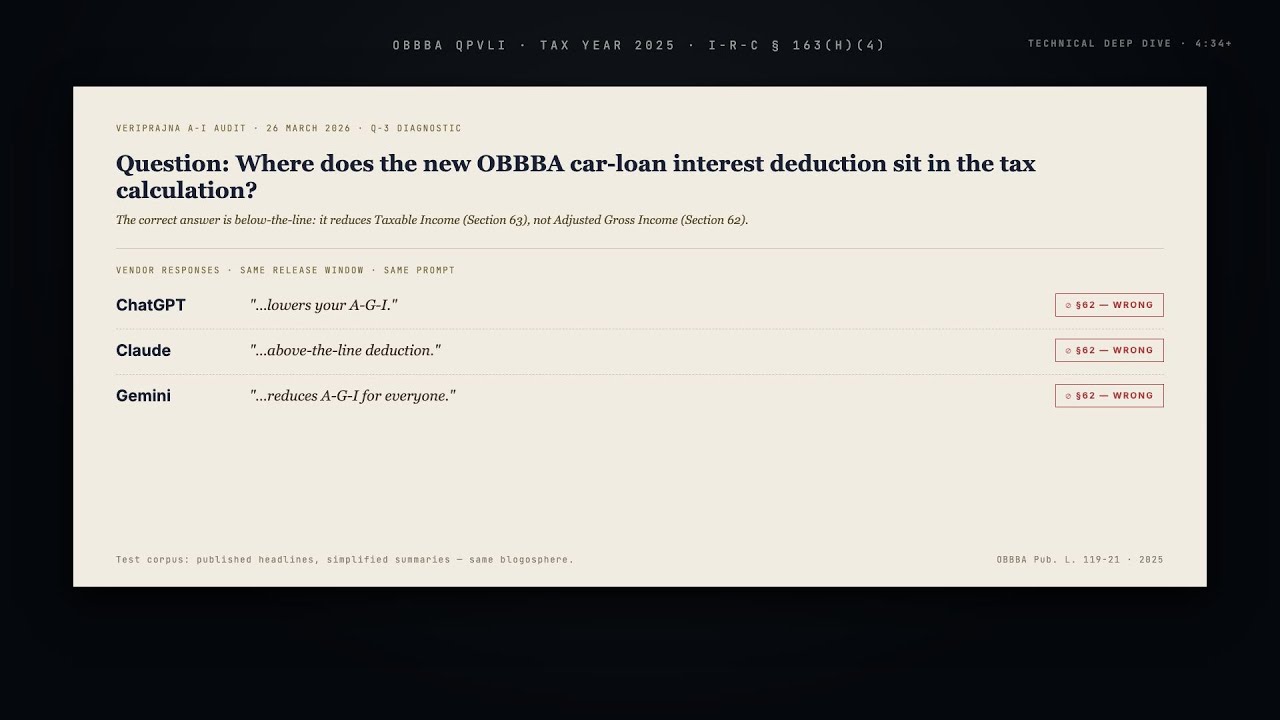
A definitive analysis of how major LLMs uniformly failed to distinguish between IRC Section 62 (AGI) and Section 63 (Taxable Income) deductions.
OBBBA created "Qualified Passenger Vehicle Loan Interest" (QPVLI) deduction for tax years 2025-2028. Critical detail: Added to IRC Section 63 (Taxable Income), not Section 62 (AGI).
Financial blogosphere erupted with headlines: "Car Loan Interest Now Deductible!" Most failed to distinguish above-the-line vs below-the-line. LLMs learned this false association.
The AGI vs Taxable Income distinction affects state taxes (AGI-coupled states), Medicare premiums (IRMAA), medical deduction floors, student loan repayment thresholds.
The Error: LLMs consistently place OBBBA at step 2 (lowers AGI) when it actually belongs at step 3 (only lowers Taxable Income). This creates cascading downstream errors.
| Impact Area | "Consensus" AI Answer (WRONG) | Legal Statute Answer (RIGHT) | Financial Consequence |
|---|---|---|---|
| AGI Calculation | Lowers AGI | Does NOT lower AGI | Tax Fraud / Federal Underpayment |
| State Taxes | Lowers state tax (AGI-coupled) | May NOT lower state tax | State Audit Risk & Penalties |
| Medicare Premiums (IRMAA) | Lowers premiums | No effect on premiums | Unexpected Costs for Retirees |
| Medical Deduction Floor | Lowers floor (easier to deduct) | No effect on floor | Disallowed Deductions |
| Student Loan Repayment | Qualifies for lower payments | No effect on qualification | Loan Default / Non-Compliance |
The current industry standard for mitigating hallucinations is insufficient for complex legal reasoning.
Tax bills are series of amendments: "Section 163(h) is amended by inserting..." LLMs must reconstruct logical state from fragments. If retrieved chunk says "deduction allowed" without stating "Section 63," model reverts to training bias.
Query "car loans" retrieves paragraphs about car loans. Won't retrieve Section 62 definition of AGI—which excludes car loans by omission. "Absence of evidence" is "evidence of absence" in law, but not in cosine similarity.
RAG solves retrieval, not reasoning. Even with correct source text, model's internal weights (biased by millions of incorrect blog examples) act as "biased reader," misinterpreting statute to fit pre-conceived consensus.
Bridging the gap between linguistic fluency and logical rigidity by fusing two distinct AI paradigms.
Deep Learning, LLMs, Transformers
Knowledge Graphs, Logic Solvers, Rules Engines
| Feature | Vector Database (Standard RAG) | Knowledge Graph (Neuro-Symbolic) |
|---|---|---|
| Data Representation | High-dimensional vectors (embeddings) | Nodes (Entities) + Edges (Relationships) |
| Search Mechanism | Cosine similarity (statistical) | Graph traversal / Logical inference |
| Understanding | "These words are similar" | "This concept CAUSES that concept" |
| Relationships | Implicit, probabilistic | Explicit (is_exception_to, depends_on) |
| Auditability | Low (black box retrieval) | High (traceable reasoning path) |
| Suitability for Law | Good for finding text | Good for applying rules & hierarchy |
Specialized programming languages designed to faithfully translate statutory law into executable, verifiable code.
Developed by INRIA, used by French government (DGFIP)
Prolog-based Legal Reasoning
Answer Set Programming
A pipeline that separates intent understanding (Neural) from logical execution (Symbolic).
Input: User uploads ledger, scanned invoice, or natural language query
Role: Map natural language to ontological concepts in Knowledge Graph
Input: Structured entities (JSON)
Role: Query Knowledge Graph, execute Catala/PROLEG logic, identify missing facts, perform deterministic calculation
Input: Fact sheet from Truth Anchor
Role: Synthesize answer in human-readable text—NO freedom to hallucinate
Transform AI from opaque probability engine to transparent, auditable reasoning system.
Auditor: "Why did the AI allow this deduction?"
Response: "Because probability token #492 was 'Yes' with confidence 0.87"
Neuro-Symbolic AI enables deterministic audit of every transaction—moving beyond statistical sampling.
Human bandwidth limitations force auditors to check statistically significant sample. If sample is clean, books assumed clean.
Risk: Systematic errors in non-sampled transactions remain undetected
Engine ingests entire General Ledger. Every transaction runs through Knowledge Graph logic.
Benefit: 100% deterministic compliance verification—zero missed errors
Systems that don't just answer questions—they perform tasks autonomously in real-time.
Fundamentally changes role of accountant from data entry to logic supervisor.
Three-phase deployment strategy for organizations adopting Veriprajna's Neuro-Symbolic solution.
Before logic can be applied, data must be structured. Connect AI to ERP (SAP, Oracle, NetSuite) and use Neural Extraction to turn PDF invoices and loan agreements into structured JSON objects (Digital Twins).
Define corporate-specific tax posture. While IRC is standard, company's risk appetite and internal policies vary. This involves Knowledge Graph editing to map internal accounts to IRC Ontology.
Deploy background processes (event-driven architecture via Kafka/Temporal) that trigger Logic Solvers on every transaction, enabling real-time compliance dashboards.
Consensus Error is a critical failure mode where LLMs align output with the majority opinion in training data rather than statutory truth. When 90% of financial blogs incorrectly describe a tax provision, the model's probability weights converge on the false consensus, producing systematically wrong tax advice regardless of prompt quality.
RAG solves retrieval, not reasoning. Vector search finds semantically similar text but cannot identify causal dependencies or hierarchical exclusions in tax law. Even with correct source text retrieved, the model's internal weights—biased by millions of incorrect blog examples—misinterpret statutes to fit pre-conceived consensus.
Neuro-symbolic AI separates intent understanding (neural layer) from logical execution (symbolic layer). The neural layer extracts entities from natural language, the symbolic Truth Anchor queries a Knowledge Graph and executes Catala/PROLEG logic for deterministic calculation, and a response generator synthesizes human-readable answers constrained to verified facts.
It's time for "Verify, then Trust"
Veriprajna offers a different path: Build an auditor that reads the Law and proves its work—not a chatbot that reads Reddit and hopes for the best.
Complete analysis: OBBBA case study, Consensus Error mathematics, RAG limitations, Catala/PROLEG implementation, Knowledge Graph architecture, Answer Set Programming, comprehensive works cited.