The Algorithmic Ableism Crisis: Deconstructing the Aon-ACLU Complaint and the Imperative for Deep AI Governance
The Watershed Moment in Human Capital Management
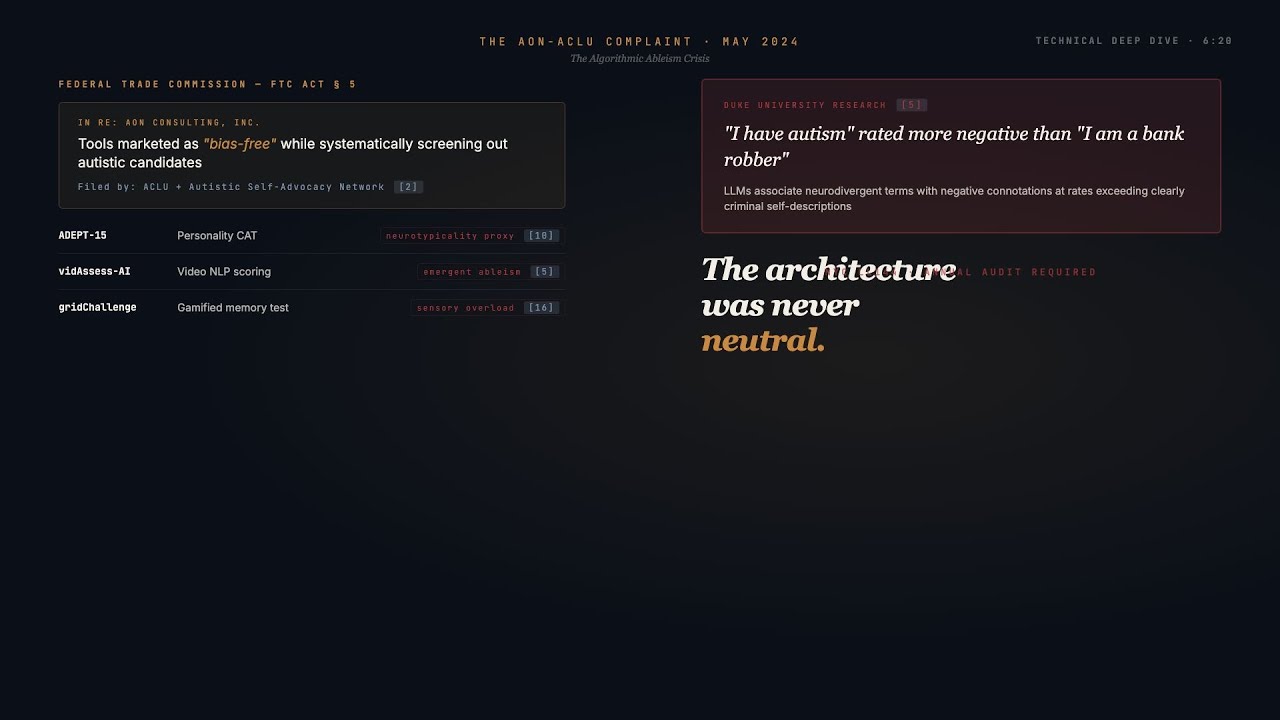
In May 2024, the landscape of artificial intelligence in human resources shifted fundamentally when the American Civil Liberties Union (ACLU) filed a formal complaint with the Federal Trade Commission (FTC) against Aon Consulting, Inc..1 This administrative action, supported by the Autistic Self-Advocacy Network and other civil rights groups, marks a decisive end to the era of unchecked algorithmic optimism.2 For over a decade, hiring technology vendors have marketed their platforms as "bias-free," promising that sophisticated machine learning models could eliminate the subjective prejudices inherent in human recruitment.2 However, the allegations against Aon’s proprietary tools—ADEPT-15, vidAssess-AI, and gridChallenge—expose a critical disconnect between the promise of algorithmic neutrality and the reality of technical discrimination.1
The complaint alleges that Aon engaged in deceptive marketing by claiming its products "improve diversity" and have "no adverse impact," while in practice, these tools likely screen out qualified candidates based on race and disability.2 Specifically, the ACLU contends that the assessments evaluate traits such as "positivity," "emotional awareness," and "liveliness" which are not only non-essential for many job roles but function as direct proxies for clinical diagnostic criteria associated with autism and various mental health conditions.2 For an enterprise-grade AI consultancy like Veriprajna, this incident highlights a systemic failure in the industry: the reliance on superficial "wrapper" technologies that fail to account for the deep causal relationships between behavioral data and protected characteristics.1
The implications of this complaint extend far beyond Aon. It serves as a warning to the entire enterprise ecosystem that the "black box" defense—claiming a tool is fair because it was trained on "big data"—is no longer legally or ethically tenable.6 Regulators, led by the FTC and bolstered by the Equal Employment Opportunity Commission (EEOC), are shifting their focus from voluntary guidelines to aggressive enforcement of substantiation requirements.6 Any claim of fairness must now be backed by rigorous, transparent, and empirical evidence.6
Architectural Deconstruction of the Aon Assessment Suite
To understand the failure of current "bias-free" narratives, one must analyze the technical architecture of the tools identified in the complaint. These tools represent the current "state-of-the-art" in psychometric AI, making their vulnerability to disability bias particularly instructive for the industry.10
ADEPT-15: The Algorithmic Personality Proxy
The Adaptive Employee Personality Test (ADEPT-15) is an algorithmic assessment identified in its current form as Version 7.1.10 It is marketed as an advanced personality test based on 50 years of psychometric research, utilizing a massive database of 350,000 unique items to evaluate 15 personality constructs.12 Technically, ADEPT-15 is a Computer Adaptive Test (CAT). Unlike traditional static surveys, a CAT adjusts the difficulty and content of questions in real-time based on the candidate's previous responses.10 This is intended to increase measurement precision and reduce "test fatigue," but it introduces a layer of algorithmic complexity that can obscure discriminatory pathways.10
The assessment utilizes a "forced-choice" format, presenting statement pairs (e.g., "I work well with other people" or "People say I am level-headed") and requiring the candidate to select the strength of their agreement.10 While this design is intended to mitigate "social desirability bias"—the tendency for candidates to guess the "correct" answer—it inadvertently increases the cognitive load and sensory processing requirements for the test-taker.5
| Psychometric Construct (ADEPT-15) | Polarities Defined by Aon | Core Interaction Style |
|---|---|---|
| Drive | Relaxed vs. Focused | Task Approach |
| Structure | Big Picture vs. Detail Focus | Cognitive Processing |
| Cooperativeness | Independent vs. Team-Oriented | Social Alignment |
| Sensitivity | Stoic vs. Compassionate | Emotional Reactivity |
| Humility | Proud vs. Humble | Self-Perception |
| Conceptual | Practical vs. Abstract | Problem Solving |
| Flexibility | Consistent vs. Flexible | Change Management |
| Mastery | Doing vs. Improving | Skill Acquisition |
| Composure | Passionate vs. Calm | Stress Regulation |
| Positivity | Concerned vs. Hopeful | Outlook |
| Awareness | Insulated vs. Self-Aware | Interpersonal Insight |
| Ambition | Contented vs. Striving | Achievement Drive |
| Power | Contributor vs. Controller | Leadership Style |
| Assertiveness | Cautious vs. Socially Bold | Social Initiative |
| Liveliness | Reserved vs. Outgoing | Social Energy |
The technical failure point identified by the ACLU is that these 15 constructs are not neutral personality traits in the context of neurodiversity.4"Liveliness," "Awareness," and "Positivity" are traits that track closely with neurotypical social performance.2When an algorithm penalizes a "reserved" or "insulated" response, it is functionally screening for neurotypicality rather than job competence.2
vidAssess-AI: The Performance of Neurotypicality
The vidAssess-AI platform integrates the ADEPT-15 personality model into an asynchronous video interviewing format.10 The tool records candidate responses to predefined questions and then utilizes Natural Language Processing (NLP) and speech-to-text algorithms for scoring.17 Aon claims this produces a "legally defensible" report by scoring candidates against "job-relevant criteria" linked to their personality model.17
However, the use of AI in video analysis introduces what researchers call "emergent ableism".5NLP models are trained on massive datasets that predominantly reflect neurotypical speech patterns, prosody, and linguistic structures.16 For a candidate with autism, whose speech may include flat intonation or atypical pauses, or for a candidate with ADHD who may exhibit non-linear narrative structures, the AI’s NLP engine may interpret these as "lack of confidence" or "disorganization".20
Furthermore, the ACLU complaint notes that Aon's vidAssess-AI scores responses by associating the content of spoken words—specific phrases and vocabularies—with the personality constructs in ADEPT-15.10 This creates a "double jeopardy" for neurodivergent individuals: they are judged not only on the content of their answer but on a machine-interpreted version of their personality as expressed through a biased linguistic filter.22
gridChallenge: The Gamification of Cognitive Barriers
The third tool in the suite, gridChallenge (Version 3.0), is a "gamified" cognitive assessment focused on working memory.10 It requires candidates to perform complex memory tasks—such as identifying the location of highlighted circles—while simultaneously performing "distractor tasks" like symmetry assessments.10 Aon markets these gamified elements as increasing "candidate engagement," but for individuals with sensory processing disorders or ADHD, these distractors can lead to a sensory overload that degrades performance in a way that is unrelated to their actual job-related cognitive capacity.16
The Convergence of Psychometrics and Clinical Diagnostics
The most legally and ethically significant claim in the ACLU filing is that Aon’s questions "closely track autism/mental health diagnostics." This suggests that "personality" assessments in the workplace have evolved into a form of "medical examination" by stealth, which would be a direct violation of the Americans with Disabilities Act (ADA).4
By mapping the ADEPT-15 constructs against standard clinical tools like the Autism Spectrum Quotient (AQ) and the DSM-5 criteria, the overlap becomes undeniable.25 The AQ, a 50-item self-report measure, assesses traits across five areas: social skills, attention shifting, attention to detail, communication, and imagination.25
| Clinical Domain (AQ/DSM-5) | Corresponding ADEPT-15 Aspect | Discriminatory Risk |
|---|---|---|
| Social Skills / Reciprocity | Liveliness / Assertiveness | Penalizing "reserved" communication typical of ASD. |
| Attention Shifting | Flexibility / Consistency | Screening out individuals who prefer routine or deep focus. |
| Attention to Detail | Structure | Over-valuing or under-valuing hyper-focus on detail. |
| Communication / Pragmatics | Awareness | Misinterpreting difficulty with "reading between lines." |
| Emotional Regulation | Composure / Positivity | Pathologizing flat affect or anxiety-related responses. |
When an AI-driven tool like ADEPT-15 asks questions that mirror clinical criteria (e.g., "I focus intensely on details" or "I prefer working alone"), it creates a "hidden path" between the candidate's disability status and the hiring outcome.5If the algorithm is trained to favor "socially bold" and "flexible" candidates, it will systematically and mathematically exclude autistic individuals without ever having to ask about their diagnosis.5
The Regulatory Paradigm Shift: From Ethics to Enforcement
The FTC’s move against Aon is not an isolated event; it is the cornerstone of a broader regulatory crackdown known as "Operation AI Comply".6This initiative signals that federal agencies are no longer satisfied with "Responsible AI" as a corporate social responsibility (CSR) buzzword. Instead, they are applying the rigors of consumer protection law and civil rights law to algorithmic products.6
FTC: Section 5 and the Deception Mandate
The FTC’s primary weapon is Section 5 of the FTC Act, which prohibits "unfair or deceptive acts or practices".4In the context of AI, the FTC has clarified that "overstating a product's AI or other capabilities without adequate evidence is deceptive".9 The agency has already taken action against companies like DoNotPay, which faced a $193,000 fine for unsubstantiated claims about its AI legal services, and Rytr, which was targeted for its role in generating fake reviews.6
The message for deep AI solution providers like Veriprajna is clear: every claim of "bias-free" performance must be substantiated with empirical evidence.6The FTC has explicitly warned that vendors cannot "bury their heads in the sand" regarding the disparate impact of their tools.2Failure to conduct rigorous bias audits can lead to permanent bans on selling business opportunities or deploying high-risk software.29
EEOC: The ADA and the "Reasonable Accommodation" Clause
The EEOC has reinforced that employers are legally responsible for any discrimination caused by the AI tools they purchase from vendors.1Under the ADA, an employer cannot use a selection criterion that screens out or tends to screen out an individual with a disability unless that criterion is "job-related and consistent with business necessity".23
| Regulatory Requirement | Enterprise Implication | Potential Liability |
|---|---|---|
| Substantiation of AI Claims | Must prove "bias-free" assertions with data. | FTC fines, brand damage, bans. |
| Reasonable Accommodation | Must allow candidates to opt-out of AI screens. | EEOC lawsuits, class-action litigation. |
| Transparency / Inference Logic | Must explain why an algorithm rejected a user. | State-level fines (e.g., NYC LL 144). |
| Duty to Audit | Annual independent bias audits required. | Regulatory non-compliance penalties. |
The EEOC’s recent public hearings on "Navigating Employment Discrimination in AI" emphasized that automated systems are a "new civil rights frontier".31 The commission has successfully secured hundreds of millions of dollars in monetary relief for victims of discrimination in the 2024 fiscal year, and algorithmic bias is now a top enforcement priority.8
Why "Wrappers" Fail: The Deep AI vs. Surface AI Distinction
The Aon incident serves as a critical proof point for Veriprajna's positioning: the "LLM wrapper" model is fundamentally incapable of meeting modern enterprise standards for fairness and safety. A wrapper simply passes data through an existing foundation model (like GPT-4) and presents the output.32 However, foundation models are not neutral; they inherit the "historical data bias" of the internet.34
The Recursive Bias Loop
Machine learning models are trained on historical hiring data, which often reflects decades of neurotypical and racial preferences.16 When an AI model is deployed, its decisions are used to inform future training sets, creating a "continuous loop" where marginalized groups remain underrepresented.16 A simple wrapper cannot break this loop because it lacks the "causal representation" required to distinguish between true job qualifications and "noise" that correlates with protected characteristics.36
Emergent Ableism in Large Language Models
Research at Duke University has shown that LLMs systematically associate neurodivergent terms with negative connotations.5 For instance, the phrase "I have autism" is often viewed by these models as more negative than "I am a bank robber".5When these same language models power hiring tools via an API wrapper, they embed these discriminatory associations into the recruitment process without the developer ever intending to do so.5
Veriprajna’s Framework for Deep AI Integrity
To move beyond the pitfalls of Aon’s ADEPT-15 and the "wrapper" paradigm, Veriprajna employs a multi-layered technical strategy that integrates causal inference, adversarial debiasing, and neuro-inclusive interaction design.36
1. Causal Representation Learning (CRL)
Veriprajna utilizes CRL to identify and remove the hidden pathways through which bias flows.36 Traditional AI relies on correlation, but correlation is where discrimination hides. CRL identifies the "structural features" of a candidate’s profile while controlling for sensitive information.36
The framework uses a Structural Causal Model (SCM) to formalize dependencies. If represents a protected attribute (e.g., neurodivergence), represents applicant features, and represents the hiring outcome, Veriprajna designs models to ensure "interventional invariance".36 This means the representation used for the final decision is mathematically isolated from , such that:
By ensuring that the decision does not change even if the attribute is hypothetically altered, we can provide a mathematical guarantee of counterfactual fairness.36
2. Adversarial Debiasing
In-processing bias mitigation is achieved through adversarial training.39 In this architecture, a primary model (the "Predictor") is trained to identify the best candidate, while a secondary model (the "Adversary") is trained to try and guess the candidate's protected characteristic from the Predictor’s internal data representations.37
If the Adversary succeeds, it means the Predictor is still using protected information as a proxy for performance. The system then "penalizes" the Predictor through an adversarial loss function, forcing it to "unlearn" the biased patterns.36 This technique is particularly effective for removing biases in video analysis and personality assessments where behavioral signals could serve as proxies for disability.39
3. Counterfactual Fairness Auditing
VerityAI does not just audit for group-level fairness (e.g., "are 10% of all hires disabled?"); we audit for "individual fairness" through counterfactual simulation.38 This involves generating synthetic variations of a real candidate’s data—changing only their sensitive attribute while holding all other variables constant—to ensure the AI’s recommendation remains consistent.38
| Mitigation Strategy | Technical Goal | Impact on Equity |
|---|---|---|
| CRL / Structural Modeling | Isolates causal paths of influence. | Prevents proxy-variable discrimination. |
| Adversarial Training | Minimizes predictive leakages. | "Strips" protected info from model logic. |
| Counterfactual Analysis | Ensures individual-level consistency. | Guarantees "equal treatment" for similar applicants. |
| Fairness-Aware Regularization | Adds "penalties" for biased outcomes. | Forces model to prioritize parity alongside accuracy. |
Designing for Neuro-Inclusion: The "Social Model" of AI
The Aon complaint highlights that most hiring tech is built on a "medical deficit" model of disability—viewing neurodivergent traits as "problems" to be scored down.44 Veriprajna advocates for a "Precision Neurodiversity" approach, which views neurological differences as natural manifestations of human brain diversity.44
Temporal and Multimodal Elasticity
Standard AI assessments often penalize candidates for slow response times or atypical non-verbal cues.5A deep AI solution must implement "temporal elasticity"—recognizing that a longer response time in a video interview may be a function of cognitive processing speed or anxiety, not a lack of competence.20
Veriprajna’s architecture prioritizes "cross-channel fusion pipelines" aligned to individual baselines.45 This means the AI learns what "normal" looks like for that specific candidate during the initial stages of the interview, rather than comparing them to a "neurotypical average".45
The "Alternative Path" Mandate
To comply with the ADA and ethical standards, enterprise AI must include a "Human-in-the-Loop" (HITL) and an "Opt-Out" mechanism.21 Every automated interview or assessment invite should include a clear option to request a human alternative or a "Reasonable Accommodation" without penalty.21
Furthermore, Veriprajna recommends the "Audio-Only" pivot for video tools.21 By disabling the facial analysis features and focusing only on the transcribed content of the answers, companies can remove 90% of the bias against neurodivergent candidates while still benefiting from the efficiency of AI-powered transcription and summarization.21
Enterprise Governance: The NIST AI RMF Playbook
Transitioning from a "wrapper" to a "deep AI" culture requires board-level governance. The NIST AI Risk Management Framework (RMF) provides the standard for this transition.47
The Executive Oversight Checklist
1. Establish a Responsible AI Committee: This should be a cross-functional body including legal, HR, IT, and external disability advocacy representatives.49
2. Conduct Annual Bias Audits: These must be independent and third-party. Reliance on vendor-provided "Model Cards" is a liability, as the Aon case demonstrates.1
3. Implement "Bias Fire Drills": Just as companies run cybersecurity penetration tests, they should simulate "worst-case" hiring scenarios—for example, a model that denies interviews to all autistic applicants—to see if their internal safeguards catch the drift.51
4. Demand Inference Logic: Vendors must provide the "why" behind an AI decision.21 If a vendor cannot explain the logic of their scoring model, it is an "inscrutable" risk that should not be deployed in a high-stakes hiring environment.21
Risk Tiers and Deployment Metrics
NIST defines four tiers of AI maturity, from "Partial" to "Adaptive".47 For enterprise hiring, an "Adaptive" maturity level is required. This means the organization has a systematic, documented process for tracking "discrimination drift"—the phenomenon where an AI model becomes more biased over time as it interacts with real-world data.47
| NIST RMF Function | Action Item for HR Leaders | Success Metric |
|---|---|---|
| GOVERN | Establish board-level accountability for AI outcomes. | Zero reported lawsuits/complaints. |
| MAP | Document the purpose and context of every AI tool. | Clear "Inference Logic" for every rejected candidate. |
| MEASURE | Run continuous bias audits using CRL and CRL-based tools. | Demographic Parity Gap < 5%. |
| MANAGE | Implement "Reasonable Accommodation" opt-outs. | 100% compliance with ADA requests. |
Strategic Implications: Why This Matters for the C-Suite
The Aon-ACLU complaint is the "Canary in the Coal Mine" for the AI era. It proves that the costs of "cheap" AI are exponentially higher than the upfront investment in "Deep AI".51 A "wrapper" solution may save time in the first quarter, but it creates massive legal, financial, and reputational liabilities that can destroy enterprise value.51
The Litigation-Proof Talent Economy
By 2027, the global talent economy will be valued at $30B.37 Companies that can prove their hiring tools are "meritocratic" and "bias-agnostic" will have a massive competitive advantage in attracting top talent.37 Neurodivergent individuals, in particular, possess extraordinary skills in pattern recognition, attention to detail, and creative problem-solving.53 A company using an Aon-style screen is systematically filtering out the very talent that drives innovation.21
Veriprajna’s approach does not just "avoid" bias; it "unlocks" talent.37 By replacing opaque "personality fit" proxies with transparent "neural verities" and causal logic, we enable enterprises to build a workforce that is not only diverse but mathematically optimized for job performance.37
The "Contract of Trust"
Ultimately, an enterprise’s AI policy is a "Contract of Trust" with its employees and customers.32 To maintain this trust, leaders must move beyond the marketing hype of "bias-free" tech and embrace the hard engineering of Deep AI. This means demanding substantiation, conducting rigorous audits, and designing systems that value the "standard brain" and the "neurodivergent brain" equally.32
The Aon complaint is a call to action. It is time for enterprises to stop being "AI users" and start being "AI architects".33 Veriprajna is here to provide the blueprints for that future—a future where AI is not a barrier to inclusion, but the ultimate enabler of human potential.53
Works cited
Another Employer Faces AI Hiring Bias Lawsuit: 10 Actions You Can Take to Prevent AI Litigation | Fisher Phillips, accessed February 6, 2026, https://www.fisherphillips.com/en/news-insights/another-employer-faces-ai-hiring-bias-lawsuit.html
ACLU Files FTC Complaint Against Major Hiring Technology Vendor for Deceptively Marketing Online Hiring Tests as “Bias Free” | American Civil Liberties Union, accessed February 6, 2026, https://www.aclu.org/press-releases/aclu-files-ftc-complaint-against-major-hiring-technology-vendor-for-deceptively-marketing-online-hiring-tests-as-bias-free
ACLU complaint to the FTC regarding Aon Consulting, Inc. | American Civil Liberties Union, accessed February 6, 2026, https://www.aclu.org/documents/aclu-complaint-to-the-ftc-regarding-aon-consulting-inc
1 FEDERAL TRADE COMMISSION Washington, DC 20580 ... - ACLU, accessed February 6, 2026, https://assets.aclu.org/live/uploads/2024/05/In-re-Aon-Consulting_FTC-Act-complaint_052924.pdf
When Algorithms Learn to Discriminate: The Hidden Crisis of Emergent Ableism, accessed February 6, 2026, https://www.techpolicy.press/when-algorithms-learn-to-discriminate-the-hidden-crisis-of-emergent-ableism/
FTC's Stance on AI Deception: Implications for Companies - Catalyst Legal, accessed February 6, 2026, https://catalystogc.com/ai-deception/
The FTC is on the Front Lines of AI Innovation & Regulation, accessed February 6, 2026, https://www.ftc.gov/system/files/ftc_gov/pdf/ai-accomplishments-1.17.25.pdf
2024 Annual Performance Report | U.S. Equal Employment Opportunity Commission, accessed February 6, 2026, https://www.eeoc.gov/2024-annual-performance-report
United States of America - Federal Trade Commission vs. AI: misleading marketing of AI and the harming of consumers - Knowledge Centre Data & Society, accessed February 6, 2026, https://data-en-maatschappij.ai/en/publications/federal-trade-commission-vs-ai-misleidende-marketing-rond-ai-en-het-schaden-van-consumenten
Final vidassess model card - ACLU, accessed February 6, 2026, https://assets.aclu.org/live/uploads/2024/10/Model-Cards-for-gridChallenge-ADEPT-15-and-vidAssess.pdf
The Critical Role of Research in the Fight for Algorithmic Accountability | TechPolicy.Press, accessed February 6, 2026, https://www.techpolicy.press/the-critical-role-of-research-in-the-fight-for-algorithmic-accountability/
Aon ADEPT-15 - AMS Verified, accessed February 6, 2026, https://app.getamsverified.com/product/aon-adept-15
Adept 15 Fact Sheet PDF | PDF | Cognitive Science | Psychology - Scribd, accessed February 6, 2026, https://www.scribd.com/document/643380773/adept-15-fact-sheet-pdf
What we learned while automating bias detection in AI hiring systems for compliance with NYC Local Law 144 - arXiv, accessed February 6, 2026, https://arxiv.org/html/2501.10371v1
Free ADEPT-15 Assessment Personality Practice Guide [2026] - JobTestPrep, accessed February 6, 2026, https://www.jobtestprep.com/adept-15-test
Hiring inclusively with AI: The dangers of screening out neurodiverse talent, accessed February 6, 2026, https://workplacejournal.co.uk/2025/08/hiring-inclusively-with-ai-the-dangers-of-screening-out-neurodiverse-talent/
Aon VidAssess AI - AMS Verified, accessed February 6, 2026, https://app.getamsverified.com/product/aon-vidassess-ai
Aon VidAssess AI vs HireVue Video Interviewing - Comparison - AMS Verified, accessed February 6, 2026, https://app.getamsverified.com/comparison/aon-vidassess-ai-vs-hirevue-video-interviewing
Prevalence of bias against neurodivergence-related terms in artificial intelligence language models - PMC, accessed February 6, 2026, https://pmc.ncbi.nlm.nih.gov/articles/PMC12233132/
Neurodivergence and the Rise of AI in Hiring: What HR Needs to Know - Enna Global, accessed February 6, 2026, https://enna.org/neurodivergence-and-the-rise-of-ai-in-hiring-what-hr-needs-to-know/
Exploring the Impact of AI Bias on Neurodivergent Candidates in HR Practices - CiteHR, accessed February 6, 2026, https://www.citehr.com/654245-impact-ai-bias-hr-practices-case-study.html
Fairness and Discrimination Risks in Neuro-Augmented AI Hiring: A Framework for Proactive Algorithmic Auditing - ResearchGate, accessed February 6, 2026, https://www.researchgate.net/publication/399936340_Fairness_and_Discrimination_Risks_in_Neuro-Augmented_AI_Hiring_A_Framework_for_Proactive_Algorithmic_Auditing
List of EEOC Disability-Related Technical Assistance Documents, accessed February 6, 2026, https://www.eeoc.gov/eeoc-disability-related-resources/list-eeoc-disability-related-technical-assistance-documents
Artificial Intelligence and the ADA | U.S. Equal Employment Opportunity Commission, accessed February 6, 2026, https://www.eeoc.gov/eeoc-disability-related-resources/artificial-intelligence-and-ada
Autism screening tests: A narrative review - PMC - NIH, accessed February 6, 2026, https://pmc.ncbi.nlm.nih.gov/articles/PMC8859712/
Clinical Testing and Diagnosis for Autism Spectrum Disorder - CDC, accessed February 6, 2026, https://www.cdc.gov/autism/hcp/diagnosis/index.html
AQ - Autism Spectrum Quotient Test - NovoPsych, accessed February 6, 2026, https://novopsych.com/assessments/diagnosis/autism-spectrum-quotient/
Disability Bias in AI: How and Why to Audit - Warden AI, accessed February 6, 2026, https://www.warden-ai.com/resources/disability-bias-in-ai-how-and-why-to-audit
Artificial Intelligence | Federal Trade Commission, accessed February 6, 2026, https://www.ftc.gov/industry/technology/artificial-intelligence
AI Bias in Hiring: Algorithmic Recruiting and Your Rights - Sanford Heisler Sharp, accessed February 6, 2026, https://sanfordheisler.com/blog/2025/12/ai-bias-in-hiring-algorithmic-recruiting-and-your-rights/
EEOC History: 2020 - 2024 | U.S. Equal Employment Opportunity Commission, accessed February 6, 2026, https://www.eeoc.gov/history/eeoc-history-2020-2024
Beyond the Hype: A Strategic Guide to LLM Model Cards for the Enterprise | by Boopathi Sarvesan | Dec, 2025 | Medium, accessed February 6, 2026, https://medium.com/@boopathisarvesan/beyond-the-hype-a-strategic-guide-to-llm-model-cards-for-the-enterprise-dc1feff63cc4
Mitigating bias: Integrating generative AI, foundation and large language models in enterprise workflows - Eightfold AI, accessed February 6, 2026, https://eightfold.ai/engineering-blog/mitigating-bias-integrating-generative-ai-foundation-and-large-language-models-in-enterprise-workflows/
AI and Bias in Recruitment: Ensuring Fairness in Algorithmic Hiring. - Journal of Informatics Education and Research, accessed February 6, 2026, https://jier.org/index.php/journal/article/download/3262/2632/5894
Fair or Flawed? How Algorithmic Bias is Redefining Recruitment and Inclusion, accessed February 6, 2026, https://exploratiojournal.com/fair-or-flawed-how-algorithmic-bias-is-redefining-recruitment-and-inclusion/
Causal Representation Learning for Bias Detection in AI Hiring ..., accessed February 6, 2026, https://www.ijcaonline.org/archives/volume187/number74/guyyala-2026-ijca-926254.pdf
(PDF) Bias Mitigation in AI Hiring Through Neurocognitive Data ..., accessed February 6, 2026, https://www.researchgate.net/publication/400103841_Bias_Mitigation_in_AI_Hiring_Through_Neurocognitive_Data_Analysis
Counterfactual Fairness - Iterate.ai, accessed February 6, 2026, https://iterate.ai/ai-glossary/counterfactual-fairness
Algorithmic Fairness in Recruitment: Designing AI-Powered Hiring ..., accessed February 6, 2026, https://pathofscience.org/index.php/ps/article/view/3471
Causal Representation Learning for Bias Detection in AI Hiring Systems, accessed February 6, 2026, https://www.ijcaonline.org/archives/volume187/number74/causal-representation-learning-for-bias-detection-in-ai-hiring-systems/
Bias & Fairness Testing for AI: Demographic Audits & Ethical Compliance - Testriq, accessed February 6, 2026, https://www.testriq.com/blog/post/bias-fairness-testing-for-ai
Behind the Screens: Uncovering Bias in AI-Driven Video Interview Assessments Using Counterfactuals - arXiv, accessed February 6, 2026, https://arxiv.org/html/2505.12114v2
Algorithmic Fairness Testing Tools - AI Ethics Lab - Rutgers University, accessed February 6, 2026, https://aiethicslab.rutgers.edu/glossary/algorithmic-fairness-testing-tools/
Precision neurodiversity: personalized brain network architecture as ..., accessed February 6, 2026, https://pmc.ncbi.nlm.nih.gov/articles/PMC12647089/
Designing Inclusive AI Interaction for Neurodiversity - ResearchGate, accessed February 6, 2026, https://www.researchgate.net/publication/396644400_Designing_Inclusive_AI_Interaction_for_Neurodiversity
Algorithmic Bias in Artificial Intelligence and Mitigation Strategies - Tata Consultancy Services, accessed February 6, 2026, https://www.tcs.com/what-we-do/products-platforms/tcs-bancs/articles/algorithmic-bias-ai-mitigation-strategies
NIST AI Risk Management Framework: A tl;dr - Wiz, accessed February 6, 2026, https://www.wiz.io/academy/ai-security/nist-ai-risk-management-framework
NIST AI Risk Management Framework: A simple guide to smarter AI governance - Diligent, accessed February 6, 2026, https://www.diligent.com/resources/blog/nist-ai-risk-management-framework
Safeguard the Future of AI: The Core Functions of the NIST AI RMF - AuditBoard, accessed February 6, 2026, https://auditboard.com/blog/nist-ai-rmf
Credit Scoring AI Bias Testing: Beyond Basic Fairness Checks for Financial Institutions, accessed February 6, 2026, https://verityai.co/blog/credit-scoring-ai-bias-testing
AI Bias Mitigation Strategies for Reliable Enterprise AI - Appinventiv, accessed February 6, 2026, https://appinventiv.com/blog/reducing-bias-in-ai-models/
Navigating the NIST AI Risk Management Framework - Hyperproof, accessed February 6, 2026, https://hyperproof.io/navigating-the-nist-ai-risk-management-framework/
AI in creating inclusive work environments for neurodiverse employees - ResearchGate, accessed February 6, 2026, https://www.researchgate.net/publication/397757972_AI_in_creating_inclusive_work_environments_for_neurodiverse_employees
Inclusive by Design: An Employer's Guide to Neurodiversity at Work - Morgan McKinley, accessed February 6, 2026, https://www.morganmckinley.com/ie/article/inclusive-design-employers-guide-neurodiversity-work
Designing Artificial Intelligence: Exploring Inclusion, Diversity, Equity, Accessibility, and Safety in Human-Centric Emerging Technologies - MDPI, accessed February 6, 2026, https://www.mdpi.com/2673-2688/6/7/143
Prefer a visual, interactive experience?
Explore the key findings, stats, and architecture of this paper in an interactive format with navigable sections and data visualizations.
Frequently Asked Questions
How do AI hiring assessments discriminate against neurodivergent candidates?
Tools like Aon's ADEPT-15 evaluate personality constructs including 'liveliness,' 'awareness,' and 'positivity' that closely track clinical diagnostic criteria for autism and mental health conditions. When algorithms penalize 'reserved' or 'insulated' responses, they functionally screen for neurotypicality rather than job competence, creating hidden pathways between disability status and hiring outcomes.
What is Causal Representation Learning and how does it prevent hiring bias?
Causal Representation Learning uses Structural Causal Models to formally identify and isolate the hidden pathways through which bias flows. It ensures interventional invariance, meaning the hiring decision remains mathematically unchanged even if a protected attribute like neurodivergence is hypothetically altered. This provides a mathematical guarantee of counterfactual fairness that correlation-based approaches cannot achieve.
What is FTC Operation AI Comply and how does it affect enterprise AI vendors?
Operation AI Comply is the FTC's enforcement initiative applying Section 5 consumer protection law to algorithmic products. It mandates that every claim of bias-free performance must be substantiated with empirical evidence. The FTC has already fined DoNotPay $193,000 for unsubstantiated AI claims and can permanently ban vendors from selling high-risk software for non-compliance.
Also Published On
Build Your AI with Confidence.
Partner with a team that has deep experience in building the next generation of enterprise AI. Let us help you design, build, and deploy an AI strategy you can trust.
Veriprajna Deep Tech Consultancy specializes in building safety-critical AI systems for healthcare, finance, and regulatory domains. Our architectures are validated against established protocols with comprehensive compliance documentation.